
Class 12 Maths Chapter 4: Determinants Notes
This chapter in five lines
Every square matrix A has a number |A|, its determinant. For order 2, |a, b; c, d| = ad − bc; for order 3, expand along any row or column using cofactors. The adjoint is the transpose of the cofactor matrix, and A⁻¹ = (1/|A|) adj A when |A| ≠ 0. A system AX = B with |A| ≠ 0 has the unique solution X = A⁻¹B.
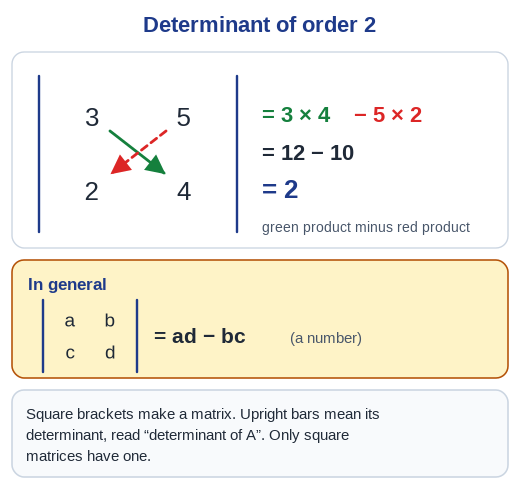
How matrices and determinants are written here. A matrix is typed row by row inside square brackets: commas separate the entries of a row, and semicolons separate the rows. So [3, 5; 2, 4] is the 2 × 2 matrix with first row 3, 5 and second row 2, 4. A determinant is typed the same way between two upright bars: |3, 5; 2, 4| is the determinant of that matrix. The diagrams show the usual layout.
What is this chapter about?
Chapter 3 treated a matrix as one object. This chapter attaches a single number to every square matrix: its determinant. That number decides whether a matrix has an inverse, and so whether a system of linear equations has exactly one solution. Along the way it gives a neat formula for the area of a triangle. The chapter keeps to determinants of order up to 3 with real entries.
What is a determinant?
For a square matrix A, the determinant is written |A|, det A or Δ. Read |A| as “determinant of A”, never as “modulus of A”.
- Order 1: |a| = a.
- Order 2: |a, b; c, d| = ad − bc. For example, |3, 5; 2, 4| = 3 × 4 − 5 × 2 = 2.
A determinant of order 3 is expanded along a row or a column. Along the first row, take each entry, multiply it by the order-2 determinant left after deleting its row and column, and use the signs +, −, +:
|2, 1, 3; 0, 4, −1; 5, 2, 1| = 2(4 + 2) − 1(0 + 5) + 3(0 − 20) = 12 − 5 − 60 = −53
Any row or column gives the same value, so choose the one with the most zeros. If A = kB for matrices of order n, then |A| = kⁿ|B|. Steps and more examples: how to find a determinant.
How does a determinant give the area of a triangle?
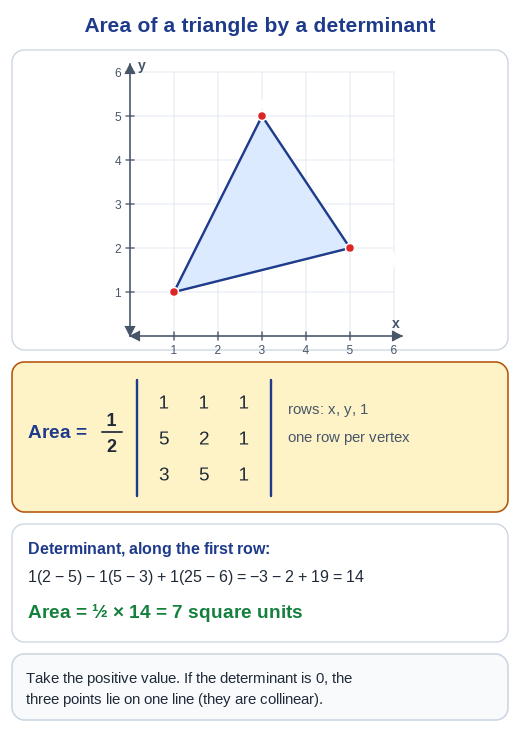
The triangle with vertices (x₁, y₁), (x₂, y₂) and (x₃, y₃) has area
Δ = (1/2)|x₁, y₁, 1; x₂, y₂, 1; x₃, y₃, 1|
Area is positive, so take the absolute value. For (1, 1), (5, 2) and (3, 5), the determinant is 1(2 − 5) − 1(5 − 3) + 1(25 − 6) = 14, so the area is 7 square units. Three points are collinear exactly when this determinant is 0, which also gives the equation of the line through two points.
What are minors and cofactors?
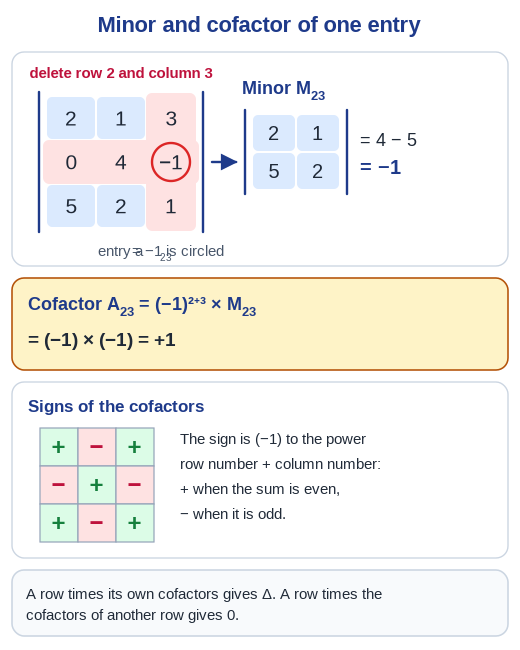
The minor Mij of the entry aij is the determinant left after deleting row i and column j. The cofactor is the minor with a sign: Aij = (−1)i + j Mij. The signs follow a chessboard pattern that starts with + in the top left corner.
Two facts make cofactors useful:
- Δ equals the entries of any row (or column) times their own cofactors, added up: Δ = a11A11 + a12A12 + a13A13.
- Entries of one row times the cofactors of a different row add up to 0.
What are the adjoint and the inverse?
The adjoint adj A is the transpose of the matrix of cofactors. For order 2 there is a shortcut: adj [a, b; c, d] = [d, −b; −c, a]. The book states, without proof, that A(adj A) = (adj A)A = |A| I.
A square matrix is singular if |A| = 0 and non-singular if |A| ≠ 0. A matrix is invertible exactly when it is non-singular, and then
A⁻¹ = (1/|A|) adj A
For A = [3, 5; 2, 4], |A| = 2 and adj A = [4, −5; −2, 3], so A⁻¹ = (1/2)[4, −5; −2, 3]. The chapter also uses |AB| = |A||B| and |adj A| = |A|ⁿ⁻¹ for order n. A full 3 × 3 example: adjoint and inverse of a matrix.
How do matrices solve linear equations?
Write the system as AX = B, where A holds the coefficients, X the unknowns and B the constants. If |A| ≠ 0, then X = A⁻¹B is the one and only solution. This is the matrix method. For x + 2y = 8 and 3x + y = 9: A = [1, 2; 3, 1], |A| = −5, and X = (−1/5)[1, −2; −3, 1][8; 9] = [2; 3], so x = 2 and y = 3.
A system with at least one solution is consistent; with none it is inconsistent. If |A| = 0, work out (adj A)B: if it is not the zero matrix, there is no solution. If it is the zero matrix, the system has either infinitely many solutions or none. Worked examples: solving linear equations using matrices.
Before we move on
This is the rationalised book (marked Reprint 2026-27). It has Exercises 4.1 to 4.5 and a Miscellaneous Exercise of 9 questions. The section on properties of determinants is not part of this edition, although older guides still teach it, and the exercises here need only expansion, cofactors, the adjoint and the matrix method. Every example and exercise is worked out in the NCERT solutions for Chapter 4.
Key terms
| Term | Meaning |
|---|---|
| Determinant |A| | A number attached to a square matrix A, also written det A or Δ. |A| is read “determinant of A”, not “modulus of A”. Only square matrices have determinants. |
| Determinant of order 2 | |a, b; c, d| = ad − bc: the product down the main diagonal minus the product of the other two entries. |
| Expansion | Writing a determinant of order 3 as a sum over one row or column: each entry times its cofactor. Every row and every column gives the same value. |
| Minor Mᵢⱼ | The determinant left after deleting row i and column j, the row and column of the entry aᵢⱼ. |
| Cofactor Aᵢⱼ | The minor with a sign: Aᵢⱼ = (−1)ⁱ⁺ʲ Mᵢⱼ. The sign is + when i + j is even and − when it is odd. |
| Area of a triangle | For vertices (x₁, y₁), (x₂, y₂), (x₃, y₃), half of |x₁, y₁, 1; x₂, y₂, 1; x₃, y₃, 1|, taken positive. It is 0 exactly when the points are collinear. |
| Adjoint adj A | The transpose of the matrix of cofactors of A. For [a, b; c, d] it is [d, −b; −c, a]. |
| Singular matrix | A square matrix with |A| = 0. It has no inverse. |
| Non-singular matrix | A square matrix with |A| ≠ 0. It has the inverse A⁻¹ = (1/|A|) adj A. |
| Consistent system | A system of equations with at least one solution. With no solution at all, the system is inconsistent. |
| Matrix method | Writing a linear system as AX = B and solving it as X = A⁻¹B when |A| ≠ 0. |
Topics in this chapter
Practice
-
The value of |3, 5; 2, 4| is:
Show answer
Answer: (b) 2
-
In a determinant of order 3, the cofactor A₂₃ equals:
Show answer
Answer: (b) −M₂₃
-
The adjoint of [3, 5; 2, 4] is:
Show answer
Answer: (a) [4, −5; −2, 3]
-
A square matrix A has an inverse exactly when:
Show answer
Answer: (c) |A| ≠ 0
-
A is a 3 × 3 matrix with |A| = 2. Then |3A| equals:
Show answer
Answer: (d) 54
Questions students ask
What are the main topics of Class 12 Maths Chapter 4?
Determinants of order 1, 2 and 3 and their expansion, the area of a triangle, minors and cofactors, the adjoint and inverse of a matrix, and solving a system of linear equations by the matrix method. The chapter has Exercises 4.1 to 4.5 and a Miscellaneous Exercise.
What is the difference between a matrix and a determinant?
A matrix is an arrangement of numbers in rows and columns and can have any order. A determinant is a single number worked out from a square matrix. So [3, 5; 2, 4] is a matrix, while |3, 5; 2, 4| = 12 − 10 = 2 is a number.
Are properties of determinants in the 2026-27 book?
No. The rationalised Chapter 4 has no section on properties of determinants, so determinants are evaluated by expansion along a row or column. The book still states a few results it needs, such as |AB| = |A||B| and |kA| = kⁿ|A|. Older guides carry many more.
Why does a singular matrix have no inverse?
If A had an inverse B, then AB = I, so |A||B| = |I| = 1, and |A| could not be 0. Also the formula A⁻¹ = (1/|A|) adj A would need division by zero.
Stuck on a question?
Take a photo and Lagnever AI explains it step by step. Try it for 7 days for ₹2.
Get it on Google Play Open in browser
For parents: after the trial, the plan renews monthly by UPI or card autopay. You can cancel anytime in the app.