
How do you solve linear equations using matrices?
Answer in short
Write the system as AX = B: A holds the coefficients, X the unknowns, B the constants. If |A| ≠ 0, the system is consistent and its only solution is X = A⁻¹B. If |A| = 0, find (adj A)B: if it is not the zero matrix, the system is inconsistent; otherwise it has infinitely many solutions or none.
Stuck on a question? Take a photo and Lagnever AI explains it step by step. Try it for 7 days for ₹2. Get it on Google Play
How matrices and determinants are written here. A matrix is typed row by row: commas separate the entries of a row and semicolons separate the rows, so [1, 2; 3, 1] has rows 1, 2 and 3, 1, and [8; 9] is a column. The same entries between upright bars, |1, 2; 3, 1|, mean the determinant.
How do you write a system as a matrix equation?
Take the equations
a₁x + b₁y + c₁z = d₁, a₂x + b₂y + c₂z = d₂, a₃x + b₃y + c₃z = d₃.
Collect the coefficients in a matrix A, the unknowns in a column X and the constants in a column B:
A = [a₁, b₁, c₁; a₂, b₂, c₂; a₃, b₃, c₃], X = [x; y; z], B = [d₁; d₂; d₃]
Multiplying out AX gives the left sides of the three equations, so the whole system is the single equation AX = B. First write every equation with its variables in the same order and its constant on the right. A missing variable has the coefficient 0.
How does the matrix method work?
If A is non-singular (|A| ≠ 0), then A⁻¹ exists. Multiply AX = B on the left by A⁻¹:
A⁻¹(AX) = A⁻¹B, so (A⁻¹A)X = A⁻¹B, so IX = A⁻¹B, so X = A⁻¹B.
Since an inverse is unique, this is the only solution. With A⁻¹ = (1/|A|) adj A (see adjoint and inverse of a matrix), the working formula is X = (1/|A|)(adj A)B.
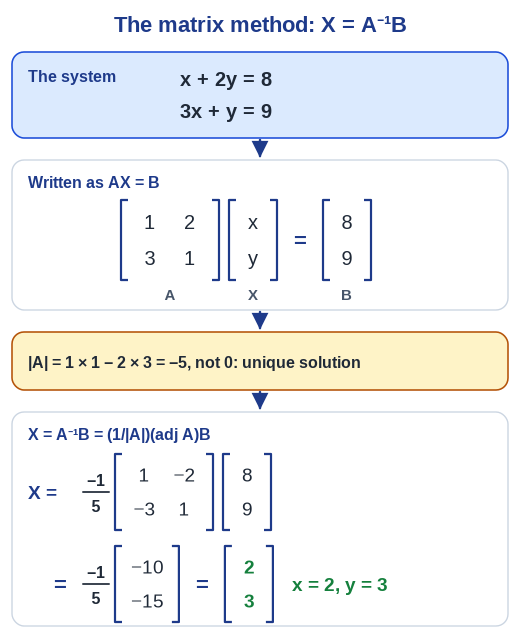
Two variables. Solve x + 2y = 8 and 3x + y = 9.
A = [1, 2; 3, 1], B = [8; 9]. |A| = 1 − 6 = −5 ≠ 0, and adj A = [1, −2; −3, 1].
X = (−1/5)[1, −2; −3, 1][8; 9] = (−1/5)[8 − 18; −24 + 9] = (−1/5)[−10; −15] = [2; 3]
So x = 2 and y = 3. Check: 2 + 6 = 8 and 6 + 3 = 9.
A word problem. At a canteen, 2 samosas and 1 cup of chai cost ₹40, and 1 samosa and 2 cups of chai cost ₹35. With ₹s for a samosa and ₹c for a chai: 2s + c = 40 and s + 2c = 35. Here A = [2, 1; 1, 2], |A| = 3 and adj A = [2, −1; −1, 2], so
X = (1/3)[80 − 35; −40 + 70] = (1/3)[45; 30] = [15; 10]
A samosa costs ₹15 and a chai ₹10.
How do you solve three equations?
Solve x + 2y = 5, y + 3z = 11 and 2x + z = 5.
Fill in the zero coefficients: A = [1, 2, 0; 0, 1, 3; 2, 0, 1], B = [5; 11; 5].
|A| = 1(1 − 0) − 2(0 − 6) + 0 = 1 + 12 = 13 ≠ 0, so there is a unique solution.
The cofactors give adj A = [1, −2, 6; 6, 1, −3; −2, 4, 1]. Then
(adj A)B = [5 − 22 + 30; 30 + 11 − 15; −10 + 44 + 5] = [13; 26; 39]
X = (1/13)[13; 26; 39] = [1; 2; 3]
So x = 1, y = 2 and z = 3. Check: 1 + 4 = 5, 2 + 9 = 11 and 2 + 3 = 5.
When is a system consistent?
A system is consistent if it has one or more solutions, and inconsistent if it has none. For AX = B with A square:
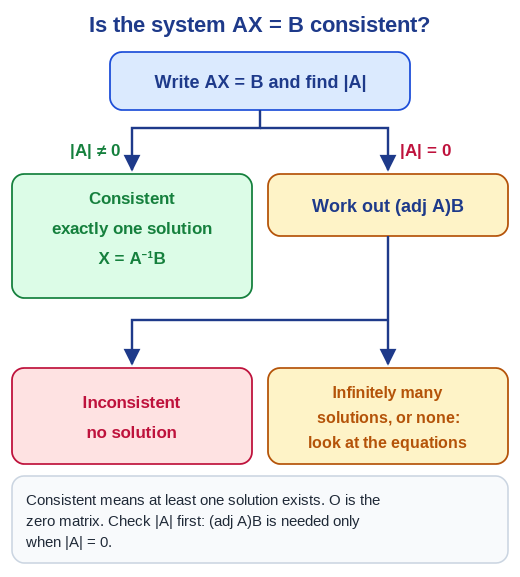
- |A| ≠ 0: consistent, with exactly one solution, X = A⁻¹B.
- |A| = 0 and (adj A)B ≠ O: no solution; the system is inconsistent.
- |A| = 0 and (adj A)B = O: the system has either infinitely many solutions or no solution.
Two quick examples, both with A = [1, 2; 2, 4], so |A| = 0 and adj A = [4, −2; −2, 1]:
- x + 2y = 3, 2x + 4y = 7. Here (adj A)B = [12 − 14; −6 + 7] = [−2; 1] ≠ O, so the system is inconsistent. The two lines are parallel.
- x + 2y = 3, 2x + 4y = 6. Here (adj A)B = [12 − 12; −6 + 6] = O. The second equation is just twice the first, so every point on the line x + 2y = 3 is a solution: infinitely many.
To answer “examine the consistency”, start with |A|. If it is not 0, write “consistent” and stop; you need (adj A)B only when |A| = 0. The book’s own solved examples all have a unique solution.
Read next: adjoint and inverse of a matrix, how to find a determinant and the NCERT solutions.
Practice
-
The system 2x + 3y = 5, 4x + 6y = 9 is:
Show answer
Answer: (c) inconsistent
-
For AX = B with |A| ≠ 0, the solution is:
Show answer
Answer: (b) X = A⁻¹B
-
The coefficient matrix of x + 2y = 3, 4x − y = 5 is:
Show answer
Answer: (a) [1, 2; 4, −1]
-
Solve 3x + y = 7, x + 2y = 4 by the matrix method.
Show answer
Answer: A = [3, 1; 1, 2], B = [7; 4]. |A| = 6 − 1 = 5 ≠ 0 and adj A = [2, −1; −1, 3]. X = (1/5)[14 − 4; −7 + 12] = (1/5)[10; 5] = [2; 1]. So x = 2 and y = 1.
-
Examine the consistency of x − 2y = 4, 2x − 4y = 8.
Show answer
Answer: A = [1, −2; 2, −4], so |A| = −4 + 4 = 0. adj A = [−4, 2; −2, 1] and (adj A)B = [−16 + 16; −8 + 8] = O. The second equation is twice the first, so every point of the line x − 2y = 4 is a solution: the system is consistent, with infinitely many solutions.
Questions students ask
What is the matrix method?
It solves a system of linear equations by writing it as one matrix equation AX = B and multiplying both sides by A⁻¹ on the left, which gives X = A⁻¹B. It works whenever |A| ≠ 0.
What do consistent and inconsistent mean?
A system is consistent if it has one or more solutions and inconsistent if it has none. Two lines that cross, or that coincide, form a consistent system; two different parallel lines form an inconsistent one.
What happens when |A| = 0?
Then A has no inverse, so there is no unique solution. Work out (adj A)B. If it is not the zero matrix, the system has no solution. If it is the zero matrix, the system has either infinitely many solutions or none.
Why is the solution unique when |A| ≠ 0?
Because the inverse of a matrix is unique. Any solution X must satisfy A⁻¹(AX) = A⁻¹B, that is, X = A⁻¹B, so there cannot be two different solutions.
Stuck on a question?
Take a photo and Lagnever AI explains it step by step. Try it for 7 days for ₹2.
Get it on Google Play Open in browser
For parents: after the trial, the plan renews monthly by UPI or card autopay. You can cancel anytime in the app.