
How do you find the adjoint and inverse of a matrix?
Answer in short
The adjoint adj A is the transpose of the matrix of cofactors of A; for [a, b; c, d] it is [d, −b; −c, a]. Always A(adj A) = (adj A)A = |A| I. If |A| ≠ 0, A is non-singular and A⁻¹ = (1/|A|) adj A. If |A| = 0, A is singular, with no inverse.
Stuck on a question? Take a photo and Lagnever AI explains it step by step. Try it for 7 days for ₹2. Get it on Google Play
How matrices and determinants are written here. A matrix is typed row by row: commas separate the entries of a row and semicolons separate the rows, so [3, 5; 2, 4] has rows 3, 5 and 2, 4. The same entries between upright bars, |3, 5; 2, 4|, mean its determinant.
What is the adjoint of a matrix?
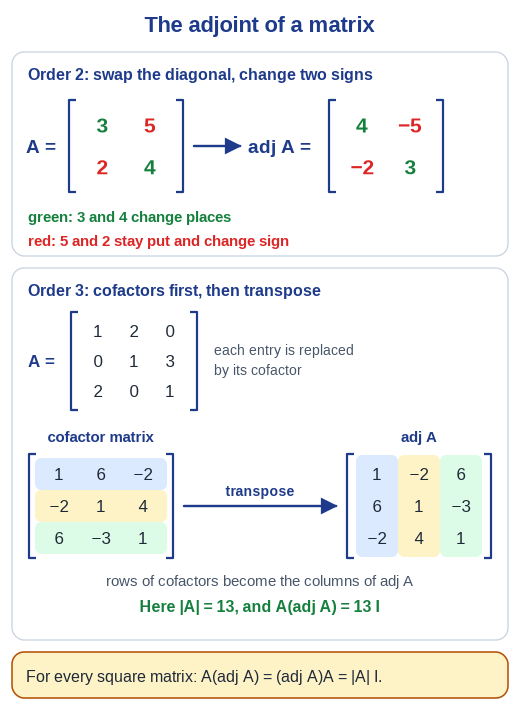
Take a square matrix A = [aij] and find the cofactor Aij of every entry. (A cofactor is the minor with the sign (−1)i + j; see how to find a determinant.) Put each cofactor in the place of its entry, then take the transpose. The result is the adjoint of A, written adj A.
So the cofactors of the first row of A form the first column of adj A.
For a 2 × 2 matrix this gives a quick rule: swap the diagonal entries and change the signs of the other two.
adj [a, b; c, d] = [d, −b; −c, a]
For A = [3, 5; 2, 4], adj A = [4, −5; −2, 3].
How do you find the adjoint of a 3 × 3 matrix?
Take A = [1, 2, 0; 0, 1, 3; 2, 0, 1]. Each cofactor is an order-2 determinant with the chessboard sign:
A11 = (1)(1) − (3)(0) = 1, A12 = −[(0)(1) − (3)(2)] = 6, A13 = (0)(0) − (1)(2) = −2
A21 = −[(2)(1) − (0)(0)] = −2, A22 = (1)(1) − (0)(2) = 1, A23 = −[(1)(0) − (2)(2)] = 4
A31 = (2)(3) − (0)(1) = 6, A32 = −[(1)(3) − (0)(0)] = −3, A33 = (1)(1) − (2)(0) = 1
The cofactor matrix is [1, 6, −2; −2, 1, 4; 6, −3, 1]. Its transpose is
adj A = [1, −2, 6; 6, 1, −3; −2, 4, 1]
What does A(adj A) equal?
Theorem 1. For any square matrix A of order n, A(adj A) = (adj A)A = |A| I.
The book states this without proof. It works because a row of A times its own cofactors gives |A|, while a row times the cofactors of another row gives 0. For our 3 × 3 example, |A| = 1(1) + 2(6) + 0(−2) = 13, and
A(adj A) = [1 + 12 + 0, −2 + 2 + 0, 6 − 6 + 0; 0 + 6 − 6, 0 + 1 + 12, 0 − 3 + 3; 2 + 0 − 2, −4 + 0 + 4, 12 + 0 + 1] = [13, 0, 0; 0, 13, 0; 0, 0, 13] = 13 I
What are singular and non-singular matrices?
A square matrix A is singular if |A| = 0 and non-singular if |A| ≠ 0. For example, [1, 2; 2, 4] is singular, since 4 − 4 = 0, while [3, 5; 2, 4] is non-singular, since its determinant is 2.
The chapter states three more results:
- Theorem 2. If A and B are non-singular matrices of the same order, then AB and BA are non-singular too.
- Theorem 3. |AB| = |A||B| for square matrices of the same order.
- Theorem 4. A square matrix is invertible if and only if it is non-singular.
Two useful results follow. Taking determinants in (adj A)A = |A| I gives |adj A| = |A|ⁿ⁻¹ for order n, so |adj A| = |A|² for a 3 × 3 matrix. And from AA⁻¹ = I, |A||A⁻¹| = 1, so |A⁻¹| = 1/|A|.
How do you find the inverse?
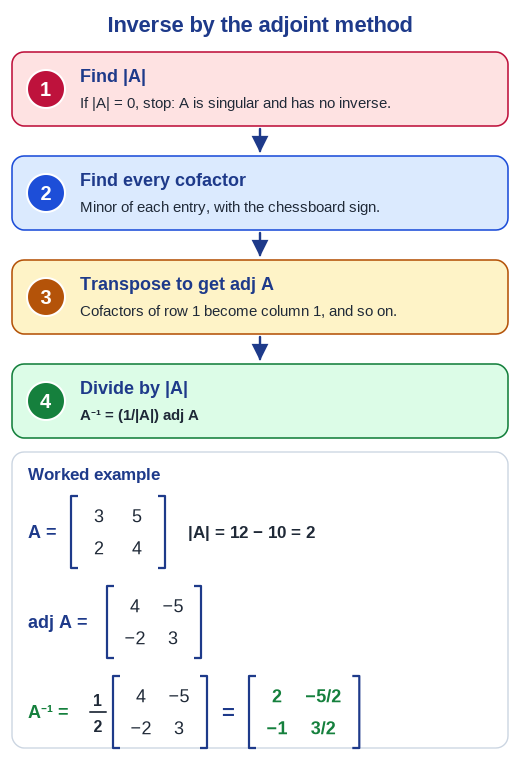
If |A| ≠ 0, divide Theorem 1 by |A|: A × (1/|A|) adj A = I. So
A⁻¹ = (1/|A|) adj A
Work in this order:
- Find |A|. If it is 0, stop: there is no inverse.
- Find all the cofactors.
- Transpose the cofactor matrix to get adj A.
- Divide every entry by |A|.
Order 2. For A = [3, 5; 2, 4]: |A| = 2 and adj A = [4, −5; −2, 3], so A⁻¹ = (1/2)[4, −5; −2, 3] = [2, −5/2; −1, 3/2]. Check: [3, 5; 2, 4][2, −5/2; −1, 3/2] = [6 − 5, −15/2 + 15/2; 4 − 4, −5 + 6] = I.
Order 3. For A = [1, 2, 0; 0, 1, 3; 2, 0, 1] above, |A| = 13, so
A⁻¹ = (1/13)[1, −2, 6; 6, 1, −3; −2, 4, 1]
From a matrix equation. Sometimes A satisfies an equation such as A² − 4A + I = O. If |A| ≠ 0, multiply through by A⁻¹: A − 4I + A⁻¹ = O, so A⁻¹ = 4I − A, with no cofactors needed. Several exercise questions use this idea.
Read next: solving linear equations using matrices, how to find a determinant and the NCERT solutions.
Practice
-
The adjoint of [2, 3; 1, 4] is:
Show answer
Answer: (a) [4, −3; −1, 2]
-
Which of these matrices is singular?
Show answer
Answer: (c) [1, 2; 2, 4]
-
A is a square matrix of order 3 with |A| = 4. Then |adj A| equals:
Show answer
Answer: (b) 16
-
Find the inverse of A = [5, 3; 3, 2].
Show answer
Answer: |A| = 10 − 9 = 1 ≠ 0. adj A = [2, −3; −3, 5]. So A⁻¹ = (1/1)[2, −3; −3, 5] = [2, −3; −3, 5]. Check: [5, 3; 3, 2][2, −3; −3, 5] = [10 − 9, −15 + 15; 6 − 6, −9 + 10] = I.
-
For which value of k is [k, 6; 2, 3] singular?
Show answer
Answer: |A| = 3k − 12. The matrix is singular when 3k − 12 = 0, that is, when k = 4.
Questions students ask
What is the adjoint of a matrix?
It is the transpose of the matrix of cofactors. Find the cofactor of every entry, put each in the place of its entry, and then turn rows into columns. For a 2 × 2 matrix, just swap the diagonal entries and change the signs of the other two.
When does a matrix have an inverse?
Exactly when it is square and its determinant is not zero. Such a matrix is called non-singular. If |A| = 0, the matrix is singular and no inverse exists.
Is the adjoint the same as the inverse?
No. The inverse is the adjoint divided by the determinant: A⁻¹ = (1/|A|) adj A. The two are equal only when |A| = 1. The adjoint always exists for a square matrix; the inverse needs |A| ≠ 0.
Does the book prove A(adj A) = |A| I?
It states the theorem without proof and checks it for order 3. The check uses two facts: a row's entries times their own cofactors give |A|, and a row's entries times another row's cofactors give 0.
Stuck on a question?
Take a photo and Lagnever AI explains it step by step. Try it for 7 days for ₹2.
Get it on Google Play Open in browser
For parents: after the trial, the plan renews monthly by UPI or card autopay. You can cancel anytime in the app.