
How do you find the determinant of a matrix?
Answer in short
For order 2, |a, b; c, d| = ad − bc. For order 3, expand along any row or column: multiply each entry by its cofactor, the minor with the sign (−1)ⁱ⁺ʲ, and add. Every row or column gives the same value. Half of |x₁, y₁, 1; x₂, y₂, 1; x₃, y₃, 1| gives a triangle's area.
Stuck on a question? Take a photo and Lagnever AI explains it step by step. Try it for 7 days for ₹2. Get it on Google Play
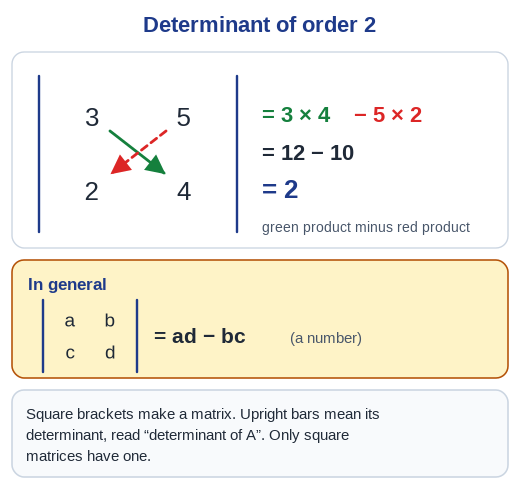
How matrices and determinants are written here. A matrix is typed row by row: commas separate the entries of a row and semicolons separate the rows, so [3, 5; 2, 4] has rows 3, 5 and 2, 4. The same entries between upright bars, |3, 5; 2, 4|, mean the determinant of that matrix.
What is a determinant?
Every square matrix A has one number attached to it, called its determinant and written |A|, det A or Δ. Read |A| as “determinant of A”; it is not a modulus, and it can be negative. A matrix that is not square has no determinant.
- Order 1: the determinant of [a] is a itself.
- Order 2: |a, b; c, d| = ad − bc.
So |3, 5; 2, 4| = 3 × 4 − 5 × 2 = 12 − 10 = 2, and |1, 2; 3, 4| = 4 − 6 = −2.
How do you expand a determinant of order 3?
A determinant of order 3 is written in terms of determinants of order 2. To expand along the first row:
- Take the first entry. Delete its row and column, and multiply the entry by the order-2 determinant that is left.
- Do the same for the second and third entries.
- Join the three products with the signs +, −, +.
For Δ = |2, 1, 3; 0, 4, −1; 5, 2, 1|:
Δ = 2 × |4, −1; 2, 1| − 1 × |0, −1; 5, 1| + 3 × |0, 4; 5, 2|
= 2(4 + 2) − 1(0 + 5) + 3(0 − 20) = 12 − 5 − 60 = −53
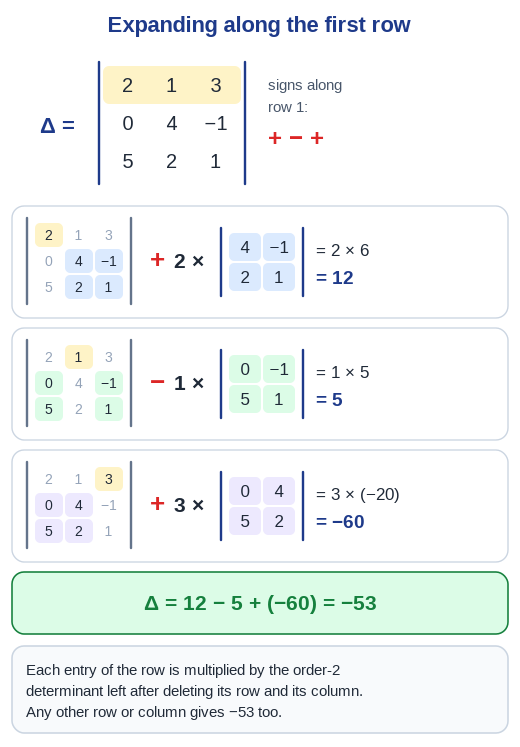
There are six ways to expand, one for each row and column, and all six give the same value. The first column here has a zero, so it is quicker: Δ = 2(4 + 2) − 0 + 5(−1 − 12) = 12 − 65 = −53.
One more fact from the chapter: if A = kB for square matrices of order n, then |A| = kⁿ|B|. Multiplying a 3 × 3 matrix by 2 multiplies its determinant by 2³ = 8.
What are minors and cofactors?
The minor of the entry aij, written Mij, is the determinant left after deleting row i and column j. In the determinant above, the entry −1 sits in row 2, column 3, so
M23 = |2, 1; 5, 2| = 4 − 5 = −1.
The cofactor is the minor with a sign attached: Aij = (−1)i + j Mij. Here A23 = (−1)5(−1) = 1. The sign is + when i + j is even and − when it is odd, which makes a chessboard pattern.
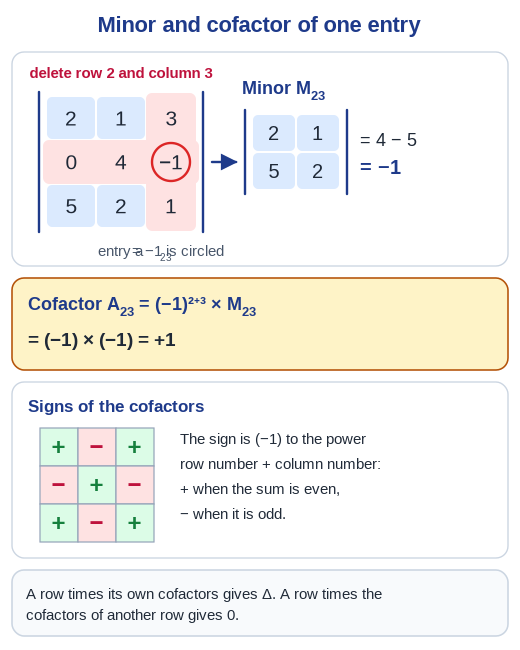
With cofactors, an expansion becomes one short line: Δ = a11A11 + a12A12 + a13A13, and the same holds for any other row or column. Along the second row of our example, A21 = −(1 − 6) = 5, A22 = 2 − 15 = −13 and A23 = 1, so Δ = 0(5) + 4(−13) + (−1)(1) = −53 again.
If the entries of one row meet the cofactors of a different row, the sum is 0. With the first-row entries and the second-row cofactors: 2(5) + 1(−13) + 3(1) = 0. This fact is what makes the adjoint work.
How does a determinant give the area of a triangle?
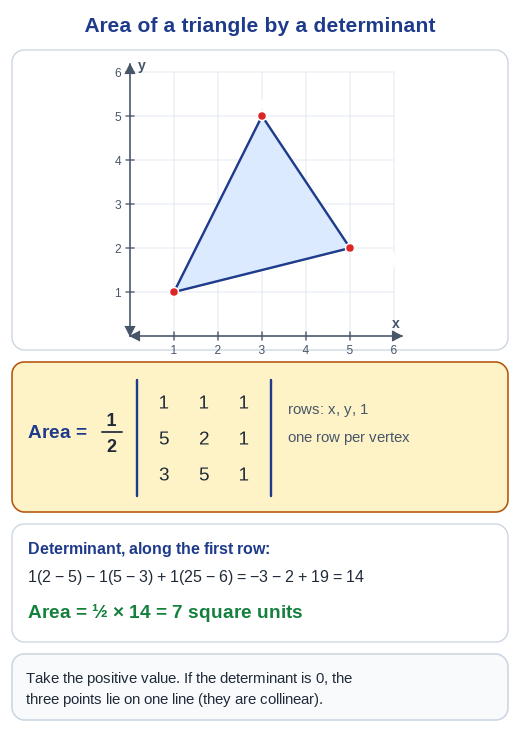
For a triangle with vertices (x₁, y₁), (x₂, y₂) and (x₃, y₃):
Area = (1/2)|x₁, y₁, 1; x₂, y₂, 1; x₃, y₃, 1|, taken positive.
For the vertices (1, 1), (5, 2) and (3, 5), expand along the first row: 1(2 − 5) − 1(5 − 3) + 1(25 − 6) = −3 − 2 + 19 = 14. The area is (1/2)(14) = 7 square units.
Three uses follow:
- Collinear points. If the determinant is 0, the area is 0 and the points lie on one line. For (1, 2), (2, 4), (3, 6): 1(4 − 6) − 2(2 − 3) + 1(12 − 12) = −2 + 2 + 0 = 0.
- Equation of a line. A point (x, y) is on the line through (1, 2) and (3, 6) when |x, y, 1; 1, 2, 1; 3, 6, 1| = 0. This gives −4x + 2y = 0, that is, y = 2x.
- Finding an unknown vertex. When the area is given, set the determinant equal to both + and − twice the area, and solve for both values.
Read next: adjoint and inverse of a matrix, solving linear equations using matrices and the NCERT solutions.
Practice
-
The value of |4, −2; 3, 5| is:
Show answer
Answer: (b) 26
-
In |1, 2, 3; 4, 5, 6; 7, 8, 9|, the minor of the entry 4 is:
Show answer
Answer: (c) −6
-
The points (1, 2), (2, 4) and (3, 6) are:
Show answer
Answer: (a) collinear
-
Evaluate |1, 0, 2; 3, 1, 0; 0, 2, 1|.
Show answer
Answer: Along the first row: 1(1 × 1 − 0 × 2) − 0(3 × 1 − 0 × 0) + 2(3 × 2 − 1 × 0) = 1 − 0 + 12 = 13.
-
Find the area of the triangle with vertices (0, 0), (4, 0) and (0, 6).
Show answer
Answer: |0, 0, 1; 4, 0, 1; 0, 6, 1| = 0 − 0 + 1(24 − 0) = 24, so the area is (1/2)(24) = 12 square units.
Questions students ask
Can a determinant be negative?
Yes. A determinant is just a number and can be positive, negative or zero: |1, 2; 3, 4| = 4 − 6 = −2. Only when it stands for an area do we take its absolute value.
Which row or column should I expand along?
Any of them gives the same value. Choose the row or column with the most zeros, because every zero entry removes one order-2 determinant from the work.
What is the difference between a minor and a cofactor?
The minor Mᵢⱼ is the determinant left after deleting row i and column j. The cofactor Aᵢⱼ is that minor with the sign (−1)ⁱ⁺ʲ. They are equal when i + j is even and opposite in sign when i + j is odd.
How do determinants show that three points are collinear?
Put the points in the area formula. If |x₁, y₁, 1; x₂, y₂, 1; x₃, y₃, 1| = 0, the triangle has zero area, so the three points lie on one line.
Stuck on a question?
Take a photo and Lagnever AI explains it step by step. Try it for 7 days for ₹2.
Get it on Google Play Open in browser
For parents: after the trial, the plan renews monthly by UPI or card autopay. You can cancel anytime in the app.