
NCERT Solutions Class 12 Maths Chapter 6: Application of Derivatives
Answers to every question of Exercises 6.1 to 6.3 and the Miscellaneous Exercise, and to all 37 worked examples, of Chapter 6, Application of Derivatives, of Mathematics Part I, the Class 12 NCERT textbook. Page numbers follow the 2026-27 reprint (pages 147–186). The exercise questions are quoted from the book; the examples are restated in short and labelled by number and page. Every derivative, critical point, interval and extreme value below was checked again by a script (numerically, on fine grids), and the answers agree with the book’s answer key; the few notes on the key are marked where they come. Short notes: Chapter 6 notes.
How the maths is typed here. f′(x) and f″(x) are the first and second derivatives. Fractions are written with a slash, so (3/2)(2x + 1) means three halves of (2x + 1), and powers such as x1/3 are cube roots. Intervals use the usual brackets: (a, b) leaves out the ends and [a, b] includes them. The quoted questions use the same layout.
Four facts carry most of the answers:
- Rate of change: dy/dx; with time, dV/dt = (dV/dr)(dr/dt).
- f′ > 0 on an interval: f increasing there; f′ < 0: decreasing.
- At a critical point c (f′(c) = 0): f″(c) < 0 gives a local maximum, f″(c) > 0 a local minimum; if f″(c) = 0, look at the sign change of f′.
- On [a, b]: compare f at the critical points and at a and b.
Examples 1 to 6: rate of change (pages 148–150)
Example 1 (page 148): how fast a circle’s area changes with its radius when r = 5 cm. A = πr², so dA/dr = 2πr = 2π(5) = 10π cm² per cm. (The book writes the unit as cm²/s; the rate is with respect to the radius, so cm² per cm.)
Example 2 (page 148): a cube’s volume grows at 9 cm³/s; how fast does its surface area grow when the edge is 10 cm? V = x³ gives 9 = 3x² dx/dt, so dx/dt = 3/x². S = 6x² gives dS/dt = 12x dx/dt = 12x(3/x²) = 36/x = 3.6 cm²/s at x = 10.
Example 3 (page 149): ripples spread at 4 cm/s; how fast does the area grow at r = 10 cm? dA/dt = 2πr dr/dt = 2π(10)(4) = 80π cm²/s.
Example 4 (page 149): a rectangle’s length x falls at 3 cm/min and width y rises at 2 cm/min; rates of perimeter and area at x = 10 cm, y = 6 cm. P = 2(x + y): dP/dt = 2(−3 + 2) = −2 cm/min. A = xy: dA/dt = y dx/dt + x dy/dt = 6(−3) + 10(2) = 2 cm²/min.
Example 5 (page 150): marginal cost at x = 3 for C(x) = 0.005x³ − 0.02x² + 30x + 5000. C′(x) = 0.015x² − 0.04x + 30, so C′(3) = 0.135 − 0.12 + 30 = 30.015, about ₹30.02.
Example 6 (page 150): marginal revenue at x = 5 for R(x) = 3x² + 36x + 5. R′(x) = 6x + 36, so R′(5) = ₹66.
Exercise 6.1 (pages 150–152)
1. “Find the rate of change of the area of a circle with respect to its radius r when (a) r = 3 cm (b) r = 4 cm”
A = πr², so dA/dr = 2πr.
(a) At r = 3: 2π(3) = 6π cm²/cm. (b) At r = 4: 2π(4) = 8π cm²/cm.
2. “The volume of a cube is increasing at the rate of 8 cm³/s. How fast is the surface area increasing when the length of an edge is 12 cm?”
Let the edge be x. V = x³, so dV/dt = 3x² dx/dt = 8 and dx/dt = 8/(3x²).
S = 6x², so dS/dt = 12x dx/dt = 12x × 8/(3x²) = 32/x.
At x = 12: dS/dt = 32/12 = 8/3 cm²/s.
3. “The radius of a circle is increasing uniformly at the rate of 3 cm/s. Find the rate at which the area of the circle is increasing when the radius is 10 cm.”
dA/dt = 2πr dr/dt = 2π(10)(3) = 60π cm²/s.
4. “An edge of a variable cube is increasing at the rate of 3 cm/s. How fast is the volume of the cube increasing when the edge is 10 cm long?”
V = x³, so dV/dt = 3x² dx/dt = 3(10)²(3) = 900 cm³/s.
5. “A stone is dropped into a quiet lake and waves move in circles at the speed of 5 cm/s. At the instant when the radius of the circular wave is 8 cm, how fast is the enclosed area increasing?”
dA/dt = 2πr dr/dt = 2π(8)(5) = 80π cm²/s.
6. “The radius of a circle is increasing at the rate of 0.7 cm/s. What is the rate of increase of its circumference?”
C = 2πr, so dC/dt = 2π dr/dt = 2π(0.7) = 1.4π cm/s. It does not depend on the radius.
7. “The length x of a rectangle is decreasing at the rate of 5 cm/minute and the width y is increasing at the rate of 4 cm/minute. When x = 8cm and y = 6cm, find the rates of change of (a) the perimeter, and (b) the area of the rectangle.”
dx/dt = −5 (decreasing) and dy/dt = 4.
(a) P = 2(x + y): dP/dt = 2(−5 + 4) = −2 cm/min (the perimeter decreases at 2 cm/min).
(b) A = xy: dA/dt = y dx/dt + x dy/dt = 6(−5) + 8(4) = −30 + 32 = 2 cm²/min.
8. “A balloon, which always remains spherical on inflation, is being inflated by pumping in 900 cubic centimetres of gas per second. Find the rate at which the radius of the balloon increases when the radius is 15 cm.”
V = (4/3)πr³, so dV/dt = 4πr² dr/dt. With dV/dt = 900 and r = 15:
900 = 4π(225) dr/dt, so dr/dt = 900/(900π) = 1/π cm/s.
9. “A balloon, which always remains spherical has a variable radius. Find the rate at which its volume is increasing with the radius when the later is 10 cm.”
V = (4/3)πr³, so dV/dr = 4πr² = 4π(100) = 400π cm³/cm at r = 10. (“Later” in the question means “latter”, the radius.)
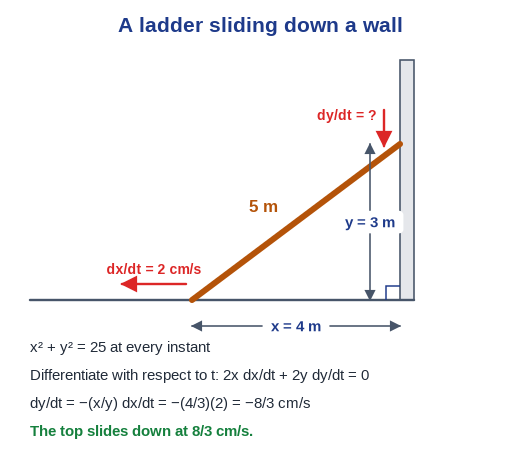
10. “A ladder 5 m long is leaning against a wall. The bottom of the ladder is pulled along the ground, away from the wall, at the rate of 2cm/s. How fast is its height on the wall decreasing when the foot of the ladder is 4 m away from the wall ?”
Let the foot be x m from the wall and the top y m high. Then x² + y² = 25. Differentiating with respect to t: 2x dx/dt + 2y dy/dt = 0, so dy/dt = −(x/y) dx/dt.
At x = 4, y = √(25 − 16) = 3. With dx/dt = 2 cm/s, dy/dt = −(4/3)(2) = −8/3 cm/s.
The height is decreasing at 8/3 cm/s.
11. “A particle moves along the curve 6y = x³ +2. Find the points on the curve at which the y-coordinate is changing 8 times as fast as the x-coordinate.”
Differentiate with respect to t: 6 dy/dt = 3x² dx/dt, so dy/dt = (x²/2) dx/dt.
We need dy/dt = 8 dx/dt, so x²/2 = 8, x² = 16 and x = ±4 (taking dx/dt ≠ 0).
x = 4: 6y = 64 + 2 = 66, y = 11. x = −4: 6y = −64 + 2 = −62, y = −31/3.
The points are (4, 11) and (−4, −31/3).
12. “The radius of an air bubble is increasing at the rate of 1/2 cm/s. At what rate is the volume of the bubble increasing when the radius is 1 cm?”
dV/dt = 4πr² dr/dt = 4π(1)²(1/2) = 2π cm³/s.
13. “A balloon, which always remains spherical, has a variable diameter (3/2)(2x + 1). Find the rate of change of its volume with respect to x.”
The radius is half the diameter: r = (3/4)(2x + 1). So
V = (4/3)πr³ = (4/3)π × (27/64)(2x + 1)³ = (9π/16)(2x + 1)³
dV/dx = (9π/16) × 3(2x + 1)² × 2 = (27π/8)(2x + 1)².
14. “Sand is pouring from a pipe at the rate of 12 cm³/s. The falling sand forms a cone on the ground in such a way that the height of the cone is always one-sixth of the radius of the base. How fast is the height of the sand cone increasing when the height is 4 cm?”
h = r/6, so r = 6h. V = (1/3)πr²h = (1/3)π(36h²)h = 12πh³.
dV/dt = 36πh² dh/dt. With dV/dt = 12 and h = 4: 12 = 36π(16) dh/dt, so dh/dt = 12/(576π) = 1/(48π) cm/s.
15. “The total cost C (x) in Rupees associated with the production of x units of an item is given by C (x) = 0.007x³ − 0.003x² + 15x + 4000. Find the marginal cost when 17 units are produced.”
MC = C′(x) = 0.021x² − 0.006x + 15.
C′(17) = 0.021(289) − 0.006(17) + 15 = 6.069 − 0.102 + 15 = ₹20.967.
16. “The total revenue in Rupees received from the sale of x units of a product is given by R (x) = 13x² + 26x + 15. Find the marginal revenue when x = 7.”
MR = R′(x) = 26x + 26, so R′(7) = 182 + 26 = ₹208.
“Choose the correct answer for questions 17 and 18.”
17. “The rate of change of the area of a circle with respect to its radius r at r = 6 cm is (A) 10π (B) 12π (C) 8π (D) 11π”
dA/dr = 2πr = 2π(6) = 12π. Answer: (B).
18. “The total revenue in Rupees received from the sale of x units of a product is given by R(x) = 3x² + 36x + 5. The marginal revenue, when x = 15 is (A) 116 (B) 96 (C) 90 (D) 126”
R′(x) = 6x + 36, so R′(15) = 90 + 36 = 126. Answer: (D).
Examples 7 to 13: increasing and decreasing functions (pages 153–158)
Example 7 (page 153): f(x) = 7x − 3 is increasing on R. If x₁ < x₂, then 7x₁ < 7x₂ and 7x₁ − 3 < 7x₂ − 3, so f(x₁) < f(x₂): f is strictly increasing on R, straight from the definition.
Example 8 (page 154): f(x) = x³ − 3x² + 4x is increasing on R. f′(x) = 3x² − 6x + 4 = 3(x − 1)² + 1 > 0 for every x, so f is increasing on R.
Example 9 (pages 154–155): cos x on (0, π), (π, 2π) and (0, 2π). f′(x) = −sin x. On (0, π), sin x > 0, so f′ < 0: decreasing. On (π, 2π), sin x < 0, so f′ > 0: increasing. So on (0, 2π) it is neither increasing nor decreasing.
Example 10 (page 155): intervals for f(x) = x² − 4x + 6. f′(x) = 2x − 4 = 0 at x = 2. f′ < 0 on (−∞, 2): decreasing; f′ > 0 on (2, ∞): increasing.
Example 11 (pages 155–156): intervals for f(x) = 4x³ − 6x² − 72x + 30. f′(x) = 12x² − 12x − 72 = 12(x − 3)(x + 2), zero at x = −2 and 3.
| Interval | Sign of f′(x) | f is |
|---|---|---|
| (−∞, −2) | (−)(−) > 0 | increasing |
| (−2, 3) | (−)(+) < 0 | decreasing |
| (3, ∞) | (+)(+) > 0 | increasing |
So f is increasing on (−∞, −2) and (3, ∞) and decreasing on (−2, 3).
Example 12 (pages 156–157): f(x) = sin 3x on [0, π/2]. f′(x) = 3 cos 3x. For x in [0, π/2], 3x is in [0, 3π/2], and cos 3x = 0 gives 3x = π/2 or 3π/2, so x = π/6 or π/2. On (0, π/6), 3x is in (0, π/2) and f′ > 0; on (π/6, π/2), 3x is in (π/2, 3π/2) and f′ < 0. So f is increasing on [0, π/6] and decreasing on [π/6, π/2].
Example 13 (pages 157–158): f(x) = sin x + cos x on [0, 2π]. f′(x) = cos x − sin x = 0 when tan x = 1: x = π/4 and 5π/4. f′ > 0 on [0, π/4) and (5π/4, 2π]: increasing; f′ < 0 on (π/4, 5π/4): decreasing.
Exercise 6.2 (pages 158–159)
1. “Show that the function given by f (x) = 3x + 17 is increasing on R.”
f′(x) = 3 > 0 for every real x, so f is increasing on R. (Directly: x₁ < x₂ gives 3x₁ + 17 < 3x₂ + 17.)
2. “Show that the function given by f (x) = e2x is increasing on R.”
f′(x) = 2e2x. Since e2x > 0 for every x, f′(x) > 0 on R, so f is increasing on R.
3. “Show that the function given by f (x) = sin x is (a) increasing in (0, π/2) (b) decreasing in (π/2, π) (c) neither increasing nor decreasing in (0, π)”
f′(x) = cos x.
(a) For x in (0, π/2), cos x > 0, so f is increasing.
(b) For x in (π/2, π), cos x < 0, so f is decreasing.
(c) On (0, π), f rises on the first part and falls on the second (for example sin(π/6) < sin(π/2) but sin(π/2) > sin(5π/6)), so it is neither increasing nor decreasing on (0, π).
4. “Find the intervals in which the function f given by f(x) = 2x² − 3x is (a) increasing (b) decreasing”
f′(x) = 4x − 3 = 0 at x = 3/4.
(a) f′ > 0 for x > 3/4: increasing on (3/4, ∞). (b) f′ < 0 for x < 3/4: decreasing on (−∞, 3/4).
5. “Find the intervals in which the function f given by f(x) = 2x³ − 3x² − 36x + 7 is (a) increasing (b) decreasing”
f′(x) = 6x² − 6x − 36 = 6(x² − x − 6) = 6(x − 3)(x + 2), zero at x = −2 and 3.
On (−∞, −2): (−)(−) > 0. On (−2, 3): (−)(+) < 0. On (3, ∞): (+)(+) > 0.
(a) Increasing on (−∞, −2) and (3, ∞). (b) Decreasing on (−2, 3).
6. “Find the intervals in which the following functions are strictly increasing or decreasing: (a) x² + 2x − 5 (b) 10 − 6x − 2x² (c) −2x³ − 9x² − 12x + 1 (d) 6 − 9x − x² (e) (x + 1)³ (x − 3)³”
(a) f′(x) = 2x + 2, zero at x = −1. Strictly decreasing for x < −1 and strictly increasing for x > −1.
(b) f′(x) = −6 − 4x, zero at x = −3/2. f′ > 0 for x < −3/2: strictly increasing for x < −3/2; strictly decreasing for x > −3/2.
(c) f′(x) = −6x² − 18x − 12 = −6(x + 1)(x + 2). It is zero at x = −2 and x = −1. Check the sign on each part:
- x < −2: (x + 1)(x + 2) is positive, so f′ = −6 × (positive) < 0.
- −2 < x < −1: (x + 1)(x + 2) is negative, so f′ > 0.
- x > −1: (x + 1)(x + 2) is positive again, so f′ < 0.
So f is strictly increasing for −2 < x < −1 and strictly decreasing for x < −2 and x > −1.
(d) f′(x) = −9 − 2x, zero at x = −9/2. Strictly increasing for x < −9/2 and strictly decreasing for x > −9/2.
(e) By the product rule,
f′(x) = 3(x + 1)²(x − 3)³ + 3(x + 1)³(x − 3)² = 3(x + 1)²(x − 3)²[(x − 3) + (x + 1)] = 6(x − 1)(x + 1)²(x − 3)²
The squares (x + 1)² and (x − 3)² are never negative. So the sign of f′ is just the sign of x − 1. f′ = 0 at x = −1, 1 and 3.
- For x < 1 (leaving out x = −1): f′ < 0.
- For x > 1 (leaving out x = 3): f′ > 0.
Answer: f is strictly decreasing on (−∞, −1) and (−1, 1) and strictly increasing on (1, 3) and (3, ∞), as the key gives. (f′ is zero only at single points, so you may also say: strictly decreasing on (−∞, 1) and strictly increasing on (1, ∞).)
7. “Show that y = log(1 + x) − 2x/(2 + x), x > −1, is an increasing function of x throughout its domain.”
dy/dx = 1/(1 + x) − [2(2 + x) − 2x]/(2 + x)² = 1/(1 + x) − 4/(2 + x)²
= [(2 + x)² − 4(1 + x)] / [(1 + x)(2 + x)²] = x² / [(1 + x)(2 + x)²]
For x > −1, 1 + x > 0 and (2 + x)² > 0, while x² ≥ 0. So dy/dx ≥ 0, and it is 0 only at x = 0. Hence y is increasing throughout x > −1.
8. “Find the values of x for which y = [x(x − 2)]² is an increasing function.”
y = x²(x − 2)². dy/dx = 2x(x − 2)² + 2x²(x − 2) = 2x(x − 2)(x − 2 + x) = 4x(x − 1)(x − 2).
Zeros at 0, 1, 2. Signs: (−∞, 0): −; (0, 1): +; (1, 2): −; (2, ∞): +.
y is increasing for 0 < x < 1 and x > 2.
9. “Prove that y = 4 sin θ/(2 + cos θ) − θ is an increasing function of θ in [0, π/2].”
dy/dθ = [4 cos θ (2 + cos θ) − 4 sin θ (−sin θ)]/(2 + cos θ)² − 1 = (8 cos θ + 4)/(2 + cos θ)² − 1, using sin² θ + cos² θ = 1.
= [8 cos θ + 4 − (4 + 4 cos θ + cos² θ)]/(2 + cos θ)² = cos θ (4 − cos θ)/(2 + cos θ)²
On [0, π/2], cos θ ≥ 0 and 4 − cos θ > 0, so dy/dθ ≥ 0, and it is 0 only at θ = π/2. Hence y is increasing on [0, π/2].
10. “Prove that the logarithmic function is increasing on (0, ∞).”
f(x) = log x has f′(x) = 1/x > 0 for every x > 0, so log x is increasing on (0, ∞).
11. “Prove that the function f given by f(x) = x² − x + 1 is neither strictly increasing nor decreasing on (− 1, 1).”
f′(x) = 2x − 1, zero at x = 1/2. On (−1, 1/2), f′ < 0 and f decreases; on (1/2, 1), f′ > 0 and f increases. For example f(0) = 1 > f(1/2) = 3/4 < f(0.9) = 0.91. So on (−1, 1) f is neither strictly increasing nor decreasing.
12. “Which of the following functions are decreasing on (0, π/2)? (A) cos x (B) cos 2x (C) cos 3x (D) tan x”
Look at the sign of each derivative on (0, π/2):
- (A) cos x: derivative −sin x. sin x > 0 here, so the derivative is negative. Decreasing.
- (B) cos 2x: derivative −2 sin 2x. Here 2x lies in (0, π), where sin 2x > 0, so the derivative is negative. Decreasing.
- (C) cos 3x: derivative −3 sin 3x. Here 3x lies in (0, 3π/2). sin 3x is positive for x < π/3 and negative for x > π/3, so cos 3x first falls and then rises. Not decreasing.
- (D) tan x: derivative sec² x > 0. Increasing.
Answer: (A) and (B). (The print leaves out the brackets round 0, π/2 in Questions 12 and 13; the open interval (0, π/2) is meant.)
13. “On which of the following intervals is the function f given by f(x) = x100 + sin x − 1 decreasing ? (A) (0,1) (B) (π/2, π) (C) (0, π/2) (D) None of these”
f′(x) = 100x99 + cos x.
- (A) On (0, 1): x99 > 0 and cos x > 0, so f′ > 0.
- (C) On (0, π/2): again both terms are positive, so f′ > 0.
- (B) On (π/2, π): x > 1.5, so 100x99 is a huge positive number, while cos x is never below −1. So f′ > 0.
f is increasing (not decreasing) on all three intervals. Answer: (D).
14. “For what values of a the function f given by f(x) = x² + ax + 1 is increasing on [1, 2]?”
f′(x) = 2x + a. This grows with x, so on [1, 2] its smallest value is at x = 1, namely 2 + a.
f′(x) > 0 on all of [1, 2] when 2 + a > 0. Answer: a > −2, as the key gives.
(Note: at a = −2, f′(x) = 2(x − 1). It is 0 only at the end point x = 1 and positive on the rest, so f is still increasing on [1, 2] by Theorem 1. So a ≥ −2 is also correct.)
15. “Let I be any interval disjoint from [−1, 1]. Prove that the function f given by f(x) = x + 1/x is increasing on I.”
f′(x) = 1 − 1/x² = (x² − 1)/x².
An interval disjoint from [−1, 1] lies wholly in x > 1 or wholly in x < −1 (and does not contain 0). In both cases x² > 1, so x² − 1 > 0, and x² > 0. So f′(x) > 0 on I, and f is increasing on I.
16. “Prove that the function f given by f(x) = log sin x is increasing on (0, π/2) and decreasing on (π/2, π).”
f′(x) = (1/sin x) × cos x = cot x.
On (0, π/2), cot x > 0, so f is increasing. On (π/2, π), cot x < 0, so f is decreasing. (sin x > 0 on (0, π), so log sin x is defined there.)
17. “Prove that the function f given by f(x) = log |cos x| is decreasing on (0, π/2) and increasing on (3π/2, 2π).”
Where cos x ≠ 0, the derivative of log |u| is u′/u, so f′(x) = (−sin x)/cos x = −tan x.
On (0, π/2), tan x > 0, so f′ < 0 and f is decreasing. On (3π/2, 2π), tan x < 0, so f′ > 0 and f is increasing.
18. “Prove that the function given by f(x) = x³ − 3x² + 3x − 100 is increasing in R.”
f′(x) = 3x² − 6x + 3 = 3(x − 1)² ≥ 0 for every x, and it is 0 only at x = 1. So f is increasing on R.
19. “The interval in which y = x²e−x is increasing is (A) (−∞, ∞) (B) (−2, 0) (C) (2, ∞) (D) (0, 2)”
dy/dx = 2xe−x − x²e−x = x(2 − x)e−x. Since e−x > 0, the sign is that of x(2 − x), positive only for 0 < x < 2. Answer: (D).
Examples 14 to 21: maxima, minima and the two tests (pages 161–167)
Example 14 (page 161): maximum and minimum of f(x) = x² on R. x² ≥ 0 and f(0) = 0, so the minimum is 0 at x = 0; x² grows without limit, so there is no maximum. On [−2, 1] only, the maximum would be (−2)² = 4 at x = −2.
Example 15 (page 161): maximum and minimum of f(x) = |x| on R. |x| ≥ 0 and |0| = 0: minimum 0 at x = 0, no maximum. On [−2, 1] the maximum would be |−2| = 2. Note that |x| is not differentiable at 0, yet it has its minimum there.
Example 16 (page 162): f(x) = x on (0, 1). f is strictly increasing, but the open interval has no smallest or largest point: for any x₀ in (0, 1), x₀/2 is smaller and (x₀ + 1)/2 is larger. So f has neither a maximum nor a minimum on (0, 1). On [0, 1] it would have minimum 0 and maximum 1.
Example 17 (page 165): local maxima and minima of f(x) = x³ − 3x + 3. f′(x) = 3x² − 3 = 3(x − 1)(x + 1), zero at x = ±1. Near x = 1, f′ goes from − to +: local minimum f(1) = 1. Near x = −1, f′ goes from + to −: local maximum f(−1) = 5.
Example 18 (page 166): f(x) = 2x³ − 6x² + 6x + 5. f′(x) = 6x² − 12x + 6 = 6(x − 1)², zero only at x = 1, and positive on both sides. f′ does not change sign, so x = 1 is neither a local maximum nor a local minimum: a point of inflexion.
Example 19 (pages 166–167): local minimum of f(x) = 3 + |x|. f is not differentiable at 0, so use the first derivative test. For x < 0, f(x) = 3 − x and f′ = −1 < 0; for x > 0, f(x) = 3 + x and f′ = 1 > 0. So x = 0 is a point of local minima, with local minimum value f(0) = 3.
Example 20 (page 167): local extrema of f(x) = 3x⁴ + 4x³ − 12x² + 12. f′(x) = 12x³ + 12x² − 24x = 12x(x − 1)(x + 2), zero at x = 0, 1, −2. f″(x) = 36x² + 24x − 24, with f″(0) = −24 < 0, f″(1) = 36 > 0 and f″(−2) = 72 > 0. So the local maximum is f(0) = 12, and the local minima are f(1) = 7 and f(−2) = −20. (The book’s last line says “at x = −1 and −2”; it means x = 1 and −2, as its values f(1) = 7 and f(−2) = −20 show.)
Example 21 (page 167): the function of Example 18 again, by the second derivative test. f′(x) = 6(x − 1)² and f″(x) = 12(x − 1), so f′(1) = 0 and f″(1) = 0: the second derivative test fails. Going back to the first derivative test (Example 18), x = 1 is a point of inflexion.
Examples 22 to 29: applied problems and closed intervals (pages 167–174)
Example 22 (pages 167–168): two positive numbers with sum 15 and the least sum of squares. S(x) = x² + (15 − x)² = 2x² − 30x + 225. S′(x) = 4x − 30 = 0 gives x = 15/2, and S″ = 4 > 0, so S is least there. The numbers are 15/2 and 15/2. In general, for sum k the numbers are k/2 and k/2.
Example 23 (pages 168–169): shortest distance from (0, c) to the parabola y = x², with 1/2 ≤ c ≤ 5. For a point (h, k) on the parabola, k = h², so D² = h² + (k − c)² = k + (k − c)². This is least where 1 + 2(k − c) = 0, that is, k = (2c − 1)/2; D′ changes from − to + there. Then D² = (2c − 1)/2 + 1/4 = (4c − 1)/4, so the shortest distance is √(4c − 1)/2.
Example 24 (page 169): poles AP = 16 m and BQ = 22 m stand 20 m apart; where on AB should R be so that RP² + RQ² is least? With AR = x, S(x) = x² + 16² + (20 − x)² + 22² = 2x² − 40x + 1140. S′(x) = 4x − 40 = 0 gives x = 10, and S″ = 4 > 0. So AR = 10 m.
Example 25 (pages 169–170): largest trapezium with its three sides other than the base equal to 10 cm. Let the base stick out x cm beyond the top side at each end. The height is √(100 − x²) and the parallel sides are 10 and 10 + 2x, so A(x) = (x + 10)√(100 − x²). A′(x) = (−2x² − 10x + 100)/√(100 − x²) = 0 gives x² + 5x − 50 = 0, so x = 5 (x = −10 is not a length). The book shows A″(5) = −2250/(75√75) < 0, so this is a maximum: A(5) = 15√75 = 75√3 cm².
Example 26 (pages 170–171): the cylinder of greatest curved surface inside a cone of radius r and height h has radius r/2. A cylinder of radius x inside the cone has height h(r − x)/r, by similar triangles. Its curved surface is S(x) = 2πx × h(r − x)/r = (2πh/r)(rx − x²). S′(x) = (2πh/r)(r − 2x) = 0 gives x = r/2, and S″(x) = −4πh/r < 0. So the radius is r/2, half that of the cone.
Example 27 (page 173): absolute extrema of f(x) = 2x³ − 15x² + 36x + 1 on [1, 5]. f′(x) = 6x² − 30x + 36 = 6(x − 2)(x − 3), zero at x = 2 and 3. f(1) = 24, f(2) = 29, f(3) = 28 and f(5) = 56. Absolute maximum 56 at x = 5; absolute minimum 24 at x = 1.
Example 28 (pages 173–174): absolute extrema of f(x) = 12x4/3 − 6x1/3 on [−1, 1]. f′(x) = 16x1/3 − 2x−2/3 = 2(8x − 1)/x2/3. It is 0 at x = 1/8 and undefined at x = 0, so both are critical points. f(−1) = 12 + 6 = 18, f(0) = 0, f(1/8) = 12(1/16) − 6(1/2) = −9/4, f(1) = 12 − 6 = 6. Absolute maximum 18 at x = −1; absolute minimum −9/4 at x = 1/8.
Example 29 (page 174): a helicopter flies along y = x² + 7; its least distance from the point (3, 7). The distance from (x, x² + 7) to (3, 7) is √[(x − 3)² + x⁴]. Let f(x) = (x − 3)² + x⁴. f′(x) = 2(x − 3) + 4x³ = 2(x − 1)(2x² + 2x + 3); the quadratic has no real roots, so x = 1 is the only critical point, with f(1) = 4 + 1 = 5. Since √f(0) = 3 > √5, the value √5 is a minimum. The least distance is √5 units.
Exercise 6.3 (pages 174–177)
1. “Find the maximum and minimum values, if any, of the following functions given by (i) f(x) = (2x − 1)² + 3 (ii) f(x) = 9x² + 12x + 2 (iii) f(x) = −(x − 1)² + 10 (iv) g(x) = x³ + 1”
(i) (2x − 1)² ≥ 0, so f(x) ≥ 3, with f(1/2) = 3. Minimum value 3; f grows without limit, so no maximum.
(ii) 9x² + 12x + 2 = (3x + 2)² − 2 ≥ −2, with equality at x = −2/3. Minimum value −2; no maximum.
(iii) −(x − 1)² ≤ 0, so f(x) ≤ 10, with f(1) = 10. Maximum value 10; no minimum.
(iv) x³ + 1 takes every real value (it goes to +∞ and −∞), so it has neither a maximum nor a minimum.
2. “Find the maximum and minimum values, if any, of the following functions given by (i) f(x) = |x + 2| − 1 (ii) g(x) = −|x + 1| + 3 (iii) h(x) = sin(2x) + 5 (iv) f(x) = |sin 4x + 3| (v) h(x) = x + 1, x ∈ (−1, 1)”
(i) |x + 2| ≥ 0, so f(x) ≥ −1, with f(−2) = −1. Minimum value −1; no maximum.
(ii) −|x + 1| ≤ 0, so g(x) ≤ 3, with g(−1) = 3. Maximum value 3; no minimum.
(iii) −1 ≤ sin 2x ≤ 1, so 4 ≤ h(x) ≤ 6. Both are reached (sin 2x = −1 at x = 3π/4, sin 2x = 1 at x = π/4). Minimum 4, maximum 6.
(iv) −1 ≤ sin 4x ≤ 1, so 2 ≤ sin 4x + 3 ≤ 4; the expression is always positive, so |sin 4x + 3| = sin 4x + 3. Minimum 2, maximum 4.
(v) On the open interval (−1, 1), h(x) = x + 1 takes every value in (0, 2) but not 0 or 2 (as in Example 16). Neither a minimum nor a maximum.
3. “Find the local maxima and local minima, if any, of the following functions. Find also the local maximum and the local minimum values, as the case may be: (i) f(x) = x² (ii) g(x) = x³ − 3x (iii) h(x) = sin x + cos x, 0 < x < π/2 (iv) f(x) = sin x − cos x, 0 < x < 2π (v) f(x) = x³ − 6x² + 9x + 15 (vi) g(x) = x/2 + 2/x, x > 0 (vii) g(x) = 1/(x² + 2) (viii) f(x) = x√(1 − x), 0 < x < 1”
(i) f′(x) = 2x = 0 at x = 0, and f″(0) = 2 > 0. Local minimum at x = 0, value 0.
(ii) g′(x) = 3x² − 3 = 3(x − 1)(x + 1), zero at ±1; g″(x) = 6x. g″(1) = 6 > 0: local minimum at x = 1, value g(1) = −2. g″(−1) = −6 < 0: local maximum at x = −1, value g(−1) = 2.
(iii) h′(x) = cos x − sin x = 0 gives tan x = 1, x = π/4. h″(x) = −sin x − cos x, so h″(π/4) = −√2 < 0. Local maximum at x = π/4, value √2/2 + √2/2 = √2.
(iv) f′(x) = cos x + sin x = 0 gives tan x = −1, so x = 3π/4 or 7π/4. f″(x) = −sin x + cos x.
f″(3π/4) = −√2/2 − √2/2 = −√2 < 0: local maximum at x = 3π/4, value √2/2 + √2/2 = √2.
f″(7π/4) = √2/2 + √2/2 = √2 > 0: local minimum at x = 7π/4, value −√2/2 − √2/2 = −√2.
(v) f′(x) = 3x² − 12x + 9 = 3(x − 1)(x − 3); f″(x) = 6x − 12. f″(1) = −6 < 0: local maximum at x = 1, value 1 − 6 + 9 + 15 = 19. f″(3) = 6 > 0: local minimum at x = 3, value 27 − 54 + 27 + 15 = 15.
(vi) g′(x) = 1/2 − 2/x² = 0 gives x² = 4, and x > 0, so x = 2. g″(x) = 4/x³, so g″(2) = 1/2 > 0. Local minimum at x = 2, value 1 + 1 = 2.
(vii) g′(x) = −2x/(x² + 2)², zero at x = 0. g′ > 0 for x < 0 and g′ < 0 for x > 0 (+ to −). Local maximum at x = 0, value 1/2.
(viii) f′(x) = √(1 − x) − x/(2√(1 − x)) = [2(1 − x) − x]/(2√(1 − x)) = (2 − 3x)/(2√(1 − x)), zero at x = 2/3. f′ > 0 for x < 2/3 and f′ < 0 for 2/3 < x < 1. Local maximum at x = 2/3, value (2/3)√(1/3) = 2/(3√3) = 2√3/9.
4. “Prove that the following functions do not have maxima or minima: (i) f(x) = ex (ii) g(x) = log x (iii) h(x) = x³ + x² + x + 1”
A local maximum or minimum of a differentiable function needs f′ = 0 somewhere.
(i) f′(x) = ex > 0 for all x: never 0, so no maxima or minima.
(ii) g′(x) = 1/x > 0 for all x > 0 (the domain): never 0, so none.
(iii) h′(x) = 3x² + 2x + 1 = 3(x + 1/3)² + 2/3 > 0 for all x (its discriminant 4 − 12 is negative): never 0, so none.
5. “Find the absolute maximum value and the absolute minimum value of the following functions in the given intervals: (i) f(x) = x³, x ∈ [−2, 2] (ii) f(x) = sin x + cos x , x ∈ [0, π] (iii) f(x) = 4x − (1/2)x², x ∈ [−2, 9/2] (iv) f(x) = (x − 1)² + 3, x ∈ [−3, 1]”
(i) f′(x) = 3x² = 0 at x = 0. f(−2) = −8, f(0) = 0, f(2) = 8. Absolute maximum 8 (at x = 2), absolute minimum −8 (at x = −2).
(ii) f′(x) = cos x − sin x = 0 at x = π/4 in [0, π]. f(0) = 1, f(π/4) = √2, f(π) = −1. Absolute maximum √2, absolute minimum −1.
(iii) f′(x) = 4 − x = 0 at x = 4. f(−2) = −8 − 2 = −10, f(4) = 16 − 8 = 8, f(9/2) = 18 − 81/8 = 63/8. Absolute maximum 8 (at x = 4), absolute minimum −10 (at x = −2).
(iv) f′(x) = 2(x − 1) = 0 at x = 1, which is an end point. f(−3) = 16 + 3 = 19, f(1) = 3. Absolute maximum 19 (at x = −3), absolute minimum 3 (at x = 1).
(Answer key note: for (iv) the key prints “Absolute minimum value = 19, absolute maximum value = 3”, with the two words swapped. The maximum is 19 and the minimum is 3.)
6. “Find the maximum profit that a company can make, if the profit function is given by p(x) = 41 − 72x − 18x²”
- p′(x) = −72 − 36x. Setting p′(x) = 0 gives x = −2.
- p″(x) = −36 < 0, so p has its maximum at x = −2.
- p(−2) = 41 + 144 − 72 = 113.
Answer: maximum profit = 113, the key’s answer.
(Note: x = −2 means a negative number of units, which a real company cannot make. If we allow only x ≥ 0, p′(x) < 0, so p only falls and its largest value is p(0) = 41. The book expects 113, from the calculus alone.)
7. “Find both the maximum value and the minimum value of 3x⁴ − 8x³ + 12x² − 48x + 25 on the interval [0, 3].”
f′(x) = 12x³ − 24x² + 24x − 48 = 12[x²(x − 2) + 2(x − 2)] = 12(x − 2)(x² + 2). x² + 2 > 0, so the only critical point is x = 2.
f(0) = 25, f(2) = 48 − 64 + 48 − 96 + 25 = −39, f(3) = 243 − 216 + 108 − 144 + 25 = 16.
Maximum value 25 at x = 0; minimum value −39 at x = 2.
8. “At what points in the interval [0, 2π], does the function sin 2x attain its maximum value?”
The largest value of sin 2x is 1, reached when 2x = π/2 + 2nπ, that is, x = π/4 + nπ. In [0, 2π] these are x = π/4 and x = 5π/4. (By calculus: 2 cos 2x = 0 gives x = π/4, 3π/4, 5π/4, 7π/4; sin 2x is 1 at π/4 and 5π/4 and −1 at the other two.)
9. “What is the maximum value of the function sin x + cos x?”
f′(x) = cos x − sin x = 0 gives tan x = 1, x = π/4 (and π/4 + nπ). f″(x) = −(sin x + cos x), which is −√2 < 0 at π/4. The maximum value is f(π/4) = √2. (Also: sin x + cos x = √2 sin(x + π/4) ≤ √2.)
10. “Find the maximum value of 2x³ − 24x + 107 in the interval [1, 3]. Find the maximum value of the same function in [−3, −1].”
f′(x) = 6x² − 24 = 6(x − 2)(x + 2), zero at x = ±2.
On [1, 3]: f(1) = 85, f(2) = 16 − 48 + 107 = 75, f(3) = 54 − 72 + 107 = 89. Maximum 89 at x = 3.
On [−3, −1]: f(−3) = −54 + 72 + 107 = 125, f(−2) = −16 + 48 + 107 = 139, f(−1) = −2 + 24 + 107 = 129. Maximum 139 at x = −2.
11. “It is given that at x = 1, the function x⁴ − 62x² + ax + 9 attains its maximum value, on the interval [0, 2]. Find the value of a.”
x = 1 is inside [0, 2], so f′(1) = 0. f′(x) = 4x³ − 124x + a, so 4 − 124 + a = 0 and a = 120.
Check: with a = 120, f(0) = 9, f(1) = 68 and f(2) = 17, and f″(1) = 12 − 124 < 0, so the maximum on [0, 2] is indeed at x = 1.
12. “Find the maximum and minimum values of x + sin 2x on [0, 2π].”
f′(x) = 1 + 2 cos 2x = 0 gives cos 2x = −1/2, so 2x = 2π/3, 4π/3, 8π/3, 10π/3 and x = π/3, 2π/3, 4π/3, 5π/3.
f(0) = 0; f(π/3) = π/3 + √3/2 ≈ 1.91; f(2π/3) = 2π/3 − √3/2 ≈ 1.23; f(4π/3) = 4π/3 + √3/2 ≈ 5.05; f(5π/3) = 5π/3 − √3/2 ≈ 4.37; f(2π) = 2π ≈ 6.28.
Maximum value 2π at x = 2π; minimum value 0 at x = 0.
13. “Find two numbers whose sum is 24 and whose product is as large as possible.”
Let the numbers be x and 24 − x. P(x) = x(24 − x) = 24x − x². P′(x) = 24 − 2x = 0 gives x = 12, and P″ = −2 < 0. The numbers are 12 and 12.
14. “Find two positive numbers x and y such that x + y = 60 and xy³ is maximum.”
y = 60 − x, so P(x) = x(60 − x)³ for 0 < x < 60.
P′(x) = (60 − x)³ − 3x(60 − x)² = (60 − x)²(60 − 4x). In 0 < x < 60, P′ = 0 only at x = 15; P′ > 0 before 15 and P′ < 0 after, so P is largest at x = 15.
x = 15 and y = 45. (The key prints “45, 15”; with xy³ largest, x = 15 and y = 45.)
15. “Find two positive numbers x and y such that their sum is 35 and the product x²y⁵ is a maximum.”
y = 35 − x, so P(x) = x²(35 − x)⁵ for 0 < x < 35.
P′(x) = 2x(35 − x)⁵ − 5x²(35 − x)⁴ = x(35 − x)⁴[2(35 − x) − 5x] = x(35 − x)⁴(70 − 7x).
In 0 < x < 35, P′ = 0 only at x = 10, with P′ > 0 before and P′ < 0 after. x = 10 and y = 25. (The key prints “25, 10”; x = 10, y = 25 gives the maximum.)
16. “Find two positive numbers whose sum is 16 and the sum of whose cubes is minimum.”
S(x) = x³ + (16 − x)³. S′(x) = 3x² − 3(16 − x)² = 0 gives x = 16 − x, so x = 8. S″(x) = 6x + 6(16 − x) = 96 > 0, so this is a minimum. The numbers are 8 and 8.
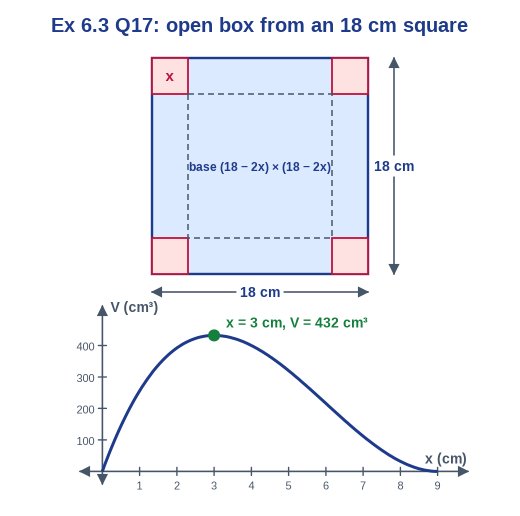
17. “A square piece of tin of side 18 cm is to be made into a box without top, by cutting a square from each corner and folding up the flaps to form the box. What should be the side of the square to be cut off so that the volume of the box is the maximum possible.”
Cut squares of side x cm. The box has height x and a square base of side 18 − 2x, so 0 < x < 9 and
V(x) = x(18 − 2x)² = 4x³ − 72x² + 324x
V′(x) = 12x² − 144x + 324 = 12(x − 3)(x − 9). In (0, 9), V′ = 0 only at x = 3. V″(x) = 24x − 144, so V″(3) = −72 < 0: a maximum.
The square cut off should have side 3 cm. (The box then holds 3 × 12 × 12 = 432 cm³.)
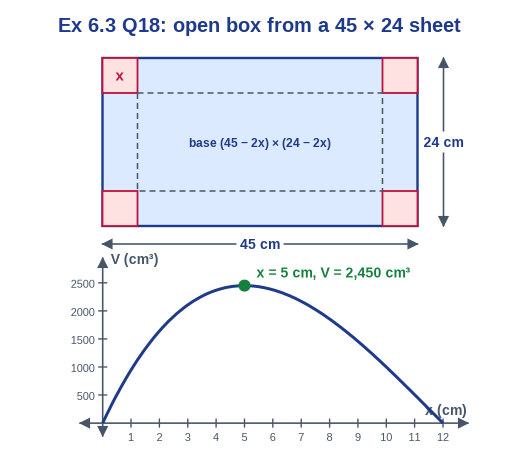
18. “A rectangular sheet of tin 45 cm by 24 cm is to be made into a box without top, by cutting off square from each corner and folding up the flaps. What should be the side of the square to be cut off so that the volume of the box is maximum ?”
With squares of side x cut off, the box is x high, (45 − 2x) long and (24 − 2x) wide, so 0 < x < 12 and
V(x) = x(45 − 2x)(24 − 2x) = 4x³ − 138x² + 1080x
V′(x) = 12x² − 276x + 1080 = 12(x² − 23x + 90) = 12(x − 5)(x − 18). Only x = 5 lies in (0, 12). V″(x) = 24x − 276, so V″(5) = −156 < 0: a maximum.
The square cut off should have side 5 cm. (The box then holds 5 × 35 × 14 = 2,450 cm³.)
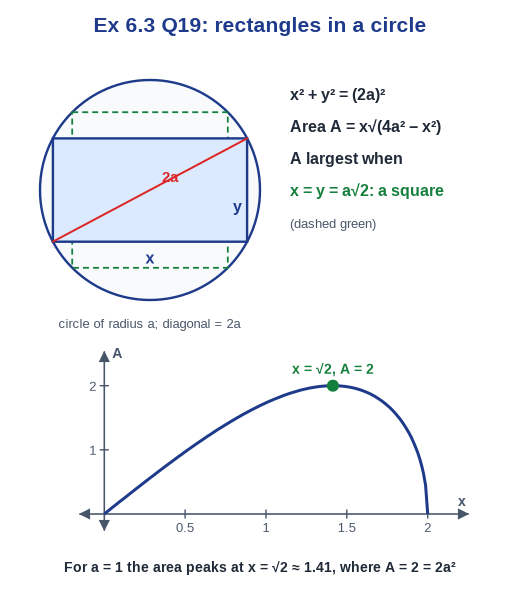
19. “Show that of all the rectangles inscribed in a given fixed circle, the square has the maximum area.”
Let the circle have radius a. A rectangle inscribed in it has its diagonal along a diameter, so its sides x and y satisfy x² + y² = 4a². Its area is A = x√(4a² − x²), for 0 < x < 2a.
A is largest when S = A² = x²(4a² − x²) = 4a²x² − x⁴ is largest. S′(x) = 8a²x − 4x³ = 4x(2a² − x²) = 0 gives x = a√2. S″(x) = 8a² − 12x², which is 8a² − 24a² = −16a² < 0 at x = a√2: a maximum.
Then y = √(4a² − 2a²) = a√2 = x. The rectangle of largest area has equal sides: it is a square.
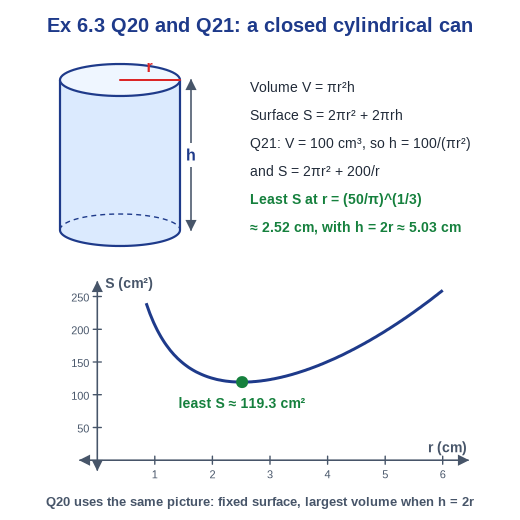
20. “Show that the right circular cylinder of given surface and maximum volume is such that its height is equal to the diameter of the base.”
Take a closed cylinder of radius r and height h with total surface S (fixed): S = 2πr² + 2πrh, so h = (S − 2πr²)/(2πr).
V = πr²h = r(S − 2πr²)/2 = (Sr − 2πr³)/2
V′(r) = (S − 6πr²)/2 = 0 gives S = 6πr². V″(r) = −6πr < 0, so V is largest there.
Then 2πrh = S − 2πr² = 6πr² − 2πr² = 4πr², so h = 2r: the height equals the diameter of the base.
21. “Of all the closed cylindrical cans (right circular), of a given volume of 100 cubic centimetres, find the dimensions of the can which has the minimum surface area?”
πr²h = 100, so h = 100/(πr²). The surface area is
S(r) = 2πr² + 2πrh = 2πr² + 200/r
S′(r) = 4πr − 200/r² = 0 gives r³ = 50/π, so r = (50/π)1/3. S″(r) = 4π + 400/r³ > 0: a minimum.
Then h = 100/(πr²) = 100r/(πr³) = 100r/50 = 2r.
Radius (50/π)1/3 cm ≈ 2.52 cm and height 2(50/π)1/3 cm ≈ 5.03 cm.
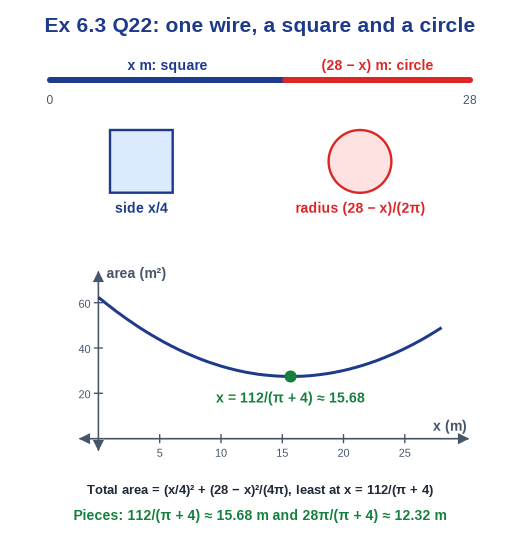
22. “A wire of length 28 m is to be cut into two pieces. One of the pieces is to be made into a square and the other into a circle. What should be the length of the two pieces so that the combined area of the square and the circle is minimum?”
Let x m make the square (side x/4) and 28 − x m make the circle (radius (28 − x)/(2π)). The total area is
A(x) = x²/16 + π[(28 − x)/(2π)]² = x²/16 + (28 − x)²/(4π)
A′(x) = x/8 − (28 − x)/(2π) = 0 gives πx = 4(28 − x), so x(π + 4) = 112 and x = 112/(π + 4). A″(x) = 1/8 + 1/(2π) > 0: a minimum.
The pieces are 112/(π + 4) m for the square and 28π/(π + 4) m for the circle (about 15.68 m and 12.32 m).
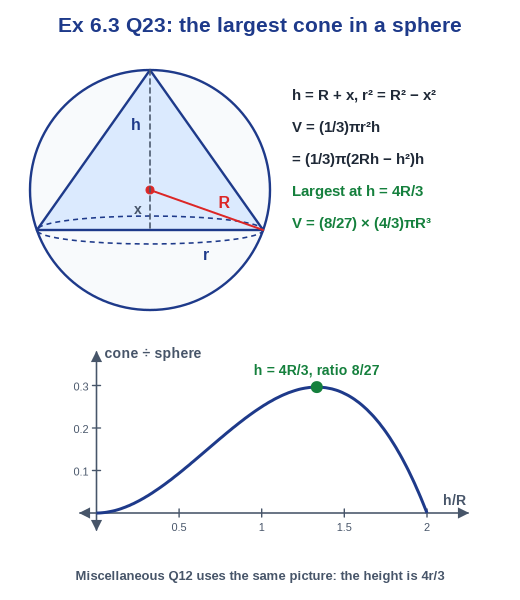
23. “Prove that the volume of the largest cone that can be inscribed in a sphere of radius R is 8/27 of the volume of the sphere.”
Let the cone’s vertex be on the sphere and its base circle be x below the centre O, as in the figure. Then the cone has height h = R + x and base radius r with r² = R² − x², for 0 ≤ x < R.
V(x) = (1/3)π(R² − x²)(R + x)
V′(x) = (1/3)π[−2x(R + x) + (R² − x²)] = (1/3)π(R + x)(R − 3x)
V′ = 0 at x = R/3; V′ > 0 before and V′ < 0 after, so V is largest there. Then h = 4R/3, r² = 8R²/9 and
V = (1/3)π(8R²/9)(4R/3) = 32πR³/81 = (8/27) × (4/3)πR³
So the largest cone has 8/27 of the volume of the sphere.
24. “Show that the right circular cone of least curved surface and given volume has an altitude equal to √2 time the radius of the base.”
- The volume V = (1/3)πr²h is fixed, so h = 3V/(πr²).
- The curved surface is C = πrl, where the slant height l satisfies l² = r² + h². C is least when C² is least (this avoids a square root).
- C² = π²r²(r² + h²) = π²r⁴ + π²r² × 9V²/(π²r⁴) = π²r⁴ + 9V²/r².
- d(C²)/dr = 4π²r³ − 18V²/r³ = 0 gives 2π²r⁶ = 9V².
- The second derivative 12π²r² + 54V²/r⁴ is positive, so this is a minimum.
- Put back 9V² = π²r⁴h²: 2π²r⁶ = π²r⁴h², so h² = 2r².
Answer: h = √2 r, the altitude is √2 times the radius.
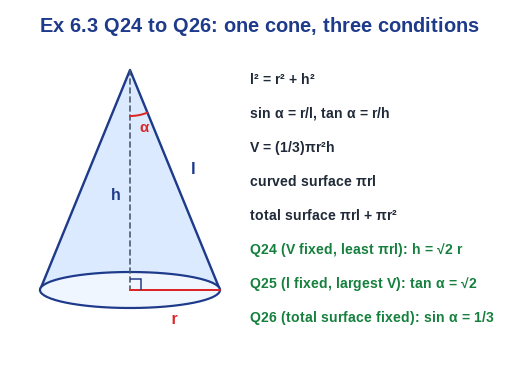
25. “Show that the semi-vertical angle of the cone of the maximum volume and of given slant height is tan−1 √2.”
Let the slant height l be fixed and the semi-vertical angle be θ. Then r = l sin θ and h = l cos θ, so
V(θ) = (1/3)πr²h = (1/3)πl³ sin² θ cos θ, for 0 < θ < π/2
V′(θ) = (1/3)πl³(2 sin θ cos² θ − sin³ θ) = (1/3)πl³ sin θ (2 cos² θ − sin² θ)
V′ = 0 when tan² θ = 2, that is, tan θ = √2. For smaller θ, 2 cos² θ > sin² θ and V′ > 0; for larger θ, V′ < 0. So V is largest when θ = tan−1 √2.
26. “Show that semi-vertical angle of right circular cone of given surface area and maximum volume is sin−1(1/3).”
Let the cone have radius r, slant height l, height h and semi-vertical angle θ (the angle between the slant side and the axis), so sin θ = r/l.
- The total surface S = πrl + πr² is fixed, so l = (S − πr²)/(πr).
- Since h² = l² − r²: h² = [(S − πr²)² − π²r⁴]/(π²r²) = (S² − 2πSr²)/(π²r²).
- V = (1/3)πr²h is largest when V² is largest: V² = (1/9)π²r⁴h² = (1/9)(S²r² − 2πSr⁴).
- d(V²)/dr = (1/9)(2S²r − 8πSr³) = 0 gives S = 4πr².
- Second derivative: (1/9)(2S² − 24πSr²) = (1/9)(2S² − 6S²) < 0 there, so V is largest.
- Then πrl = S − πr² = 3πr², so l = 3r and sin θ = r/l = 1/3.
Answer: the semi-vertical angle is sin−1(1/3).
“Choose the correct answer in Questions 27 and 29.” (Questions 27 to 29 are meant.)
27. “The point on the curve x² = 2y which is nearest to the point (0, 5) is (A) (2√2, 4) (B) (2√2, 0) (C) (0, 0) (D) (2, 2)”
A point on the curve is (x, y) with x² = 2y. Its squared distance from (0, 5) is D² = x² + (y − 5)² = 2y + (y − 5)² = y² − 8y + 25 = (y − 4)² + 9. This is least at y = 4, x² = 8, x = ±2√2, and then the distance is 3. Answer: (A) (2√2, 4).
28. “For all real values of x, the minimum value of (1 − x + x²)/(1 + x + x²) is (A) 0 (B) 1 (C) 3 (D) 1/3”
f′(x) = [(2x − 1)(x² + x + 1) − (x² − x + 1)(2x + 1)]/(x² + x + 1)² = 2(x² − 1)/(x² + x + 1)².
f′ = 0 at x = ±1; f′ goes − to + at x = 1, so f(1) = 1/3 is a minimum (f(−1) = 3 is a maximum). As x → ±∞, f → 1 > 1/3. Answer: (D) 1/3.
29. “The maximum value of [x(x − 1) + 1]1/3, 0 ≤ x ≤ 1 is (A) (1/3)1/3 (B) 1/2 (C) 1 (D) 0”
Inside the bracket is g(x) = x² − x + 1, with g′(x) = 2x − 1 = 0 at x = 1/2. g(0) = 1, g(1/2) = 3/4, g(1) = 1. The cube root is an increasing function, so the largest value of [g(x)]1/3 on [0, 1] is 11/3 = 1. Answer: (C).
Miscellaneous Examples 30 to 37 (pages 177–183)
Example 30 (page 177): a car covers x = t²(2 − t/3) metres in t seconds and stops at Q. v = dx/dt = 4t − t² = t(4 − t), which is 0 at t = 0 (start) and t = 4. So the car reaches Q after 4 s, and PQ = 16(2 − 4/3) = 32/3 m.
Example 31 (page 178): water flows at 5 m³/h into an inverted cone with semi-vertical angle tan−1(0.5); how fast does the level rise at depth 4 m? r/h = 0.5, so r = h/2 and V = (1/3)π(h/2)²h = πh³/12. dV/dt = (πh²/4) dh/dt, so 5 = 4π dh/dt and dh/dt = 5/(4π) m/h; with π = 22/7, this is 35/88 m/h.
Example 32 (pages 178–179): a man 2 m tall walks at 5 km/h away from a 6 m lamp post; how fast does his shadow grow? If he is l m from the post and his shadow is s m long, similar triangles give (l + s)/6 = s/2, so l = 2s and ds/dt = (1/2) dl/dt = 5/2 km/h.
Example 33 (pages 179–180): intervals for f(x) = (3/10)x⁴ − (4/5)x³ − 3x² + (36/5)x + 11. f′(x) = (6/5)(x − 1)(x + 2)(x − 3), zero at −2, 1, 3. f is decreasing on (−∞, −2) and (1, 3) and increasing on (−2, 1) and (3, ∞).
Example 34 (pages 180–181): f(x) = tan−1(sin x + cos x) is increasing on (0, π/4). f′(x) = (cos x − sin x)/[1 + (sin x + cos x)²] = (cos x − sin x)/(2 + sin 2x). On (0, π/4), 2 + sin 2x > 0 and cos x > sin x, so f′ > 0: f is increasing.
Example 35 (page 181): a heated disc’s radius grows at 0.05 cm/s; area rate at r = 3.2 cm. dA/dt = 2πr dr/dt = 2π(3.2)(0.05) = 0.32π cm²/s.
Example 36 (pages 181–182): the largest open box from a 3 m by 8 m sheet. V(x) = x(3 − 2x)(8 − 2x) = 4x³ − 22x² + 24x. V′(x) = 12x² − 44x + 24 = 4(x − 3)(3x − 2). x = 3 is impossible (3 − 2x would be negative), so x = 2/3; V″(2/3) = 24(2/3) − 44 = −28 < 0. The largest volume is V(2/3) = 200/27 m³.
Example 37 (pages 182–183): x items sell at ₹(5 − x/100) each and cost ₹(x/5 + 500) in all; the number for the largest profit. P(x) = x(5 − x/100) − (x/5 + 500) = (24/5)x − x²/100 − 500. P′(x) = 24/5 − x/50 = 0 gives x = 240, and P″ = −1/50 < 0. He should sell 240 items.
Miscellaneous Exercise on Chapter 6 (pages 183–185)
The answer key prints answers for Questions 2, 3, 4, 5, 6, 8, 10, 11, 14 and 16 of this exercise (the last six on page 222), and the answers below agree with all of them. Questions 1, 7, 9, 12, 13 and 15 are “show” or “prove” questions with no printed answer; those answers are our own, each checked by script.
1. “Show that the function given by f(x) = (log x)/x has maximum at x = e.”
For x > 0, f′(x) = [x(1/x) − log x]/x² = (1 − log x)/x². f′(x) = 0 when log x = 1, that is, x = e. For x < e, log x < 1 and f′ > 0; for x > e, f′ < 0. So f changes from increasing to decreasing at x = e: f has its maximum at x = e, with value 1/e.
2. “The two equal sides of an isosceles triangle with fixed base b are decreasing at the rate of 3 cm per second. How fast is the area decreasing when the two equal sides are equal to the base ?”
Let each equal side be a. The height on the base is √(a² − b²/4), so the area is A = (b/2)√(a² − b²/4) = (b/4)√(4a² − b²).
dA/dt = (b/4) × 4a/√(4a² − b²) × da/dt = [ab/√(4a² − b²)] da/dt
With da/dt = −3 and a = b: dA/dt = (−3)b²/(√3 b) = −√3 b.
The area is decreasing at √3 b cm²/s.
3. “Find the intervals in which the function f given by f(x) = (4 sin x − 2x − x cos x)/(2 + cos x) is (i) increasing (ii) decreasing.”
Since 2x + x cos x = x(2 + cos x), f(x) = 4 sin x/(2 + cos x) − x. Exactly as in Exercise 6.2 Q9,
f′(x) = cos x (4 − cos x)/(2 + cos x)²
Here 4 − cos x > 0 and (2 + cos x)² > 0, so f′ has the sign of cos x. Taking x in [0, 2π], as the key does:
(i) increasing for 0 ≤ x ≤ π/2 and 3π/2 < x < 2π (where cos x > 0);
(ii) decreasing for π/2 < x < 3π/2 (where cos x < 0).
(The question names no interval. On all of R, the same rule holds on every period: f increases where cos x > 0 and decreases where cos x < 0.)
4. “Find the intervals in which the function f given by f(x) = x³ + 1/x³, x ≠ 0 is (i) increasing (ii) decreasing.”
f′(x) = 3x² − 3/x⁴ = 3(x⁶ − 1)/x⁴. Here x⁴ > 0, and x⁶ − 1 > 0 exactly when |x| > 1.
(i) Increasing for x < −1 and x > 1. (ii) Decreasing for −1 < x < 1 (x ≠ 0).
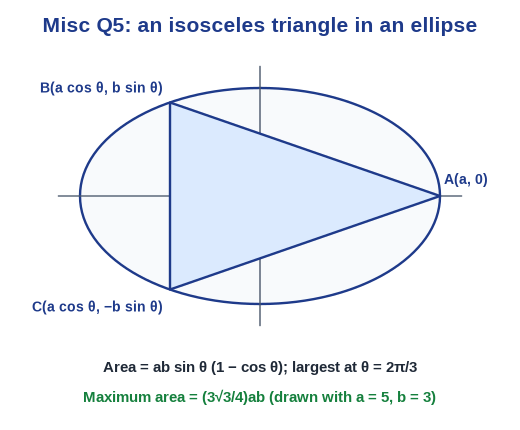
5. “Find the maximum area of an isosceles triangle inscribed in the ellipse x²/a² + y²/b² = 1 with its vertex at one end of the major axis.”
Take the vertex A(a, 0). The base is a chord at right angles to the major axis, with ends B(a cos θ, b sin θ) and C(a cos θ, −b sin θ), 0 < θ < π. The base is 2b sin θ and the height is a − a cos θ, so
A(θ) = (1/2)(2b sin θ)(a − a cos θ) = ab sin θ (1 − cos θ)
A′(θ) = ab[cos θ − cos² θ + sin² θ] = ab(cos θ − cos 2θ) = ab(1 − cos θ)(2 cos θ + 1), using cos 2θ = 2cos² θ − 1.
A′ = 0 at cos θ = −1/2, θ = 2π/3; A′ > 0 before and A′ < 0 after. The maximum area is
A(2π/3) = ab(√3/2)(1 + 1/2) = (3√3/4)ab.
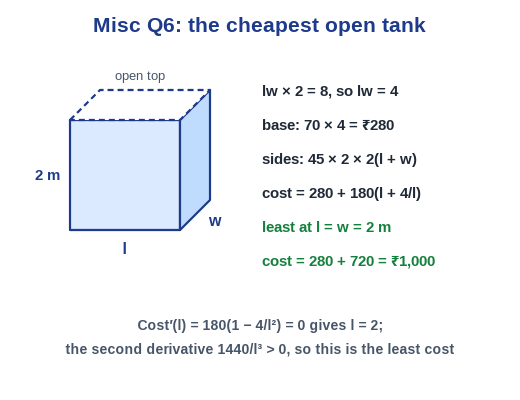
6. “A tank with rectangular base and rectangular sides, open at the top is to be constructed so that its depth is 2 m and volume is 8 m³. If building of tank costs Rs 70 per sq metres for the base and Rs 45 per square metre for sides. What is the cost of least expensive tank?”
Let the base be l m by w m. 2lw = 8, so lw = 4 and w = 4/l. The base costs 70 × 4 = ₹280. The four sides have area 2 × 2l + 2 × 2w = 4(l + w), costing 45 × 4(l + w) = 180(l + w). So
Cost(l) = 280 + 180(l + 4/l)
Cost′(l) = 180(1 − 4/l²) = 0 gives l = 2 (l > 0), and Cost″(l) = 1440/l³ > 0: a minimum. Then w = 2 and the cost is 280 + 180 × 4 = ₹1,000.
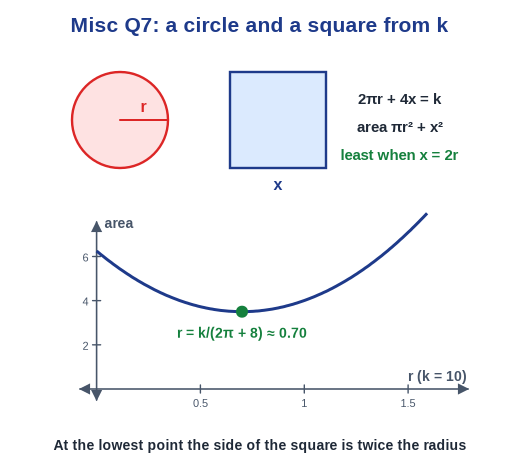
7. “The sum of the perimeter of a circle and square is k, where k is some constant. Prove that the sum of their areas is least when the side of square is double the radius of the circle.”
Let the circle have radius r and the square side x: 2πr + 4x = k, so x = (k − 2πr)/4. The total area is
A(r) = πr² + x² = πr² + (k − 2πr)²/16
A′(r) = 2πr − (π/4)(k − 2πr) = 2πr − πx = 0 gives x = 2r. A″(r) = 2π + π²/2 > 0, so the area is least. Hence the sum of the areas is least when the side of the square is double the radius.
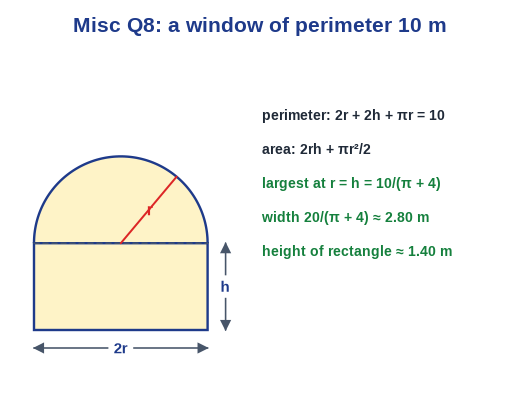
8. “A window is in the form of a rectangle surmounted by a semicircular opening. The total perimeter of the window is 10 m. Find the dimensions of the window to admit maximum light through the whole opening.”
Let the rectangle be 2r wide (so the semicircle has radius r) and h high. The perimeter is 2r + 2h + πr = 10, so h = [10 − (π + 2)r]/2. The light depends on the area:
A(r) = 2rh + πr²/2 = 10r − (π + 2)r² + πr²/2 = 10r − (π/2 + 2)r²
A′(r) = 10 − (π + 4)r = 0 gives r = 10/(π + 4), and A″ = −(π + 4) < 0: a maximum. Then h = [10(π + 4) − 10(π + 2)]/[2(π + 4)] = 10/(π + 4).
The window is 20/(π + 4) m wide (about 2.80 m), and the rectangular part is 10/(π + 4) m high (about 1.40 m), with a semicircle of radius 10/(π + 4) m on top.
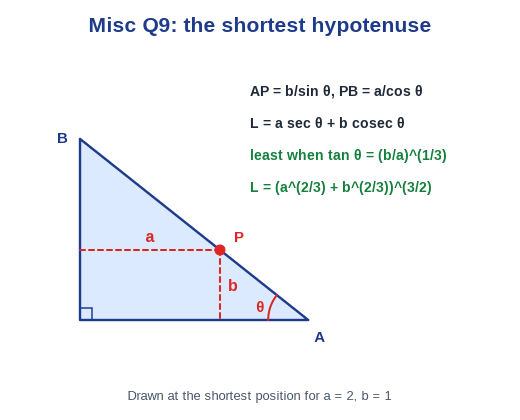
9. “A point on the hypotenuse of a triangle is at distance a and b from the sides of the triangle. Show that the minimum length of the hypotenuse is (a2/3 + b2/3)3/2.”
The triangle is right-angled (it has a hypotenuse). Let P on the hypotenuse AB be at distance b from side CA and a from side CB, and let θ be the angle at A, as in the figure. Then AP = b/sin θ and PB = a/cos θ, so
L(θ) = a sec θ + b cosec θ, for 0 < θ < π/2
L′(θ) = a sec θ tan θ − b cosec θ cot θ = 0 gives a sin θ/cos² θ = b cos θ/sin² θ, so tan³ θ = b/a and tan θ = (b/a)1/3.
L grows without limit as θ → 0 or θ → π/2, and this is its only critical point, so it gives the minimum. With tan θ = b1/3/a1/3:
sec θ = √(a2/3 + b2/3)/a1/3 and cosec θ = √(a2/3 + b2/3)/b1/3
L = a2/3√(a2/3 + b2/3) + b2/3√(a2/3 + b2/3) = (a2/3 + b2/3)3/2.
10. “Find the points at which the function f given by f(x) = (x − 2)⁴ (x + 1)³ has (i) local maxima (ii) local minima (iii) point of inflexion”
f′(x) = 4(x − 2)³(x + 1)³ + 3(x − 2)⁴(x + 1)² = (x − 2)³(x + 1)²[4(x + 1) + 3(x − 2)] = (x − 2)³(x + 1)²(7x − 2).
Zeros: x = −1, 2/7, 2. Since (x + 1)² ≥ 0, the sign of f′ is that of (x − 2)³(7x − 2):
| Interval | (x − 2)³ | 7x − 2 | f′ |
|---|---|---|---|
| x < −1 | − | − | + |
| −1 < x < 2/7 | − | − | + |
| 2/7 < x < 2 | − | + | − |
| x > 2 | + | + | + |
(i) Local maximum at x = 2/7 (+ to −), value (−12/7)⁴(9/7)³ = 15116544/823543 ≈ 18.36.
(ii) Local minimum at x = 2 (− to +), value 0.
(iii) Point of inflexion at x = −1 (f′ = 0 but + on both sides).
11. “Find the absolute maximum and minimum values of the function f given by f(x) = cos² x + sin x, x ∈ [0, π]”
f′(x) = −2 sin x cos x + cos x = cos x (1 − 2 sin x). In [0, π], cos x = 0 at x = π/2, and sin x = 1/2 at x = π/6 and 5π/6.
f(0) = 1, f(π/6) = 3/4 + 1/2 = 5/4, f(π/2) = 0 + 1 = 1, f(5π/6) = 5/4, f(π) = 1.
Absolute maximum 5/4 (at x = π/6 and 5π/6); absolute minimum 1 (at x = 0, π/2 and π).
12. “Show that the altitude of the right circular cone of maximum volume that can be inscribed in a sphere of radius r is 4r/3.”
This is Exercise 6.3 Q23 with the sphere’s radius called r. With the base circle x below the centre, the cone has height r + x and base radius √(r² − x²), and V(x) = (1/3)π(r² − x²)(r + x). V′(x) = (1/3)π(r + x)(r − 3x) = 0 gives x = r/3, with V′ changing from + to −. So the altitude of the largest cone is r + r/3 = 4r/3.
13. “Let f be a function defined on [a, b] such that f′(x) > 0, for all x ∈ (a, b). Then prove that f is an increasing function on (a, b).”
Take any x₁ < x₂ in (a, b). f is differentiable on (a, b), so it is continuous on [x₁, x₂] and differentiable on (x₁, x₂). By the Mean Value Theorem there is a c in (x₁, x₂) with
f(x₂) − f(x₁) = f′(c)(x₂ − x₁)
Here f′(c) > 0 and x₂ − x₁ > 0, so f(x₂) − f(x₁) > 0, that is, f(x₁) < f(x₂). This holds for every pair x₁ < x₂ in (a, b), so f is increasing on (a, b).
14. “Show that the height of the cylinder of maximum volume that can be inscribed in a sphere of radius R is 2R/√3. Also find the maximum volume.”
Let the cylinder have height h, so its radius ρ satisfies ρ² + (h/2)² = R², that is, ρ² = R² − h²/4. Then
V(h) = πρ²h = π(R²h − h³/4), for 0 < h < 2R
V′(h) = π(R² − 3h²/4) = 0 gives h = 2R/√3, and V″(h) = −(3/2)πh < 0: a maximum. The height is 2R/√3, and the maximum volume is
V = π(R² − R²/3)(2R/√3) = π(2R²/3)(2R/√3) = 4πR³/(3√3).
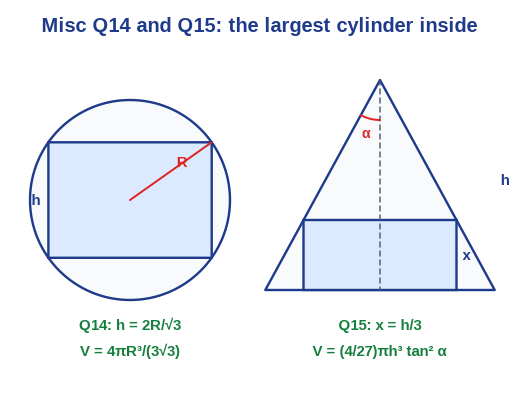
15. “Show that height of the cylinder of greatest volume which can be inscribed in a right circular cone of height h and semi vertical angle α is one-third that of the cone and the greatest volume of cylinder is (4/27)πh³ tan² α.”
Let the cylinder have height x. Its top circle is h − x below the vertex, so its radius is (h − x) tan α. Then
V(x) = π(h − x)² tan² α × x, for 0 < x < h
V′(x) = π tan² α [(h − x)² − 2x(h − x)] = π tan² α (h − x)(h − 3x)
V′ = 0 at x = h/3 in (0, h), with V′ > 0 before and V′ < 0 after: a maximum. So the height is h/3, one-third of the cone’s, and the greatest volume is
V = π(2h/3)² tan² α × (h/3) = (4/27)πh³ tan² α.
16. “A cylindrical tank of radius 10 m is being filled with wheat at the rate of 314 cubic metre per hour. Then the depth of the wheat is increasing at the rate of (A) 1 m/h (B) 0.1 m/h (C) 1.1 m/h (D) 0.5 m/h”
V = π(10)²h = 100πh, so dV/dt = 100π dh/dt = 314 and dh/dt = 314/(100π) = 3.14/π ≈ 1 m/h (with π ≈ 3.14). Answer: (A).
Notes on the book
- The rationalised chapter has no section or exercise on tangents and normals or on approximations, although its first paragraph (page 147) still lists them.
- Some cross-references point to the older book’s numbering: page 162 says “Example 27” for the |x| example (Example 15), page 165 says “Example 30” for Example 18, page 168 says “Example 34” for Example 22, page 169 says “Example 35” for Example 23, and page 164 says “Fig 6.14(b)” where Fig 6.12(b) is meant. Example 21 repeats Example 18’s function on purpose, to show the second derivative test failing.
- The Summary on page 185 defines “increasing” with f(x₁) < f(x₂), while Definition 1 on page 152 uses f(x₁) ≤ f(x₂) and keeps the strict sign for “strictly increasing”. These solutions follow Definition 1.
Practice
-
The edge of a cube grows at 2 cm/s. When the edge is 5 cm, its volume grows at:
Show answer
Answer: (b) 150 cm³/s
-
f(x) = x³ − 27x is decreasing on:
Show answer
Answer: (a) (−3, 3)
-
The local maximum value of f(x) = −x² + 6x − 4 is:
Show answer
Answer: (b) 5
-
On [0, 2], what are the greatest and least values of f(x) = x³ − 3x + 2?
Show answer
Answer: f′(x) = 3x² − 3 = 3(x − 1)(x + 1). Only x = 1 lies in [0, 2]. f(0) = 2, f(1) = 0, f(2) = 4. The absolute maximum is 4 at x = 2 and the absolute minimum is 0 at x = 1.
-
Two positive numbers add up to 20. Which pair gives the largest product?
Show answer
Answer: Let the numbers be x and 20 − x. P(x) = x(20 − x) = 20x − x². P′(x) = 20 − 2x = 0 gives x = 10, and P″(x) = −2 < 0, so P is largest there. The numbers are 10 and 10.
Stuck on a question?
Take a photo and Lagnever AI explains it step by step. Try it for 7 days for ₹2.
Get it on Google Play Open in browser
For parents: after the trial, the plan renews monthly by UPI or card autopay. You can cancel anytime in the app.