
Class 12 Maths Chapter 6: Application of Derivatives Notes
This chapter in five lines
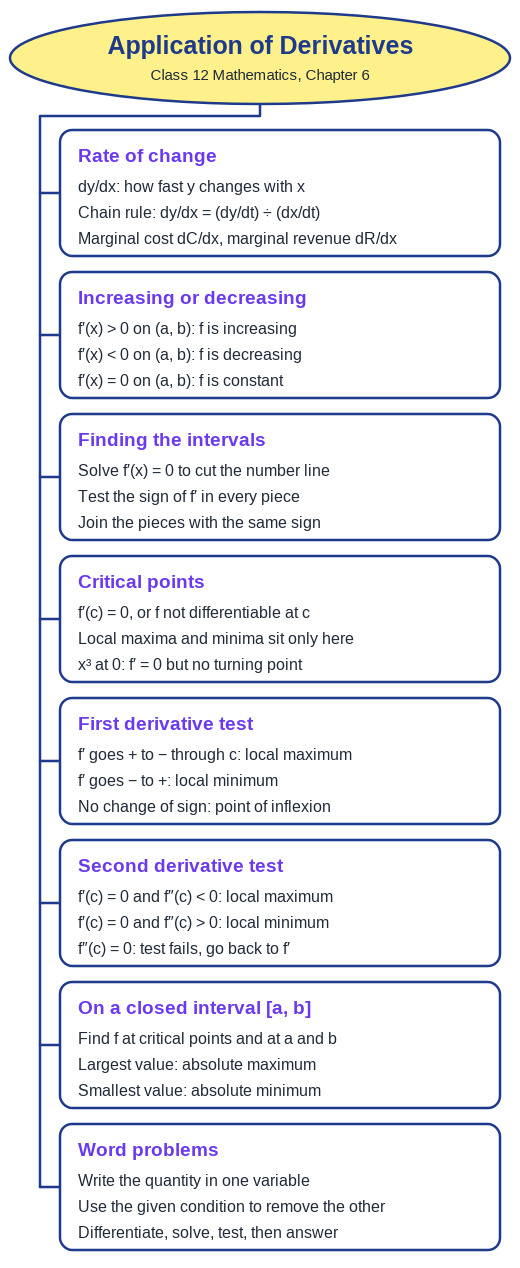
The derivative dy/dx is the rate at which y changes with x. Its sign tells where a function rises (f′ > 0) or falls (f′ < 0). Turning points sit where f′(c) = 0 or f′ does not exist; the first or second derivative test says whether each is a local maximum or minimum. On [a, b], compare f at those points and at a and b.
What is this chapter about?
Chapter 5, Continuity and Differentiability, taught how to find derivatives. This chapter puts them to work. A derivative tells how fast one quantity changes with another, whether a function rises or falls, and where a graph turns. That turns into answers to practical questions: how fast a ripple’s area grows, how large a box can be made from a sheet of tin, or how to fence the largest garden with a given length of wire.
Two jobs that older books did in this chapter, tangents and normals and approximations, are not in the 2026-27 book. The opening lines still name them, but there is no section or exercise on them, so these notes leave them out.
Rate of change of quantities
If y = f(x), then dy/dx (or f′(x)) is the rate of change of y with respect to x, and f′(x₀) is that rate at x = x₀. When x and y both change with time t, the chain rule links the rates:
dy/dx = (dy/dt) ÷ (dx/dt), as long as dx/dt ≠ 0
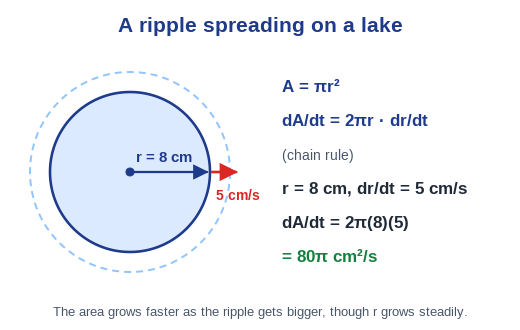
A positive rate means the quantity grows; a negative one means it shrinks. For a circle, A = πr², so dA/dt = 2πr · dr/dt. A ripple of radius 8 cm spreading at 5 cm/s has its area growing at 2π(8)(5) = 80π cm²/s.
In business problems, how fast the total cost C(x) changes as output x grows is the marginal cost, C′(x), and how fast the total revenue R(x) changes is the marginal revenue, R′(x). More examples: rate of change of quantities.
Increasing and decreasing functions
A function f is increasing on an interval I if x₁ < x₂ in I always gives f(x₁) ≤ f(x₂), and strictly increasing if it always gives f(x₁) < f(x₂). Decreasing and strictly decreasing are defined the same way with the inequality turned round. Moving left to right, an increasing graph never goes down.
The derivative does the checking for us (Theorem 1 of the chapter). Let f be continuous on [a, b] and differentiable on (a, b):
- f′(x) > 0 for every x in (a, b): f is increasing on [a, b].
- f′(x) < 0 for every x in (a, b): f is decreasing on [a, b].
- f′(x) = 0 for every x in (a, b): f is constant on [a, b].
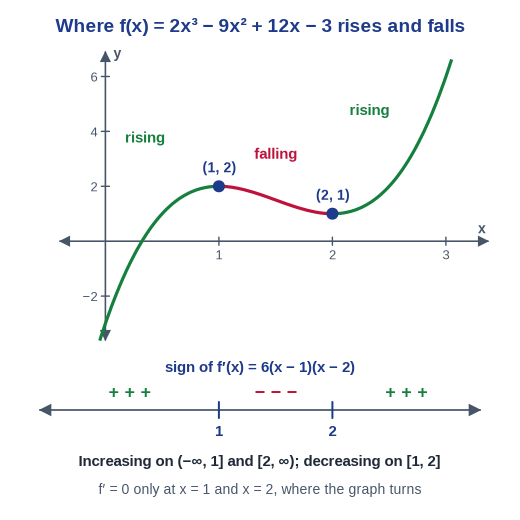
To find the intervals, solve f′(x) = 0, use those points to cut the number line, and test the sign of f′ in each piece. For f(x) = 2x³ − 9x² + 12x − 3, f′(x) = 6(x − 1)(x − 2): f increases on (−∞, 1] and [2, ∞) and decreases on [1, 2]. Full method: increasing and decreasing functions.
Maxima and minima
A point c is a point of local maxima if f(c) ≥ f(x) for every x near c, and of local minima if f(c) ≤ f(x) for every x near c. If f has a local maximum or minimum at c, then f′(c) = 0 or f is not differentiable at c. Such points are critical points. The reverse fails: f(x) = x³ has f′(0) = 0 but no turning point at 0.
- First derivative test. If f′ changes from + to − as x passes c, c is a point of local maxima; from − to +, local minima; with no change of sign, c is a point of inflexion.
- Second derivative test. If f′(c) = 0 and f″(c) < 0, local maximum; if f″(c) > 0, local minimum; if f″(c) = 0, the test fails and we go back to the first test.
For our cubic, f″(x) = 12x − 18, so f″(1) = −6 < 0 gives the local maximum f(1) = 2 and f″(2) = 6 > 0 gives the local minimum f(2) = 1.
Absolute maximum and minimum on a closed interval
A continuous function on a closed interval [a, b] always has a greatest and a least value. To find them: list the critical points inside [a, b], add the end points a and b, work out f at all of them, and pick the largest (absolute maximum) and smallest (absolute minimum). For f(x) = x³ − 3x² on [−1, 4], the values at −1, 0, 2 and 4 are −4, 0, −4 and 16, so the absolute maximum is 16 and the absolute minimum is −4.
Word problems follow one plan: write the quantity to be made largest or smallest in terms of one variable, find its critical points, test them, and answer the question that was asked. Worked examples: maxima and minima.
Before we move on
This is the rationalised book (marked Reprint 2026-27). It has Exercise 6.1 (18 questions), Exercise 6.2 (19), Exercise 6.3 (29) and a Miscellaneous Exercise of 16 questions, with 37 worked examples. The chapter quotes the Mean Value Theorem from Chapter 5 to prove the increasing–decreasing test, and states the other theorems without proof. Every example and exercise is worked out in the NCERT solutions for Chapter 6.
Key terms
| Term | Meaning |
|---|---|
| Rate of change | dy/dx, the rate at which y changes with respect to x. Its value at x = x₀ is the rate at that instant or point. |
| Chain rule for rates | If x and y both depend on t, then dy/dx = (dy/dt) ÷ (dx/dt), provided dx/dt ≠ 0. |
| Marginal cost and marginal revenue | How fast total cost C(x) or total revenue R(x) changes, at a given output, as the number of units x changes: C′(x) and R′(x). |
| Increasing function | f is increasing on I if x₁ < x₂ in I gives f(x₁) ≤ f(x₂). If it always gives f(x₁) < f(x₂), f is strictly increasing. |
| Decreasing function | f is decreasing on I if x₁ < x₂ in I gives f(x₁) ≥ f(x₂); strictly decreasing if it always gives f(x₁) > f(x₂). |
| Critical point | A point c in the domain where f′(c) = 0 or f is not differentiable. Local maxima and minima can occur only at such points. |
| Local maximum and local minimum | c is a point of local maxima if f(c) ≥ f(x) for all x close to c, and of local minima if f(c) ≤ f(x) for all x close to c. f(c) is the local maximum or minimum value. |
| Point of inflexion | A critical point where f′ does not change sign, so the point is neither a local maximum nor a local minimum. Example: x = 0 for f(x) = x³. |
| First derivative test | If f′ changes from + to − as x passes c, c is a local maximum; from − to +, a local minimum; no change, neither. |
| Second derivative test | If f′(c) = 0 and f″(c) < 0, c is a local maximum; if f″(c) > 0, a local minimum; if f″(c) = 0, the test fails. |
| Absolute maximum and minimum | The greatest and least values of f on a whole interval. A continuous f on a closed interval [a, b] always has both. |
Topics in this chapter
Practice
-
The radius of a circle grows at 2 cm/s. When r = 5 cm, its area grows at:
Show answer
Answer: (b) 20π cm²/s
-
f(x) = x² − 6x + 1 is decreasing on:
Show answer
Answer: (b) (−∞, 3)
-
For f(x) = x³ − 12x, the point of local minima is:
Show answer
Answer: (c) x = 2
-
If f′(c) = 0 and f″(c) = 0, then:
Show answer
Answer: (d) the second derivative test gives no answer
-
The absolute maximum of f(x) = x² on [−3, 2] is:
Show answer
Answer: (b) 9
Questions students ask
What are the main topics of Class 12 Maths Chapter 6?
Rate of change of quantities, increasing and decreasing functions, and maxima and minima: critical points, the first and second derivative tests, absolute maximum and minimum on a closed interval and applied problems. The chapter has Exercises 6.1 to 6.3 and a Miscellaneous Exercise.
Are tangents, normals and approximations in the 2026-27 book?
No. The chapter's opening lines still mention tangents and normals and approximate values, but the rationalised chapter has no section and no exercise on them. Its sections are 6.2 Rate of Change, 6.3 Increasing and Decreasing Functions and 6.4 Maxima and Minima.
What is the difference between a local maximum and the absolute maximum?
A local maximum is highest only among nearby points: a little hill. The absolute maximum is the greatest value on the whole interval. On a closed interval it can be at an end point, where there is no hill at all, as with x² on [−3, 2] at x = −3.
Which test should I use, the first or the second derivative test?
The second derivative test is quicker when f″ is easy to find and not zero at c. Use the first derivative test when f″(c) = 0, when f is not differentiable at c (such as |x| at 0), or when the sign of f′ is easy to read from its factors.
Stuck on a question?
Take a photo and Lagnever AI explains it step by step. Try it for 7 days for ₹2.
Get it on Google Play Open in browser
For parents: after the trial, the plan renews monthly by UPI or card autopay. You can cancel anytime in the app.