
Class 12 Maths Chapter 6: Application of Derivatives Notes Hinglish mein
Ye chapter 5 lines mein
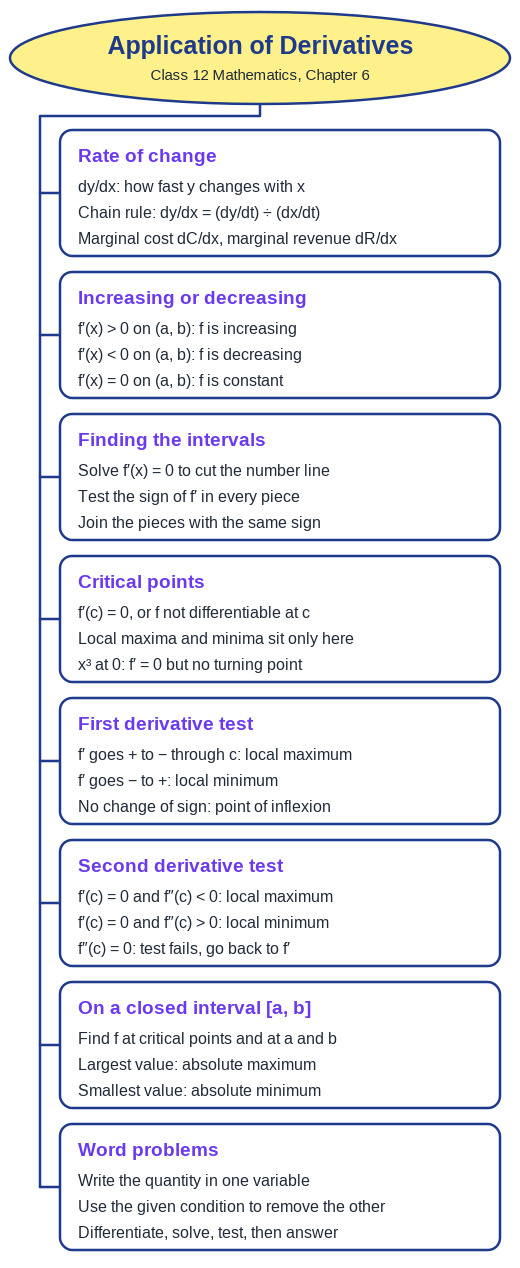
Derivative dy/dx batata hai ki x ke saath y kitni tezi se badalta hai. Iska sign batata hai function kahan badhta hai (f′ > 0) aur kahan ghatta hai (f′ < 0). Turning points wahan hote hain jahan f′(c) = 0 ho ya f′ exist na kare; first ya second derivative test batata hai ki wo local maximum hai ya minimum. [a, b] par un points aur a, b par f compare karo.
Ye chapter kis baare mein hai?
Chapter 5, Continuity and Differentiability, ne derivatives nikaalna sikhaya. Ye chapter unhe kaam mein lagata hai. Derivative batata hai ki ek quantity doosri ke saath kitni tezi se badalti hai, function badh raha hai ya ghat raha hai, aur graph kahan mudta hai. Isse practical sawalon ke jawab milte hain: lehar ka area kitni tezi se badhta hai, tin ki sheet se kitna bada dabba ban sakta hai, ya diye gaye taar se sabse bada garden kaise ghera jaye.
Purani books is chapter mein do aur kaam karti thi, tangents aur normals, aur approximations. Ye 2026-27 ki book mein nahi hain. Pehli lines mein inka naam hai, par koi section ya exercise nahi, isliye ye notes inhe chhod dete hain.
Quantities ki rate of change
Agar y = f(x) ho, to dy/dx (ya f′(x)) x ke saath y ki rate of change hai, aur f′(x₀) x = x₀ par wo rate hai. Jab x aur y dono time t ke saath badalte hain, to chain rule rates ko jodta hai:
dy/dx = (dy/dt) ÷ (dx/dt), jab tak dx/dt ≠ 0 ho
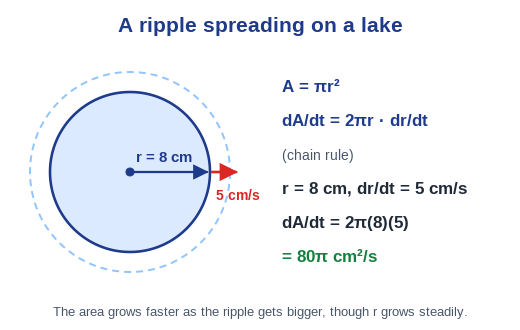
Positive rate matlab quantity badh rahi hai; negative matlab ghat rahi hai. Circle ke liye A = πr², to dA/dt = 2πr · dr/dt. 8 cm radius ki lehar 5 cm/s se phail rahi ho to uska area 2π(8)(5) = 80π cm²/s se badhta hai.
Business ke sawalon mein output x ke saath total cost C(x) ki rate of change marginal cost C′(x) hai, aur total revenue R(x) ki rate marginal revenue R′(x). Aur examples: rate of change kaise nikaalein.
Increasing aur decreasing functions
Interval I par x₁ < x₂ se hamesha f(x₁) ≤ f(x₂) mile to f increasing hai, aur hamesha f(x₁) < f(x₂) mile to strictly increasing. Decreasing aur strictly decreasing isi tarah, inequality ulti karke. Left se right chalte hue increasing graph kabhi neeche nahi jaata.
Ye jaanch derivative kar deta hai (chapter ka Theorem 1). Maan lo f [a, b] par continuous aur (a, b) par differentiable hai:
- (a, b) ke har x par f′(x) > 0: f [a, b] par increasing hai.
- (a, b) ke har x par f′(x) < 0: f [a, b] par decreasing hai.
- (a, b) ke har x par f′(x) = 0: f [a, b] par constant hai.
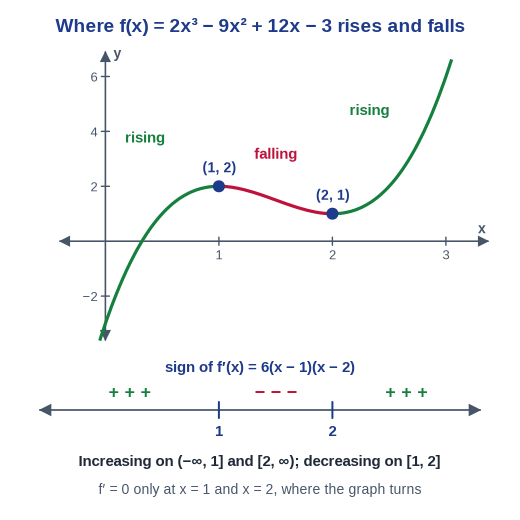
Intervals nikaalne ke liye f′(x) = 0 hal karo, un points se number line kaato, aur har tukde mein f′ ka sign dekho. f(x) = 2x³ − 9x² + 12x − 3 ke liye f′(x) = 6(x − 1)(x − 2): f (−∞, 1] aur [2, ∞) par badhta hai aur [1, 2] par ghatta hai. Poora tareeka: increasing aur decreasing functions.
Maxima aur minima
Point c local maxima ka point hai agar c ke paas ke har x ke liye f(c) ≥ f(x) ho, aur local minima ka agar f(c) ≤ f(x) ho. Agar c par f ka local maximum ya minimum ho, to f′(c) = 0 hoga ya f c par differentiable nahi hoga. Aise points critical points hain. Ulta sach nahi: f(x) = x³ mein f′(0) = 0 hai par 0 par koi mod nahi.
- First derivative test. x ke c se guzarte hue f′ + se − ho to c local maxima ka point; − se + ho to local minima; sign na badle to c point of inflexion hai.
- Second derivative test. f′(c) = 0 aur f″(c) < 0 ho to local maximum; f″(c) > 0 ho to local minimum; f″(c) = 0 ho to test fail, first test par wapas jao.
Hamare cubic ke liye f″(x) = 12x − 18, to f″(1) = −6 < 0 se local maximum f(1) = 2, aur f″(2) = 6 > 0 se local minimum f(2) = 1 milta hai.
Closed interval par absolute maximum aur minimum
Closed interval [a, b] par continuous function ki hamesha ek sabse badi aur ek sabse chhoti value hoti hai. Inhe nikaalne ke liye: [a, b] ke andar ke critical points likho, end points a aur b jodo, sab par f nikaalo, aur sabse badi (absolute maximum) aur sabse chhoti (absolute minimum) chuno. [−1, 4] par f(x) = x³ − 3x² ke liye −1, 0, 2 aur 4 par values −4, 0, −4 aur 16 hain, to absolute maximum 16 aur absolute minimum −4 hai.
Word problems ek hi plan se chalte hain: jis quantity ko sabse bada ya chhota karna hai use ek variable mein likho, uske critical points nikaalo, unhe test karo, aur poocha gaya jawab do. Hal kiye examples: maxima aur minima kaise nikaalein.
Aage badhne se pehle
Ye rationalised book hai (Reprint 2026-27 likha hai). Ismein Exercise 6.1 (18 sawal), Exercise 6.2 (19), Exercise 6.3 (29) aur 16 sawalon ki Miscellaneous Exercise hai, saath mein 37 worked examples. Increasing–decreasing test ka proof Chapter 5 ke Mean Value Theorem se hota hai, aur baaki theorems bina proof ke diye gaye hain. Har example aur exercise Chapter 6 ke NCERT solutions mein hal kiya gaya hai.
Key terms (zaroori shabd)
| Term | Matlab |
|---|---|
| Rate of change | dy/dx, yaani x ke saath y ke badalne ki rate. x = x₀ par iski value us point ki rate hai. |
| Rates ke liye chain rule | Agar x aur y dono t par depend karein, to dy/dx = (dy/dt) ÷ (dx/dt), jab dx/dt ≠ 0 ho. |
| Marginal cost aur marginal revenue | Units x ke saath total cost C(x) ya total revenue R(x) ke badalne ki instantaneous rate: C′(x) aur R′(x). |
| Increasing function | I par x₁ < x₂ se hamesha f(x₁) ≤ f(x₂) mile to f increasing hai. Hamesha f(x₁) < f(x₂) mile to strictly increasing. |
| Decreasing function | I par x₁ < x₂ se f(x₁) ≥ f(x₂) mile to f decreasing hai; hamesha f(x₁) > f(x₂) mile to strictly decreasing. |
| Critical point | Domain ka wo point c jahan f′(c) = 0 ho ya f differentiable na ho. Local maxima aur minima sirf aise points par ho sakte hain. |
| Local maximum aur local minimum | c ke paas ke saare x ke liye f(c) ≥ f(x) ho to c local maxima ka point hai, f(c) ≤ f(x) ho to local minima ka. f(c) local maximum ya minimum value hai. |
| Point of inflexion | Wo critical point jahan f′ ka sign nahi badalta, isliye wahan na local maximum hai na minimum. Example: f(x) = x³ ke liye x = 0. |
| First derivative test | c se guzarte hue f′ + se − ho jaye to c local maximum, − se + ho to local minimum, sign na badle to dono nahi. |
| Second derivative test | f′(c) = 0 aur f″(c) < 0 ho to local maximum; f″(c) > 0 ho to local minimum; f″(c) = 0 ho to test fail. |
| Absolute maximum aur minimum | Poore interval par f ki sabse badi aur sabse chhoti value. Closed interval [a, b] par continuous f ke dono hamesha hote hain. |
Is chapter ke topics
Practice karo
-
Circle ka radius 2 cm/s se badh raha hai. r = 5 cm par uska area kis rate se badhta hai?
Jawab dekho
Jawab: (b) 20π cm²/s
-
f(x) = x² − 6x + 1 kahan decreasing hai?
Jawab dekho
Jawab: (b) (−∞, 3)
-
f(x) = x³ − 12x ka local minima ka point hai:
Jawab dekho
Jawab: (c) x = 2
-
Agar f′(c) = 0 aur f″(c) = 0 ho, to:
Jawab dekho
Jawab: (d) second derivative test koi jawab nahi deta
-
[−3, 2] par f(x) = x² ka absolute maximum hai:
Jawab dekho
Jawab: (b) 9
Students ke sawal
Class 12 Maths Chapter 6 ke main topics kya hain?
Quantities ki rate of change, increasing aur decreasing functions, aur maxima-minima: critical points, first aur second derivative tests, closed interval par absolute maximum aur minimum, aur applied problems. Chapter mein Exercise 6.1 se 6.3 aur ek Miscellaneous Exercise hai.
Kya tangents, normals aur approximations 2026-27 ki book mein hain?
Nahi. Chapter ki pehli lines mein tangents, normals aur approximate values ka naam abhi bhi hai, par rationalised chapter mein inka koi section ya exercise nahi hai. Iske sections 6.2 Rate of Change, 6.3 Increasing and Decreasing Functions aur 6.4 Maxima and Minima hain.
Local maximum aur absolute maximum mein kya fark hai?
Local maximum sirf aas-paas ke points mein sabse bada hota hai: ek chhoti pahadi. Absolute maximum poore interval ki sabse badi value hai. Closed interval par ye end point par bhi ho sakta hai jahan koi pahadi nahi hoti, jaise [−3, 2] par x² ke liye x = −3 par.
Kaunsa test lagaayein, first ya second derivative test?
f″ aasaani se nikle aur c par zero na ho to second derivative test jaldi kaam karta hai. f″(c) = 0 ho, f c par differentiable na ho (jaise 0 par |x|), ya f′ ke factors se sign aasaani se dikhe, to first derivative test lagao.
Koi sawal atak gaya?
Photo lo, Lagnever AI step-by-step samjhayega. 7 din ka trial sirf ₹2.
Google Play se app lo Browser mein kholo
Parents ke liye: trial ke baad plan har mahine UPI ya card autopay se renew hota hai. App mein kabhi bhi cancel kar sakte hain.