
Function kahan increasing aur kahan decreasing hai, kaise nikaalein?
Short mein jawab
f′(x) nikaalo aur f′(x) = 0 hal karo. Ye points number line ko intervals mein kaatte hain. Har interval mein f′ ka sign dekho: f′(x) > 0 wahan function increasing hai, f′(x) < 0 wahan decreasing. Poore interval par f′(x) = 0 ho to f wahan constant hai. Jahan f′ undefined ho wo points bhi dekho.
Koi sawal atak gaya? Photo lo, Lagnever AI step-by-step samjhayega. 7 din ka trial sirf ₹2. Google Play se app lo
Increasing aur decreasing ka matlab kya hai?
Graph par left se right chalo. Agar aap kabhi dhalaan par neeche na jao, to function increasing hai; kabhi chadhaai na chadho, to decreasing.
Symbols mein, f ke domain ke andar ek interval I ke liye:
- I mein x₁ < x₂ se hamesha f(x₁) ≤ f(x₂) mile to f increasing hai;
- I mein x₁ < x₂ se hamesha f(x₁) ≥ f(x₂) mile to f decreasing hai;
- I ke har x ke liye f(x) = c ho to f constant hai.
Strict inequalities, f(x₁) < f(x₂) ya f(x₁) > f(x₂), ke saath hum strictly increasing ya strictly decreasing kehte hain. Function kisi point x₀ par increasing (ya decreasing) hai agar x₀ wale kisi open interval par wo increasing (ya decreasing) ho.
Jaise, f(x) = 5x + 2 R par strictly increasing hai: agar x₁ < x₂, to 5x₁ + 2 < 5x₂ + 2.
Derivative kaise madad karta hai?
Har jode x₁, x₂ ki jaanch dheemi hai. Derivative ye ek saath kar deta hai.
Theorem 1. Maan lo f [a, b] par continuous aur (a, b) par differentiable hai. Tab
- (a, b) ke har x par f′(x) > 0 ho to f [a, b] par increasing hai;
- (a, b) ke har x par f′(x) < 0 ho to f [a, b] par decreasing hai;
- (a, b) ke har x par f′(x) = 0 ho to f [a, b] par constant hai.
Wajah Mean Value Theorem hai: x₁ aur x₂ ke beech kisi c ke liye f(x₂) − f(x₁) = f′(c)(x₂ − x₁), aur f′(c) ka sign is fark ka sign tay karta hai.
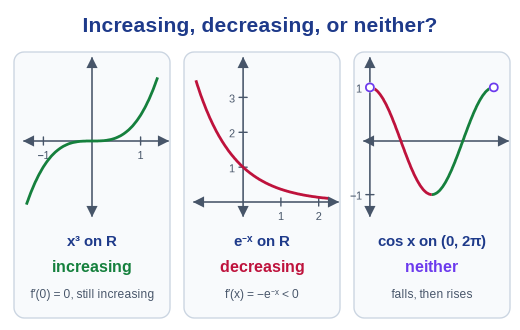
Beech wale graph e⁻ˣ ka derivative −e⁻ˣ hamesha negative hai, isliye wo har jagah neeche aata hai. Right wala, (0, 2π) par cos x, (0, π) par ghatta aur (π, 2π) par badhta hai, isliye poore (0, 2π) par na increasing hai na decreasing.
Intervals step by step kaise nikaalein?
- f′(x) nikaalo aur ho sake to factorise karo.
- f′(x) = 0 hal karo, aur wo points bhi dekho jahan f′(x) undefined ho.
- In points ko number line par lagao. Ye use alag-alag intervals mein kaat dete hain.
- Har interval mein factors ke signs se ya ek test value se f′(x) ka sign nikaalo.
- f′ > 0: increasing; f′ < 0: decreasing.
Example. f(x) = 2x³ − 9x² + 12x − 3.
f′(x) = 6x² − 18x + 12 = 6(x² − 3x + 2) = 6(x − 1)(x − 2).
f′(x) = 0, x = 1 aur x = 2 par, to intervals (−∞, 1), (1, 2) aur (2, ∞) hain.
| Interval | x − 1 | x − 2 | f′(x) ka sign | f hai |
|---|---|---|---|---|
| (−∞, 1) | − | − | + | increasing |
| (1, 2) | + | − | − | decreasing |
| (2, ∞) | + | + | + | increasing |
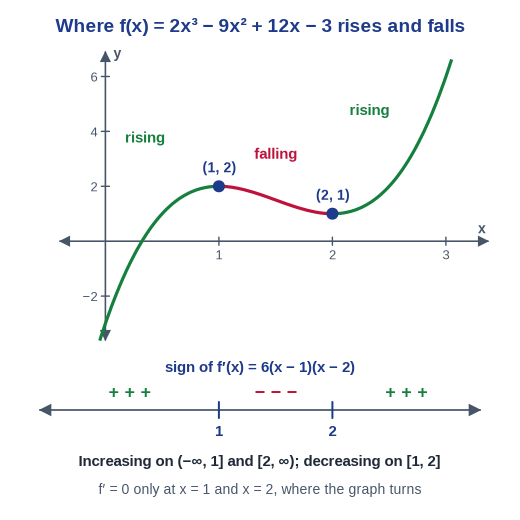
To f (−∞, 1] aur [2, ∞) par increasing hai, aur [1, 2] par decreasing. Shabd “aur” par dhyan do: dono ko milakar ek interval maano to f us par increasing nahi, kyonki 1 aur 2 ke beech wo girta hai.
Trigonometric function ka example. [0, 2π] par f(x) = x + 2 cos x. f′(x) = 1 − 2 sin x, jo sin x = 1/2 par 0 hai, yaani x = π/6 aur 5π/6 par. x = 0, π/2 aur π par test karne se f′ = 1, −1 aur 1 milta hai, signs +, − aur +. To f [0, π/6] aur [5π/6, 2π] par increasing hai aur [π/6, 5π/6] par decreasing.
Agar f′ kabhi negative na ho to?
Agar f′(x) ≥ 0 ho aur sirf alag-alag points par zero ho, to bhi f increasing hai. f(x) = x³ + 3x² + 3x + 7 ke liye f′(x) = 3x² + 6x + 3 = 3(x + 1)², jo sirf x = −1 par 0 hai. To f poore R par increasing hai. f′ ko perfect square plus kuch positive likhna aise results prove karne ka jaldi wala tareeka hai.
Aage padho: maxima aur minima kaise nikaalein, rate of change kaise nikaalein aur Exercise 6.2 ke saare 19 sawalon ke liye NCERT solutions.
Practice karo
-
f(x) = x² − 4x kahan increasing hai?
Jawab dekho
Jawab: (b) (2, ∞)
-
Kaunsa function poore R par decreasing hai?
Jawab dekho
Jawab: (c) 5 − 3x
-
f(x) = x³ − 3x kin intervals par increasing aur decreasing hai?
Jawab dekho
Jawab: f′(x) = 3x² − 3 = 3(x − 1)(x + 1), jo x = −1 aur 1 par zero hai. (−∞, −1) aur (1, ∞) par f′ > 0, to f wahan increasing hai; (−1, 1) par f′ < 0, to f (−1, 1) par decreasing hai.
-
Dikhao ki f(x) = x + sin x poore R par increasing hai.
Jawab dekho
Jawab: f′(x) = 1 + cos x ≥ 0, kyonki cos x ≥ −1. Ye sirf alag-alag points x = π, 3π, … par 0 hota hai, to f kabhi neeche nahi jaata aur R par increasing hai.
Students ke sawal
Increasing aur strictly increasing mein kya fark hai?
Increasing mein x₁ < x₂ ke liye f(x₁) = f(x₂) bhi chalta hai, yaani seedha flat hissa allowed hai. Strictly increasing mein har baar f(x₁) < f(x₂) chahiye, graph ko lagaataar upar jaana hai. Book ka Theorem 1, f′ > 0 ke saath, asal mein strict wala deta hai.
Kya f′ kahin 0 ho to bhi function increasing ho sakta hai?
Haan, agar f′ sirf alag-alag points par zero ho. f(x) = x³ mein f′(0) = 0 hai par dono taraf badhta hai, isliye poore R par increasing hai. Agar f′ poore interval par zero ho, to f wahan constant hai.
Kya intervals mein end points shamil karne chahiye?
Agar f end point par continuous ho to shamil kar sakte ho: Theorem 1 kehta hai ki (a, b) par f′ > 0 ho to f closed interval [a, b] par increasing hai. Kai jawab, book ki key bhi, open intervals likhte hain; jahan f continuous ho wahan dono sahi maane jaate hain.
Yahan Mean Value Theorem ki zaroorat kyon hai?
Test ko prove karne ke liye. x₁ < x₂ ke liye theorem beech mein ek point c deta hai jismein f(x₂) − f(x₁) = f′(c)(x₂ − x₁). Agar f′(c) > 0 ho, to right side positive hai, to f(x₂) > f(x₁).
Koi sawal atak gaya?
Photo lo, Lagnever AI step-by-step samjhayega. 7 din ka trial sirf ₹2.
Google Play se app lo Browser mein kholo
Parents ke liye: trial ke baad plan har mahine UPI ya card autopay se renew hota hai. App mein kabhi bhi cancel kar sakte hain.