
How do you find where a function is increasing or decreasing?
Answer in short
Find f′(x) and solve f′(x) = 0. These points cut the number line into intervals. Test the sign of f′ in each one: where f′(x) > 0 the function is increasing, where f′(x) < 0 it is decreasing. If f′(x) = 0 throughout an interval, f is constant there. Check points where f′ is undefined too.
Stuck on a question? Take a photo and Lagnever AI explains it step by step. Try it for 7 days for ₹2. Get it on Google Play
What do increasing and decreasing mean?
Walk along a graph from left to right. If you never go downhill, the function is increasing; if you never go uphill, it is decreasing.
In symbols, for an interval I inside the domain of f:
- f is increasing on I if x₁ < x₂ in I always gives f(x₁) ≤ f(x₂);
- f is decreasing on I if x₁ < x₂ in I always gives f(x₁) ≥ f(x₂);
- f is constant on I if f(x) = c for every x in I.
With strict inequalities, f(x₁) < f(x₂) or f(x₁) > f(x₂), we say strictly increasing or strictly decreasing. A function is increasing (or decreasing) at a point x₀ if it is increasing (or decreasing) on some open interval containing x₀.
For example, f(x) = 5x + 2 is strictly increasing on R: if x₁ < x₂, then 5x₁ + 2 < 5x₂ + 2.
How does the derivative help?
Checking every pair x₁, x₂ is slow. The derivative does it at once.
Theorem 1. Let f be continuous on [a, b] and differentiable on (a, b). Then
- f is increasing on [a, b] if f′(x) > 0 for each x in (a, b);
- f is decreasing on [a, b] if f′(x) < 0 for each x in (a, b);
- f is constant on [a, b] if f′(x) = 0 for each x in (a, b).
The reason is the Mean Value Theorem: f(x₂) − f(x₁) = f′(c)(x₂ − x₁) for some c between x₁ and x₂, and the sign of f′(c) fixes the sign of the difference.
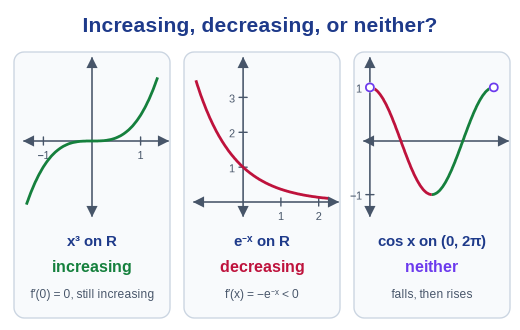
The middle graph, e⁻ˣ, has derivative −e⁻ˣ, which is always negative, so it falls everywhere. The right one, cos x on (0, 2π), falls on (0, π) and rises on (π, 2π), so on the whole of (0, 2π) it is neither increasing nor decreasing.
How do you find the intervals, step by step?
- Find f′(x) and factorise it if you can.
- Solve f′(x) = 0, and note any points where f′(x) is undefined.
- Mark these points on the number line. They cut it into separate intervals.
- In each interval, find the sign of f′(x), using the signs of the factors or one test value.
- f′ > 0: increasing; f′ < 0: decreasing.
Example. f(x) = 2x³ − 9x² + 12x − 3.
f′(x) = 6x² − 18x + 12 = 6(x² − 3x + 2) = 6(x − 1)(x − 2).
f′(x) = 0 at x = 1 and x = 2, giving the intervals (−∞, 1), (1, 2) and (2, ∞).
| Interval | x − 1 | x − 2 | Sign of f′(x) | f is |
|---|---|---|---|---|
| (−∞, 1) | − | − | + | increasing |
| (1, 2) | + | − | − | decreasing |
| (2, ∞) | + | + | + | increasing |
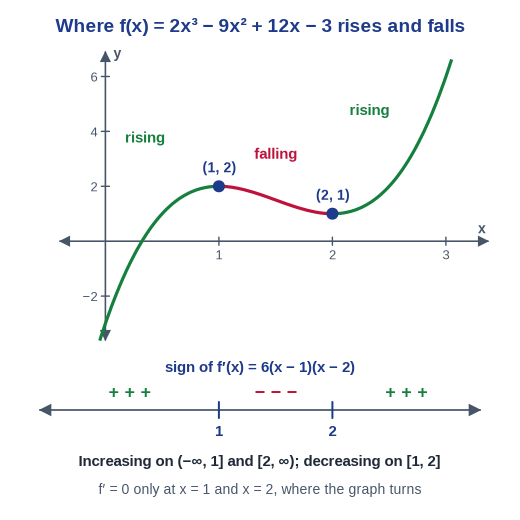
So f is increasing on (−∞, 1] and [2, ∞), and decreasing on [1, 2]. Note the word “and”: f is not increasing on the union taken as one interval, because it drops between 1 and 2.
Example with a trigonometric function. f(x) = x + 2 cos x on [0, 2π]. f′(x) = 1 − 2 sin x, which is 0 when sin x = 1/2, at x = π/6 and 5π/6. Testing x = 0, π/2 and π gives f′ = 1, −1 and 1, signs +, − and +. So f is increasing on [0, π/6] and [5π/6, 2π] and decreasing on [π/6, 5π/6].
What if f′ is never negative?
If f′(x) ≥ 0 and is zero only at separate points, f is still increasing. For f(x) = x³ + 3x² + 3x + 7, f′(x) = 3x² + 6x + 3 = 3(x + 1)², which is 0 only at x = −1. So f is increasing on the whole of R. Writing f′ as a perfect square plus something positive is a quick way to prove such results.
Read next: maxima and minima, rate of change of quantities and the NCERT solutions for all 19 questions of Exercise 6.2.
Practice
-
f(x) = x² − 4x is increasing on:
Show answer
Answer: (b) (2, ∞)
-
Which function is decreasing on all of R?
Show answer
Answer: (c) 5 − 3x
-
Find the intervals on which f(x) = x³ − 3x is increasing and decreasing.
Show answer
Answer: f′(x) = 3x² − 3 = 3(x − 1)(x + 1), zero at x = −1 and 1. f′ > 0 on (−∞, −1) and (1, ∞), so f is increasing there; f′ < 0 on (−1, 1), so f is decreasing on (−1, 1).
-
Show that f(x) = x + sin x is increasing on R.
Show answer
Answer: f′(x) = 1 + cos x ≥ 0, because cos x ≥ −1. It is 0 only at isolated points x = π, 3π, …, so f never goes down and is increasing on R.
Questions students ask
What is the difference between increasing and strictly increasing?
Increasing allows f(x₁) = f(x₂) for x₁ < x₂, so a flat stretch is allowed. Strictly increasing needs f(x₁) < f(x₂) every time, so the graph must keep going up. The book's Theorem 1, with f′ > 0, in fact gives the stricter kind.
Can a function be increasing if f′ is 0 somewhere?
Yes, if f′ is zero only at separate points. f(x) = x³ has f′(0) = 0 but rises on both sides, so it is increasing on all of R. If f′ is zero on a whole interval, f is constant there.
Should the end points be included in the intervals?
If f is continuous at an end point, it can be included: Theorem 1 gives f increasing on the closed interval [a, b] when f′ > 0 on (a, b). Many answers, including the book's key, write open intervals; both are accepted when f is continuous there.
Why do we need the Mean Value Theorem here?
To prove the test. For x₁ < x₂, the theorem gives a point c between them with f(x₂) − f(x₁) = f′(c)(x₂ − x₁). If f′(c) > 0, the right side is positive, so f(x₂) > f(x₁).
Stuck on a question?
Take a photo and Lagnever AI explains it step by step. Try it for 7 days for ₹2.
Get it on Google Play Open in browser
For parents: after the trial, the plan renews monthly by UPI or card autopay. You can cancel anytime in the app.