
How do you find maxima and minima of a function?
Answer in short
Find the critical points, where f′(x) = 0 or f′ does not exist. At each one, use the first derivative test (f′ changes + to − for a maximum, − to + for a minimum) or the second (f″ < 0 maximum, f″ > 0 minimum). On a closed interval, also compare f at the end points.
Stuck on a question? Take a photo and Lagnever AI explains it step by step. Try it for 7 days for ₹2. Get it on Google Play
What are local maxima and minima?
Picture a graph with hills and valleys. The top of each little hill is a local maximum, and the bottom of each valley a local minimum. “Local” means the value is the highest (or lowest) only among nearby points.
Formally, let c be an interior point of the domain of f.
- c is a point of local maxima if there is an h > 0 with f(c) ≥ f(x) for all x in (c − h, c + h). Then f(c) is a local maximum value.
- c is a point of local minima if there is an h > 0 with f(c) ≤ f(x) for all x in (c − h, c + h). Then f(c) is a local minimum value.
Just before a hilltop the graph rises (f′ > 0) and just after it falls (f′ < 0), so at the top itself f′(c) = 0, unless the graph has a sharp corner there.
Theorem. If f has a local maximum or minimum at c, then either f′(c) = 0 or f is not differentiable at c. Such a c is called a critical point.
The reverse is not true. A critical point need not be a turning point.
The first derivative test
Let c be a critical point where f is continuous. Watch the sign of f′ as x passes through c from left to right:
- + to −: c is a point of local maxima;
- − to +: c is a point of local minima;
- no change: neither. Such a point is a point of inflexion.
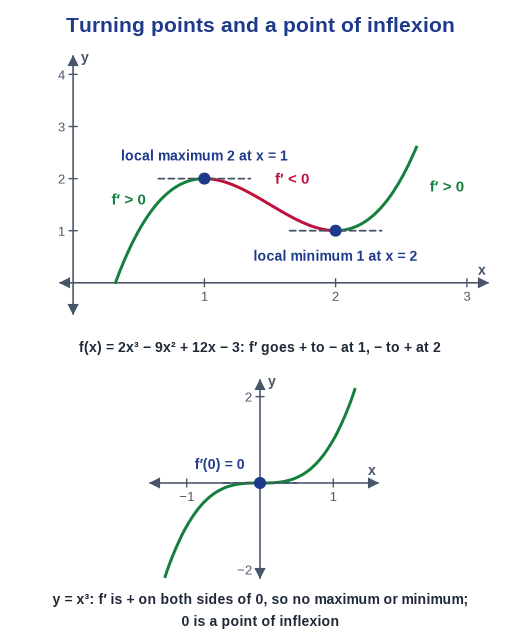
Example. f(x) = 2x³ − 9x² + 12x − 3 has f′(x) = 6(x − 1)(x − 2). Near x = 1, f′ is + on the left and − on the right, so x = 1 gives the local maximum f(1) = 2. Near x = 2 the sign goes − to +, so x = 2 gives the local minimum f(2) = 1.
The test also works where f′ does not exist. For f(x) = |x − 3| + 2, f′ is −1 to the left of 3 and +1 to the right, so x = 3 is a point of local minima with value 2.
The second derivative test
If f is twice differentiable at c and f′(c) = 0:
- f″(c) < 0: c is a point of local maxima (the graph bends down like a cap);
- f″(c) > 0: c is a point of local minima (the graph bends up like a cup);
- f″(c) = 0: the test fails, so go back to the first derivative test.
For our cubic, f″(x) = 12x − 18. f″(1) = −6 < 0 confirms the maximum and f″(2) = 6 > 0 the minimum. This test is often quicker, but it cannot decide cases like x³ or x⁴ at 0, where f″ = 0.
Absolute maximum and minimum on a closed interval
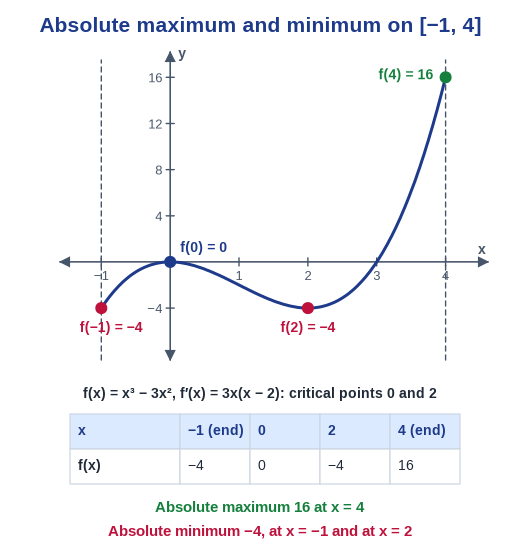
A function continuous on a closed interval [a, b] always has a greatest value (the absolute maximum) and a least value (the absolute minimum). Each is reached at a critical point inside the interval or at an end point. So:
- Find all critical points of f in (a, b).
- Add the end points a and b.
- Work out f at every point in this list.
- The largest value is the absolute maximum; the smallest is the absolute minimum.
Example. f(x) = x³ − 3x² on [−1, 4]. f′(x) = 3x² − 6x = 3x(x − 2), zero at x = 0 and 2. Then f(−1) = −4, f(0) = 0, f(2) = −4 and f(4) = 16. The absolute maximum is 16 at x = 4 (an end point) and the absolute minimum is −4, at both x = −1 and x = 2.
How do you solve an optimisation word problem?
- Draw a figure and name the quantities.
- Write the quantity to be made largest or smallest.
- Use the given condition to write it in terms of one variable, and note the allowed range of that variable.
- Differentiate, solve f′(x) = 0, and test with f″ or the sign of f′.
- Answer in the words of the question, with units.
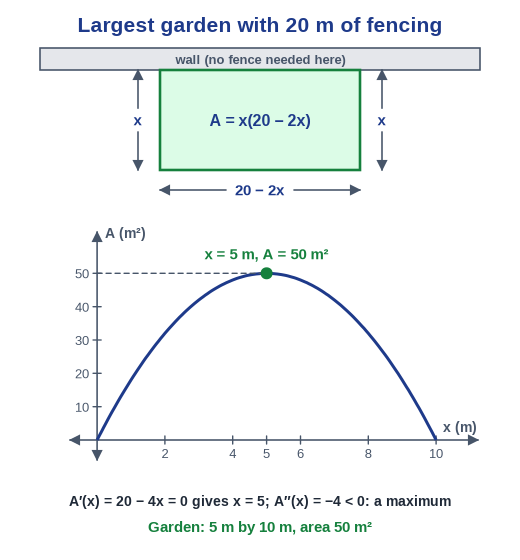
Example. A gardener has 20 m of fencing to enclose a rectangular plot against a long wall, which needs no fence. If each side at right angles to the wall is x m, the side facing the wall is 20 − 2x m and the area is A(x) = x(20 − 2x) = 20x − 2x², for 0 < x < 10. Then A′(x) = 20 − 4x = 0 gives x = 5, and A″(x) = −4 < 0, so this is a maximum. The largest plot is 5 m by 10 m, with area 50 m².
Read next: increasing and decreasing functions, rate of change of quantities and the NCERT solutions for Exercise 6.3 and the Miscellaneous Exercise.
Practice
-
f(x) = x² − 8x + 5 has a local minimum at:
Show answer
Answer: (b) x = 4
-
If f′(2) = 0 and f″(2) = −3, then x = 2 is:
Show answer
Answer: (a) a point of local maxima
-
Find the local maximum and minimum values of f(x) = x³ − 12x + 1.
Show answer
Answer: f′(x) = 3x² − 12 = 3(x − 2)(x + 2), zero at x = ±2. f″(x) = 6x. f″(−2) = −12 < 0, so the local maximum is f(−2) = −8 + 24 + 1 = 17. f″(2) = 12 > 0, so the local minimum is f(2) = 8 − 24 + 1 = −15.
-
Find the absolute maximum and minimum of f(x) = x² − 2x on [0, 3].
Show answer
Answer: f′(x) = 2x − 2 = 0 at x = 1, inside [0, 3]. f(0) = 0, f(1) = −1, f(3) = 3. The absolute maximum is 3 at x = 3 and the absolute minimum is −1 at x = 1.
Questions students ask
What is a critical point?
A point c in the domain where f′(c) = 0 or where f is not differentiable. Local maxima and minima can happen only at critical points, so they are the only places to test. |x| at x = 0 is a critical point of the second kind.
What is a point of inflexion?
A critical point where f′ keeps the same sign on both sides, so the graph flattens for a moment but does not turn. For f(x) = x³, x = 0 is such a point.
When does the second derivative test fail?
When f″(c) = 0, or when f″(c) does not exist. Then use the first derivative test. For f(x) = x⁴, f″(0) = 0, but f′ changes from − to + at 0, so 0 is a local minimum.
Is the local maximum always the largest value?
No. A local maximum is largest only near c. A function can have a local maximum that is smaller than another local minimum, and on a closed interval the absolute maximum may sit at an end point.
Stuck on a question?
Take a photo and Lagnever AI explains it step by step. Try it for 7 days for ₹2.
Get it on Google Play Open in browser
For parents: after the trial, the plan renews monthly by UPI or card autopay. You can cancel anytime in the app.