
How do you find the rate of change of a quantity?
Answer in short
If y = f(x), the rate of change of y with respect to x is dy/dx, and f′(x₀) is the rate at x = x₀. If both change with time, differentiate their relation with respect to t: the chain rule gives dy/dx = (dy/dt) ÷ (dx/dt). A negative rate means a decrease.
Stuck on a question? Take a photo and Lagnever AI explains it step by step. Try it for 7 days for ₹2. Get it on Google Play
What does a derivative measure?
If one quantity y depends on another quantity x by a rule y = f(x), then dy/dx, also written f′(x), is the rate of change of y with respect to x. Its value at a particular point x = x₀, written f′(x₀), is the rate at that point.
You have met one such rate already: if s is the distance covered in time t, then ds/dt is the speed. The same idea works for any pair of quantities.
Example. The area of a circle is A = πr², so dA/dr = 2πr. At r = 3 cm the area changes at 6π cm² per cm of radius. A larger circle gains more area for the same small increase in radius, because its edge is longer.
What if both quantities change with time?
Often x and y both depend on time t. Then the chain rule links their rates:
dy/dx = (dy/dt) ÷ (dx/dt), provided dx/dt ≠ 0
More often we use it the other way round. If V depends on r and r depends on t, then
dV/dt = (dV/dr) × (dr/dt)
So: find the rate with respect to the inner variable, then multiply by how fast that variable is moving.
Example: a growing balloon. A spherical balloon has V = (4/3)πr³. Its radius grows at 0.2 cm/s. Then dV/dt = 4πr² × dr/dt. When r = 5 cm, dV/dt = 4π(25)(0.2) = 20π cm³/s.
Example: a ripple. A ripple’s radius grows at 5 cm/s. A = πr², so dA/dt = 2πr × dr/dt. When r = 8 cm, dA/dt = 2π(8)(5) = 80π cm²/s.
How do you solve a related-rates problem?
Use the same five steps every time:
- Draw a picture and name every changing quantity with a letter.
- Write down the given rates, with a minus sign for anything that is decreasing.
- Write the equation that links the quantities.
- Differentiate the whole equation with respect to t.
- Only now put in the values at the given instant, and solve for the unknown rate.
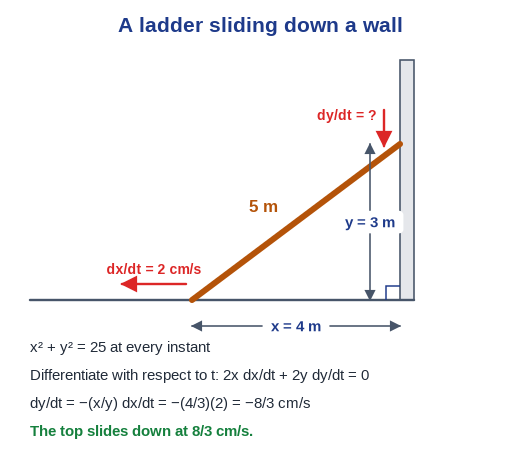
Example: a sliding ladder. A ladder 5 m long leans against a wall. Its foot slides away from the wall at 2 cm/s. How fast does the top come down when the foot is 4 m from the wall?
Let the foot be x m from the wall and the top y m up. By Pythagoras, x² + y² = 25 at every instant. Differentiating with respect to t:
2x (dx/dt) + 2y (dy/dt) = 0, so dy/dt = −(x/y)(dx/dt)
When x = 4, y = √(25 − 16) = 3. With dx/dt = 2 cm/s, dy/dt = −(4/3)(2) = −8/3 cm/s. The minus sign says the height is decreasing: the top slides down at 8/3 cm/s. The ratio x/y has no unit, so the answer keeps the unit cm/s.
Example: a rectangle. The length x of a rectangle decreases at 1 cm/s while the width y increases at 2 cm/s. Its perimeter P = 2(x + y) changes at dP/dt = 2(−1 + 2) = 2 cm/s, whatever the sizes. Its area A = xy changes at dA/dt = y(dx/dt) + x(dy/dt), which depends on x and y: when x = 6 cm and y = 4 cm, dA/dt = 4(−1) + 6(2) = 8 cm²/s.
What are marginal cost and marginal revenue?
In business, C(x) is the total cost of producing x units and R(x) the total revenue from selling x units.
- Marginal cost measures how fast total cost grows as output grows, at that output: MC = dC/dx.
- Marginal revenue measures how fast total revenue grows as more units are sold: MR = dR/dx.
Example. If C(x) = 2x² + 5x + 100 rupees, then MC = 4x + 5. At x = 10 units, MC = ₹45. If R(x) = x² + 20x rupees, then MR = 2x + 20, which is ₹40 at x = 10.
The textbook’s examples use the same steps with cubic cost functions. Only the differentiation changes; the meaning stays the same.
Read next: increasing and decreasing functions, maxima and minima and the NCERT solutions for all 18 questions of Exercise 6.1.
Practice
-
The side of a square grows at 0.1 cm/s. When the side is 10 cm, its area grows at:
Show answer
Answer: (b) 2 cm²/s
-
The radius of a spherical balloon grows at 0.2 cm/s. When r = 5 cm, the volume grows at:
Show answer
Answer: (a) 20π cm³/s
-
C(x) = 2x² + 5x + 100 rupees is the cost of x units. Find the marginal cost at x = 10.
Show answer
Answer: Marginal cost = C′(x) = 4x + 5. At x = 10 it is 4(10) + 5 = ₹45 per unit.
-
A rectangle has length x decreasing at 1 cm/s and width y increasing at 2 cm/s. Find the rate of change of its area when x = 6 cm and y = 4 cm.
Show answer
Answer: A = xy, so dA/dt = y dx/dt + x dy/dt = 4(−1) + 6(2) = −4 + 12 = 8 cm²/s. The area is increasing at 8 cm²/s.
Questions students ask
What does dy/dx mean as a rate?
It is how much y changes per unit change in x at that instant. If s is distance and t is time, ds/dt is the speed. If A is the area of a circle and r its radius, dA/dr = 2πr tells how fast the area grows as the radius grows.
What are related rates?
Two or more quantities linked by an equation, all changing with time. Differentiate the equation with respect to t using the chain rule, then put in the values at the given instant. One known rate then gives the unknown one.
What is marginal cost?
How fast the total cost changes as more units are produced, measured at a given output: C′(x). For a large output it is close to the cost of making one more unit.
Why is a rate sometimes negative?
A negative dy/dt means y is going down as time goes on. For a ladder sliding down a wall, the height has a negative rate; the answer then says the height is decreasing at that speed.
Stuck on a question?
Take a photo and Lagnever AI explains it step by step. Try it for 7 days for ₹2.
Get it on Google Play Open in browser
For parents: after the trial, the plan renews monthly by UPI or card autopay. You can cancel anytime in the app.