
NCERT Solutions Class 12 Maths Chapter 9: Differential Equations
Answers to every question of Exercises 9.1 to 9.5 and the Miscellaneous Exercise, and to all 22 worked examples, of Chapter 9, Differential Equations, of Mathematics Part II, the Class 12 NCERT textbook. Page numbers follow the 2026-27 reprint (pages 300–337). The exercise questions are quoted from the book; the examples are restated in short and labelled by number and page. Every solution below was checked by script: it was substituted back into its differential equation (the difference simplifies to 0, or vanishes at several test points), every initial condition was checked, and every order and degree was worked out from the equation. The answers agree with the book’s answer key except in two places, Exercise 9.3 Question 13 and a misprint in Exercise 9.5 Question 8, both marked where they come. Short notes: Chapter 9 notes.
How the maths is typed here. y′, y″, y‴ and y⁗ are the first to fourth derivatives of y with respect to x. Fractions use a slash, so (1 − cos x)/(1 + cos x) is one bracket over the other. Powers that are hard to read as superscripts are written with ^, so e^(x/y) is e to the power x/y. log is the natural logarithm, as in the book. C, A and c are arbitrary constants; a renamed constant keeps the same letter. I.F. is the integrating factor. The quoted questions use the same layout.
Words used below. A general solution contains arbitrary constants, as many as the order of the equation. A particular solution has fixed values for them, found from a given condition such as “y = 1 when x = 0”. To separate the variables means to bring every y term (with dy) to one side and every x term (with dx) to the other. An integrating factor (I.F.) is the multiplier that turns the left side of a linear equation into the derivative of a single product.
Four facts carry most of the answers:
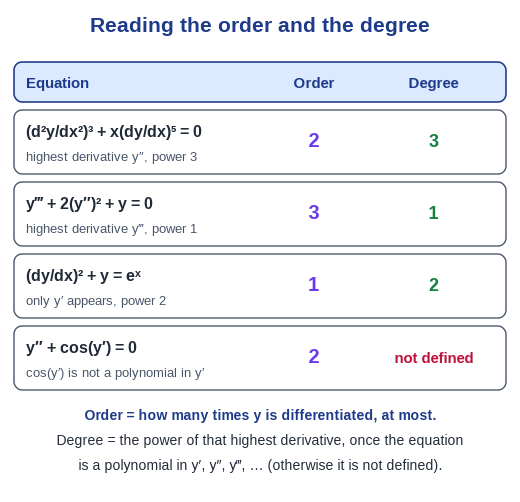
- Order = the highest derivative present. Degree = its power, defined only when the equation is a polynomial in the derivatives.
- Variables separable: dy/dx = g(x) h(y) ⇒ ∫dy/h(y) = ∫g(x) dx + C.
- Homogeneous (F(λx, λy) = F(x, y)): put y = vx, dy/dx = v + x dv/dx; for dx/dy = h(x/y) put x = vy.
- Linear: dy/dx + Py = Q ⇒ y × e^(∫P dx) = ∫Q e^(∫P dx) dx + C; dx/dy + P₁x = Q₁ ⇒ x × e^(∫P₁ dy) = ∫Q₁ e^(∫P₁ dy) dy + C.
Example 1: order and degree (page 303)
Example 1 (page 303): order and degree of (i) dy/dx − cos x = 0, (ii) xy d²y/dx² + x(dy/dx)² − y dy/dx = 0, (iii) y‴ + y² + e^(y′) = 0. (i) Highest derivative y′, power 1: order 1, degree 1. (ii) Highest derivative y″, and the equation is a polynomial in y″ and y′ with y″ to the power 1: order 2, degree 1. (iii) Highest derivative y‴, but e^(y′) is not a polynomial in y′: order 3, degree not defined.
Exercise 9.1 (pages 303–304)
The book’s instruction for Questions 1 to 10: “Determine order and degree (if defined) of differential equations given in Exercises 1 to 10.”
1. “d⁴y/dx⁴ + sin(y‴) = 0” The highest derivative is y⁗, so the order is 4. sin(y‴) is not a polynomial in y‴. Order 4; degree not defined.
2. “y′ + 5y = 0” Only y′ appears, to the power 1. Order 1; degree 1.
3. “(ds/dt)⁴ + 3s d²s/dt² = 0” The highest derivative is d²s/dt², to the power 1; the fourth power belongs to the lower derivative ds/dt. Order 2; degree 1.
4. “(d²y/dx²)² + cos(dy/dx) = 0” The highest derivative is y″, but cos(y′) is not a polynomial in y′. Order 2; degree not defined.
5. “d²y/dx² = cos 3x + sin 3x” The highest derivative is y″, to the power 1; the right side involves x only. Order 2; degree 1.
6. “(y‴)² + (y″)³ + (y′)⁴ + y⁵ = 0” The highest derivative is y‴, and its power is 2. Order 3; degree 2.
7. “y‴ + 2y″ + y′ = 0” Highest derivative y‴, power 1. Order 3; degree 1.
8. “y′ + y = eˣ” Only y′, power 1. Order 1; degree 1.
9. “y″ + (y′)² + 2y = 0” Highest derivative y″, power 1. Order 2; degree 1.
10. “y″ + 2y′ + sin y = 0” Highest derivative y″, power 1. sin y is a function of y, not of a derivative, so the equation is still a polynomial in y″ and y′. Order 2; degree 1.
11. “The degree of the differential equation (d²y/dx²)³ + (dy/dx)² + sin(dy/dx) + 1 = 0 is (A) 3 (B) 2 (C) 1 (D) not defined” The term sin(dy/dx) is not a polynomial in y′, so the degree is not defined. Answer (D).
12. “The order of the differential equation 2x² d²y/dx² − 3 dy/dx + y = 0 is (A) 2 (B) 1 (C) 0 (D) not defined” The highest derivative is d²y/dx². Answer (A), order 2.
Examples 2 and 3: checking a solution (page 305)
Example 2 (page 305): show that y = e⁻³ˣ solves y″ + y′ − 6y = 0. y′ = −3e⁻³ˣ and y″ = 9e⁻³ˣ. Then y″ + y′ − 6y = (9 − 3 − 6)e⁻³ˣ = 0. It is a solution.
Example 3 (page 305): show that y = a cos x + b sin x solves y″ + y = 0. y′ = −a sin x + b cos x, y″ = −a cos x − b sin x = −y. So y″ + y = 0. It is a solution, for every a and b.
Exercise 9.2 (page 306)
The book’s instruction for Questions 1 to 10: “In each of the Exercises 1 to 10 verify that the given functions (explicit or implicit) is a solution of the corresponding differential equation:”
1. “y = eˣ + 1 : y″ − y′ = 0” y′ = eˣ and y″ = eˣ, so y″ − y′ = 0. Verified.
2. “y = x² + 2x + C : y′ − 2x − 2 = 0” y′ = 2x + 2, so y′ − 2x − 2 = 0. Verified.
3. “y = cos x + C : y′ + sin x = 0” y′ = −sin x, so y′ + sin x = 0. Verified.
4. “y = √(1 + x²) : y′ = xy/(1 + x²)” y′ = x/√(1 + x²) = x√(1 + x²)/(1 + x²) = xy/(1 + x²). Verified.
5. “y = Ax : xy′ = y (x ≠ 0)” y′ = A, so xy′ = Ax = y. Verified.
6. “y = x sin x : xy′ = y + x √(x² − y²) (x ≠ 0 and x > y or x < −y)” y′ = sin x + x cos x, so xy′ = x sin x + x² cos x. On the right, √(x² − y²) = √(x² − x² sin² x) = √(x² cos² x) = x cos x (taking the root as x cos x, which holds where x cos x ≥ 0). So y + x√(x² − y²) = x sin x + x² cos x = xy′. Verified.
7. “xy = log y + C : y′ = y²/(1 − xy) (xy ≠ 1)” Differentiate: y + xy′ = y′/y. Multiply by y: y² + xyy′ = y′, so y′(1 − xy) = y² and y′ = y²/(1 − xy). Verified.
8. “y − cos y = x : (y sin y + cos y + x) y′ = y” Differentiate: y′ + sin y · y′ = 1, so y′ = 1/(1 + sin y). From the relation, x = y − cos y, so y sin y + cos y + x = y sin y + y = y(1 + sin y). Hence (y sin y + cos y + x) y′ = y. Verified.
9. “x + y = tan⁻¹y : y² y′ + y² + 1 = 0” Differentiate: 1 + y′ = y′/(1 + y²). So y′[1/(1 + y²) − 1] = 1, that is −y² y′/(1 + y²) = 1, or y² y′ = −(1 + y²). Hence y² y′ + y² + 1 = 0. Verified.
10. “y = √(a² − x²) x ∈ (−a, a) : x + y dy/dx = 0 (y ≠ 0)” dy/dx = −x/√(a² − x²) = −x/y, so x + y dy/dx = x − x = 0. Verified.
11. “The number of arbitrary constants in the general solution of a differential equation of fourth order are: (A) 0 (B) 2 (C) 3 (D) 4” A general solution has as many arbitrary constants as the order. Answer (D), 4.
12. “The number of arbitrary constants in the particular solution of a differential equation of third order are: (A) 3 (B) 2 (C) 1 (D) 0” In a particular solution every constant has a fixed value. Answer (D), 0.
Examples 4 to 9: variables separable (pages 307–310)
Example 4 (page 307): general solution of dy/dx = (x + 1)/(2 − y), y ≠ 2. Separate: (2 − y) dy = (x + 1) dx. Integrate: 2y − y²/2 = x²/2 + x + C₁. Multiply by 2 and rearrange: x² + y² + 2x − 4y + C = 0 (C = 2C₁).
Example 5 (page 308): general solution of dy/dx = (1 + y²)/(1 + x²). 1 + y² is never 0, so dy/(1 + y²) = dx/(1 + x²). Integrate: tan⁻¹ y = tan⁻¹ x + C.
Example 6 (page 308): particular solution of dy/dx = −4xy², with y = 1 when x = 0. For y ≠ 0, dy/y² = −4x dx, so −1/y = −2x² + C, that is y = 1/(2x² − C). At x = 0, y = 1 gives C = −1. y = 1/(2x² + 1).
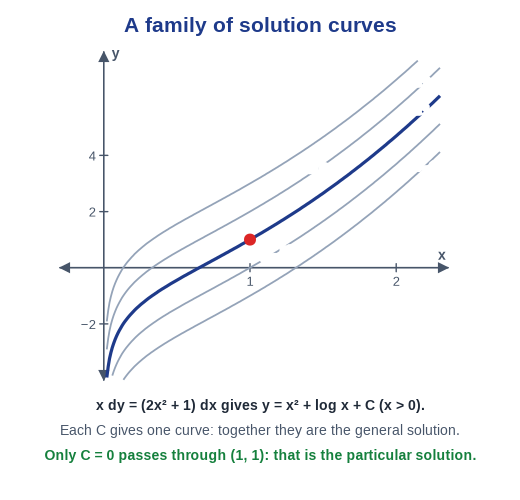
Example 7 (page 308): the curve through (1, 1) with x dy = (2x² + 1) dx (x ≠ 0). dy = (2x + 1/x) dx, so y = x² + log|x| + C. At (1, 1), 1 = 1 + 0 + C, so C = 0. y = x² + log|x|.
Example 8 (page 309): the curve through (−2, 3) with tangent slope 2x/y². dy/dx = 2x/y², so y² dy = 2x dx and y³/3 = x² + C. At (−2, 3), 9 = 4 + C, so C = 5. y³/3 = x² + 5, or y = (3x² + 15)^(1/3).
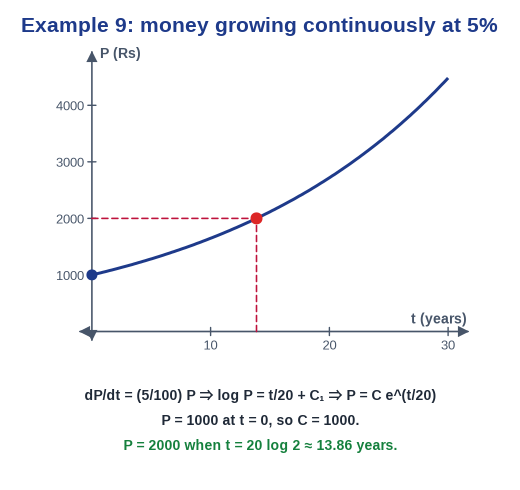
Example 9 (page 310): Rs 1000 grows continuously at 5% a year. When does it double? With P the principal at time t (years), dP/dt = (5/100)P = P/20. Separate: dP/P = dt/20, so log P = t/20 + C₁ and P = C e^(t/20). At t = 0, P = 1000, so C = 1000 and P = 1000 e^(t/20). P = 2000 when e^(t/20) = 2, that is t = 20 log 2 years (about 13.86 years).
Exercise 9.3 (pages 310–312)
The book’s instruction for Questions 1 to 10: “For each of the differential equations in Exercises 1 to 10, find the general solution:”
1. “dy/dx = (1 − cos x)/(1 + cos x)” Using 1 − cos x = 2 sin²(x/2) and 1 + cos x = 2 cos²(x/2), dy/dx = tan²(x/2) = sec²(x/2) − 1. Integrate: y = 2 tan(x/2) − x + C.
2. “dy/dx = √(4 − y²) (−2 < y < 2)” Separate: dy/√(4 − y²) = dx. Integrate: sin⁻¹(y/2) = x + C. y = 2 sin(x + C).
3. “dy/dx + y = 1 (y ≠ 1)” dy/dx = 1 − y, so dy/(1 − y) = dx and −log|1 − y| = x + C₁. So 1 − y = K e⁻ˣ with K = ±e^(−C₁), and with A = −K, y = 1 + Ae⁻ˣ.
4. “sec² x tan y dx + sec² y tan x dy = 0” Divide by tan x tan y: (sec² x/tan x) dx + (sec² y/tan y) dy = 0. Each term is of the form f′/f, so log|tan x| + log|tan y| = log|C|. tan x tan y = C.
5. “(eˣ + e⁻ˣ) dy − (eˣ − e⁻ˣ) dx = 0” dy = (eˣ − e⁻ˣ)/(eˣ + e⁻ˣ) dx. The numerator is the derivative of the denominator, so y = log(eˣ + e⁻ˣ) + C.
6. “dy/dx = (1 + x²)(1 + y²)” dy/(1 + y²) = (1 + x²) dx. tan⁻¹ y = x + x³/3 + C.
7. “y log y dx − x dy = 0” dy/(y log y) = dx/x. The left side integrates to log|log y| (substitute t = log y), so log|log y| = log|x| + log|C|, giving log y = Cx. y = e^(Cx).
8. “x⁵ dy/dx = − y⁵” y⁻⁵ dy = −x⁻⁵ dx. Integrate: −y⁻⁴/4 = x⁻⁴/4 + C₁. Multiply by −4: x⁻⁴ + y⁻⁴ = C.
9. “dy/dx = sin⁻¹ x” y = ∫sin⁻¹ x dx. By parts, ∫sin⁻¹ x · 1 dx = x sin⁻¹ x − ∫x/√(1 − x²) dx = x sin⁻¹ x + √(1 − x²). y = x sin⁻¹ x + √(1 − x²) + C.
10. “eˣ tan y dx + (1 − eˣ) sec² y dy = 0” Rearrange: (sec² y/tan y) dy = eˣ/(eˣ − 1) dx. Both sides are of the form f′/f: log|tan y| = log|eˣ − 1| + log|C|. So tan y = C(eˣ − 1); renaming −C as C, tan y = C(1 − eˣ).
The book’s instruction for Questions 11 to 14: “For each of the differential equations in Exercises 11 to 14, find a particular solution satisfying the given condition:”
11. “(x³ + x² + x + 1) dy/dx = 2x² + x; y = 1 when x = 0”
- Factorise: x³ + x² + x + 1 = x²(x + 1) + (x + 1) = (x + 1)(x² + 1). So dy/dx = (2x² + x)/((x + 1)(x² + 1)).
- Break the right side into partial fractions (simpler fractions that add up to it): (2x² + x)/((x + 1)(x² + 1)) = A/(x + 1) + (Bx + D)/(x² + 1). Putting x = −1 gives A = 1/2. Comparing x² terms gives B = 3/2, and comparing constants gives D = −1/2.
- Integrate each part: y = (1/2) log|x + 1| + (3/4) log(x² + 1) − (1/2) tan⁻¹ x + C.
- Use y = 1 when x = 0: 1 = 0 + 0 − 0 + C, so C = 1.
- Join the two logs: (1/2) log|x + 1| = (1/4) log(x + 1)² and (3/4) log(x² + 1) = (1/4) log(x² + 1)³.
Answer: y = (1/4) log[(x + 1)²(x² + 1)³] − (1/2) tan⁻¹ x + 1.
12. “x(x² − 1) dy/dx = 1 ; y = 0 when x = 2” 1/(x(x − 1)(x + 1)) = −1/x + (1/2)/(x − 1) + (1/2)/(x + 1). So y = −log|x| + (1/2) log|x² − 1| + C = (1/2) log|(x² − 1)/x²| + C. At x = 2: 0 = (1/2) log(3/4) + C. y = (1/2) log((x² − 1)/x²) − (1/2) log(3/4).
13. “cos(dy/dx) = a (a ∈ R); y = 1 when x = 0” dy/dx = cos⁻¹ a, a constant, so y = x cos⁻¹ a + C. At x = 0, y = 1 gives C = 1. y = x cos⁻¹ a + 1, or cos((y − 1)/x) = a.
Answer key note: the key prints cos((y − 2)/x) = a. That curve gives y = 2 when x = 0, not the given y = 1, so the 2 should be 1.
14. “dy/dx = y tan x ; y = 1 when x = 0” dy/y = tan x dx, so log|y| = log|sec x| + log|C| and y = C sec x. At x = 0, 1 = C. y = sec x.
15. “Find the equation of a curve passing through the point (0, 0) and whose differential equation is y′ = eˣ sin x.” y = ∫eˣ sin x dx = eˣ(sin x − cos x)/2 + C (by parts twice). At (0, 0): 0 = −1/2 + C, so C = 1/2. 2y − 1 = eˣ(sin x − cos x).
16. “For the differential equation xy dy/dx = (x + 2)(y + 2), find the solution curve passing through the point (1, −1).” Separate: y/(y + 2) dy = (x + 2)/x dx, that is (1 − 2/(y + 2)) dy = (1 + 2/x) dx. Integrate: y − 2 log|y + 2| = x + 2 log|x| + C. At (1, −1): −1 − 0 = 1 + 0 + C, so C = −2. y − x + 2 = log(x²(y + 2)²).
17. “Find the equation of a curve passing through the point (0, –2) given that at any point (x, y) on the curve, the product of the slope of its tangent and y coordinate of the point is equal to the x coordinate of the point.” y dy/dx = x, so y dy = x dx and y²/2 = x²/2 + C₁, or y² − x² = C. At (0, −2), C = 4. y² − x² = 4.
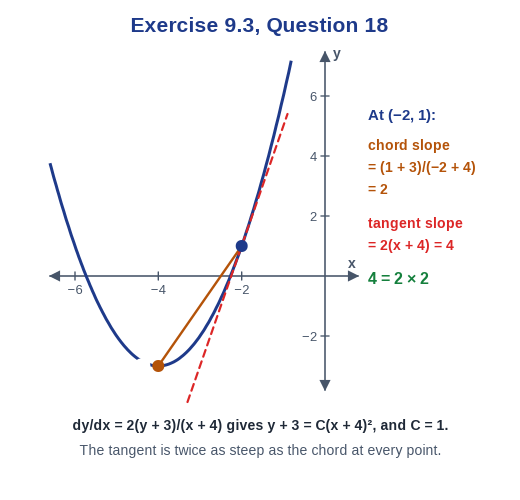
18. “At any point (x, y) of a curve, the slope of the tangent is twice the slope of the line segment joining the point of contact to the point (– 4, –3). Find the equation of the curve given that it passes through (–2, 1).” The segment’s slope is (y + 3)/(x + 4), so dy/dx = 2(y + 3)/(x + 4). Separate: dy/(y + 3) = 2 dx/(x + 4), so log|y + 3| = 2 log|x + 4| + log|C| and y + 3 = C(x + 4)². At (−2, 1): 4 = 4C, so C = 1. (x + 4)² = y + 3.
19. “The volume of spherical balloon being inflated changes at a constant rate. If initially its radius is 3 units and after 3 seconds it is 6 units. Find the radius of balloon after t seconds.” Let V = (4/3)πr³ and dV/dt = k. Then (4/3)πr³ = kt + C. At t = 0, r = 3: C = 36π. At t = 3, r = 6: 288π = 3k + 36π, so k = 84π. Hence (4/3)πr³ = 84πt + 36π, so r³ = 63t + 27. r = (63t + 27)^(1/3).
20. “In a bank, principal increases continuously at the rate of r% per year. Find the value of r if Rs 100 double itself in 10 years (logₑ2 = 0.6931).” dP/dt = (r/100)P gives P = 100 e^(rt/100). For P = 200 at t = 10: e^(r/10) = 2, so r = 10 logₑ 2 = 10 × 0.6931. r = 6.931 ≈ 6.93%.
21. “In a bank, principal increases continuously at the rate of 5% per year. An amount of Rs 1000 is deposited with this bank, how much will it worth after 10 years (e^0.5 = 1.648).” As in Example 9, P = 1000 e^(t/20). At t = 10, P = 1000 e^0.5 = 1000 × 1.648. Rs 1648.
22. “In a culture, the bacteria count is 1,00,000. The number is increased by 10% in 2 hours. In how many hours will the count reach 2,00,000, if the rate of growth of bacteria is proportional to the number present?” dN/dt = kN gives N = 1,00,000 e^(kt). After 2 hours N = 1,10,000, so e^(2k) = 11/10 and k = (1/2) log(11/10). N = 2,00,000 when e^(kt) = 2, that is t = (log 2)/k. t = 2 log 2 / log(11/10) hours (about 14.5 hours).
23. “The general solution of the differential equation dy/dx = e^(x + y) is (A) eˣ + e⁻ʸ = C (B) eˣ + eʸ = C (C) e⁻ˣ + eʸ = C (D) e⁻ˣ + e⁻ʸ = C” dy/dx = eˣ eʸ, so e⁻ʸ dy = eˣ dx and −e⁻ʸ = eˣ + C₁. Hence eˣ + e⁻ʸ = C. Answer (A).
Examples 10 to 13: homogeneous equations (pages 314–320)
Example 10 (page 314): show that (x − y) dy/dx = x + 2y is homogeneous and solve it.
- Write dy/dx = (x + 2y)/(x − y) = F(x, y). Replacing x, y by λx, λy leaves F unchanged, so the equation is homogeneous.
- Put y = vx, so dy/dx = v + x dv/dx. Then v + x dv/dx = (1 + 2v)/(1 − v), which gives x dv/dx = (v² + v + 1)/(1 − v).
- Separate: (v − 1)/(v² + v + 1) dv = −dx/x.
- To integrate the left side, write v − 1 = (1/2)(2v + 1) − 3/2 and complete the square, v² + v + 1 = (v + 1/2)² + 3/4. This gives (1/2) log|v² + v + 1| − √3 tan⁻¹((2v + 1)/√3) = −log|x| + C₁.
- Move −log|x| to the left as +(1/2) log x² (the book’s “Why?” step), put v = y/x and multiply by 2.
Answer: log|x² + xy + y²| = 2√3 tan⁻¹((x + 2y)/(√3 x)) + C.
Example 11 (page 316): show that x cos(y/x) dy/dx = y cos(y/x) + x is homogeneous and solve it. dy/dx = (y cos(y/x) + x)/(x cos(y/x)), unchanged when x, y become λx, λy. Put y = vx: v + x dv/dx = v + 1/cos v, so cos v dv = dx/x. Then sin v = log|x| + log|C|. sin(y/x) = log|Cx|.
Example 12 (page 318): show that 2y e^(x/y) dx + (y − 2x e^(x/y)) dy = 0 is homogeneous and find the solution with x = 0 when y = 1. dx/dy = (2x e^(x/y) − y)/(2y e^(x/y)), a function of x/y, so put x = vy: v + y dv/dy = v − 1/(2eᵛ). So 2eᵛ dv = −dy/y and 2eᵛ = −log|y| + C. With v = x/y: 2e^(x/y) + log|y| = C. At x = 0, y = 1: C = 2. 2e^(x/y) + log|y| = 2.
Example 13 (page 319): show that the curves whose tangent slope at (x, y) is (x² + y²)/(2xy) are x² − y² = cx. dy/dx = (x² + y²)/(2xy) is homogeneous. With y = vx: x dv/dx = (1 + v²)/(2v) − v = (1 − v²)/(2v), so 2v dv/(v² − 1) = −dx/x. Then log|v² − 1| = −log|x| + log|C₁|, so (v² − 1)x = ±C₁, that is (y² − x²)/x = ±C₁. x² − y² = Cx.
Exercise 9.4 (pages 321–322)
The book’s instruction for Questions 1 to 10: “In each of the Exercises 1 to 10, show that the given differential equation is homogeneous and solve each of them.” In each one, writing the equation as dy/dx = F(x, y) (or dx/dy = F(x, y)) and replacing x, y by λx, λy leaves F unchanged, so F is homogeneous of degree zero; a script checked this for every equation of the exercise.
1. “(x² + xy) dy = (x² + y²) dx”
- dy/dx = (x² + y²)/(x² + xy). Put y = vx: v + x dv/dx = (1 + v²)/(1 + v).
- So x dv/dx = (1 + v²)/(1 + v) − v = (1 − v)/(1 + v).
- Separate: (1 + v)/(1 − v) dv = dx/x. Split the left side: (1 + v)/(1 − v) = −1 + 2/(1 − v).
- Integrate: −v − 2 log|1 − v| = log|x| + C₁.
- Rearrange: log|x| + log(1 − v)² = −v − C₁, so x(1 − v)² = C e⁻ᵛ.
- Put v = y/x: x(1 − y/x)² = (x − y)²/x.
Answer: (x − y)² = Cx e^(−y/x).
2. “y′ = (x + y)/x” Put y = vx: v + x dv/dx = 1 + v, so dv = dx/x and v = log|x| + C. y = x log|x| + Cx.
3. “(x – y) dy – (x + y) dx = 0” dy/dx = (x + y)/(x − y). With y = vx: x dv/dx = (1 + v)/(1 − v) − v = (1 + v²)/(1 − v). Separate: (1 − v)/(1 + v²) dv = dx/x. Integrate: tan⁻¹ v − (1/2) log(1 + v²) = log|x| + C. Since (1/2) log(1 + v²) + log|x| = (1/2) log(x² + y²), tan⁻¹(y/x) = (1/2) log(x² + y²) + C.
4. “(x² – y²) dx + 2xy dy = 0” dy/dx = (y² − x²)/(2xy). With y = vx: x dv/dx = (v² − 1)/(2v) − v = −(1 + v²)/(2v). Separate: 2v dv/(1 + v²) = −dx/x, so log(1 + v²) = −log|x| + log C and x(1 + v²) = C. x² + y² = Cx.
5. “x² dy/dx = x² − 2y² + xy” dy/dx = 1 − 2(y/x)² + y/x. With y = vx: x dv/dx = 1 − 2v². Separate: dv/(1 − 2v²) = dx/x. Since ∫dv/(1 − 2v²) = (1/(2√2)) log|(1 + √2 v)/(1 − √2 v)|, (1/(2√2)) log|(x + √2 y)/(x − √2 y)| = log|x| + C.
6. “x dy – y dx = √(x² + y²) dx” dy/dx = (y + √(x² + y²))/x. For x > 0, √(x² + y²)/x = √(1 + v²), so with y = vx: x dv/dx = √(1 + v²). Separate: dv/√(1 + v²) = dx/x, so log|v + √(1 + v²)| = log|x| + log C and v + √(1 + v²) = Cx. Multiply by x: y + √(x² + y²) = Cx².
7. “{x cos(y/x) + y sin(y/x)} y dx = {y sin(y/x) − x cos(y/x)} x dy”
- Put v = y/x, so y = vx. Dividing top and bottom by x², dy/dx = (v cos v + v² sin v)/(v sin v − cos v).
- With dy/dx = v + x dv/dx: x dv/dx = (v cos v + v² sin v)/(v sin v − cos v) − v = 2v cos v/(v sin v − cos v).
- Separate: (v sin v − cos v)/(v cos v) dv = 2 dx/x. The left side splits as (tan v − 1/v) dv.
- Integrate: −log|cos v| − log|v| = 2 log|x| + C₁. So x² v cos v = C.
- Since x² v = x² (y/x) = xy:
Answer: xy cos(y/x) = C.
8. “x dy/dx − y + x sin(y/x) = 0” dy/dx = y/x − sin(y/x). With y = vx: x dv/dx = −sin v, so cosec v dv = −dx/x. Integrate: log|cosec v − cot v| = −log|x| + log|C|, so x(1 − cos v)/sin v = C. x[1 − cos(y/x)] = C sin(y/x).
9. “y dx + x log(y/x) dy − 2x dy = 0”
- dy/dx = y/(2x − x log(y/x)). With y = vx this is v/(2 − log v).
- So x dv/dx = v/(2 − log v) − v = v(log v − 1)/(2 − log v).
- Separate: (2 − log v)/(v(log v − 1)) dv = dx/x.
- Substitute u = log v − 1. Then du = dv/v and 2 − log v = 1 − u, so the left side becomes (1 − u)/u du = (1/u − 1) du.
- Integrate: log|u| − u = log|x| + C₁. So u/x = K eᵘ for a constant K.
- Here eᵘ = e^(log v − 1) = v/e = y/(ex). So u/x = (K/e)(y/x), which gives u = cy with c = K/e.
- Put back u = log v − 1 = log(y/x) − 1.
Answer: cy = log|y/x| − 1.
10. “(1 + e^(x/y)) dx + e^(x/y) (1 − x/y) dy = 0”
- dx/dy = −e^(x/y)(1 − x/y)/(1 + e^(x/y)). This is a function of x/y, so put x = vy, with dx/dy = v + y dv/dy.
- Then v + y dv/dy = −eᵛ(1 − v)/(1 + eᵛ), so y dv/dy = −(v + eᵛ)/(1 + eᵛ).
- Separate: (1 + eᵛ)/(v + eᵛ) dv = −dy/y. The top is the derivative of the bottom.
- Integrate: log|v + eᵛ| = −log|y| + log|C|, so y(v + eᵛ) = C.
- Put v = x/y: y(v + eᵛ) = x + y e^(x/y).
Answer: y e^(x/y) + x = C.
The book’s instruction for Questions 11 to 15: “For each of the differential equations in Exercises from 11 to 15, find the particular solution satisfying the given condition:”
11. “(x + y) dy + (x – y) dx = 0; y = 1 when x = 1” dy/dx = (y − x)/(x + y). With y = vx: x dv/dx = −(1 + v²)/(1 + v). Separate: (1 + v)/(1 + v²) dv = −dx/x. Integrate: tan⁻¹ v + (1/2) log(1 + v²) = −log|x| + C, so tan⁻¹(y/x) + (1/2) log(x² + y²) = C. At (1, 1): π/4 + (1/2) log 2 = C. Doubling, log(x² + y²) + 2 tan⁻¹(y/x) = π/2 + log 2.
12. “x² dy + (xy + y²) dx = 0; y = 1 when x = 1” dy/dx = −(v + v²) with y = vx, so x dv/dx = −(v² + 2v). Separate: dv/(v(v + 2)) = −dx/x. Since 1/(v(v + 2)) = (1/2)(1/v − 1/(v + 2)), (1/2) log|v/(v + 2)| = −log|x| + C, so x² v/(v + 2) = K, that is x²y/(y + 2x) = K. At (1, 1), K = 1/3. 3x²y = y + 2x (the key’s y + 2x = 3x²y).
13. “[x sin²(y/x) − y] dx + x dy = 0; y = π/4 when x = 1” dy/dx = y/x − sin²(y/x). With y = vx: x dv/dx = −sin² v, so −cosec² v dv = dx/x. Integrate: cot v = log|x| + C. At x = 1, v = π/4: C = 1. cot(y/x) = log|ex|.
14. “dy/dx − y/x + cosec(y/x) = 0; y = 0 when x = 1” With y = vx: x dv/dx = −cosec v, so sin v dv = −dx/x. Integrate: −cos v = −log|x| − C, so cos v = log|x| + C. At x = 1, v = 0: C = 1. cos(y/x) = log|ex|. (cosec(y/x) is not defined at y = 0 itself; the condition fixes C on the curve’s limiting point, as the book intends.)
15. “2xy + y² − 2x² dy/dx = 0; y = 2 when x = 1” dy/dx = (2xy + y²)/(2x²) = v + v²/2. So x dv/dx = v²/2, 2 dv/v² = dx/x, and −2/v = log|x| + C. At x = 1, v = 2: C = −1. Then −2x/y = log|x| − 1. y = 2x/(1 − log|x|) (x ≠ 0, x ≠ e).
16. “A homogeneous differential equation of the from dx/dy = h(x/y) can be solved by making the substitution. (A) y = vx (B) v = yx (C) x = vy (D) x = v” When dx/dy is a function of x/y, the substitution is x = vy, with dx/dy = v + y dv/dy. Answer (C).
17. “Which of the following is a homogeneous differential equation? (A) (4x + 6y + 5) dy – (3y + 2x + 4) dx = 0 (B) (xy) dx – (x³ + y³) dy = 0 (C) (x³ + 2y²) dx + 2xy dy = 0 (D) y² dx + (x² – xy – y²) dy = 0” In (D), dy/dx = −y²/(x² − xy − y²): top and bottom are both of degree 2, so F(λx, λy) = F(x, y). (A) has constant terms 5 and 4, (B) mixes degree 2 with degree 3, and (C) mixes x³ with 2y². Answer (D).
Examples 14 to 18: linear equations (pages 324–328)
Example 14 (page 324): general solution of dy/dx − y = cos x. P = −1, Q = cos x, I.F. = e⁻ˣ. So y e⁻ˣ = ∫e⁻ˣ cos x dx. Integrating by parts twice, I = ∫e⁻ˣ cos x dx satisfies 2I = e⁻ˣ(sin x − cos x), so y e⁻ˣ = e⁻ˣ(sin x − cos x)/2 + C. y = (sin x − cos x)/2 + Ceˣ.
Example 15 (page 325): general solution of x dy/dx + 2y = x² (x ≠ 0). dy/dx + (2/x)y = x, so I.F. = e^(2 log x) = x². Then yx² = ∫x³ dx = x⁴/4 + C. y = x²/4 + Cx⁻².
Example 16 (page 326): general solution of y dx − (x + 2y²) dy = 0. dx/dy − x/y = 2y, linear in x with P₁ = −1/y, I.F. = e^(−log y) = 1/y. Then x/y = ∫2 dy = 2y + C. x = 2y² + Cy.
Example 17 (page 326): particular solution of dy/dx + y cot x = 2x + x² cot x (x ≠ 0), with y = 0 when x = π/2. I.F. = e^(∫cot x dx) = sin x. So y sin x = ∫(2x sin x + x² cos x) dx. The integrand is exactly d/dx (x² sin x), so y sin x = x² sin x + C. At x = π/2: 0 = π²/4 + C. y = x² − π²/(4 sin x) (sin x ≠ 0).
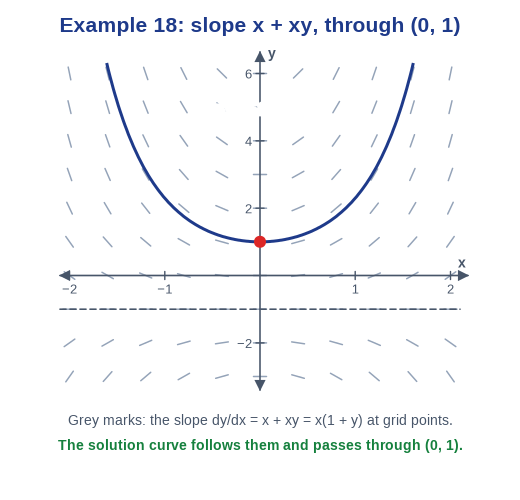
Example 18 (page 327): the curve through (0, 1) whose tangent slope at (x, y) is x + xy. dy/dx − xy = x, with P = −x, I.F. = e^(−x²/2). Then y e^(−x²/2) = ∫x e^(−x²/2) dx = −e^(−x²/2) + C (put t = −x²/2). So y = −1 + C e^(x²/2). At (0, 1): C = 2. y = −1 + 2e^(x²/2).
Exercise 9.5 (pages 328–329)
The book’s instruction for Questions 1 to 12: “For each of the differential equations given in Exercises 1 to 12, find the general solution:”
1. “dy/dx + 2y = sin x” I.F. = e²ˣ. y e²ˣ = ∫e²ˣ sin x dx = e²ˣ(2 sin x − cos x)/5 + C. y = (1/5)(2 sin x − cos x) + Ce⁻²ˣ.
2. “dy/dx + 3y = e⁻²ˣ” I.F. = e³ˣ. y e³ˣ = ∫eˣ dx = eˣ + C. y = e⁻²ˣ + Ce⁻³ˣ.
3. “dy/dx + y/x = x²” P = 1/x, I.F. = e^(log x) = x. xy = ∫x³ dx. xy = x⁴/4 + C.
4. “dy/dx + (sec x) y = tan x (0 ≤ x < π/2)” I.F. = e^(∫sec x dx) = sec x + tan x. y(sec x + tan x) = ∫tan x (sec x + tan x) dx = ∫(sec x tan x + sec² x − 1) dx. y(sec x + tan x) = sec x + tan x − x + C.
5. “cos² x dy/dx + y = tan x (0 ≤ x < π/2)” Divide by cos² x: dy/dx + sec² x · y = tan x sec² x. I.F. = e^(tan x). y e^(tan x) = ∫tan x sec² x e^(tan x) dx = ∫t eᵗ dt (t = tan x) = (t − 1)eᵗ + C. y = (tan x − 1) + Ce^(−tan x).
6. “x dy/dx + 2y = x² log x” dy/dx + (2/x)y = x log x, I.F. = x². yx² = ∫x³ log x dx = (x⁴/4) log x − x⁴/16 + C. y = (x²/16)(4 log|x| − 1) + Cx⁻².
7. “x log x dy/dx + y = (2/x) log x” dy/dx + y/(x log x) = 2/x². I.F. = e^(log(log x)) = log x. y log x = ∫(2/x²) log x dx = −(2/x) log x − 2/x + C (by parts). y log x = −(2/x)(1 + log|x|) + C.
8. “(1 + x²) dy + 2xy dx = cot x dx (x ≠ 0)” dy/dx + (2x/(1 + x²))y = cot x/(1 + x²). I.F. = 1 + x². y(1 + x²) = ∫cot x dx = log|sin x| + C. y = (1 + x²)⁻¹ log|sin x| + C(1 + x²)⁻¹.
Answer key note: the key prints the first term as (1 + x)⁻¹ log|sin x|. That is a misprint: the integrating factor is 1 + x², so the factor must be (1 + x²)⁻¹, as in the second term.
9. “x dy/dx + y − x + xy cot x = 0 (x ≠ 0)” dy/dx + (1/x + cot x)y = 1. I.F. = e^(log x + log sin x) = x sin x. xy sin x = ∫x sin x dx = −x cos x + sin x + C. y = 1/x − cot x + C/(x sin x).
10. “(x + y) dy/dx = 1” dx/dy = x + y, so dx/dy − x = y: linear in x, I.F. = e⁻ʸ. x e⁻ʸ = ∫y e⁻ʸ dy = −(y + 1)e⁻ʸ + C. So x = −(y + 1) + Ceʸ. x + y + 1 = Ceʸ.
11. “y dx + (x − y²) dy = 0” dx/dy + x/y = y. I.F. = y. xy = ∫y² dy = y³/3 + C. x = y²/3 + C/y.
12. “(x + 3y²) dy/dx = y (y > 0).” dx/dy = (x + 3y²)/y, so dx/dy − x/y = 3y. I.F. = 1/y. x/y = ∫3 dy = 3y + C. x = 3y² + Cy.
The book’s instruction for Questions 13 to 15: “For each of the differential equations given in Exercises 13 to 15, find a particular solution satisfying the given condition:”
13. “dy/dx + 2y tan x = sin x; y = 0 when x = π/3” I.F. = e^(2 log sec x) = sec² x. y sec² x = ∫sin x sec² x dx = ∫sec x tan x dx = sec x + C, so y = cos x + C cos² x. At x = π/3: 0 = 1/2 + C/4, C = −2. y = cos x − 2 cos² x.
14. “(1 + x²) dy/dx + 2xy = 1/(1 + x²); y = 0 when x = 1” dy/dx + (2x/(1 + x²))y = 1/(1 + x²)². I.F. = 1 + x². y(1 + x²) = ∫dx/(1 + x²) = tan⁻¹ x + C. At x = 1: 0 = π/4 + C. y(1 + x²) = tan⁻¹ x − π/4.
15. “dy/dx − 3y cot x = sin 2x; y = 2 when x = π/2” I.F. = e^(−3 log sin x) = 1/sin³ x. y/sin³ x = ∫2 sin x cos x/sin³ x dx = ∫2 cos x/sin² x dx = −2/sin x + C. So y = −2 sin² x + C sin³ x. At x = π/2: 2 = −2 + C, C = 4. y = 4 sin³ x − 2 sin² x.
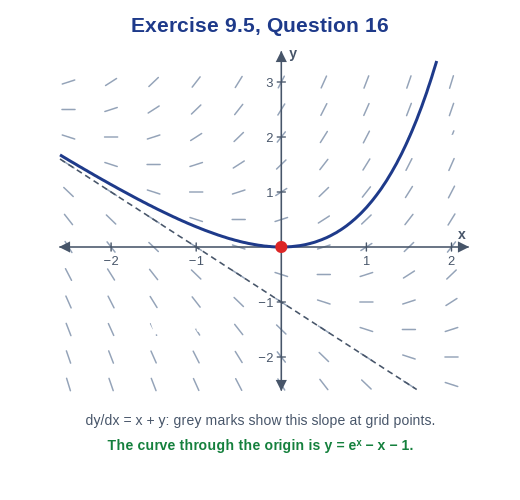
16. “Find the equation of a curve passing through the origin given that the slope of the tangent to the curve at any point (x, y) is equal to the sum of the coordinates of the point.” dy/dx = x + y, so dy/dx − y = x. I.F. = e⁻ˣ. y e⁻ˣ = ∫x e⁻ˣ dx = −(x + 1)e⁻ˣ + C, so y = −x − 1 + Ceˣ. Through (0, 0): C = 1. y = eˣ − x − 1, or x + y + 1 = eˣ.
17. “Find the equation of a curve passing through the point (0, 2) given that the sum of the coordinates of any point on the curve exceeds the magnitude of the slope of the tangent to the curve at that point by 5.” Following the book’s answer, take the condition as x + y − dy/dx = 5, that is dy/dx − y = x − 5. I.F. = e⁻ˣ. y e⁻ˣ = ∫(x − 5)e⁻ˣ dx = −(x − 5)e⁻ˣ − e⁻ˣ + C = (4 − x)e⁻ˣ + C, so y = 4 − x + Ceˣ. At (0, 2): C = −2. y = 4 − x − 2eˣ.
Why the word “magnitude” is set aside: read literally, the condition says |dy/dx| = x + y − 5. At the given point (0, 2) that would make |dy/dx| = −3, and a magnitude cannot be negative. So the book (and this answer) takes the slope itself, dy/dx = x + y − 5.
18. “The Integrating Factor of the differential equation x dy/dx − y = 2x² is (A) e⁻ˣ (B) e⁻ʸ (C) 1/x (D) x” dy/dx − y/x = 2x, so P = −1/x and I.F. = e^(−log x) = 1/x. Answer (C).
19. “The Integrating Factor of the differential equation (1 − y²) dx/dy + yx = ay (−1 < y < 1) is (A) 1/(y² − 1) (B) 1/√(y² − 1) (C) 1/(1 − y²) (D) 1/√(1 − y²)” dx/dy + (y/(1 − y²))x = ay/(1 − y²). P₁ = y/(1 − y²), and ∫P₁ dy = −(1/2) log(1 − y²). So I.F. = (1 − y²)^(−1/2). Answer (D).
Miscellaneous Examples 19 to 22 (pages 329–333)
Example 19 (page 329): show that y = e^(ax)(c₁ cos bx + c₂ sin bx) solves y″ − 2ay′ + (a² + b²)y = 0. Write y = e^(ax)u with u = c₁ cos bx + c₂ sin bx, so u″ = −b²u. Then y′ = e^(ax)(au + u′) and y″ = e^(ax)(a²u + 2au′ + u″). Substituting, y″ − 2ay′ + (a² + b²)y = e^(ax)[a²u + 2au′ + u″ − 2a²u − 2au′ + a²u + b²u] = e^(ax)(u″ + b²u) = 0. It is a solution.
Example 20 (page 330): particular solution of log(dy/dx) = 3x + 4y, with y = 0 when x = 0. dy/dx = e³ˣ e⁴ʸ, so e⁻⁴ʸ dy = e³ˣ dx and −e⁻⁴ʸ/4 = e³ˣ/3 + C. Multiply by −12: 4e³ˣ + 3e⁻⁴ʸ + 12C = 0. At (0, 0): 7 + 12C = 0, so 12C = −7. 4e³ˣ + 3e⁻⁴ʸ − 7 = 0.
Example 21 (page 331): solve (x dy − y dx) y sin(y/x) = (y dx + x dy) x cos(y/x).
- Expand and collect dy and dx: dy/dx = (xy cos(y/x) + y² sin(y/x))/(xy sin(y/x) − x² cos(y/x)).
- Divide top and bottom by x². With v = y/x, dy/dx = (v cos v + v² sin v)/(v sin v − cos v). It depends on v only, so the equation is homogeneous.
- Put y = vx: x dv/dx = 2v cos v/(v sin v − cos v) (the same algebra as Exercise 9.4 Question 7).
- Separate: (tan v − 1/v) dv = 2 dx/x.
- Integrate: log|sec v| − log|v| = 2 log|x| + log|C₁|, so sec v = C₁ v x² (the ± sign goes into the constant).
- Since v x² = xy:
Answer: sec(y/x) = Cxy.
Example 22 (page 333): solve (tan⁻¹ y − x) dy = (1 + y²) dx. dx/dy + x/(1 + y²) = tan⁻¹ y/(1 + y²), linear in x. I.F. = e^(tan⁻¹ y). So x e^(tan⁻¹ y) = ∫(tan⁻¹ y/(1 + y²)) e^(tan⁻¹ y) dy. With t = tan⁻¹ y, this is ∫t eᵗ dt = (t − 1)eᵗ. So x e^(tan⁻¹ y) = (tan⁻¹ y − 1)e^(tan⁻¹ y) + C. x = (tan⁻¹ y − 1) + C e^(−tan⁻¹ y).
Miscellaneous Exercise on Chapter 9 (pages 333–335)
1. “For each of the differential equations given below, indicate its order and degree (if defined). (i) d²y/dx² + 5x(dy/dx)² − 6y = log x (ii) (dy/dx)³ − 4(dy/dx)² + 7y = sin x (iii) d⁴y/dx⁴ − sin(d³y/dx³) = 0”
(i) Highest derivative y″, power 1: order 2, degree 1. (ii) Only y′, highest power 3: order 1, degree 3. (iii) Highest derivative y⁗, but sin(y‴) is not a polynomial in y‴: order 4, degree not defined.
2. “For each of the exercises given below, verify that the given function (implicit or explicit) is a solution of the corresponding differential equation.”
(i) “xy = a eˣ + b e⁻ˣ + x² : x d²y/dx² + 2 dy/dx − xy + x² − 2 = 0”. Differentiate: y + xy′ = aeˣ − be⁻ˣ + 2x. Again: 2y′ + xy″ = aeˣ + be⁻ˣ + 2 = (xy − x²) + 2. So xy″ + 2y′ − xy + x² − 2 = 0. Verified.
(ii) “y = eˣ (a cos x + b sin x) : d²y/dx² − 2 dy/dx + 2y = 0”. y′ = y + eˣ(−a sin x + b cos x), so eˣ(−a sin x + b cos x) = y′ − y. Differentiating again, y″ = y′ + (y′ − y) − eˣ(a cos x + b sin x) = 2y′ − 2y. So y″ − 2y′ + 2y = 0. Verified.
(iii) “y = x sin 3x : d²y/dx² + 9y − 6 cos 3x = 0”. y′ = sin 3x + 3x cos 3x and y″ = 6 cos 3x − 9x sin 3x. Then y″ + 9y − 6 cos 3x = 6 cos 3x − 9x sin 3x + 9x sin 3x − 6 cos 3x = 0. Verified.
(iv) “x² = 2y² log y : (x² + y²) dy/dx − xy = 0”. Differentiate: 2x = (4y log y + 2y)y′, so y′ = x/(y(2 log y + 1)). Then (x² + y²)y′ = y²(2 log y + 1) · x/(y(2 log y + 1)) = xy. Verified.
3. “Prove that x² – y² = c (x² + y²)² is the general solution of differential equation (x³ – 3x y²) dx = (y³ – 3x²y) dy, where c is a parameter.”
- Differentiate x² − y² = c(x² + y²)²: 2x − 2yy′ = 2c(x² + y²)(2x + 2yy′).
- Remove c by putting c = (x² − y²)/(x² + y²)², and clear the fraction: (x − yy′)(x² + y²) = 2(x² − y²)(x + yy′).
- Expand both sides and collect the y′ terms: −x³ + 3xy² = y′(3x²y − y³).
- So y′ = (x³ − 3xy²)/(y³ − 3x²y), which is the same as (x³ − 3xy²) dx = (y³ − 3x²y) dy.
- The relation satisfies the equation, and it has one arbitrary constant (c) for a first order equation.
Answer: so x² − y² = c(x² + y²)² is the general solution.
4. “Find the general solution of the differential equation dy/dx + √((1 − y²)/(1 − x²)) = 0.” dy/√(1 − y²) = −dx/√(1 − x²). Integrate: sin⁻¹ y + sin⁻¹ x = C.
5. “Show that the general solution of the differential equation dy/dx + (y² + y + 1)/(x² + x + 1) = 0 is given by (x + y + 1) = A (1 − x − y − 2xy), where A is parameter.”
- Separate: dy/(y² + y + 1) + dx/(x² + x + 1) = 0.
- Complete the square: t² + t + 1 = (t + 1/2)² + 3/4. So ∫dt/(t² + t + 1) = (2/√3) tan⁻¹((2t + 1)/√3).
- Integrate and divide by 2/√3: tan⁻¹((2y + 1)/√3) + tan⁻¹((2x + 1)/√3) = C₁.
- Let p = (2y + 1)/√3 and q = (2x + 1)/√3, and use tan⁻¹ p + tan⁻¹ q = tan⁻¹((p + q)/(1 − pq)). Here p + q = 2(x + y + 1)/√3 and 1 − pq = 2(1 − x − y − 2xy)/3.
- So (p + q)/(1 − pq) = √3(x + y + 1)/(1 − x − y − 2xy) = tan C₁, a constant.
Answer: x + y + 1 = A(1 − x − y − 2xy), with A = (tan C₁)/√3.
6. “Find the equation of the curve passing through the point (0, π/4) whose differential equation is sin x cos y dx + cos x sin y dy = 0.” Divide by cos x cos y: tan x dx + tan y dy = 0. Integrate: log|sec x| + log|sec y| = log C, so sec x sec y = C. At (0, π/4): C = 1 × √2 = √2. So sec y = √2 cos x, that is cos y = sec x/√2.
7. “Find the particular solution of the differential equation (1 + e²ˣ) dy + (1 + y²) eˣ dx = 0, given that y = 1 when x = 0.” dy/(1 + y²) + eˣ dx/(1 + e²ˣ) = 0. With t = eˣ the second term is dt/(1 + t²), so tan⁻¹ y + tan⁻¹(eˣ) = C. At (0, 1): π/4 + π/4 = C. tan⁻¹ y + tan⁻¹(eˣ) = π/2.
8. “Solve the differential equation y e^(x/y) dx = (x e^(x/y) + y²) dy (y ≠ 0).” dx/dy = x/y + y e^(−x/y). Put x = vy: v + y dv/dy = v + y e⁻ᵛ, so eᵛ dv = dy. Integrate: eᵛ = y + C. e^(x/y) = y + C.
9. “Find a particular solution of the differential equation (x – y) (dx + dy) = dx – dy, given that y = –1, when x = 0. (Hint: put x – y = t)”
- Put t = x − y. Then dt = dx − dy, so dy = dx − dt and dx + dy = 2 dx − dt.
- The equation (x − y)(dx + dy) = dx − dy becomes t(2 dx − dt) = dt.
- Rearrange: 2t dx = (1 + t) dt, so 2 dx = (1 + 1/t) dt.
- Integrate: 2x = t + log|t| + C.
- Put t = x − y: 2x = x − y + log|x − y| + C, so x + y = log|x − y| + C.
- Use y = −1 when x = 0: −1 = log 1 + C, so C = −1.
Answer: log|x − y| = x + y + 1.
10. “Solve the differential equation [e^(−2√x)/√x − y/√x] dx/dy = 1 (x ≠ 0).” dy/dx = e^(−2√x)/√x − y/√x, so dy/dx + y/√x = e^(−2√x)/√x. I.F. = e^(∫x^(−1/2) dx) = e^(2√x). y e^(2√x) = ∫(1/√x) dx = 2√x + C. y e^(2√x) = 2√x + C.
11. “Find a particular solution of the differential equation dy/dx + y cot x = 4x cosec x (x ≠ 0), given that y = 0 when x = π/2.” I.F. = sin x. y sin x = ∫4x dx = 2x² + C. At x = π/2: 0 = π²/2 + C. y sin x = 2x² − π²/2 (sin x ≠ 0).
12. “Find a particular solution of the differential equation (x + 1) dy/dx = 2 e⁻ʸ − 1, given that y = 0 when x = 0.” Separate: dy/(2e⁻ʸ − 1) = dx/(x + 1). Multiply top and bottom on the left by eʸ: eʸ dy/(2 − eʸ) = dx/(x + 1). Integrate: −log|2 − eʸ| = log|x + 1| + C. At (0, 0): C = 0. So (2 − eʸ)(x + 1) = 1, eʸ = 2 − 1/(x + 1) = (2x + 1)/(x + 1). y = log|(2x + 1)/(x + 1)|, x ≠ −1.
13. “The general solution of the differential equation (y dx – x dy)/y = 0 is (A) xy = C (B) x = Cy² (C) y = Cx (D) y = Cx²” y dx = x dy, so dy/y = dx/x and log|y| = log|x| + log|C|. y = Cx. Answer (C).
14. “The general solution of a differential equation of the type dx/dy + P₁x = Q₁ is (A) y e^(∫P₁ dy) = ∫(Q₁ e^(∫P₁ dy)) dy + C (B) y . e^(∫P₁ dx) = ∫(Q₁ e^(∫P₁ dx)) dx + C (C) x e^(∫P₁ dy) = ∫(Q₁ e^(∫P₁ dy)) dy + C (D) x e^(∫P₁ dx) = ∫(Q₁ e^(∫P₁ dx)) dx + C” Here x is the dependent variable and y the independent one, so the I.F. is e^(∫P₁ dy) and it multiplies x. Answer (C).
15. “The general solution of the differential equation eˣ dy + (y eˣ + 2x) dx = 0 is (A) x eʸ + x² = C (B) x eʸ + y² = C (C) y eˣ + x² = C (D) y eʸ + x² = C” eˣ dy + y eˣ dx = d(y eˣ), so the equation is d(y eˣ) + 2x dx = 0. Integrate: y eˣ + x² = C. Answer (C).
Practice
-
The order and degree of y‴ + (y′)⁴ + y = 0 are:
Show answer
Answer: (a) order 3, degree 1
-
The integrating factor of dy/dx + 2y = e⁻ˣ is:
Show answer
Answer: (a) e²ˣ
-
The substitution that solves dy/dx = (x² + y²)/(xy) is:
Show answer
Answer: (a) y = vx
-
Solve dy/dx = eˣ/y, given y = 2 when x = 0.
Show answer
Answer: Separate: y dy = eˣ dx, so y²/2 = eˣ + C. At x = 0, 2 = 1 + C, so C = 1 and y² = 2eˣ + 2.
-
Solve dy/dx + y/x = 1 (x > 0).
Show answer
Answer: Linear with P = 1/x, I.F. = e^(log x) = x. Then xy = ∫x dx = x²/2 + C, so y = x/2 + C/x.
Stuck on a question?
Take a photo and Lagnever AI explains it step by step. Try it for 7 days for ₹2.
Get it on Google Play Open in browser
For parents: after the trial, the plan renews monthly by UPI or card autopay. You can cancel anytime in the app.