
Class 12 Maths Chapter 9: Differential Equations Notes
This chapter in five lines
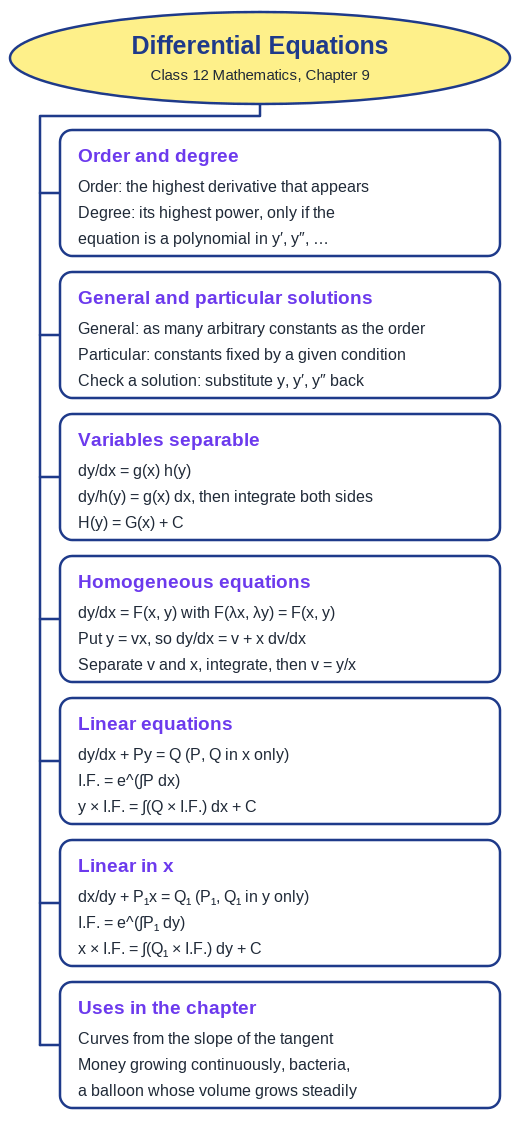
A differential equation links x, y and derivatives of y. Its order is the highest derivative in it; its degree is the power of that derivative when the equation is a polynomial in the derivatives. First order, first degree equations are solved by separating the variables, by y = vx when they are homogeneous, or by the integrating factor e^(∫P dx) when they are linear.
What is this chapter about?
In Chapter 7, Integrals, we found a function from its derivative: if dy/dx = g(x), then y = ∫g(x) dx. A differential equation is the wider version of that question. The derivative may now depend on y as well as on x, as in dy/dx = x + y, or the equation may contain y″ and y‴. Equations like these describe anything whose rate of change is known: a sum of money growing with interest, a population of bacteria, the shape of a curve whose tangent slope is given.
The chapter covers book pages 300–337. It has four parts: the words used to describe a differential equation (order and degree), what a solution is (general and particular), three methods for first order, first degree equations, and four Miscellaneous Examples that mix the methods.
Order and degree
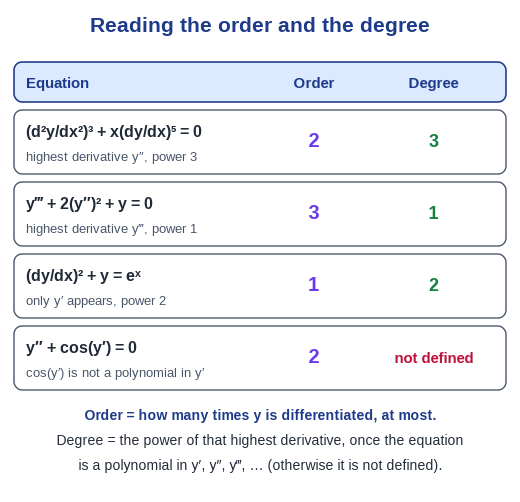
The order of a differential equation tells you how high a derivative of y it contains: y″ means order 2, y‴ order 3. The degree is the power of that highest derivative, but only when the equation is a polynomial in y′, y″, y‴ and so on. If a derivative sits inside sin, cos, eˣ, log or a root that cannot be cleared, the degree is not defined. The equation does not have to be a polynomial in y itself.
More examples: order and degree of a differential equation.
General and particular solutions
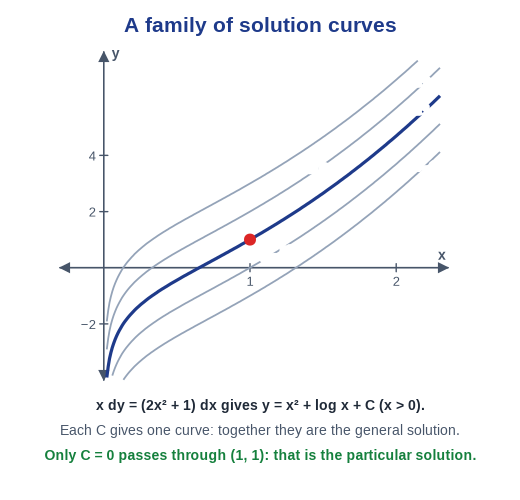
A solution of a differential equation is a function, not a number. y = φ(x) is a solution if substituting it and its derivatives makes the equation true. For y″ + y = 0, the function y = a sin(x + b) works for every a and b: y″ = −a sin(x + b), so y″ + y = 0.
- A general solution keeps arbitrary constants, as many as the order: two for a second order equation.
- A particular solution has the constants fixed, for example by a condition such as y = 0 when x = 0, or by a point the curve must pass through.
Each value of the constant gives one curve, so a general solution is a whole family of solution curves; the particular solution picks one member.
Three methods for first order, first degree equations
Every equation in this part can be written dy/dx = F(x, y).
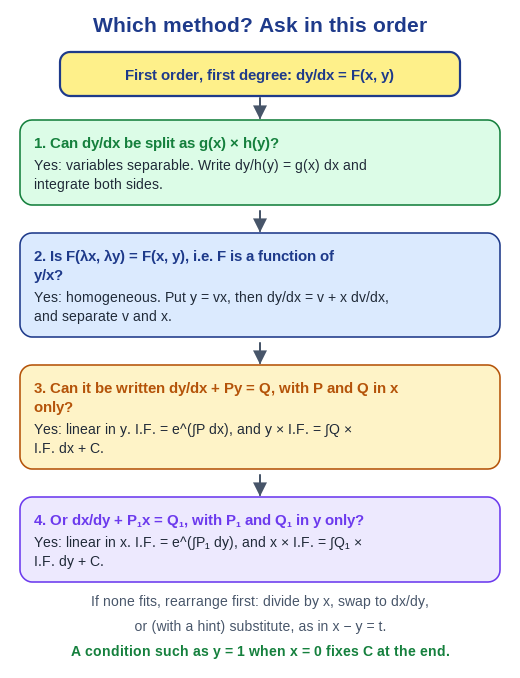
1. Variables separable. If F(x, y) = g(x) h(y), move all y-terms to dy and all x-terms to dx, then integrate: ∫dy/h(y) = ∫g(x) dx + C. For dy/dx = −4xy², ∫dy/y² = ∫−4x dx gives −1/y = −2x² + C.
2. Homogeneous equations. If F(λx, λy) = F(x, y) for every λ ≠ 0, then F depends only on y/x. Substitute y = vx, so dy/dx = v + x dv/dx. The equation becomes separable in v and x. After integrating, put v = y/x back.
3. Linear equations. If the equation is dy/dx + Py = Q with P and Q functions of x only, multiply by the integrating factor I.F. = e^(∫P dx). The left side becomes the derivative of y × I.F., so
y × I.F. = ∫(Q × I.F.) dx + C.
If x and y swap roles, dx/dy + P₁x = Q₁, use I.F. = e^(∫P₁ dy) and x × I.F. = ∫(Q₁ × I.F.) dy + C.
Full working for all three: methods of solving differential equations.
Where the equations come from
- Curves. The slope of the tangent is dy/dx, so a rule for the slope at (x, y) is a differential equation. The point the curve passes through fixes the constant.
- Growth. If an amount grows at a rate proportional to itself, dP/dt = kP, and separating the variables gives P = P₀ e^(kt). In the book’s Example 9, money growing continuously at 5% a year doubles in 20 log 2 ≈ 13.86 years.
- Volume and rates. A balloon whose volume grows at a constant rate leads to d/dt (4πr³/3) = k.
Before we move on
This is the rationalised book (marked Reprint 2026-27). Its introduction still mentions forming differential equations, but there is no such section or exercise: the chapter keeps 9.2 Basic Concepts, 9.3 General and Particular Solutions and 9.4 the three methods, with Exercises 9.1 to 9.5, a Miscellaneous Exercise of 15 questions and 22 worked examples. Every one of them is worked out in the NCERT solutions for Chapter 9, and every answer there was substituted back into its equation by a script.
Key terms
| Term | Meaning |
|---|---|
| Differential equation | An equation that contains the derivative (or derivatives) of a dependent variable y with respect to an independent variable x, such as dy/dx + 2y = sin x. |
| Ordinary differential equation | One in which all derivatives are taken with respect to a single independent variable. This chapter uses only these and calls them simply differential equations. |
| Order | The order of the highest derivative of y that appears. y″ + y = 0 has order 2. |
| Degree | The highest power of the highest order derivative, defined only when the equation is a polynomial in y′, y″, y‴, … . It is not defined for y′ + sin(y′) = 0. |
| Solution | A function y = φ(x) that turns the equation into a true statement when it and its derivatives are substituted. Its graph is called a solution curve (integral curve). |
| General solution | A solution with arbitrary constants, as many as the order of the equation. y = a cos x + b sin x is the general solution of y″ + y = 0. |
| Particular solution | A solution with no arbitrary constant, got by giving the constants fixed values, usually from a condition such as y = 1 when x = 0. |
| Variables separable | An equation dy/dx = g(x) h(y). It is solved as ∫dy/h(y) = ∫g(x) dx. |
| Homogeneous function of degree n | F(x, y) with F(λx, λy) = λⁿ F(x, y) for every nonzero λ. y² + 2xy has degree 2; cos(y/x) has degree 0. |
| Homogeneous differential equation | dy/dx = F(x, y) where F is homogeneous of degree zero, so F depends only on y/x. Solved with y = vx (or x = vy for dx/dy = F(x, y)). |
| Linear differential equation | dy/dx + Py = Q with P and Q constants or functions of x only; or dx/dy + P₁x = Q₁ with P₁ and Q₁ in y only. |
| Integrating factor (I.F.) | e^(∫P dx). Multiplying dy/dx + Py = Q by it turns the left side into d/dx (y × I.F.), so y × I.F. = ∫Q × I.F. dx + C. |
Topics in this chapter
Practice
-
The order and degree of (d²y/dx²)² + (dy/dx)³ + y = 0 are:
Show answer
Answer: (a) order 2, degree 2
-
How many arbitrary constants does the general solution of a second order differential equation have?
Show answer
Answer: (c) 2
-
Which of these is a homogeneous function of degree zero?
Show answer
Answer: (b) (x + y)/(x − y)
-
The integrating factor of dy/dx + (1/x)y = x² (x > 0) is:
Show answer
Answer: (a) x
-
The general solution of dy/dx = y (y > 0) is:
Show answer
Answer: (b) y = Ceˣ
Questions students ask
What are the main topics of Class 12 Maths Chapter 9?
The order and degree of a differential equation, general and particular solutions, and three ways to solve first order, first degree equations: separating the variables, homogeneous equations with y = vx, and linear equations with an integrating factor. The book uses them for curves with a given tangent slope, money growing continuously and bacteria growth.
Is formation of differential equations in the 2026-27 book?
No. The introduction of the rationalised chapter still lists it, but the chapter has no section or exercise on forming an equation from a family of curves. Its sections are 9.1 to 9.4, with Exercises 9.1 to 9.5, so these notes do not teach it.
How do I know which method to use?
Ask in order: can dy/dx be split as g(x) × h(y)? Then separate. Is dy/dx a function of y/x only? Then put y = vx. Is it dy/dx + Py = Q with P, Q in x only (or dx/dy + P₁x = Q₁ with P₁, Q₁ in y only)? Then use the integrating factor. Sometimes an equation fits more than one method.
Why is the degree of y″ + cos(y′) = 0 not defined?
Degree needs the equation to be a polynomial in the derivatives. cos(y′) is not a polynomial in y′, so no power of y″ can be called the degree. The order is still 2.
Stuck on a question?
Take a photo and Lagnever AI explains it step by step. Try it for 7 days for ₹2.
Get it on Google Play Open in browser
For parents: after the trial, the plan renews monthly by UPI or card autopay. You can cancel anytime in the app.