
Class 12 Maths Chapter 9: Differential Equations Notes Hinglish mein
Ye chapter 5 lines mein
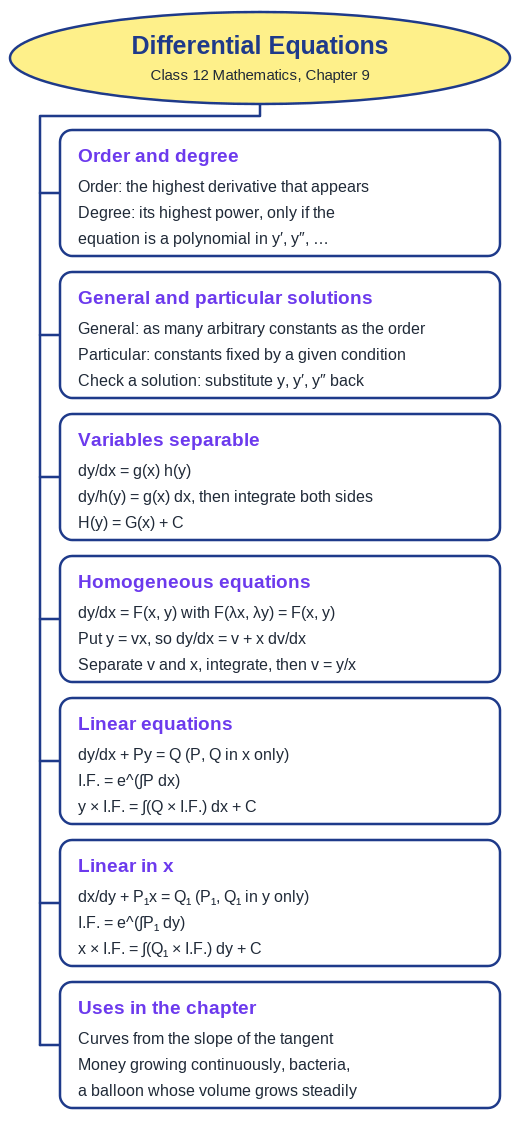
Differential equation x, y aur y ke derivatives ko jodti hai. Uska order sabse oonche derivative ka order hai; degree us derivative ki power hai, jab equation derivatives mein polynomial ho. First order, first degree equations teen tareeke se hal hoti hain: variables alag karke, homogeneous ho to y = vx rakhkar, aur linear ho to integrating factor e^(∫P dx) se.
Ye chapter kis baare mein hai?
Chapter 7, Integrals, mein humne derivative se function nikaala tha: agar dy/dx = g(x), to y = ∫g(x) dx. Differential equation usi sawal ka bada roop hai. Ab derivative x ke saath y par bhi depend kar sakta hai, jaise dy/dx = x + y, ya equation mein y″ aur y‴ bhi aa sakte hain. Aisi equations har us cheez ko describe karti hain jiske badalne ki rate pata ho: interest ke saath badhta paisa, bacteria ki ginti, ya aisa curve jiske tangent ka slope diya ho.
Chapter book ke pages 300–337 mein hai. Iske chaar hisse hain: differential equation ko describe karne wale shabd (order aur degree), solution kya hota hai (general aur particular), first order, first degree equations ke teen methods, aur chaar Miscellaneous Examples jo methods ko milate hain.
Order aur degree
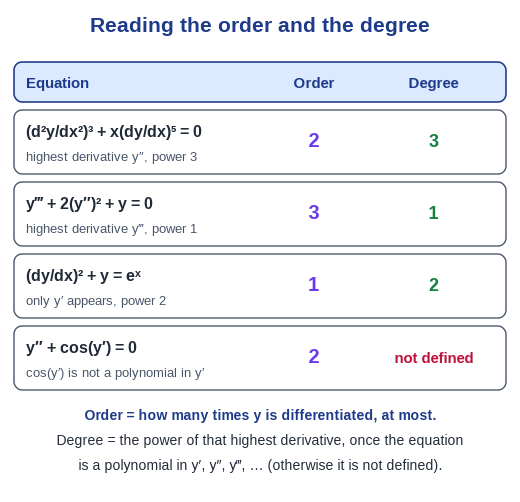
Differential equation ka order usme y ke sabse oonche derivative ka order hai. Degree us sabse oonche derivative ki power hai, lekin sirf tab jab equation y′, y″, y‴ waghairah mein polynomial ho. Agar koi derivative sin, cos, eˣ, log ya aise root ke andar baitha hai jo hataya na ja sake, to degree defined nahi hoti. Equation ka y mein polynomial hona zaroori nahi.
Aur examples: order aur degree kaise pata karein.
General aur particular solutions
Differential equation ka solution ek function hota hai, number nahi. y = φ(x) solution hai agar use aur uske derivatives ko daalne se equation sach ho jaye. y″ + y = 0 ke liye y = a sin(x + b) har a aur b ke liye chalta hai: y″ = −a sin(x + b), to y″ + y = 0.
- General solution mein arbitrary constants rehte hain, jitna order utne: second order equation ke liye do.
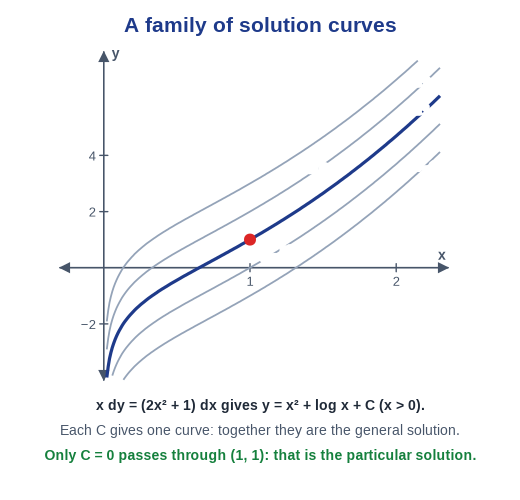
- Particular solution mein constants fixed hote hain, jaise y = 0 jab x = 0 wali condition se, ya us point se jisse curve ko guzarna hai.
Constant ki har value ek curve deti hai, to general solution solution curves ki poori family hai; particular solution usme se ek member chunta hai.
First order, first degree equations ke teen methods
Is hisse ki har equation dy/dx = F(x, y) likhi ja sakti hai.
1. Variables separable. Agar F(x, y) = g(x) h(y), to saare y-terms dy ke saath aur saare x-terms dx ke saath le jao, phir integrate karo: ∫dy/h(y) = ∫g(x) dx + C. dy/dx = −4xy² ke liye ∫dy/y² = ∫−4x dx se −1/y = −2x² + C.
2. Homogeneous equations. Agar har λ ≠ 0 ke liye F(λx, λy) = F(x, y), to F sirf y/x par depend karta hai. y = vx rakho, to dy/dx = v + x dv/dx. Equation v aur x mein separable ban jaati hai. Integrate karne ke baad v = y/x wapas rakho.
3. Linear equations. Agar equation dy/dx + Py = Q hai, P aur Q sirf x ke functions, to integrating factor I.F. = e^(∫P dx) se multiply karo. Left side y × I.F. ka derivative ban jaati hai, to
y × I.F. = ∫(Q × I.F.) dx + C.
Agar x aur y ki jagah badal jaye, dx/dy + P₁x = Q₁, to I.F. = e^(∫P₁ dy) aur x × I.F. = ∫(Q₁ × I.F.) dy + C.
Teeno ki poori working: differential equations hal karne ke tareeke.
Equations kahan se aati hain
- Curves. Tangent ka slope dy/dx hai, to (x, y) par slope ka koi rule ek differential equation hai. Jis point se curve guzarta hai, wo constant fix karta hai.
- Growth. Agar koi amount apne hi anupaat mein badhe, dP/dt = kP, to variables alag karne se P = P₀ e^(kt). Book ke Example 9 mein 5% saalana continuously badhta paisa 20 log 2 ≈ 13.86 saal mein double hota hai.
- Volume aur rates. Jis balloon ka volume constant rate se badhe, usse d/dt (4πr³/3) = k milta hai.
Aage badhne se pehle
Ye rationalised book hai (Reprint 2026-27). Iska introduction abhi bhi differential equations banane (formation) ka zikr karta hai, lekin aisa koi section ya exercise nahi hai: chapter mein 9.2 Basic Concepts, 9.3 General and Particular Solutions aur 9.4 teen methods hain, Exercises 9.1 se 9.5, 15 sawalon ki Miscellaneous Exercise aur 22 worked examples ke saath. Har ek Chapter 9 ke NCERT solutions mein hal kiya gaya hai, aur wahan ka har jawab ek script ne wapas uski equation mein daal kar jaancha.
Key terms (zaroori shabd)
| Term | Matlab |
|---|---|
| Differential equation | Aisi equation jisme dependent variable y ka independent variable x ke respect mein derivative (ya derivatives) ho, jaise dy/dx + 2y = sin x. |
| Ordinary differential equation | Jisme saare derivatives ek hi independent variable ke respect mein hon. Ye chapter sirf inhi ko leta hai aur inhe seedhe differential equations kehta hai. |
| Order | Equation mein aane wale y ke sabse oonche derivative ka order. y″ + y = 0 ka order 2 hai. |
| Degree | Sabse oonche order wale derivative ki sabse badi power; sirf tab defined jab equation y′, y″, y‴, … mein polynomial ho. y′ + sin(y′) = 0 ki degree defined nahi hai. |
| Solution | Aisa function y = φ(x) jise aur jiske derivatives ko daalne par equation sach ho jaye. Iske graph ko solution curve (integral curve) kehte hain. |
| General solution | Arbitrary constants wala solution, jitna order utne constants. y = a cos x + b sin x, y″ + y = 0 ka general solution hai. |
| Particular solution | Bina kisi arbitrary constant ka solution, jo constants ko fixed values dene se milta hai, aksar y = 1 jab x = 0 jaisi condition se. |
| Variables separable | dy/dx = g(x) h(y) wali equation. Ise ∫dy/h(y) = ∫g(x) dx se hal karte hain. |
| Degree n ka homogeneous function | F(x, y) jisme har nonzero λ ke liye F(λx, λy) = λⁿ F(x, y). y² + 2xy ki degree 2 hai; cos(y/x) ki degree 0. |
| Homogeneous differential equation | dy/dx = F(x, y) jahan F degree zero ka homogeneous ho, yaani F sirf y/x par depend kare. y = vx se hal hoti hai (dx/dy = F(x, y) ke liye x = vy). |
| Linear differential equation | dy/dx + Py = Q jahan P aur Q constants ya sirf x ke functions hon; ya dx/dy + P₁x = Q₁ jahan P₁ aur Q₁ sirf y mein hon. |
| Integrating factor (I.F.) | e^(∫P dx). dy/dx + Py = Q ko isse multiply karne par left side d/dx (y × I.F.) ban jaati hai, to y × I.F. = ∫Q × I.F. dx + C. |
Is chapter ke topics
Practice karo
-
(d²y/dx²)² + (dy/dx)³ + y = 0 ka order aur degree hain:
Jawab dekho
Jawab: (a) order 2, degree 2
-
Second order differential equation ke general solution mein arbitrary constants kitne hote hain?
Jawab dekho
Jawab: (c) 2
-
Inme se degree zero ka homogeneous function kaunsa hai?
Jawab dekho
Jawab: (b) (x + y)/(x − y)
-
dy/dx + (1/x)y = x² (x > 0) ka integrating factor hai:
Jawab dekho
Jawab: (a) x
-
dy/dx = y (y > 0) ka general solution hai:
Jawab dekho
Jawab: (b) y = Ceˣ
Students ke sawal
Class 12 Maths Chapter 9 ke main topics kya hain?
Differential equation ka order aur degree, general aur particular solutions, aur first order, first degree equations hal karne ke teen tareeke: variables alag karna, y = vx se homogeneous equations, aur integrating factor se linear equations. Book inhe diye gaye tangent slope wale curves, continuously badhte paise aur bacteria growth par lagati hai.
Kya 2026-27 book mein formation of differential equations hai?
Nahi. Rationalised chapter ka introduction ise abhi bhi list karta hai, lekin curves ki family se equation banane par koi section ya exercise nahi hai. Iske sections 9.1 se 9.4 hain, Exercises 9.1 se 9.5 ke saath, isliye ye notes use nahi padhate.
Kaise pata karein kaunsa method lagana hai?
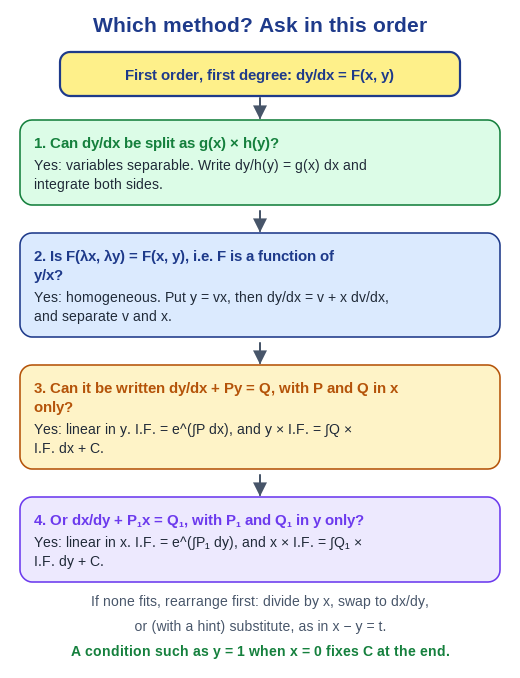
Kram se poochho: kya dy/dx ko g(x) × h(y) mein toda ja sakta hai? To alag karo. Kya dy/dx sirf y/x ka function hai? To y = vx rakho. Kya ye dy/dx + Py = Q hai jisme P, Q sirf x mein hon (ya dx/dy + P₁x = Q₁, P₁, Q₁ sirf y mein)? To integrating factor lagao. Kabhi ek equation ek se zyada method mein fit hoti hai.
y″ + cos(y′) = 0 ki degree defined kyun nahi hai?
Degree ke liye equation ka derivatives mein polynomial hona zaroori hai. cos(y′), y′ mein polynomial nahi hai, isliye y″ ki kisi power ko degree nahi keh sakte. Order phir bhi 2 hai.
Koi sawal atak gaya?
Photo lo, Lagnever AI step-by-step samjhayega. 7 din ka trial sirf ₹2.
Google Play se app lo Browser mein kholo
Parents ke liye: trial ke baad plan har mahine UPI ya card autopay se renew hota hai. App mein kabhi bhi cancel kar sakte hain.