
How do you find the order and degree of a differential equation?
Answer in short
The order is the order of the highest derivative of y that appears. The degree is the power of that derivative, defined only when the equation is a polynomial in the derivatives. So (y″)³ + (y′)⁴ + y = 0 has order 2 and degree 3, while y″ + sin(y′) = 0 has order 2 and no degree.
Stuck on a question? Take a photo and Lagnever AI explains it step by step. Try it for 7 days for ₹2. Get it on Google Play
What makes an equation a differential equation?
Equations such as x² − 5x + 6 = 0 or x + y = 7 contain only variables. An equation like dy/dx + 3y = x² also contains a derivative: the rate dy/dx at which the unknown function y changes with x. Any equation with such a derivative is a differential equation. When all the derivatives are taken with respect to one variable, it is an ordinary differential equation; these are the only kind in Class 12.
Shorthand used everywhere: y′ = dy/dx, y″ = d²y/dx², y‴ = d³y/dx³, and for higher orders yₙ = dⁿy/dxⁿ.
Order: the highest derivative
Find the highest derivative of y that appears. Its order is the order of the equation.
| Equation | Highest derivative | Order |
|---|---|---|
| dy/dx = cos x | y′ | 1 |
| d²y/dx² − 4y = 0 | y″ | 2 |
| y‴ + x(y″)⁵ − y′ = 0 | y‴ | 3 |
| (ds/dt)⁴ + 3s d²s/dt² = 0 | d²s/dt² | 2 |
The last row shows that powers do not matter for the order: (ds/dt)⁴ is a fourth power of a first derivative, still only order 1 for that term.
Degree: the power of that derivative
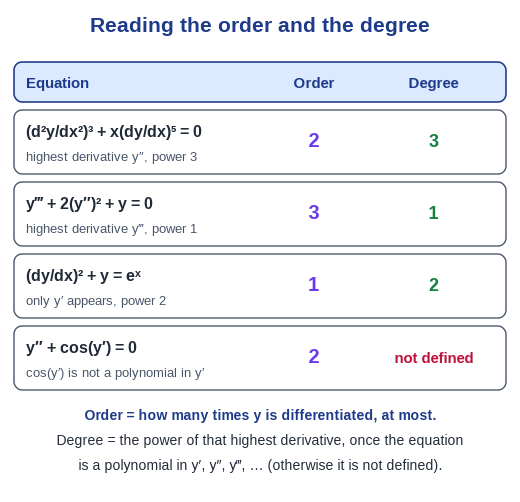
The degree needs one condition first: the equation must be a polynomial in the derivatives y′, y″, y‴, … . Then the degree is the highest power of the highest order derivative.
- (y″)³ + x(y′)⁵ = 0: highest derivative y″, power 3, so degree 3.
- y‴ + 2(y″)² + y = 0: highest derivative y‴, power 1, so degree 1.
- (y′)² + y′ − sin² y = 0: only y′ appears, highest power 2, so degree 2. The sin² y is a function of y, not of a derivative, so it does not matter.
- y″ + cos(y′) = 0: cos(y′) is not a polynomial in y′, so the degree is not defined.
Worked examples
(a) d²y/dx² + 5x(dy/dx)² − 6y = log x. The highest derivative is y″, so the order is 2. The equation is a polynomial in y″ and y′ (log x involves only x), and y″ appears to the power 1. Order 2, degree 1.
(b) (dy/dx)³ − 4(dy/dx)² + 7y = sin x. Only y′ appears; its highest power is 3. Order 1, degree 3.
(c) y⁗ − sin(y‴) = 0. The highest derivative is y⁗, so the order is 4. sin(y‴) is not a polynomial in y‴. Order 4, degree not defined.
What is a solution?
The solution of an ordinary equation like x² − 1 = 0 is a number. The solution of a differential equation is a function y = φ(x): when y, y′, y″, … are replaced by φ and its derivatives, the two sides agree. The graph of a solution is a solution curve (or integral curve).
Example. Check that y = a cos x + b sin x solves y″ + y = 0 for all constants a and b. y′ = −a sin x + b cos x and y″ = −a cos x − b sin x. Then y″ + y = (−a cos x − b sin x) + (a cos x + b sin x) = 0. It works.
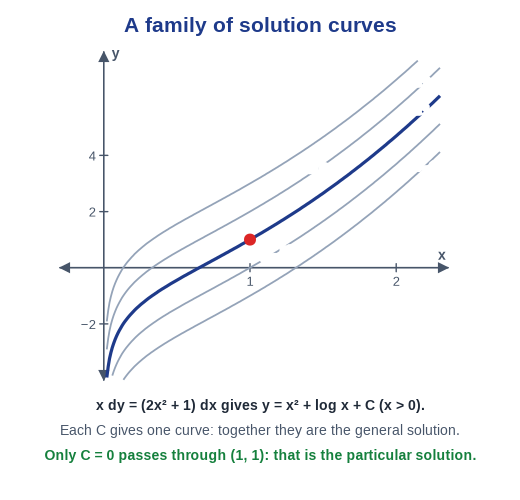
- General solution: contains arbitrary constants, as many as the order. Here y = a cos x + b sin x has two, matching order 2.
- Particular solution: the constants are given fixed values, for example a = 2 and b = 0 gives y = 2 cos x. Usually the values come from conditions such as y = 2 and y′ = 0 at x = 0.
A first order equation has a one-constant family of solutions, so one point is enough to pick a particular curve.
Checking implicit solutions
Some solutions are relations, not y = … formulas. Differentiate implicitly and substitute.
Example. Show that x² + y² = 25 satisfies x + y y′ = 0. Differentiating, 2x + 2y y′ = 0, so x + y y′ = 0 at every point of the circle (with y ≠ 0).
Read next: the methods of solving first order equations, the Chapter 9 notes and the NCERT solutions for Exercises 9.1 and 9.2.
Practice
-
The order of d³y/dx³ + 4(dy/dx)⁵ − y = 0 is:
Show answer
Answer: (b) 3
-
The degree of (y″)² + (y′)³ + eʸ = 0 is:
Show answer
Answer: (b) 2
-
Find the order and degree of y″ + e^(y′) = 0.
Show answer
Answer: The highest derivative is y″, so the order is 2. The term e^(y′) is not a polynomial in y′, so the degree is not defined.
-
Verify that y = e²ˣ is a solution of y″ − 4y = 0.
Show answer
Answer: y′ = 2e²ˣ and y″ = 4e²ˣ, so y″ − 4y = 4e²ˣ − 4e²ˣ = 0. The equation holds, so y = e²ˣ is a solution.
Questions students ask
What is the order of a differential equation?
The order of the highest derivative of the dependent variable that occurs in it. dy/dx = eˣ has order 1, y″ + y = 0 has order 2, and y‴ + x²(y″)³ = 0 has order 3.
When is the degree of a differential equation not defined?
When the equation cannot be written as a polynomial in its derivatives, for example y′ + sin(y′) = 0, y⁗ + sin(y‴) = 0 or y‴ + y² + e^(y′) = 0. The order is still defined for these.
What is the difference between a general and a particular solution?
A general solution contains arbitrary constants, as many as the order, and so describes a whole family of curves. A particular solution has fixed values for them, usually found from a condition such as y = 1 when x = 0.
Can a solution be written implicitly?
Yes. A relation such as xy = log y + C is a solution of y′ = y²/(1 − xy): differentiate it implicitly, find y′, and the equation is satisfied. Many answers in this chapter are left in implicit form.
Stuck on a question?
Take a photo and Lagnever AI explains it step by step. Try it for 7 days for ₹2.
Get it on Google Play Open in browser
For parents: after the trial, the plan renews monthly by UPI or card autopay. You can cancel anytime in the app.