
NCERT Solutions Class 12 Physics Chapter 1: Electric Charges and Fields
Answers to all 23 end-of-chapter exercises and all 12 worked examples of Chapter 1, Electric Charges and Fields, of Physics Part I, the Class 12 NCERT textbook. Page numbers follow the 2026-27 reprint (pages 1–44). The exercises come first, quoted from the book; the examples follow, restated in short. Short notes: Chapter 1 notes.
We use k = 1/(4πε₀) = 9 × 10⁹ N m² C⁻², ε₀ = 8.854 × 10⁻¹² C² N⁻¹ m⁻², e = 1.6 × 10⁻¹⁹ C, mₑ = 9.11 × 10⁻³¹ kg and mₚ = 1.67 × 10⁻²⁷ kg, as the chapter does, unless an answer says otherwise.
Exercises 1.1 to 1.8: charges, forces and fields
1.1 “What is the force between two small charged spheres having charges of 2 × 10⁻⁷C and 3 × 10⁻⁷C placed 30 cm apart in air?”
Treat the spheres as point charges in air (as in vacuum): q₁ = 2 × 10⁻⁷ C, q₂ = 3 × 10⁻⁷ C, r = 0.30 m.
F = k q₁q₂/r² = (9 × 10⁹)(2 × 10⁻⁷)(3 × 10⁻⁷)/(0.30)²
= (5.4 × 10⁻⁴)/(0.09)
= 6 × 10⁻³ N
Both charges are positive, so the force is 6 × 10⁻³ N, repulsive.
1.2 “The electrostatic force on a small sphere of charge 0.4 µC due to another small sphere of charge −0.8 µC in air is 0.2 N. (a) What is the distance between the two spheres? (b) What is the force on the second sphere due to the first?”
(a) From F = k|q₁q₂|/r²:
r² = k|q₁q₂|/F = (9 × 10⁹)(0.4 × 10⁻⁶)(0.8 × 10⁻⁶)/0.2
= (2.88 × 10⁻³)/0.2 = 1.44 × 10⁻² m²
r = 0.12 m = 12 cm
(b) By Newton’s third law (Coulomb’s law gives F₁₂ = −F₂₁), the force on the second sphere is also 0.2 N, directed towards the first sphere. The charges have opposite signs, so the force is attractive.
1.3 “Check that the ratio ke²/G memp is dimensionless. Look up a Table of Physical Constants and determine the value of this ratio. What does the ratio signify?”
Units: k has N m² C⁻² and e² has C², so ke² has N m². G has N m² kg⁻² and mₑmₚ has kg², so Gmₑmₚ has N m². The ratio has units (N m²)/(N m²): it is dimensionless.
Value, with k = 8.99 × 10⁹ N m² C⁻², e = 1.6 × 10⁻¹⁹ C, G = 6.67 × 10⁻¹¹ N m² kg⁻² (from a table of constants), mₑ = 9.11 × 10⁻³¹ kg and mₚ = 1.67 × 10⁻²⁷ kg:
ke² = 8.99 × 10⁹ × (1.6 × 10⁻¹⁹)² = 2.30 × 10⁻²⁸ N m²
Gmₑmₚ = 6.67 × 10⁻¹¹ × 9.11 × 10⁻³¹ × 1.67 × 10⁻²⁷ = 1.01 × 10⁻⁶⁷ N m²
ratio = 2.30 × 10⁻²⁸ ÷ 1.01 × 10⁻⁶⁷ ≈ 2.3 × 10³⁹
(The book’s answer key gives 2.4 × 10³⁹; with these constants the ratio works out to about 2.3 × 10³⁹.)
Meaning: ke²/r² is the electric force and Gmₑmₚ/r² the gravitational force between an electron and a proton at the same distance r, so the ratio is the electric force divided by the gravitational force. It does not depend on r, and it shows that the electric force is about 10³⁹ times stronger.
1.4 “(a) Explain the meaning of the statement ‘electric charge of a body is quantised’. (b) Why can one ignore quantisation of electric charge when dealing with macroscopic i.e., large scale charges?”
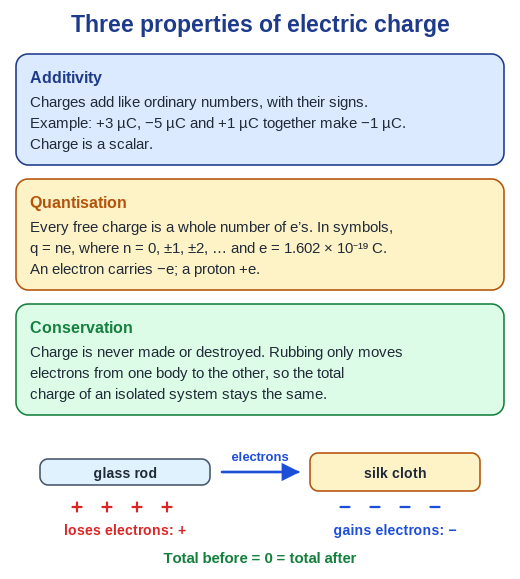
(a) It means a body can carry only whole-number multiples of a smallest charge e: q = ne, where n = 0, ±1, ±2, … and e = 1.6 × 10⁻¹⁹ C. A body gains or loses charge only in steps of e, because charge is carried by electrons and protons, each with charge −e or +e. A charge such as 1.5e is never found on any body.
(b) Everyday charges are huge compared with e. Even 1 µC is about 6 × 10¹² electrons. A change of one electron in trillions cannot be noticed, so at this scale charge behaves as if it could take any value, just as a line of dots seen from far away looks continuous.
1.5 “When a glass rod is rubbed with a silk cloth, charges appear on both. A similar phenomenon is observed with many other pairs of bodies. Explain how this observation is consistent with the law of conservation of charge.”
Before rubbing, the rod and the silk are both neutral, so the total charge is zero. Rubbing does not create charge; it transfers some electrons from the glass to the silk. The rod is left with a positive charge +q and the silk gains an equal negative charge −q. The total is still +q + (−q) = 0. Charges “appear” on both bodies, always in equal and opposite amounts, so the total charge of the isolated pair is conserved.
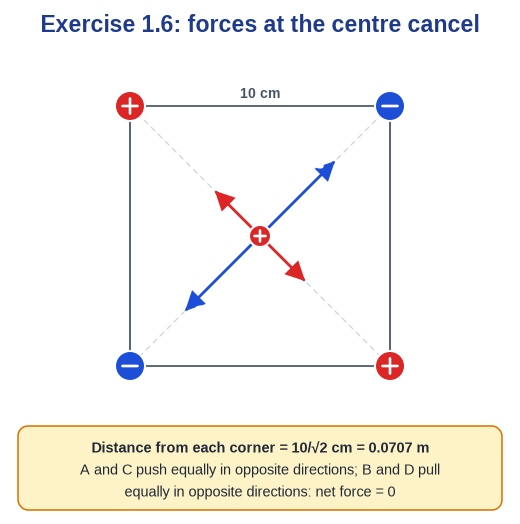
1.6 “Four point charges qA = 2 µC, qB = −5 µC, qC = 2 µC, and qD = −5 µC are located at the corners of a square ABCD of side 10 cm. What is the force on a charge of 1 µC placed at the centre of the square?”
The centre O is half a diagonal from each corner:
r = (10√2)/2 cm = 5√2 cm = 0.0707 m, so r² = 5 × 10⁻³ m²
Force on 1 µC due to A (repulsion, along AO, towards C):
FA = (9 × 10⁹)(2 × 10⁻⁶)(1 × 10⁻⁶)/(5 × 10⁻³) = 3.6 N
Due to C (repulsion, along CO, towards A): FC = 3.6 N. FA and FC are equal and opposite, so they cancel.
Due to B (attraction, towards B): FB = (9 × 10⁹)(5 × 10⁻⁶)(1 × 10⁻⁶)/(5 × 10⁻³) = 9 N
Due to D (attraction, towards D): FD = 9 N. B and D lie on opposite ends of the other diagonal, so these two also cancel.
Net force on the 1 µC charge = zero.
1.7 “(a) An electrostatic field line is a continuous curve. That is, a field line cannot have sudden breaks. Why not? (b) Explain why two field lines never cross each other at any point?”
(a) A field line follows the direction of the field from point to point. In a region without charges, the electrostatic field exists at every point and changes smoothly as we move, so the curve that follows it also runs on smoothly. A break would mean a point where the field suddenly vanished or lost its direction, which does not happen where there are no charges. Field lines begin or end only on charges (or at infinity).
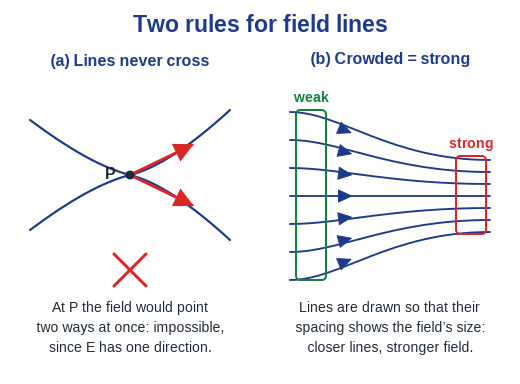
(b) The tangent to a field line at a point gives the direction of the net field there. If two lines crossed at a point, there would be two tangents, that is, two directions of the field at the same point. The net field at a point has only one direction, so two field lines can never cross.
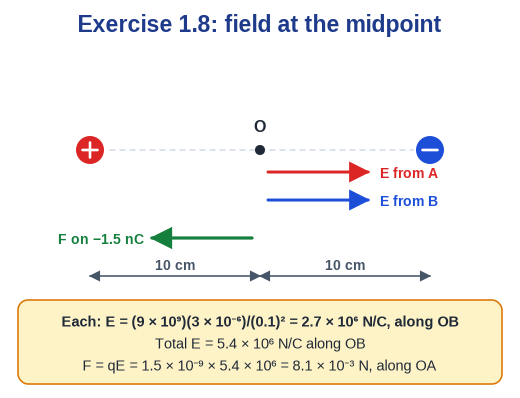
1.8 “Two point charges qA = 3 µC and qB = −3 µC are located 20 cm apart in vacuum. (a) What is the electric field at the midpoint O of the line AB joining the two charges? (b) If a negative test charge of magnitude 1.5 × 10⁻⁹ C is placed at this point, what is the force experienced by the test charge?”
(a) O is 10 cm = 0.1 m from each charge. The field of A (positive) at O points away from A, along OB. The field of B (negative) at O points towards B, also along OB. Each has the size
E = (9 × 10⁹)(3 × 10⁻⁶)/(0.1)² = 2.7 × 10⁶ N/C
Total field at O = 2 × 2.7 × 10⁶ = 5.4 × 10⁶ N/C, along OB (from A towards B).
(b) F = qE = (1.5 × 10⁻⁹)(5.4 × 10⁶) = 8.1 × 10⁻³ N. The test charge is negative, so the force points opposite to the field, along OA.
Exercises 1.9 to 1.13: dipoles and charges in a field
1.9 “A system has two charges qA = 2.5 × 10⁻⁷ C and qB = −2.5 × 10⁻⁷ C located at points A: (0, 0, −15 cm) and B: (0,0, +15 cm), respectively. What are the total charge and electric dipole moment of the system?”
Total charge = 2.5 × 10⁻⁷ + (−2.5 × 10⁻⁷) = 0.
The two equal and opposite charges form a dipole with q = 2.5 × 10⁻⁷ C and separation 2a = AB = 30 cm = 0.30 m.
p = q × 2a = (2.5 × 10⁻⁷)(0.30) = 7.5 × 10⁻⁸ C m
The dipole moment points from the negative charge (B, at z = +15 cm) to the positive charge (A, at z = −15 cm), that is, along the z-axis in the negative z direction.
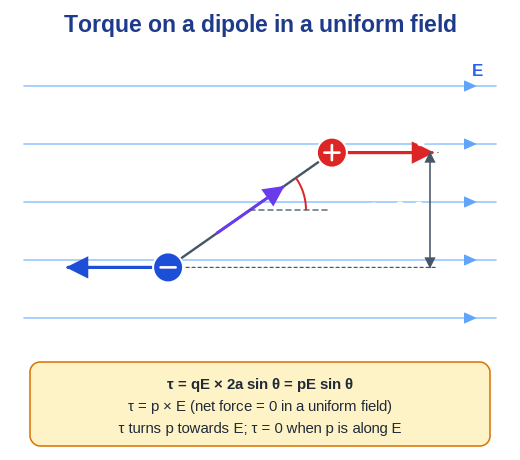
1.10 “An electric dipole with dipole moment 4 × 10⁻⁹ C m is aligned at 30° with the direction of a uniform electric field of magnitude 5 × 10⁴ NC⁻¹. Calculate the magnitude of the torque acting on the dipole.”
τ = pE sin θ = (4 × 10⁻⁹)(5 × 10⁴) sin 30°
= (2 × 10⁻⁴)(0.5)
= 1 × 10⁻⁴ N m
1.11 “A polythene piece rubbed with wool is found to have a negative charge of 3 × 10⁻⁷ C. (a) Estimate the number of electrons transferred (from which to which?) (b) Is there a transfer of mass from wool to polythene?”
(a) The polythene became negative, so it gained electrons, from the wool.
n = q/e = (3 × 10⁻⁷)/(1.6 × 10⁻¹⁹) = 1.875 × 10¹² ≈ 2 × 10¹² electrons, from wool to polythene
(b) Yes, because electrons have mass. The mass transferred is
m = n × mₑ = (1.875 × 10¹²)(9.11 × 10⁻³¹ kg) ≈ 1.7 × 10⁻¹⁸ kg
which is about 2 × 10⁻¹⁸ kg, far too small to measure.
1.12 “(a) Two insulated charged copper spheres A and B have their centres separated by a distance of 50 cm. What is the mutual force of electrostatic repulsion if the charge on each is 6.5 × 10⁻⁷ C? The radii of A and B are negligible compared to the distance of separation. (b) What is the force of repulsion if each sphere is charged double the above amount, and the distance between them is halved?”
(a) F = kq²/r² = (9 × 10⁹)(6.5 × 10⁻⁷)²/(0.50)²
= (9 × 10⁹)(4.225 × 10⁻¹³)/0.25
= 1.5 × 10⁻² N (1.52 × 10⁻² N), repulsive
(b) Doubling each charge multiplies q₁q₂ by 4; halving r divides r² by 4, which multiplies F by 4 again. So the new force is 16 times the old one:
F′ = 16 × 1.52 × 10⁻² N = 0.243 N ≈ 0.24 N, repulsive
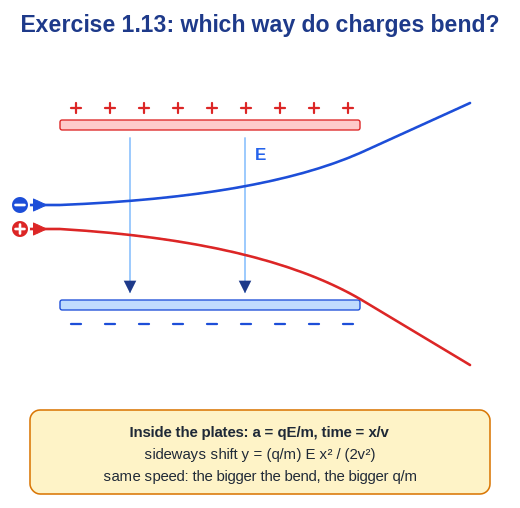
1.13 “Figure 1.30 shows tracks of three charged particles in a uniform electrostatic field. Give the signs of the three charges. Which particle has the highest charge to mass ratio?”
In Fig. 1.30 the upper plate is positive and the lower plate negative, so the field between them points downward, from + to −. A positive charge is pushed along the field, downward; a negative charge is pushed upward, towards the positive plate.
- Particles 1 and 2 bend up towards the positive plate: they are negative.
- Particle 3 bends down towards the negative plate: it is positive.
Which particle has the largest q/m? Work out how far a particle is pushed sideways while it crosses the plates:
- Sideways force = qE, so the sideways acceleration is a = qE/m.
- A particle entering with speed v crosses plates of length x in time t = x/v.
- Sideways shift y = ½at² = (q/m)E x²/(2v²).
- For the same entry speed and the same plates, y is proportional to q/m.
Particle 3 is pushed sideways the most.
Answer: 1 and 2 are negative, 3 is positive; particle 3 has the highest charge to mass ratio.
Exercises 1.14 to 1.23: flux and Gauss’s law
1.14 “Consider a uniform electric field E = 3 × 10³ î N/C. (a) What is the flux of this field through a square of 10 cm on a side whose plane is parallel to the yz plane? (b) What is the flux through the same square if the normal to its plane makes a 60° angle with the x-axis?”
Electric flux through a flat surface is φ = ES cos θ, where S is the area and θ is the angle between the field and the normal (the line at right angles to the surface).
Area of the square: S = (0.10 m)² = 1 × 10⁻² m².
(a) A plane parallel to the yz plane has its normal along the x-axis, the direction of E, so θ = 0°.
φ = ES cos 0° = (3 × 10³)(1 × 10⁻²)(1) = 30 N m²/C
(b) Now θ = 60°:
φ = ES cos 60° = 30 × 0.5 = 15 N m²/C
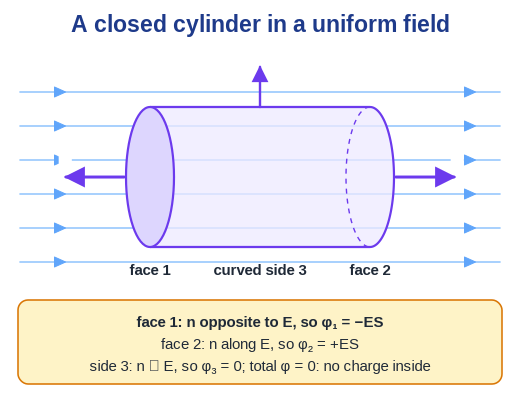
1.15 “What is the net flux of the uniform electric field of Exercise 1.14 through a cube of side 20 cm oriented so that its faces are parallel to the coordinate planes?”
- The field points along x. Only the two faces at right angles to x get any flux. Each has area (0.20 m)² = 0.04 m².
- Face where E enters: the outward normal points against E, so flux = −(3 × 10³)(0.04) = −120 N m²/C.
- Opposite face, where E leaves: flux = +(3 × 10³)(0.04) = +120 N m²/C.
- The other four faces lie along the field, so their flux is 0.
- Total = −120 + 120 + 0 = 0.
Every field line that enters the cube also leaves it. This fits Gauss’s law, because the cube holds no charge.
Answer: the net flux is zero.
1.16 “Careful measurement of the electric field at the surface of a black box indicates that the net outward flux through the surface of the box is 8.0 × 10³ Nm²/C. (a) What is the net charge inside the box? (b) If the net outward flux through the surface of the box were zero, could you conclude that there were no charges inside the box? Why or Why not?”
(a) Gauss’s law says: the total outward flux through a closed surface = (charge inside)/ε₀. So q = ε₀φ:
q = (8.854 × 10⁻¹²)(8.0 × 10³) = 7.08 × 10⁻⁸ C ≈ 0.07 µC
(b) No. Zero net flux only tells us that the net charge inside is zero. The box could hold equal amounts of positive and negative charge, for example +2 µC and −2 µC, and the flux would still be zero.
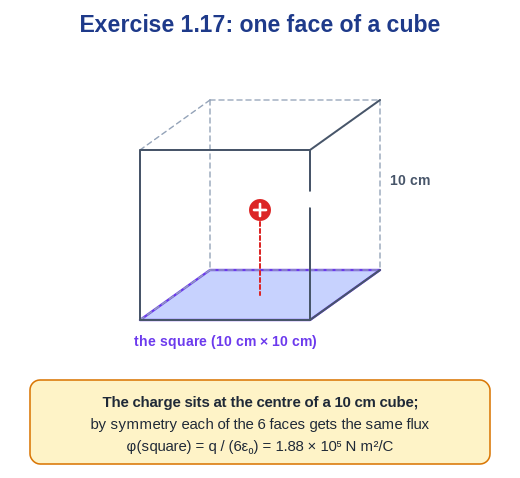
1.17 “A point charge +10 µC is a distance 5 cm directly above the centre of a square of side 10 cm, as shown in Fig. 1.31. What is the magnitude of the electric flux through the square? (Hint: Think of the square as one face of a cube with edge 10 cm.)”
- Imagine a cube of edge 10 cm with the square as its bottom face.
- The centre of this cube is 5 cm above the centre of the square. That is exactly where the charge is, so the charge sits at the centre of the cube.
- By Gauss’s law, the total flux out of the whole cube is q/ε₀.
- The six faces are placed the same way around the charge (symmetry), so each face gets one sixth of the flux.
φ (square) = q/(6ε₀) = (10 × 10⁻⁶)/(6 × 8.854 × 10⁻¹²)
= (1 × 10⁻⁵)/(5.31 × 10⁻¹¹)
Answer: 1.88 × 10⁵ N m²/C (about 1.9 × 10⁵ N m²/C)
Note: the answer key at the end of the book prints 2.2 × 10⁵ N m²/C for this exercise and 1.9 × 10⁵ N m²/C for Exercise 1.18. The working shows the two values are the other way round.
1.18 “A point charge of 2.0 µC is at the centre of a cubic Gaussian surface 9.0 cm on edge. What is the net electric flux through the surface?”
The cube encloses the whole charge, so by Gauss’s law (the size of the cube does not matter):
φ = q/ε₀ = (2.0 × 10⁻⁶)/(8.854 × 10⁻¹²) = 2.26 × 10⁵ N m²/C (about 2.3 × 10⁵ N m²/C)
1.19 “A point charge causes an electric flux of −1.0 × 10³ Nm²/C to pass through a spherical Gaussian surface of 10.0 cm radius centred on the charge. (a) If the radius of the Gaussian surface were doubled, how much flux would pass through the surface? (b) What is the value of the point charge?”
(a) The flux depends only on the charge enclosed. Doubling the radius encloses the same charge, so the flux is still −1.0 × 10³ N m²/C. (The field falls to one quarter, but the area grows four times.)
(b) q = ε₀φ = (8.854 × 10⁻¹²)(−1.0 × 10³) = −8.85 × 10⁻⁹ C = −8.85 nC (about −8.9 nC)
(The book’s answer key gives −8.8 nC: the same value, cut to two figures instead of rounded.)
1.20 “A conducting sphere of radius 10 cm has an unknown charge. If the electric field 20 cm from the centre of the sphere is 1.5 × 10³ N/C and points radially inward, what is the net charge on the sphere?”
Charge on a conductor spreads over its surface, so the sphere acts as a charged spherical shell. At a point outside it, 20 cm from the centre, the field is the same as that of a point charge at the centre: E = k|q|/r².
|q| = Er²/k = (1.5 × 10³)(0.20)²/(9 × 10⁹)
= 60/(9 × 10⁹) = 6.67 × 10⁻⁹ C
The field points inward, so the charge is negative: q = −6.67 nC.
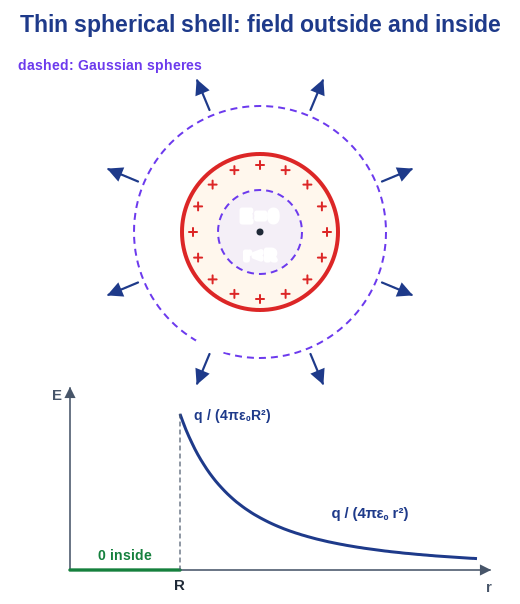
1.21 “A uniformly charged conducting sphere of 2.4 m diameter has a surface charge density of 80.0 µC/m². (a) Find the charge on the sphere. (b) What is the total electric flux leaving the surface of the sphere?”
Radius R = 1.2 m.
(a) q = σ × 4πR² = (80.0 × 10⁻⁶)(4π)(1.2)²
= (80.0 × 10⁻⁶)(18.10)
= 1.45 × 10⁻³ C
(b) φ = q/ε₀ = (1.45 × 10⁻³)/(8.854 × 10⁻¹²) = 1.6 × 10⁸ N m²/C
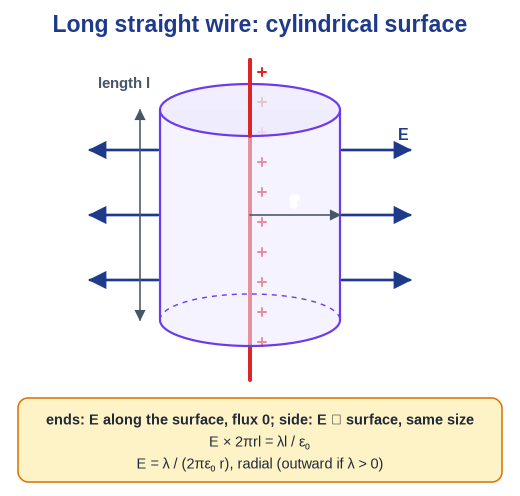
1.22 “An infinite line charge produces a field of 9 × 10⁴ N/C at a distance of 2 cm. Calculate the linear charge density.”
For an infinite line charge, E = λ/(2πε₀r), so
λ = 2πε₀rE = 2π(8.854 × 10⁻¹²)(0.02)(9 × 10⁴)
= 1.0 × 10⁻⁷ C/m (0.1 µC/m)
Check with k: λ = Er/(2k) = (9 × 10⁴)(0.02)/(2 × 9 × 10⁹) = 1 × 10⁻⁷ C/m.
Note: the answer key at the end of the book prints 10 µC/m. The calculation gives 0.1 µC/m, a hundred times smaller.
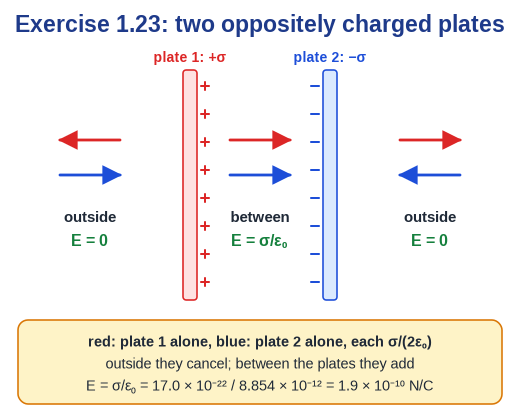
1.23 “Two large, thin metal plates are parallel and close to each other. On their inner faces, the plates have surface charge densities of opposite signs and of magnitude 17.0 × 10⁻²² C/m². What is E: (a) in the outer region of the first plate, (b) in the outer region of the second plate, and (c) between the plates?”
Let the first plate carry +σ and the second −σ, with σ = 17.0 × 10⁻²² C/m². On its own, each large plate gives a field of σ/(2ε₀): away from the positive plate and towards the negative plate.
(a) Outside the first plate, the field of the positive plate points outward (away from it) and the field of the negative plate points towards the negative plate, the opposite way. They are equal, so E = 0.
(b) Outside the second plate, the two fields again point in opposite directions and cancel: E = 0.
(c) Between the plates, both fields point from the positive plate towards the negative plate and add:
E = σ/(2ε₀) + σ/(2ε₀) = σ/ε₀ = (17.0 × 10⁻²²)/(8.854 × 10⁻¹²)
= 1.9 × 10⁻¹⁰ N/C, from the positive plate to the negative plate
Note: the answer key at the end of the book prints 1.9 N/C; the power of ten, 10⁻¹⁰, is missing there.
Worked examples 1.1 to 1.6 (pages 6–14)
The book solves these examples in the chapter. Here each one is restated in short and worked again.
Example 1.1 (page 6): 10⁹ electrons leave a body every second. How long until the other body has collected 1 C?
Charge moved per second = 10⁹ × 1.6 × 10⁻¹⁹ C = 1.6 × 10⁻¹⁰ C/s
Time = 1 C ÷ 1.6 × 10⁻¹⁰ C/s = 6.25 × 10⁹ s
In years: 6.25 × 10⁹ ÷ (365 × 24 × 3600) = 6.25 × 10⁹ ÷ 3.15 × 10⁷ ≈ 198 years, so about 200 years. A coulomb is a very large charge.
Example 1.2 (page 6): Estimate the total positive charge and the total negative charge in a cup of water (take 250 g).
Number of moles = 250 g ÷ 18 g/mol = 13.9 mol
Number of molecules = 13.9 × 6.02 × 10²³ = 8.36 × 10²⁴
Each H₂O molecule has 2 + 8 = 10 protons and 10 electrons, so
Charge = 8.36 × 10²⁴ × 10 × 1.6 × 10⁻¹⁹ C ≈ 1.34 × 10⁷ C
There are about 1.34 × 10⁷ C of positive charge and the same amount of negative charge, so the water is neutral.
Example 1.3 (pages 9–10): (a) Compare the electric and gravitational forces (i) between an electron and a proton and (ii) between two protons. (b) Find the accelerations of an electron and a proton due to their electric attraction at 1 Å (10⁻¹⁰ m).
(a) Both forces vary as 1/r², so their ratio is the same at every distance.
(i) Fₑ/FG = e²/(4πε₀ G mₚmₑ) = (9 × 10⁹)(1.6 × 10⁻¹⁹)²/[(6.67 × 10⁻¹¹)(1.67 × 10⁻²⁷)(9.11 × 10⁻³¹)] ≈ 2.3 × 10³⁹. The book gives 2.4 × 10³⁹; as in Exercise 1.3, these constants give about 2.3 × 10³⁹.
(ii) Fₑ/FG = e²/(4πε₀ G mₚ²) = 2.30 × 10⁻²⁸/[(6.67 × 10⁻¹¹)(1.67 × 10⁻²⁷)²] ≈ 1.2 × 10³⁶ (the book gives 1.3 × 10³⁶). For two protons the electric force repels while gravity attracts. At 10⁻¹⁵ m, inside a nucleus, Fₑ ≈ 230 N but FG ≈ 1.9 × 10⁻³⁴ N.
(b) F = (8.99 × 10⁹)(1.6 × 10⁻¹⁹)²/(10⁻¹⁰)² = 2.3 × 10⁻⁸ N, the same on both.
aₑ = F/mₑ = 2.3 × 10⁻⁸/9.11 × 10⁻³¹ = 2.5 × 10²² m/s²
aₚ = F/mₚ = 2.3 × 10⁻⁸/1.67 × 10⁻²⁷ = 1.4 × 10¹⁹ m/s²
Next to these, the effect of gravity (g = 9.8 m/s²) is negligible.
Example 1.4 (pages 10–11): Spheres A and B, 10 cm apart, repel with some force. Each is touched by an identical uncharged sphere, which is then removed, and B is moved to 5 cm from A. What is the new force?
Let the charges be q and q′, so F = kqq′/(0.10)². Touching an identical neutral sphere shares the charge equally, leaving q/2 on A and q′/2 on B. At half the distance:
F′ = k(q/2)(q′/2)/(0.05)² = (kqq′/4)/(0.10²/4) = kqq′/(0.10)² = F
The force is unchanged: halving each charge cuts it to a quarter, halving the distance makes it four times.
Example 1.5 (pages 12–13): Equal charges q sit at the corners of an equilateral triangle of side l. Find the force on a charge Q (same sign as q) at the centroid O.
The height of the triangle is (√3/2)l, and the centroid is two-thirds of the way down it, so
AO = BO = CO = (2/3)(√3/2)l = l/√3, and AO² = l²/3
Each corner pushes Q away from itself with the same force
F = Qq/(4πε₀ · l²/3) = 3Qq/(4πε₀l²)
along AO, BO and CO. These three equal forces are 120° apart. The resultant of the forces along BO and CO is a force of the same size along OA, which cancels the force along AO. So the net force on Q is zero. Symmetry says the same: turning the triangle by 120° about O changes nothing, so the force cannot point in any particular direction.
Example 1.6 (pages 13–14): Charges q, q and −q sit at the corners A, B and C of an equilateral triangle of side l. Find the force on each.
Every pair is a distance l apart, so each pair of charges exerts a force of the same size F = q²/(4πε₀l²).
- On q at A: B repels it along BA, and C attracts it along AC. Two forces of size F at 120° to each other add up to a force of size F, here parallel to BC.
- On q at B: A repels it along AB, and C attracts it along BC. The resultant has size F, parallel to AC.
- On −q at C: A and B both attract it, along CA and CB, which are 60° apart. The resultant is 2F cos 30° = √3F, along the bisector of angle C, towards AB.
The three forces add up to zero, as they must, because Coulomb’s law obeys Newton’s third law.
Worked examples 1.7 to 1.9 (pages 17–27)
Example 1.7 (pages 17–18): An electron falls 1.5 cm from rest in an upward field of 2.0 × 10⁴ N/C. With the field reversed, a proton falls the same distance. Find the times and compare with free fall under gravity.
Electron: the force eE points down (the electron is negative and E points up).
aₑ = eE/mₑ = (1.6 × 10⁻¹⁹)(2.0 × 10⁴)/(9.11 × 10⁻³¹) = 3.5 × 10¹⁵ m/s²
tₑ = √(2h/aₑ) = √[(2 × 1.5 × 10⁻²)/(3.5 × 10¹⁵)] = 2.9 × 10⁻⁹ s
Proton, with the field pointing down:
aₚ = eE/mₚ = (1.6 × 10⁻¹⁹)(2.0 × 10⁴)/(1.67 × 10⁻²⁷) = 1.9 × 10¹² m/s²
tₚ = √(2h/aₚ) = √[(3.0 × 10⁻²)/(1.9 × 10¹²)] = 1.3 × 10⁻⁷ s
The heavier proton takes longer. In free fall under gravity, the time does not depend on the mass of the body at all. Gravity can be ignored here, since 1.9 × 10¹² m/s² is enormous compared with g = 9.8 m/s².
Example 1.8 (pages 18–19): q₁ = +10⁻⁸ C and q₂ = −10⁻⁸ C are 0.1 m apart. Find the field at A (midway), at B (0.05 m beyond q₁, on the side away from q₂) and at C (0.1 m from each charge).
At A, each charge is 0.05 m away:
E = (9 × 10⁹)(10⁻⁸)/(0.05)² = 3.6 × 10⁴ N/C
Both fields point from q₁ towards q₂, so EA = 7.2 × 10⁴ N/C, towards q₂.
At B, q₁ is 0.05 m away and q₂ is 0.15 m away:
E from q₁ = 3.6 × 10⁴ N/C, pointing away from q₁ (away from q₂ too)
E from q₂ = (9 × 10⁹)(10⁻⁸)/(0.15)² = 4 × 10³ N/C, pointing towards q₂
EB = 3.6 × 10⁴ − 0.4 × 10⁴ = 3.2 × 10⁴ N/C, pointing away from q₂.
At C, each charge is 0.1 m away, so each field is (9 × 10⁹)(10⁻⁸)/(0.1)² = 9 × 10³ N/C. One points away from q₁ and the other towards q₂, at 120° to each other. Their sum is 2 × 9 × 10³ × cos 60° = 9 × 10³ N/C, parallel to the line from q₁ to q₂.
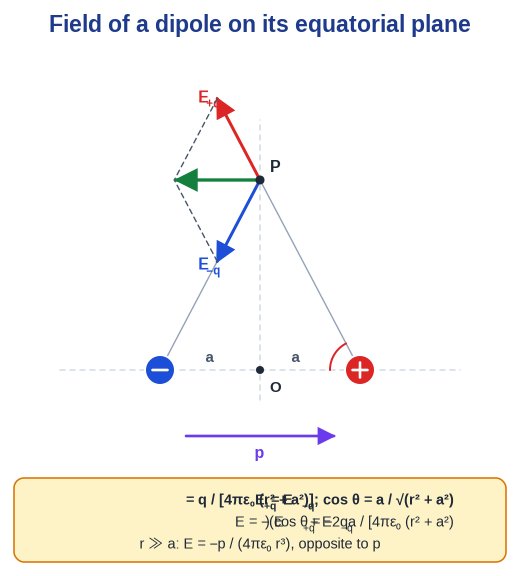
Example 1.9 (pages 25–27): Charges ±10 µC are 5.0 mm apart. Find the field at P, on the axis 15 cm from the centre on the side of +q, and at Q, 15 cm from the centre on the perpendicular bisector.
Here 2a = 5.0 mm, so a = 0.25 cm, and p = (10⁻⁵ C)(5 × 10⁻³ m) = 5 × 10⁻⁸ C m.
(a) At P, +q is 14.75 cm away and −q is 15.25 cm away:
E from +q = (8.99 × 10⁹)(10⁻⁵)/(0.1475)² = 4.13 × 10⁶ N/C, along p
E from −q = (8.99 × 10⁹)(10⁻⁵)/(0.1525)² = 3.86 × 10⁶ N/C, against p
Net E = 0.27 × 10⁶ N/C ≈ 2.7 × 10⁵ N/C, along p.
The short-dipole formula gives 2p/(4πε₀r³) = (2 × 8.99 × 10⁹ × 5 × 10⁻⁸)/(0.15)³ = 2.66 × 10⁵ N/C, which agrees.
(b) At Q, each charge is √(15² + 0.25²) cm ≈ 15.00 cm away, so each field is about 3.99 × 10⁶ N/C. The components along OQ cancel; those along the axis add:
E = 2 × 3.99 × 10⁶ × (0.25/15.00) = 1.33 × 10⁵ N/C, opposite to p
The formula p/(4πε₀r³) = (8.99 × 10⁹ × 5 × 10⁻⁸)/(0.15)³ = 1.33 × 10⁵ N/C agrees too.
Worked examples 1.10 to 1.12 (pages 31–37)
Example 1.10 (pages 31–32): The field is Ex = αx1/2, Ey = Ez = 0, with α = 800 N/C m1/2. A cube of edge a = 0.1 m has faces at x = a and x = 2a (Fig. 1.24). Find the flux through the cube and the charge inside.
Only the two faces normal to x have flux; on the other four, E lies along the face.
Left face (x = a): EL = αa1/2, outward normal along −x, so φL = −ELa²
Right face (x = 2a): ER = α(2a)1/2, outward normal along +x, so φR = ERa²
φ = a²(ER − EL) = αa5/2(√2 − 1)
= 800 × (0.1)5/2 × 0.414 = 800 × 3.16 × 10⁻³ × 0.414 = 1.05 N m²/C
Charge inside: q = ε₀φ = 8.854 × 10⁻¹² × 1.05 = 9.27 × 10⁻¹² C
Example 1.11 (page 32): E = +200 î N/C for x > 0 and −200 î N/C for x < 0. A cylinder 20 cm long, with radius 5 cm, lies along the x-axis, centred at the origin. Find the flux through each face, through the side, the total, and the charge inside.
Area of each flat face = π(0.05)² = 7.85 × 10⁻³ m².
(a) Right face (x = +10 cm): E = +200 î and the outward normal is +î, so φ = 200 × 7.85 × 10⁻³ = +1.57 N m²/C. Left face (x = −10 cm): E = −200 î and the outward normal is −î, so again φ = +1.57 N m²/C.
(b) On the side, E is parallel to the surface: zero.
(c) Total = 1.57 + 1.57 + 0 = 3.14 N m²/C.
(d) q = ε₀φ = 8.854 × 10⁻¹² × 3.14 = 2.78 × 10⁻¹¹ C.
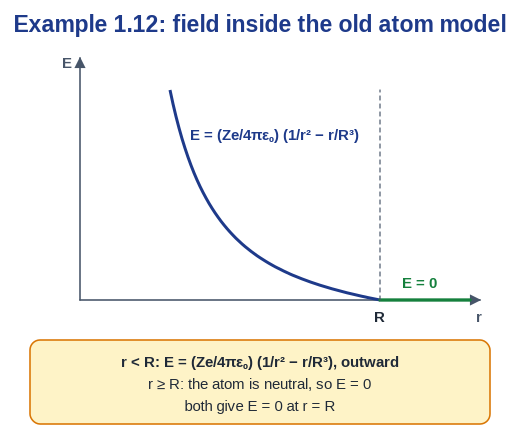
Example 1.12 (pages 36–37): In an early model of the atom, a point nucleus of charge Ze sits inside a uniform sphere of negative charge of radius R, and the atom is neutral. Find the field at distance r from the nucleus.
The negative charge is −Ze, spread over the volume 4πR³/3, so its density is ρ = −3Ze/(4πR³). Use Gaussian spheres centred on the nucleus.
(i) r < R. Charge enclosed = Ze + ρ(4πr³/3) = Ze − Ze(r³/R³). Gauss’s law gives
E × 4πr² = (Ze/ε₀)(1 − r³/R³)
E = (Ze/4πε₀)(1/r² − r/R³), radially outward
(ii) r > R. The sphere encloses the whole neutral atom, so E × 4πr² = 0 and E = 0.
At r = R both answers give E = 0.
Practice
-
Charges of +4 µC and −1 µC are 0.3 m apart in vacuum. The force between them is:
Show answer
Answer: (b) 0.4 N, attractive
-
A proton is placed in a uniform field of 1 × 10⁵ N/C. The force on it is:
Show answer
Answer: (a) 1.6 × 10⁻¹⁴ N
-
A closed surface encloses +2 µC and −5 µC. The net flux through it is about:
Show answer
Answer: (b) −3.4 × 10⁵ N m²/C
-
A dipole of moment 2 × 10⁻⁸ C m is at right angles to a uniform field of 1 × 10⁵ N/C. Find the torque on it.
Show answer
Answer: τ = pE sin 90° = 2 × 10⁻⁸ × 1 × 10⁵ × 1 = 2 × 10⁻³ N m.
-
A long straight wire carries 2 µC per metre. Find the field 10 cm from it.
Show answer
Answer: E = λ/(2πε₀r) = 2kλ/r = (2 × 9 × 10⁹ × 2 × 10⁻⁶)/0.1 = 3.6 × 10⁵ N/C, pointing away from the wire.
Stuck on a question?
Take a photo and Lagnever AI explains it step by step. Try it for 7 days for ₹2.
Get it on Google Play Open in browser
For parents: after the trial, the plan renews monthly by UPI or card autopay. You can cancel anytime in the app.