
Class 12 Physics Chapter 1: Electric Charges and Fields Notes
This chapter in five lines
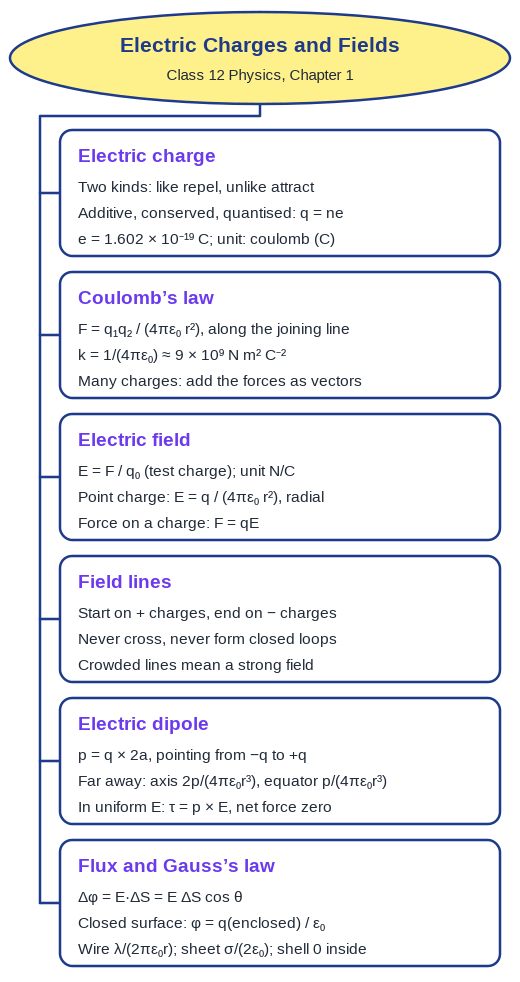
Electric charge comes in two kinds, adds like numbers, is conserved and is quantised in steps of e = 1.602 × 10⁻¹⁹ C. Coulomb’s law gives the force between point charges, F = q₁q₂/(4πε₀r²), and forces from many charges add as vectors. Every charge sets up an electric field E = F/q₀, drawn as field lines. A dipole’s field falls off as 1/r³, and Gauss’s law, φ = q/ε₀, gives the fields of symmetric charge distributions.
What is this chapter about?
The crackle when you pull off a sweater on a dry winter day, the shock from a car door and a flash of lightning are all charges jumping from one place to another. Electrostatics studies the forces, fields and potentials of charges at rest. This chapter covers charges, the forces between them and the fields they make; Chapter 2 goes on to potential and capacitance.
What are the basic properties of electric charge?
There are two kinds of charge. By convention, the charge a glass rod gets from silk is called positive, and the charge a plastic rod gets from fur is called negative. Like charges repel and unlike charges attract. Rubbing creates no charge: it moves electrons from one body to the other, so the body that loses electrons becomes positive. Conductors (metals, the human body, the earth) let charges move through them; insulators (glass, plastic, nylon) do not. A body whose size is small compared with the distances involved is treated as a point charge.
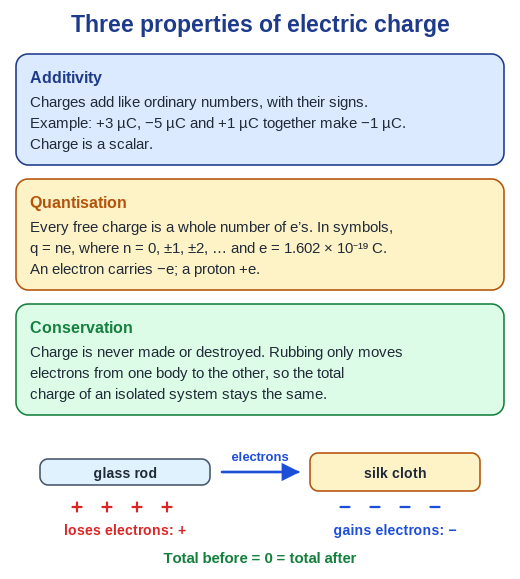
Charge has three basic properties:
- Additivity: the total charge is the algebraic sum of the charges, with signs. Charge is a scalar.
- Conservation: the total charge of an isolated system stays the same, even when charged particles are created (a neutron turning into a proton and an electron keeps the total at zero).
- Quantisation: the charge on any body is a whole number of electronic charges, q = ne, with e = 1.602 × 10⁻¹⁹ C. One coulomb is about 6 × 10¹⁸ electrons, so in everyday charges the steps of e are far too small to notice.
What does Coulomb’s law say?
Coulomb measured the force between small charged spheres with a torsion balance and found, in 1785, that the force between two point charges q₁ and q₂ a distance r apart in vacuum is
F = (1/4πε₀) · q₁q₂ / r²
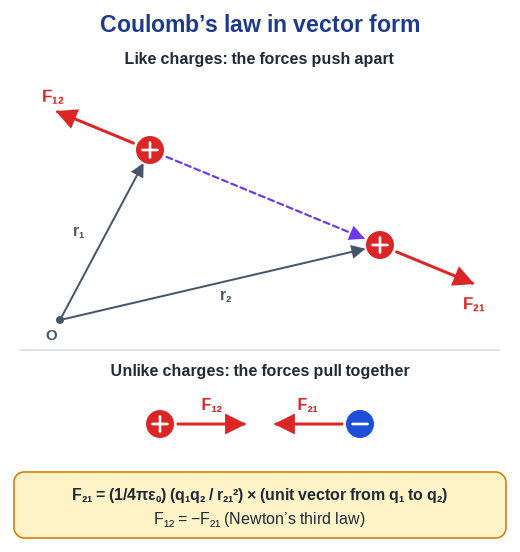
It acts along the line joining the charges: repulsive for like charges, attractive for unlike ones. Here ε₀ = 8.854 × 10⁻¹² C² N⁻¹ m⁻² is the permittivity of free space (vacuum), and 1/(4πε₀) ≈ 9 × 10⁹ N m² C⁻². Two charges of 1 C each, 1 m apart, would push each other with 9 × 10⁹ N, which shows how large a coulomb is; in practice we use µC (10⁻⁶ C) and mC (10⁻³ C). In vector form, the force on q₂ due to q₁ is F₂₁ = (1/4πε₀)(q₁q₂/r₂₁²) r̂₂₁, where r̂₂₁ is the unit vector from q₁ to q₂, and F₁₂ = −F₂₁. Read Coulomb’s law.
How do we find the force due to many charges?
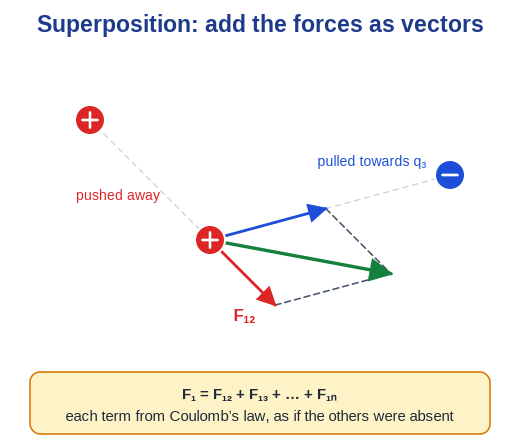
Experiments show that the force between two charges is not changed by other charges nearby. So the force on q₁ due to q₂, q₃, …, qₙ is the vector sum of the Coulomb forces from each one taken alone: F₁ = F₁₂ + F₁₃ + … + F₁ₙ. This is the principle of superposition. With Coulomb’s law, it is the basis of all of electrostatics.
What is an electric field?
A charge Q changes the space around it, so that any charge q placed there feels a force. The electric field at a point is the force per unit charge on a tiny positive test charge q₀ placed there: E = F/q₀. The test charge is taken very small so that it does not move the source charges. The field of a point charge is E = Q/(4πε₀r²), pointing radially outward for positive Q and inward for negative Q; its unit is N/C. The force on any charge q is then F = qE, and the field of many charges is the vector sum of their separate fields. Beyond electrostatics, fields are real physical things: they carry energy, and a change in one charge reaches another only after a delay, at the speed of light. Read electric field and electric dipole.
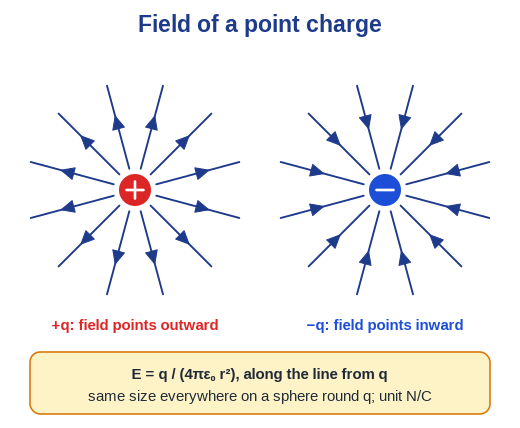
What are electric field lines?
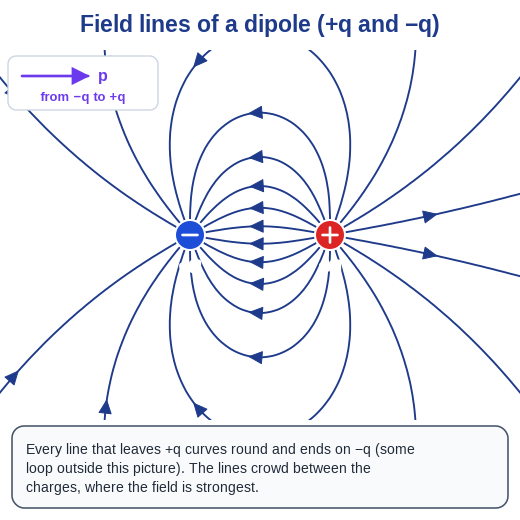
A field line is a curve whose tangent at each point gives the direction of the field there. Where the lines crowd together the field is strong; where they spread out it is weak. Their main properties:
- They start on positive charges and end on negative charges (or at infinity).
- In a region with no charge they are smooth, unbroken curves.
- Two field lines never cross, because the field at a point has only one direction.
- Electrostatic field lines never form closed loops.
What is electric flux?
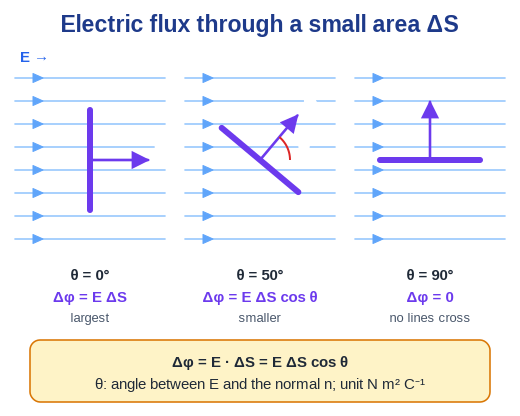
Flux measures how much field passes through a surface. For a small flat area ΔS, treated as a vector ΔS along its normal, the electric flux is Δφ = E·ΔS = E ΔS cos θ, where θ is the angle between E and the normal. Flux is largest when the area faces the field and zero when the field runs along it. For a closed surface the normal is always taken outward. The unit of flux is N m² C⁻¹, and the total flux is the sum over all the small elements of the surface.
What is an electric dipole, and what field does it make?
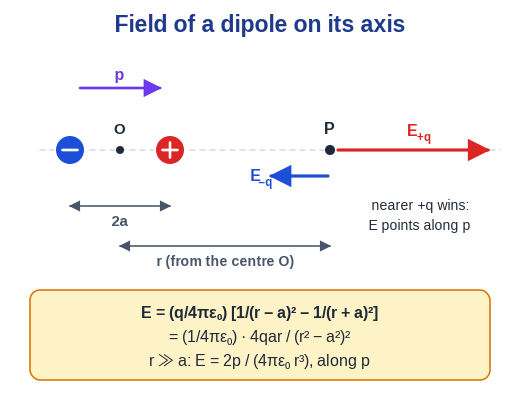
An electric dipole is made of two charges, +q and −q, held a distance 2a apart. Its dipole moment is p = q × 2a, directed from −q to +q. The total charge is zero, but the field is not, because the two charges are at different places. Adding the two Coulomb fields gives, for a distance r ≫ a from the centre:
- on the axis: E = 2p/(4πε₀r³), along p;
- on the equatorial plane: E = −p/(4πε₀r³), opposite to p.
So a dipole’s field falls off as 1/r³, faster than the 1/r² of a single charge. Molecules such as CO₂ and CH₄ have no dipole moment of their own, while polar molecules such as H₂O have a permanent one. The full derivations are in electric field and electric dipole.
What happens to a dipole in a uniform field?
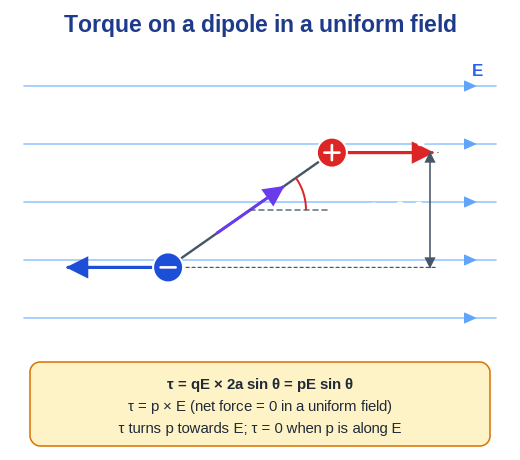
In a uniform field E, the forces qE on +q and −qE on −q cancel, so the net force is zero. But they act at different points and form a couple. Its torque has magnitude qE × 2a sin θ = pE sin θ, and as a vector τ = p × E. The torque turns the dipole to line up with the field; it is zero when p is along E. In a field that is not uniform there is also a net force. This is why a comb charged by running it through dry hair picks up bits of paper: it polarises the paper and pulls harder on the nearer side.
What is a continuous charge distribution?
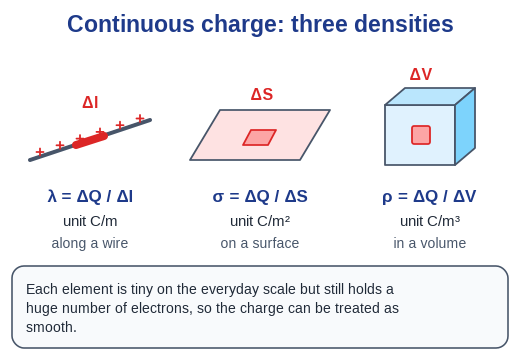
On a charged conductor it is not practical to track every electron, so we describe the charge by its density. Linear charge density λ = ΔQ/Δl (C/m) for a wire, surface charge density σ = ΔQ/ΔS (C/m²) for a surface, and volume charge density ρ = ΔQ/ΔV (C/m³) for a volume. Each element is small on our scale but still holds a very large number of electrons. The field is found by adding the fields of all the small elements.
What is Gauss’s law?
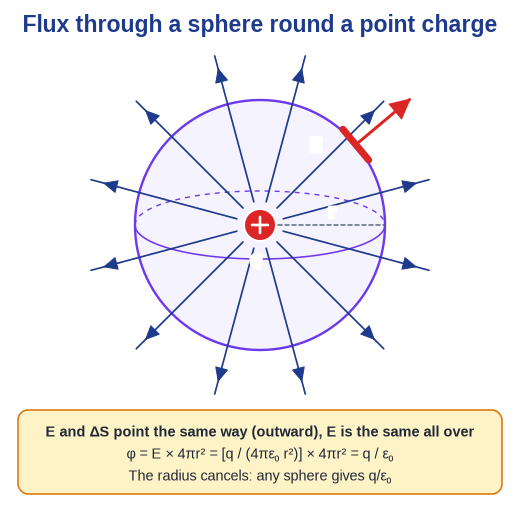
Place a charge q at the centre of a sphere of radius r. The field q/(4πε₀r²) is the same all over the sphere and points along the outward normal, so the flux is E × 4πr² = q/ε₀, whatever the radius. Gauss’s law says this holds for any closed surface: the total flux equals the total enclosed charge divided by ε₀, φ = q/ε₀. Charges outside the surface change the field on it but add no net flux. Gauss’s law rests on the inverse-square form of Coulomb’s law. Read Gauss’s law and its applications.
How does Gauss’s law give the fields of a wire, a sheet and a shell?
Choose a Gaussian surface that matches the symmetry, so that E is either constant and along the normal, or along the surface:
- Infinitely long straight wire (charge λ per metre), cylinder of radius r: E × 2πrl = λl/ε₀, so E = λ/(2πε₀r), radial.
- Infinite plane sheet (charge σ per m²), short cylinder through it: 2EA = σA/ε₀, so E = σ/(2ε₀), the same at every distance.
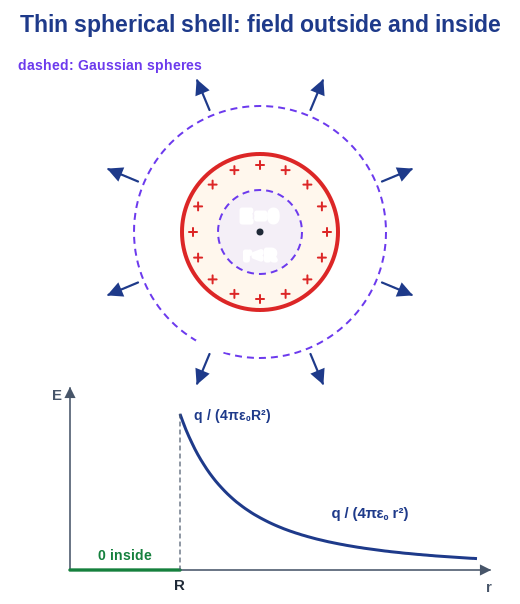
- Thin spherical shell (radius R, total charge q): outside, E = q/(4πε₀r²), as if all the charge were at the centre; inside, the Gaussian sphere encloses no charge, so E = 0.
Before we move on
Everything in this chapter grows from two ideas: Coulomb’s law and superposition. The field, the dipole and Gauss’s law are tools for using them. Practise each derivation with its diagram until you can write it without looking. Every exercise and every worked example of the chapter is solved in the NCERT solutions for Chapter 1.
Key terms
| Term | Meaning |
|---|---|
| Electric charge | A basic property of matter that comes in two kinds, positive and negative: like charges repel, unlike charges attract. |
| Coulomb (C) | The SI unit of charge; 1 C is the charge carried in 1 s by a current of 1 A. |
| Quantisation of charge | The charge on any body is a whole-number multiple of e: q = ne, with e = 1.602 × 10⁻¹⁹ C. |
| Conservation of charge | The total charge of an isolated system never changes; charge is only moved, never made or destroyed. |
| Coulomb’s law | The force between two point charges is proportional to q₁q₂, inversely proportional to r², and acts along the line joining them. |
| Permittivity of free space (ε₀) | The constant in Coulomb’s law, ε₀ = 8.854 × 10⁻¹² C² N⁻¹ m⁻², so that 1/(4πε₀) ≈ 9 × 10⁹ N m² C⁻². |
| Superposition principle | The force (or field) due to many charges is the vector sum of the forces (or fields) due to each charge on its own. |
| Electric field (E) | The force per unit positive test charge at a point, E = F/q₀; unit N/C. |
| Electric field line | A curve whose tangent at every point gives the direction of the field there; closer lines mean a stronger field. |
| Electric dipole | Two charges of the same size but opposite sign, +q and −q, held a small distance 2a apart. |
| Dipole moment (p) | The vector p = q × 2a, pointing from −q to +q; unit C m. |
| Polar molecule | A molecule, such as H₂O, whose centres of positive and negative charge do not coincide, so it has a permanent dipole moment. |
| Electric flux (φ) | The field through an area, Δφ = E·ΔS = E ΔS cos θ; unit N m² C⁻¹. |
| Gauss’s law | The total flux through any closed surface equals the charge enclosed divided by ε₀: φ = q/ε₀. |
| Gaussian surface | The closed surface chosen to apply Gauss’s law; it should match the symmetry of the charges and not pass through a point charge. |
Topics in this chapter
Practice
-
The SI unit of electric field is:
Show answer
Answer: (b) N/C
-
If the distance between two point charges is halved, the force between them becomes:
Show answer
Answer: (c) four times
-
The dipole moment of an electric dipole points:
Show answer
Answer: (b) from −q to +q
-
A dipole sits in a uniform electric field. It experiences:
Show answer
Answer: (b) a torque but no net force
-
A closed surface has no charge inside it. The total flux out of it is:
Show answer
Answer: (a) zero
-
The field inside a uniformly charged thin spherical shell is:
Show answer
Answer: (c) zero
Questions students ask
What are the main topics of Class 12 Physics Chapter 1?
The properties of charge, Coulomb’s law and the superposition principle, the electric field and field lines, electric flux, the electric dipole (its field and the torque on it in a uniform field), continuous charge distributions, and Gauss’s law with its three applications: a long wire, a plane sheet and a spherical shell.
Which derivations are in Class 12 Physics Chapter 1?
The book derives the field of a dipole on its axis and on its equatorial plane, the torque on a dipole in a uniform field, Gauss’s law for a point charge, and the fields of an infinitely long wire, an infinite plane sheet and a thin spherical shell. Practise writing each one with a labelled diagram.
Is Electric Charges and Fields in the 2026-27 NCERT book?
Yes. It is Chapter 1 of Physics Part I, the Class 12 textbook marked Reprint 2026-27, on pages 1 to 44. Chapter 2, Electrostatic Potential and Capacitance, builds on it.
What is the value of ε₀ and k?
ε₀, the permittivity of free space (vacuum), is 8.854 × 10⁻¹² C² N⁻¹ m⁻². The Coulomb constant k = 1/(4πε₀) is about 8.99 × 10⁹ N m² C⁻², usually rounded to 9 × 10⁹ N m² C⁻² in numericals.
Stuck on a question?
Take a photo and Lagnever AI explains it step by step. Try it for 7 days for ₹2.
Get it on Google Play Open in browser
For parents: after the trial, the plan renews monthly by UPI or card autopay. You can cancel anytime in the app.