
What is Gauss’s law, and how is it used to find fields?
Answer in short
Gauss’s law says that the total electric flux through any closed surface equals the total charge inside it divided by ε₀: φ = q/ε₀. Charges outside add no net flux. With a well-chosen Gaussian surface it gives fields quickly: λ/(2πε₀r) near a long wire, σ/(2ε₀) near a plane sheet, and q/(4πε₀r²) outside a shell.
Stuck on a question? Take a photo and Lagnever AI explains it step by step. Try it for 7 days for ₹2. Get it on Google Play
What is electric flux?
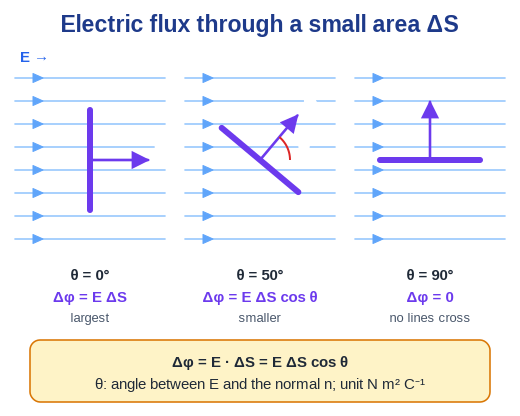
A solar panel catches the most sunlight when it faces the sun and almost none when it is turned edge-on. In the same way, electric flux measures how much field passes through a surface. Treat a small flat area ΔS as a vector ΔS, as long as the area and pointing along its normal. Then
Δφ = E·ΔS = E ΔS cos θ
where θ is the angle between E and the normal. The flux is largest when the area faces the field (θ = 0°) and zero when the field runs along it (θ = 90°). For a closed surface, the normal is always taken outward. Add up all the small pieces to get the total flux. The unit is N m² C⁻¹.
How do we get Gauss’s law from Coulomb’s law?
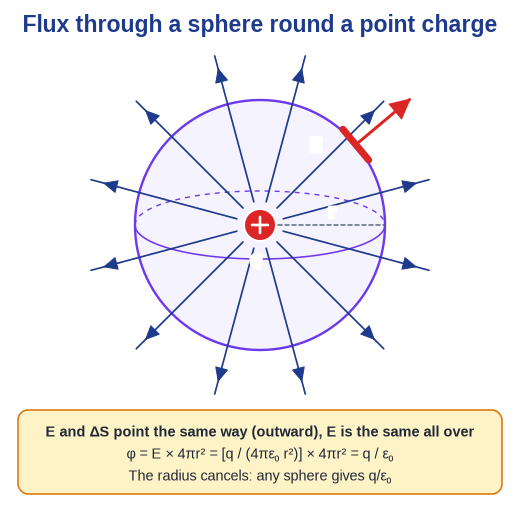
Put a point charge q at the centre of a sphere of radius r. At every point of the sphere the field has the same size, q/(4πε₀r²), and points along the outward normal. So the flux through each small piece is E ΔS, and the total is
φ = [q/(4πε₀r²)] × 4πr² = q/ε₀
The radius cancels: every sphere around q catches the same flux. This is because the field falls as 1/r² while the area grows as r².
What does Gauss’s law say?
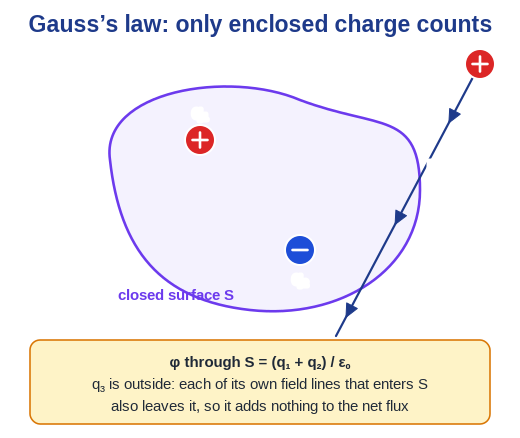
Gauss’s law: the total electric flux through any closed surface is the total charge enclosed divided by ε₀,
φ = q/ε₀
Points to keep in mind:
- It holds for a closed surface of any shape or size.
- q is the total enclosed charge, with signs. Charges outside change the field on the surface but add no net flux, since each of their lines that enters also leaves.
- The surface must not pass through a point charge, where the field is undefined. It may pass through a continuous charge distribution.
- Zero net flux tells you only that the net charge inside is zero.
- The law follows from the inverse-square form of Coulomb’s law.
A simple check: a closed cylinder with its axis along a uniform field has flux −ES through one flat face, +ES through the other and none through the curved side. The total is zero, and indeed no charge is inside.
Field of a long straight wire
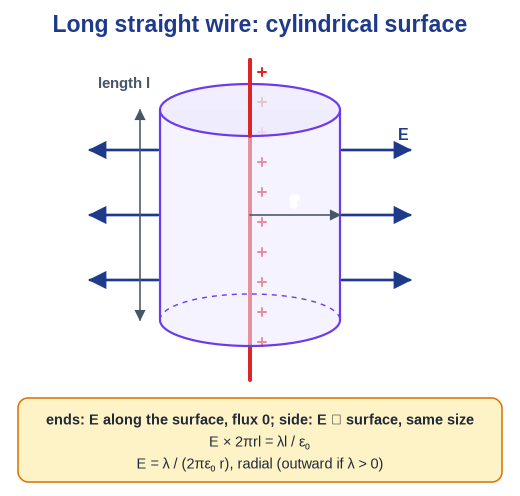
Take an infinitely long thin wire with charge λ per metre. By symmetry, E points radially away from the wire and depends only on the distance r. Choose a closed cylinder of radius r and length l around the wire. On the flat ends E runs along the surface, so their flux is zero. On the curved side E is normal and constant, so
E × 2πrl = λl/ε₀, which gives E = λ/(2πε₀r)
The field is outward for positive λ. The result needs the wire to be very long; near the middle of a real long wire it is a good approximation.
Field of an infinite plane sheet
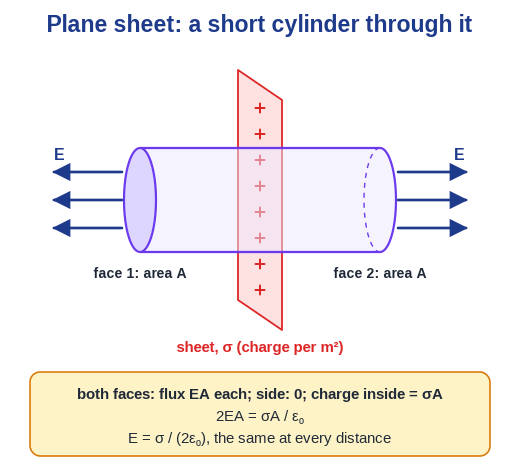
Take a flat sheet with charge σ per square metre. By symmetry, E is perpendicular to the sheet and points away from it on both sides (for positive σ). Choose a short cylinder through the sheet with flat faces of area A. Each face has flux EA and the side has none; the charge inside is σA. So
2EA = σA/ε₀, which gives E = σ/(2ε₀)
The field does not depend on the distance from the sheet. For a large but finite sheet this holds well away from its edges.
Field of a thin spherical shell
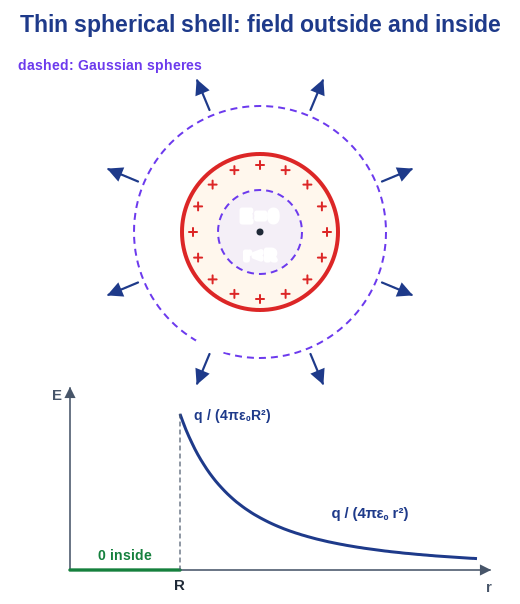
Take a thin shell of radius R with total charge q = 4πR²σ. By symmetry, E is radial and depends only on r. Use a Gaussian sphere of radius r with the same centre.
Outside (r > R): the sphere encloses q, so E × 4πr² = q/ε₀ and
E = q/(4πε₀r²)
exactly as if all the charge sat at the centre.
Inside (r < R): the sphere encloses no charge, so E × 4πr² = 0 and E = 0. The field is zero everywhere inside the shell. Experiments confirm this, which supports the 1/r² law.
Previous topic: electric field and electric dipole. See also the chapter notes and the NCERT solutions.
Practice
-
A charge q sits at the centre of a cube. The flux through one face of the cube is:
Show answer
Answer: (c) q/(6ε₀)
-
The field near an infinitely long straight charged wire varies with distance r as:
Show answer
Answer: (a) 1/r
-
A closed surface encloses +3 µC and −3 µC. The net flux through it is:
Show answer
Answer: (c) zero
-
Why must the Gaussian surface not pass through a point charge?
Show answer
Answer: The field of a point charge grows without limit as you approach it, so the field on such a surface would not be defined at that point.
-
What is the field 2 m from an infinite sheet with σ = 8.854 × 10⁻⁶ C/m²?
Show answer
Answer: E = σ/(2ε₀) = 8.854 × 10⁻⁶ ÷ (2 × 8.854 × 10⁻¹²) = 5 × 10⁵ N/C, pointing away from the sheet; it is the same at every distance.
Questions students ask
What is the statement of Gauss’s law?
The total electric flux through any closed surface is 1/ε₀ times the total charge enclosed by that surface: φ = q/ε₀. It holds for a surface of any shape and size.
What is a Gaussian surface?
It is the imaginary closed surface you choose to apply Gauss’s law. Pick one that matches the symmetry of the charges, so that E is constant and normal on some parts and along the surface on the rest, and make sure it does not pass through a point charge.
Why is the field inside a charged spherical shell zero?
A Gaussian sphere inside the shell encloses no charge, so the total flux through it is zero. By symmetry the field would have the same size at every point of that sphere, so it must be zero everywhere inside.
On what law is Gauss’s law based?
On Coulomb’s inverse-square law. The flux through a sphere comes out independent of its radius only because the field falls as 1/r² while the area grows as r². Any departure from 1/r² would break Gauss’s law.
Stuck on a question?
Take a photo and Lagnever AI explains it step by step. Try it for 7 days for ₹2.
Get it on Google Play Open in browser
For parents: after the trial, the plan renews monthly by UPI or card autopay. You can cancel anytime in the app.