
What is an electric field, and what is an electric dipole?
Answer in short
The electric field at a point is the force per unit positive test charge, E = F/q₀, in N/C; a point charge q gives E = q/(4πε₀r²). An electric dipole is a pair of charges +q and −q a distance 2a apart. Its dipole moment p = q × 2a points from −q to +q.
Stuck on a question? Take a photo and Lagnever AI explains it step by step. Try it for 7 days for ₹2. Get it on Google Play
How is the electric field defined?
A charge Q fills the space around it with an electric field. Place a small positive test charge q₀ at a point and measure the force F on it. The field there is
E = F/q₀ (in the limit q₀ → 0)
The test charge is kept tiny so that it does not push the source charge Q out of place. E does not depend on q₀, because F grows in step with q₀. The unit of E is N/C. Once E is known, the force on any charge q at that point is F = qE. Put a positive charge there and the force is along E; a negative charge is pushed the other way.
For a point charge Q, Coulomb’s law gives
E = (1/4πε₀) · (Q/r²) r̂
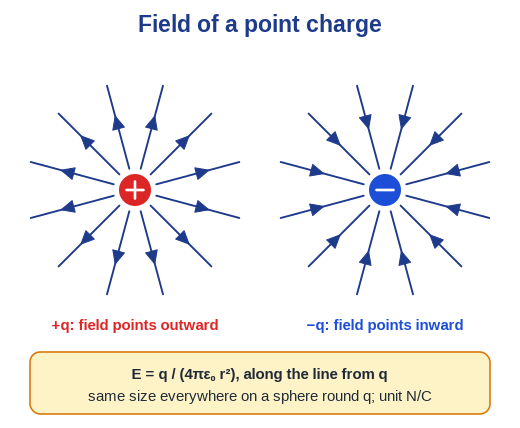
It points radially outward for positive Q and inward for negative Q, and it has the same size everywhere on a sphere centred on Q. For many charges, the field is the vector sum of their separate fields (superposition).
What do field lines show?
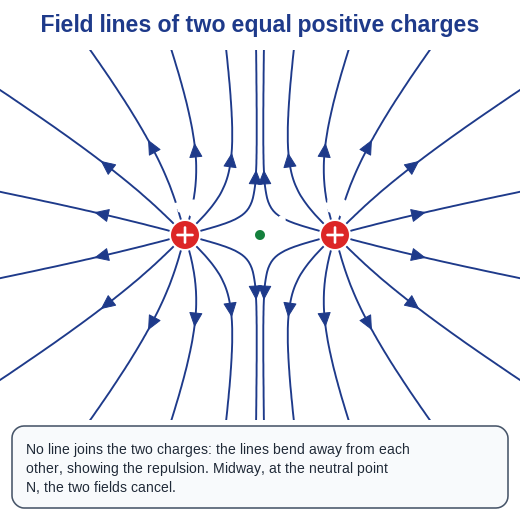
A field line is drawn so that its tangent at each point gives the direction of E there. Where lines crowd, the field is strong. For a point charge, the same number of lines crosses every sphere around it, while the area of the sphere grows as r², so the field falls as 1/r². The main properties are:
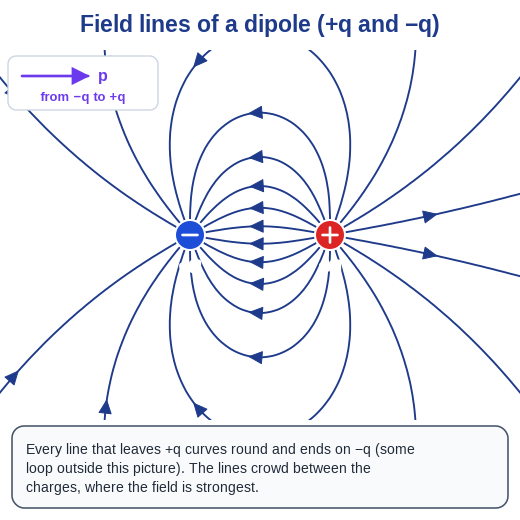
- Lines start on positive charges and end on negative charges, or run off to infinity.
- In a region with no charge they are continuous curves without breaks.
- Two lines never cross, because the field at a point has only one direction.
- Electrostatic field lines never form closed loops.
What is an electric dipole?
An electric dipole is two charges of the same size but opposite sign, +q and −q, held a small distance 2a apart. Its dipole moment is
p = q × 2a, directed from −q to +q (unit: C m)
The total charge is zero, but the two fields do not cancel exactly, because the charges sit at different places.
What is the field on the axis of a dipole?
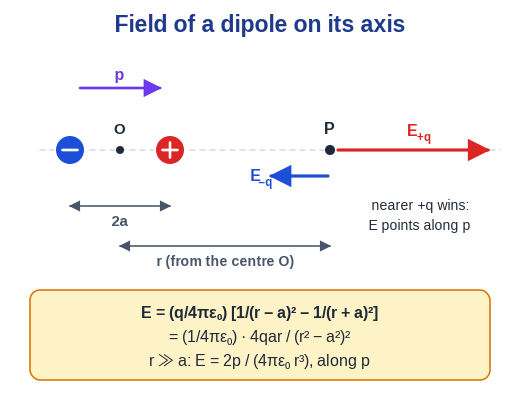
Take a point P on the axis, on the +q side, at distance r from the centre. It is r − a from +q and r + a from −q. The field of +q points away from +q, along p; the field of −q points towards −q, against p. +q is nearer, so
E = (q/4πε₀) [1/(r − a)² − 1/(r + a)²]
= (q/4πε₀) · 4ar/(r² − a²)²
For r ≫ a, the denominator is close to r⁴, so
E = 4qa/(4πε₀r³) = 2p/(4πε₀r³), along p
What is the field on the equatorial plane?
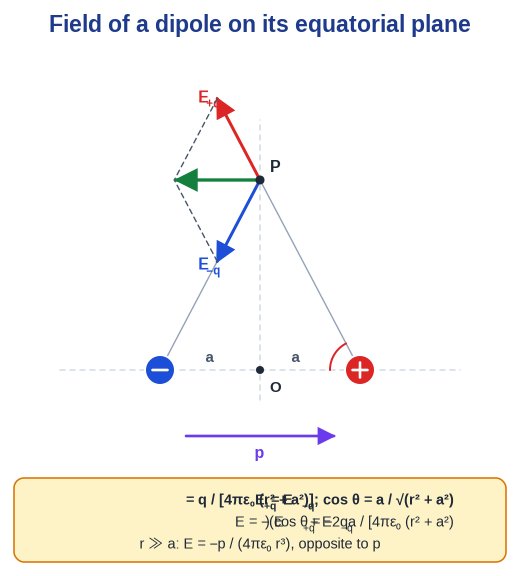
Now take P on the perpendicular bisector, a distance r from the centre. It is √(r² + a²) from each charge, so the two fields are equal in size:
E+q = E−q = q/[4πε₀(r² + a²)]
Their components perpendicular to the axis cancel. The components along the axis add, and both point from +q towards −q, opposite to p. With cos θ = a/√(r² + a²):
E = 2E+q cos θ = 2qa/[4πε₀(r² + a²)3/2], opposite to p
For r ≫ a this becomes E = −p/(4πε₀r³). At the same distance, the axial field is twice the equatorial one.
Why does a dipole’s field fall off as 1/r³?
Far away, the fields of +q and −q almost cancel, so what is left is weaker than the 1/r² field of one charge. The far field depends only on the product p = q × 2a, not on q and a separately. A point dipole, with 2a → 0 and q growing so that p stays fixed, follows the 1/r³ formulas exactly. Molecules such as H₂O are polar: their centres of positive and negative charge do not coincide, so they carry a permanent dipole moment.
What happens to a dipole in a uniform field?
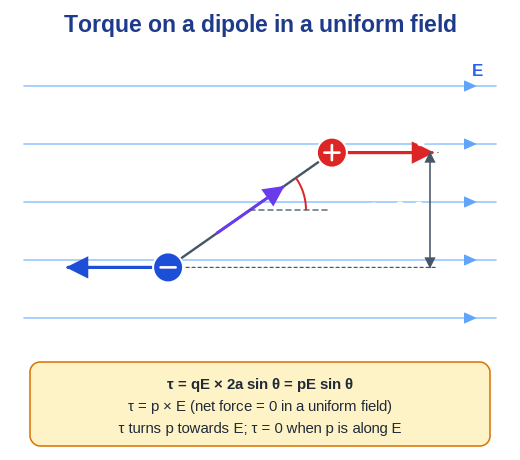
In a uniform field E, the force is qE on +q and −qE on −q, so the net force is zero. The two forces act at points 2a apart, and when p makes an angle θ with E, the perpendicular distance between their lines of action is 2a sin θ. They form a couple:
τ = qE × 2a sin θ = pE sin θ, or τ = p × E
The torque turns p towards E and is zero when p lies along E. If the field is not uniform, there is also a net force. That is how a charged comb lifts bits of paper: it induces a dipole in the paper and pulls harder on the nearer, stronger-field side.
Previous topic: Coulomb’s law. Next: Gauss’s law and its applications. See also the chapter notes and the NCERT solutions.
Practice
-
At a point on the axis of a short dipole, far away, the field varies with distance r as:
Show answer
Answer: (c) 1/r³
-
For the same distance r ≫ a, the field on the axis of a dipole compared with the field on its equatorial plane is:
Show answer
Answer: (c) twice as large
-
The torque on a dipole in a uniform field is largest when the angle between p and E is:
Show answer
Answer: (c) 90°
-
A charge of 2 µC feels a force of 0.01 N at a point. What is the electric field there?
Show answer
Answer: E = F/q = 0.01 N ÷ (2 × 10⁻⁶ C) = 5 × 10³ N/C, in the direction of the force (the charge is positive).
-
A dipole has charges ±5 nC that are 2 mm apart. What is its dipole moment?
Show answer
Answer: p = q × 2a = 5 × 10⁻⁹ C × 2 × 10⁻³ m = 1 × 10⁻¹¹ C m, pointing from −q to +q.
Questions students ask
What is the unit of electric field?
The newton per coulomb (N/C), because the field is force per unit charge. In the next chapter you meet an equivalent unit, the volt per metre (V/m).
What is the dipole moment of an electric dipole?
It is the vector p = q × 2a: the size of either charge times the distance between them, directed from −q to +q. Its SI unit is the coulomb metre (C m).
What is the field of a dipole on its axis and on its equatorial line?
For r much larger than a, the field on the axis is 2p/(4πε₀r³), along p, and on the equatorial plane it is p/(4πε₀r³), opposite to p. Both fall off as 1/r³.
Why does a dipole feel no net force in a uniform field?
The field pushes +q with qE one way and −q with qE the other way, so the two forces cancel. They act at different points, though, so they form a couple with torque τ = p × E.
Stuck on a question?
Take a photo and Lagnever AI explains it step by step. Try it for 7 days for ₹2.
Get it on Google Play Open in browser
For parents: after the trial, the plan renews monthly by UPI or card autopay. You can cancel anytime in the app.