
What is Coulomb’s law?
Answer in short
Coulomb’s law says that two point charges q₁ and q₂ a distance r apart in vacuum push or pull each other with a force F = q₁q₂/(4πε₀r²), where 1/(4πε₀) ≈ 9 × 10⁹ N m² C⁻². The force acts along the line joining the charges: like charges repel and unlike charges attract.
Stuck on a question? Take a photo and Lagnever AI explains it step by step. Try it for 7 days for ₹2. Get it on Google Play
Where does Coulomb’s law come from?
In 1785 Charles Augustin de Coulomb measured the force between small charged metal spheres with a torsion balance, a very sensitive instrument for small forces. He did not know the charges, so he used a clever trick. When a charged sphere touches an identical uncharged one, the charge shares equally between them, so he could halve a charge again and again. By changing the distance for a fixed pair, and then the charges at a fixed distance, he found that the force:
- is proportional to the product of the two charges, q₁q₂;
- is inversely proportional to the square of the distance, 1/r²;
- acts along the line joining the two charges.
The law holds from everyday distances right down to atomic ones, about 10⁻¹⁰ m.
What is the formula?
For two point charges q₁ and q₂ separated by r in vacuum:
F = k q₁q₂ / r², with k = 1/(4πε₀)
so
F = (1/4πε₀) · q₁q₂ / r²
Here ε₀ = 8.854 × 10⁻¹² C² N⁻¹ m⁻² is the permittivity of free space (vacuum), and k ≈ 9 × 10⁹ N m² C⁻². Put in q₁ = q₂ = 1 C and r = 1 m and the force is 9 × 10⁹ N. That is why the coulomb is a very large unit, and why problems use µC (10⁻⁶ C) and mC (10⁻³ C).
A quick check of how the force scales: double one charge and the force doubles; double the distance and the force falls to one quarter.
How do we write Coulomb’s law as a vector?
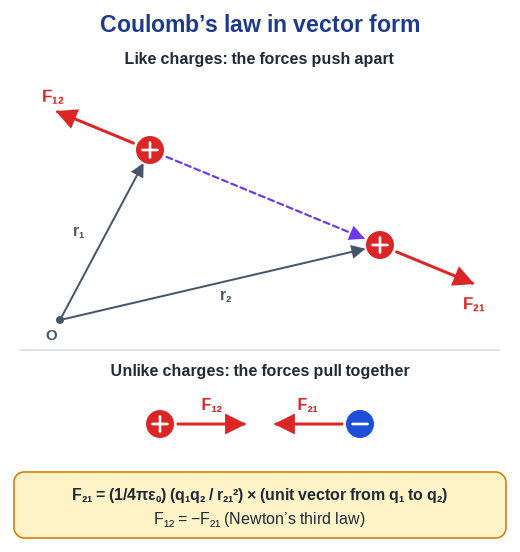
Let q₁ and q₂ sit at position vectors r₁ and r₂. The vector from q₁ to q₂ is r₂₁ = r₂ − r₁, its length is r₂₁, and r̂₂₁ = r₂₁/r₂₁ is the unit vector along it. The force on q₂ due to q₁ is
F₂₁ = (1/4πε₀) · (q₁q₂ / r₂₁²) r̂₂₁
This single formula covers every sign. If q₁ and q₂ have the same sign, q₁q₂ is positive and F₂₁ points along r̂₂₁, away from q₁: repulsion. If the signs differ, q₁q₂ is negative and F₂₁ points back towards q₁: attraction. Swapping the labels gives F₁₂ = −F₂₁, so the two forces are equal and opposite, as Newton’s third law needs. When matter fills the space between the charges, the force changes; that is taken up in the next chapter.
How strong is the electric force?
Both Coulomb’s law and Newton’s law of gravitation fall off as 1/r², so their ratio does not depend on the distance. For an electron and a proton, the electric force is about 10³⁹ times the gravitational force. Yet gravity rules the motion of planets. The reason is that gravity only attracts, while electric forces can attract or repel. Large bodies carry almost equal positive and negative charge, so their electric forces cancel and only gravity is left.
What happens when there are many charges?
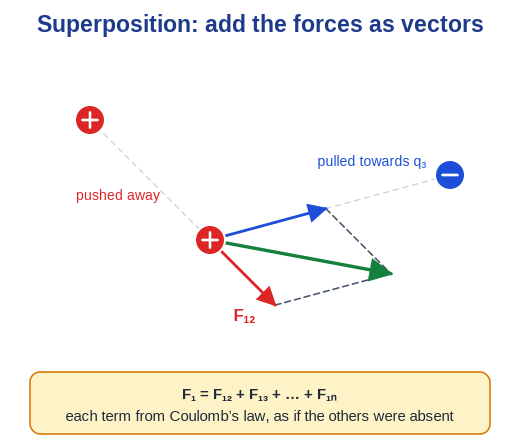
Experiments show that the force between two charges is not affected by a third charge nearby. So to find the total force on q₁ due to q₂, q₃, …, qₙ, find each Coulomb force on its own and add them as vectors:
F₁ = F₁₂ + F₁₃ + … + F₁ₙ = (1/4πε₀) Σ (q₁qᵢ / r₁ᵢ²) r̂₁ᵢ
This is the principle of superposition. Coulomb’s law and superposition together are the basis of all of electrostatics.
Our own example. Three charges lie on the x-axis: q₁ = +1 µC at x = 0, q₂ = +2 µC at x = 0.1 m and q₃ = −3 µC at x = 0.3 m. Find the force on q₁.
Force due to q₂ (repulsion, along −x):
F₁₂ = (9 × 10⁹)(1 × 10⁻⁶)(2 × 10⁻⁶)/(0.1)² = 1.8 N
Force due to q₃ (attraction, along +x):
F₁₃ = (9 × 10⁹)(1 × 10⁻⁶)(3 × 10⁻⁶)/(0.3)² = 0.3 N
Net force = 1.8 N − 0.3 N = 1.5 N, along −x.
Next topic: electric field and electric dipole. See also the chapter notes and the NCERT solutions.
Practice
-
Two charges of 1 µC each are 0.3 m apart in vacuum. The force between them is:
Show answer
Answer: (a) 0.1 N
-
If both charges are doubled and the distance is also doubled, the force:
Show answer
Answer: (b) stays the same
-
The SI unit of ε₀ is:
Show answer
Answer: (b) C² N⁻¹ m⁻²
-
Why do we not notice the electric force between everyday objects as easily as gravity?
Show answer
Answer: Ordinary objects carry almost equal amounts of positive and negative charge, so their electric forces cancel; gravity is always attractive and never cancels.
-
A +2 µC charge is at the origin and a −2 µC charge is 0.2 m away on the x-axis. What is the force on the −2 µC charge?
Show answer
Answer: F = (9 × 10⁹ × 2 × 10⁻⁶ × 2 × 10⁻⁶)/(0.2)² = 0.9 N, attractive, so it points along −x, towards the origin.
Questions students ask
What is the formula of Coulomb’s law?
F = (1/4πε₀) q₁q₂/r², where q₁ and q₂ are the charges in coulombs, r is the distance between them in metres, and 1/(4πε₀) ≈ 9 × 10⁹ N m² C⁻². The force acts along the line joining the charges.
What is the value of ε₀?
ε₀, the permittivity of free space (vacuum), is 8.854 × 10⁻¹² C² N⁻¹ m⁻². It appears in Coulomb’s law through the constant k = 1/(4πε₀) ≈ 9 × 10⁹ N m² C⁻².
Does Coulomb’s law obey Newton’s third law?
Yes. In vector form the force on q₁ due to q₂ is exactly the negative of the force on q₂ due to q₁: F₁₂ = −F₂₁. The two forces are equal in size, opposite in direction and act along the same line.
What is the superposition principle?
The force between any two charges is not changed by other charges nearby. So the total force on a charge is the vector sum of the forces from each of the other charges, each found from Coulomb’s law as if it were alone.
Stuck on a question?
Take a photo and Lagnever AI explains it step by step. Try it for 7 days for ₹2.
Get it on Google Play Open in browser
For parents: after the trial, the plan renews monthly by UPI or card autopay. You can cancel anytime in the app.