
NCERT Solutions Class 12 Physics Chapter 10: Wave Optics
Answers to all 6 end-of-chapter exercises and both worked examples of Chapter 10, Wave Optics, of Physics Part II, the Class 12 NCERT textbook. Page numbers follow the 2026-27 reprint (pages 255–273). The exercises come first, quoted from the book; the examples follow, restated in short. Every number was also checked by computer. Short notes: Chapter 10 notes.
We use c = 3.00 × 10⁸ m/s. Remember that a path difference of λ means a phase difference of 2π.
Safety: never look at the Sun, directly or through a slit, lens or polaroid, and never look into a laser beam or point one at anyone. Any slit or polaroid activity is done only with a teacher.
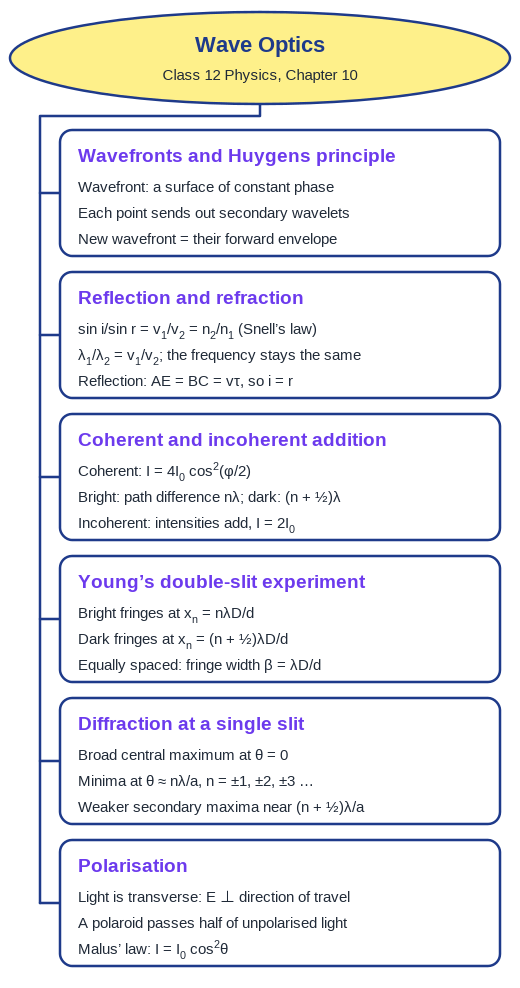
Exercises 10.1 to 10.3: wavefronts, speed and wavelength
10.1 “Monochromatic light of wavelength 589 nm is incident from air on a water surface. What are the wavelength, frequency and speed of (a) reflected, and (b) refracted light? Refractive index of water is 1.33.”
The frequency is fixed by the source and does not change on reflection or refraction:
ν = c/λ = (3.00 × 10⁸ m/s)/(589 × 10⁻⁹ m) = 5.09 × 10¹⁴ Hz
(a) Reflected light goes back into the same medium (air), so nothing changes: λ = 589 nm, ν = 5.09 × 10¹⁴ Hz, speed = 3.00 × 10⁸ m/s.
(b) Refracted light is in water:
- frequency ν = 5.09 × 10¹⁴ Hz (unchanged)
- speed v = c/n = 3.00 × 10⁸/1.33 = 2.26 × 10⁸ m/s
- wavelength λ_w = v/ν = λ/n = 589 nm/1.33 = 443 nm
(The answer key prints 444 nm, which comes from dividing the rounded values 2.26 × 10⁸/5.09 × 10¹⁴; without rounding, 589/1.33 = 442.9 nm.)
10.2 “What is the shape of the wavefront in each of the following cases: (a) Light diverging from a point source. (b) Light emerging out of a convex lens when a point source is placed at its focus. (c) The portion of the wavefront of light from a distant star intercepted by the Earth.”
(a) Spherical, centred on the point source: all points at the same distance from it oscillate in phase.
(b) Plane. A source at the focus of a convex lens gives a parallel beam, and the wavefronts perpendicular to parallel rays are planes.
(c) Plane. The star is so far away that the small part of its huge spherical wavefront that meets the Earth is practically flat.
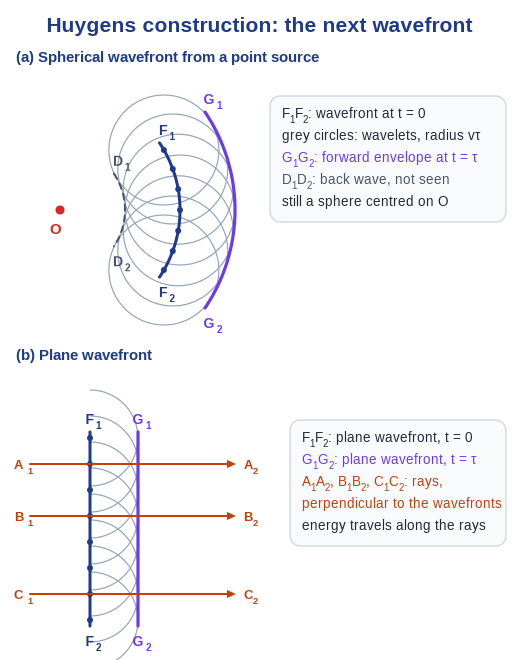
10.3 “(a) The refractive index of glass is 1.5. What is the speed of light in glass? (Speed of light in vacuum is 3.0 × 10⁸ m s⁻¹) (b) Is the speed of light in glass independent of the colour of light? If not, which of the two colours red and violet travels slower in a glass prism?”
(a) v = c/n = (3.0 × 10⁸ m s⁻¹)/1.5 = 2.0 × 10⁸ m s⁻¹
(b) No. The refractive index of glass depends on the wavelength, so the speed v = c/n differs from colour to colour (this is dispersion, Chapter 9). A prism bends violet more than red, so n_violet > n_red, and therefore violet travels slower than red in the glass. (A single value such as 1.5 is usually taken to refer to yellow light.)
Exercises 10.4 to 10.6: Young’s double-slit experiment
10.4 “In a Young’s double-slit experiment, the slits are separated by 0.28 mm and the screen is placed 1.4 m away. The distance between the central bright fringe and the fourth bright fringe is measured to be 1.2 cm. Determine the wavelength of light used in the experiment.”
Bright fringes are at x_n = nλD/d, with the central one at n = 0. The fourth bright fringe (n = 4) is at
x₄ = 4λD/d
so
λ = x₄d/(4D) = (1.2 × 10⁻² m × 0.28 × 10⁻³ m)/(4 × 1.4 m) = 3.36 × 10⁻⁶/5.6 m = 6.0 × 10⁻⁷ m = 600 nm
Check: the fringe width is β = λD/d = (6.0 × 10⁻⁷ × 1.4)/(0.28 × 10⁻³) = 3.0 mm, and 4 × 3.0 mm = 1.2 cm.
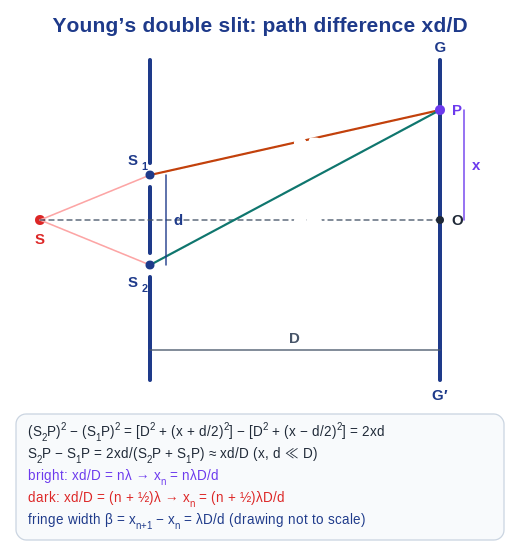
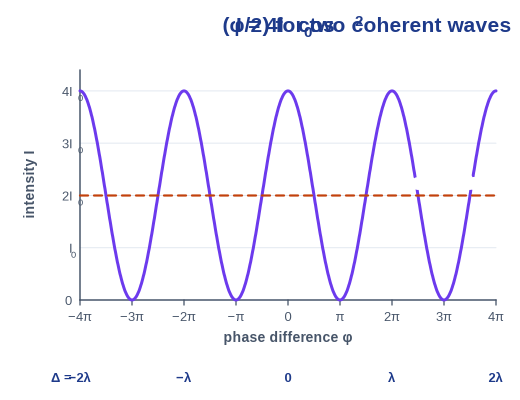
10.5 “In Young’s double-slit experiment using monochromatic light of wavelength λ, the intensity of light at a point on the screen where path difference is λ, is K units. What is the intensity of light at a point where path difference is λ/3?”
For two coherent waves each of intensity I₀, I = 4I₀ cos²(φ/2), with phase difference φ = (2π/λ) × path difference.
- Path difference λ: φ = 2π, so I = 4I₀ cos²π = 4I₀. This is K, so I₀ = K/4.
- Path difference λ/3: φ = 2π/3, so I = 4I₀ cos²(π/3) = 4I₀ × (½)² = I₀.
The intensity is K/4.
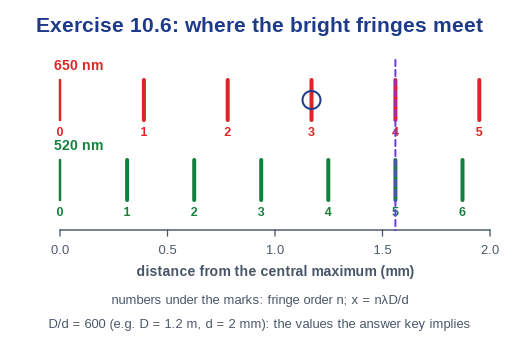
10.6 “A beam of light consisting of two wavelengths, 650 nm and 520 nm, is used to obtain interference fringes in a Young’s double-slit experiment. (a) Find the distance of the third bright fringe on the screen from the central maximum for wavelength 650 nm. (b) What is the least distance from the central maximum where the bright fringes due to both the wavelengths coincide?”
The question as printed does not give d or D. In symbols:
(a) x₃ = 3λD/d = 3 × 650 nm × (D/d) = 1.95 × 10⁻⁶ m × (D/d)
(b) A bright fringe of order n₁ for 650 nm falls on one of order n₂ for 520 nm when n₁ × 650 = n₂ × 520, that is n₁/n₂ = 520/650 = 4/5. The smallest whole numbers are n₁ = 4 and n₂ = 5 (4 × 650 nm = 5 × 520 nm = 2600 nm), so the least distance is
x = 4 × 650 nm × (D/d) = 2.6 × 10⁻⁶ m × (D/d)
The answer key gives 1.17 mm and 1.56 mm. Both correspond to D/d = 600, for example D = 1.2 m and d = 2 mm. With those values:
(a) x₃ = 3 × 650 × 10⁻⁹ × 600 = 1.17 × 10⁻³ m = 1.17 mm
(b) x = 4 × 650 × 10⁻⁹ × 600 = 1.56 × 10⁻³ m = 1.56 mm (the 4th bright fringe of 650 nm and the 5th of 520 nm)
Worked examples 10.1 and 10.2
Example 10.1 (page 262): (a) Why do reflected and refracted light have the same frequency as the incident light? (b) Does the drop in speed in a denser medium mean less energy? (c) In the photon picture, what sets the intensity?
(a) Reflection and refraction happen because the incident light interacts with the atoms of the material. The atoms behave like oscillators that are forced to vibrate at the frequency of the light falling on them, and a vibrating charge sends out light at its own frequency of vibration. So the scattered (reflected and refracted) light has the same frequency as the incident light.
(b) No. The energy carried by a wave depends on its amplitude, not on how fast it travels.
(c) For light of a given frequency, the intensity is set by the number of photons crossing unit area per unit time.
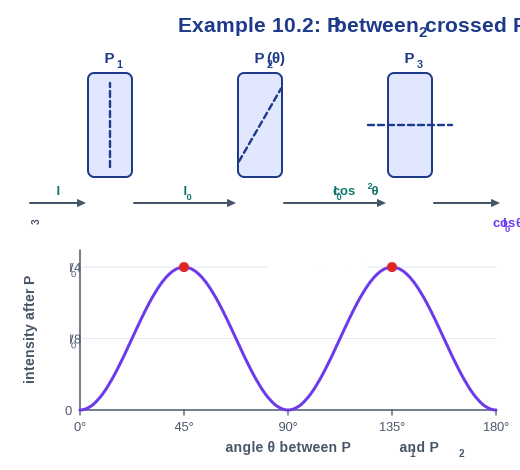
Example 10.2 (page 271): A polaroid is rotated between two crossed polaroids. How does the transmitted intensity change?
Let the light leaving the first polariser P₁ have intensity I₀, and let the middle polaroid P₂ make angle θ with P₁. By Malus’ law, after P₂ the intensity is I₀ cos²θ. P₁ and P₃ are crossed, so P₂ makes angle (π/2 − θ) with P₃, and after P₃
I = I₀ cos²θ cos²(π/2 − θ) = I₀ cos²θ sin²θ = (I₀/4) sin²2θ
This is zero for θ = 0 and θ = π/2 (P₂ parallel to P₁ or to P₃) and is greatest, I₀/4, when sin 2θ = 1, that is at θ = π/4.
Notes for checking
- The answer key agrees with Exercises 10.2 to 10.5. In 10.1(b) it prints 444 nm; 589/1.33 = 442.9 nm, so 443 nm is used above (the key’s value comes from rounded intermediate numbers).
- Exercise 10.6 as printed gives neither the slit separation nor the screen distance. The key’s 1.17 mm and 1.56 mm both follow from D/d = 600 (for example D = 1.2 m, d = 2 mm); the solution above gives the general answer and then these values.
- The answer key (pages 350–351) still lists answers 10.7 to 10.10 (0.15°; tan⁻¹(1.5) ≈ 56.3°; 5000 Å, 6 × 10¹⁴ Hz, 45°; 40 m) for exercises that are no longer in the 2026-27 chapter, which ends at 10.6.
- Page 263 refers to “Fig. 10.10(b)” for point R; the figure meant is Fig. 10.9(b).
Practice
-
Light of frequency 5.0 × 10¹⁴ Hz enters glass of refractive index 1.5 from air. Its frequency in the glass is:
Show answer
Answer: (b) 5.0 × 10¹⁴ Hz
-
In Young’s experiment the intensity at the centre is 4I₀. At a point where the phase difference is π/2 it is:
Show answer
Answer: (b) 2I₀
-
Polarised light of intensity I₀ meets a polaroid whose pass-axis is at 45° to it. The transmitted intensity is:
Show answer
Answer: (b) I₀/2
-
In Young’s experiment d = 0.5 mm, D = 1.0 m and the fringe width is 1.2 mm. Find the wavelength.
Show answer
Answer: β = λD/d, so λ = βd/D = (1.2 × 10⁻³ × 0.5 × 10⁻³)/1.0 = 6.0 × 10⁻⁷ m = 600 nm.
-
Light of 500 nm in air enters water (n = 1.33). Find its speed and wavelength in water.
Show answer
Answer: v = c/n = 3.0 × 10⁸/1.33 = 2.26 × 10⁸ m/s. λ = 500/1.33 = 376 nm. The frequency, c/λ = 6.0 × 10¹⁴ Hz, is unchanged.
Stuck on a question?
Take a photo and Lagnever AI explains it step by step. Try it for 7 days for ₹2.
Get it on Google Play Open in browser
For parents: after the trial, the plan renews monthly by UPI or card autopay. You can cancel anytime in the app.