
Class 12 Physics Chapter 10: Wave Optics Notes
This chapter in five lines
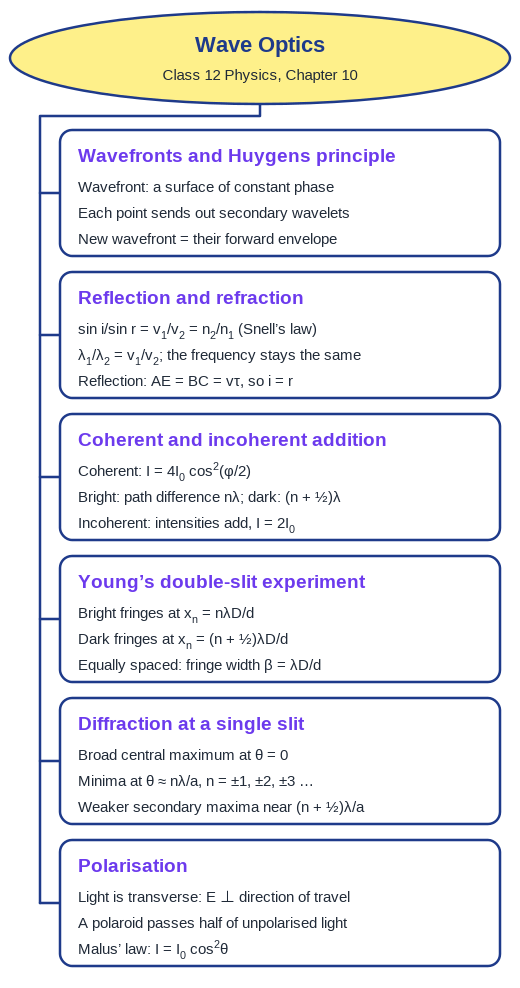
Wave optics treats light as a wave. Huygens principle builds each new wavefront from secondary wavelets and gives the laws of reflection and refraction, with light slower in the denser medium. Two coherent sources give I = 4I₀ cos²(φ/2): in Young’s experiment bright fringes sit at x = nλD/d, equally spaced by β = λD/d. A slit of width a produces a broad central maximum with minima at θ ≈ nλ/a. Polaroids show that light is transverse: Malus’ law, I = I₀ cos²θ.
What is this chapter about?
Chapter 9 treated light as rays travelling in straight lines. That works because the wavelength of light is tiny, about half a micrometre, compared with mirrors and lenses. This chapter (book pages 255 to 273) treats light as a wave, which explains effects that rays cannot: interference, diffraction and polarisation.
The history in the book runs like this. Descartes (1637) and then Newton pictured light as a stream of particles (the corpuscular model). Christiaan Huygens put forward a wave theory in 1678. Both models explain reflection and refraction, but they disagree about speed: when light bends towards the normal, the particle model needs light to be faster in the second medium and the wave model needs it to be slower. In 1850 Foucault found that light is slower in water than in air, as the wave model predicts. Thomas Young’s interference experiment of 1801 settled that light is a wave, and Maxwell’s theory then showed it to be an electromagnetic wave (Chapter 8), which is why it can cross a vacuum.
Safety: never look at the Sun, directly or through a slit, lens, mirror or filter, and never look into a laser beam or shine one at anyone. Any slit, polaroid or interference activity is done only with a teacher.
What is a wavefront?
Drop a pebble into still water and rings spread out. Every point on one ring is the same distance from the source, so all of them move up and down together. A surface joining points that oscillate in the same phase is a wavefront. The wave’s energy moves at right angles to the wavefront, and a line drawn in that direction is a ray.
- A point source in an open medium gives spherical wavefronts.
- Very far from the source, a small patch of a sphere is almost flat, so we get a plane wavefront (sunlight or starlight reaching us, for example).
What is Huygens principle?
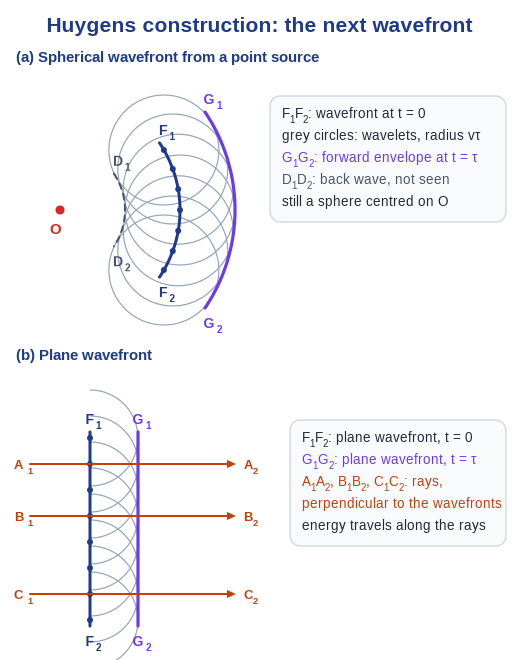
Huygens principle is a geometrical rule for finding where a wavefront will be later, if we know where it is now:
- Treat every point of the present wavefront as a source of secondary wavelets.
- In time τ each wavelet grows to a sphere of radius vτ, where v is the wave speed.
- Draw the common tangent (envelope) of these spheres in the forward direction: that is the new wavefront.
For a spherical wavefront the new one is a larger sphere about the same centre; for a plane wavefront it is a parallel plane a distance vτ ahead. The construction also gives a backward envelope, a wave going back towards the source, which is never seen. Huygens simply assumed that wavelets are strongest forwards and zero backwards; the book notes that a fuller wave theory justifies the missing back wave. Read Huygens principle.
How does Huygens principle give the law of refraction?
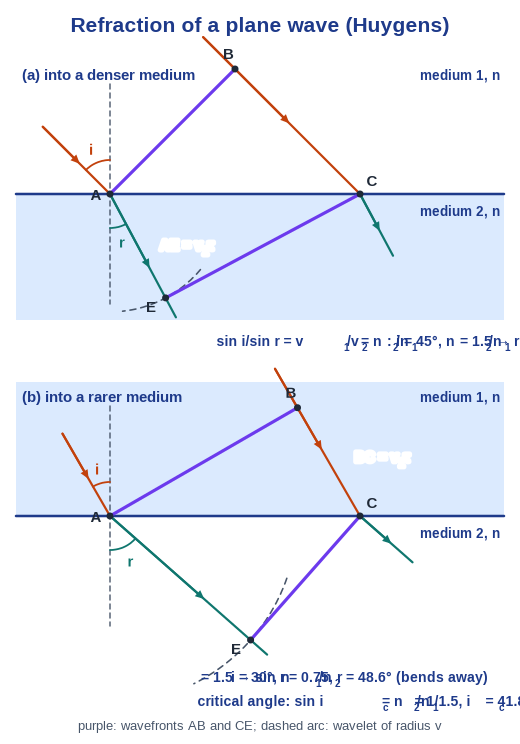
Let a plane wavefront AB meet the boundary between medium 1 (speed v₁) and medium 2 (speed v₂) at angle i, with A already touching the boundary. In the time τ that the end B takes to reach the boundary at C, so that BC = v₁τ, the wavelet from A grows inside medium 2 to a radius AE = v₂τ. The tangent from C to this wavelet, CE, is the refracted wavefront. Triangles ABC and AEC share the side AC, and
sin i = BC/AC = v₁τ/AC and sin r = AE/AC = v₂τ/AC
so sin i/sin r = v₁/v₂. With refractive indices n₁ = c/v₁ and n₂ = c/v₂ this becomes Snell’s law, n₁ sin i = n₂ sin r.
Two results follow:
- If the ray bends towards the normal (r < i), then v₂ < v₁: light is slower in the denser medium, which experiment confirms.
- If BC is one wavelength λ₁, then AE is one wavelength λ₂, so λ₁/v₁ = λ₂/v₂. The wavelength changes with the speed, and the frequency ν = v/λ stays the same.
Going into a rarer medium (v₂ > v₁) the same construction gives r > i: the wave bends away from the normal. At the angle i_c with sin i_c = n₂/n₁, r reaches 90°; beyond it no refracted wave exists and total internal reflection occurs (Chapter 9).
How does it give the law of reflection?
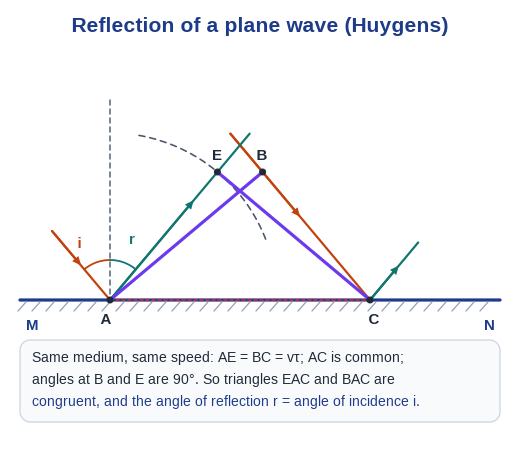
Now the wave stays in one medium, speed v. The wavefront AB meets a mirror MN; in time τ the end B reaches C (BC = vτ) while the wavelet from A grows to AE = vτ. The tangent CE is the reflected wavefront. The right-angled triangles EAC and BAC have AE = BC and the common hypotenuse AC, so they are congruent and the angle of reflection equals the angle of incidence.
What happens to wavefronts in prisms, lenses and mirrors?
The wave picture explains the ray results of Chapter 9:
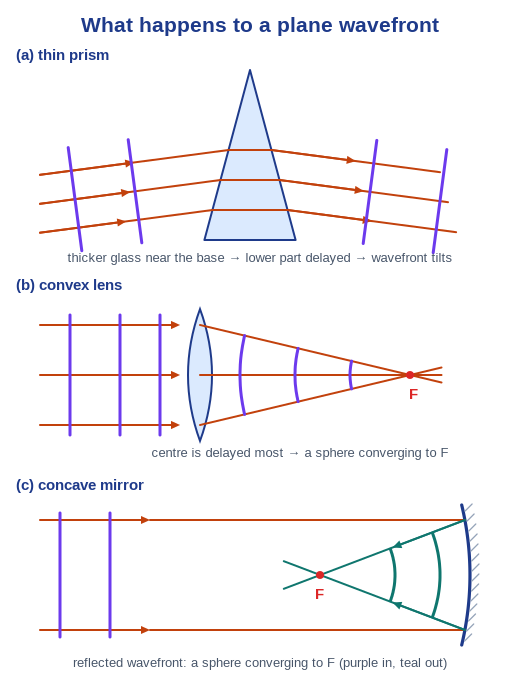
- Thin prism: the part of a plane wavefront that passes through the thick base is delayed most, so the emerging wavefront is tilted and the beam turns towards the base.
- Convex lens: the middle of the wavefront crosses the thickest glass and is held back most, so the emerging wavefront is curved inwards: a sphere that converges to the focus F.
- Concave mirror: the reflected wavefront is a sphere converging to the focus.
Because the wavefront from an object point reaches the image point all at once, the time of travel is the same along every ray. In a lens, the central ray has the shortest path but goes slowly through the most glass; the edge rays go round a longer path mostly in air, and they all take equal time.
Example 10.1 (page 262) asks three short questions on this section. Reflected and refracted light keep the incident frequency because the atoms of the material are driven at that frequency and re-emit at it. A lower speed does not mean less energy, since a wave’s energy depends on its amplitude. In the photon picture the intensity is set by the number of photons crossing unit area per second. The full answers are in the NCERT solutions.
What do coherent and incoherent sources mean?
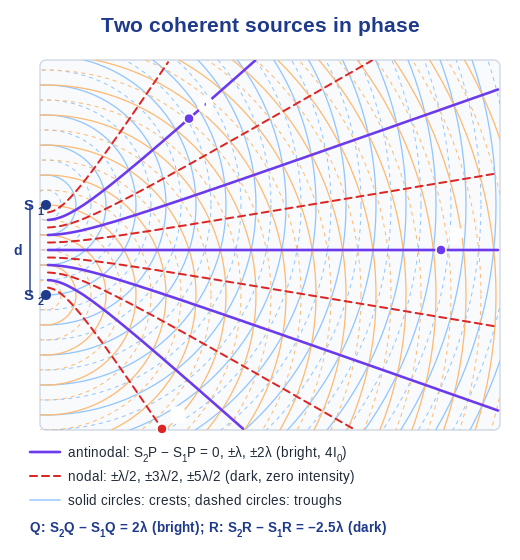
When two waves reach the same point, the total displacement is the sum of the two (the principle of superposition). Picture two needles dipping up and down together in a water trough. If, at every point, the phase difference between their two waves stays fixed in time, the sources are coherent.
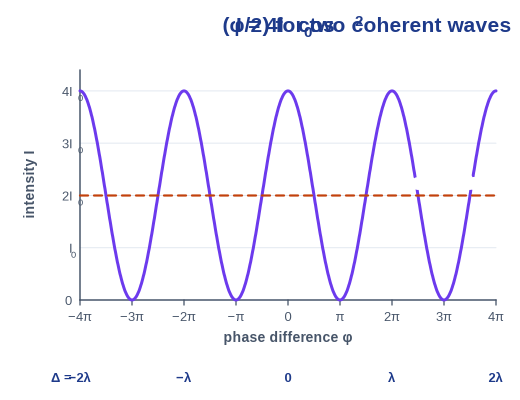
Let each source alone give displacement a cos ωt and intensity I₀ (proportional to a²) at a point. If the second wave arrives with phase difference φ, the sum is
y = a cos ωt + a cos(ωt + φ) = 2a cos(φ/2) cos(ωt + φ/2)
The amplitude is 2a cos(φ/2), so the intensity is
I = 4I₀ cos²(φ/2)
- Constructive interference: path difference S₁P ~ S₂P = nλ (φ = 0, ±2π, ±4π, …) gives I = 4I₀. Every point on the perpendicular bisector of S₁S₂ is like this.
- Destructive interference: path difference (n + ½)λ (φ = ±π, ±3π, …) gives I = 0.
A path difference of λ means a phase difference of 2π. For example, a point where the path difference is 2λ gets the two waves exactly in step; at 2.5λ they arrive exactly out of step and cancel.
If the phase difference between the sources changes rapidly and at random, the bright and dark places move too fast to see. The eye gets the time average of cos²(φ/2), which is ½, so I = 2I₀ everywhere: the intensities just add. Such sources are incoherent. Two separate lamps lighting a wall behave like this. Read Young’s double slit experiment.
How did Young get coherent light?
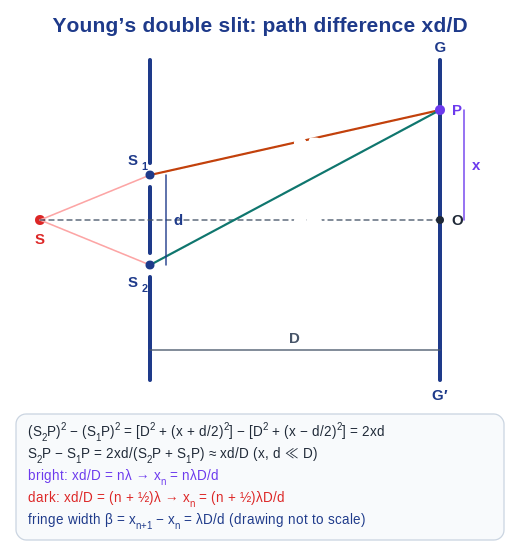
Two sodium lamps behind two pinholes give no fringes: light from an ordinary source changes phase suddenly about every 10⁻¹⁰ s, so the two lamps have no fixed phase relation. Young’s trick was to light both pinholes S₁ and S₂ (close together in an opaque screen) from a single pinhole S. Any sudden phase change at S reaches S₁ and S₂ alike, so the two act as coherent sources, “locked” in phase like the two needles.
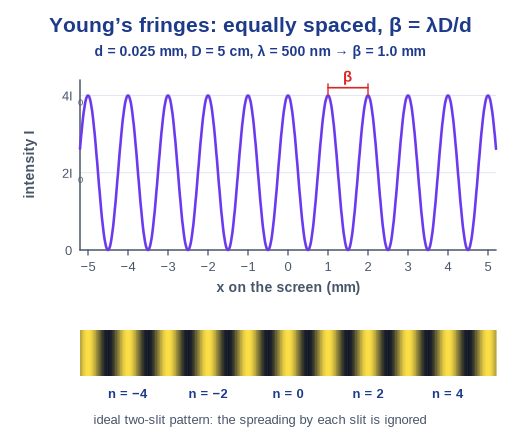
For a point P on the screen at height x above the centre O, with slit separation d and screen distance D (both x and d much smaller than D), the path difference is
S₂P − S₁P ≈ xd/D
so the fringes lie at
- bright: xd/D = nλ, so x_n = nλD/d (n = 0, ±1, ±2, …)
- dark: xd/D = (n + ½)λ, so x_n = (n + ½)λD/d
Neighbouring bright fringes, and neighbouring dark fringes, are the same distance apart: the fringe width β = λD/d. With the numbers of the book’s computer-drawn pattern (D = 5 cm, d = 0.025 mm, λ = 5 × 10⁻⁵ cm = 500 nm), β = 1 mm.
What is diffraction?
Look closely at the edge of a shadow and you will find light and dark bands, much like interference fringes. Light spreads around edges and through narrow openings into the region of geometrical shadow. This is diffraction, and every kind of wave shows it: sound, water waves, light, even matter waves. We rarely notice it with light because its wavelength is far smaller than most objects; we do hear sound round a corner. Diffraction also sets the limit to how finely the eye, a telescope or a microscope can see detail, and the colours seen on a CD come from diffraction.
The single slit
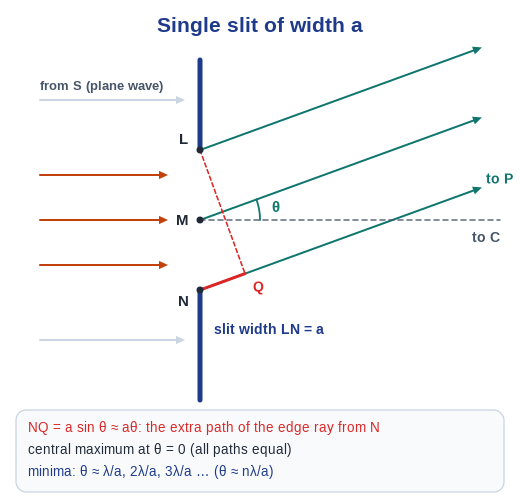
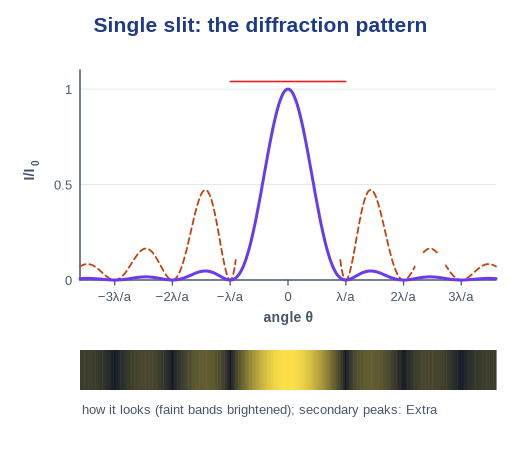
Let a parallel beam of monochromatic light fall normally on a single narrow slit LN of width a. The slit is treated as a row of secondary sources, all in phase since the incoming plane wavefront lies parallel to the slit. Light leaving at angle θ to the normal reaches a point P on a distant screen, and the contributions from all parts of the slit are added with their phase differences. The observed pattern has:
- a broad, bright central maximum at θ = 0;
- minima (zero intensity) at θ ≈ nλ/a, n = ±1, ±2, ±3, …;
- weaker and weaker secondary maxima near θ ≈ (n + ½)λ/a.
So the central maximum spreads between −λ/a and +λ/a, an angular width of 2λ/a: the narrower the slit, the wider the spread. Read diffraction and polarisation.
Interference or diffraction?
The book quotes Richard Feynman’s view that no one has found a satisfying line between the two: with a few sources we tend to say interference, with very many we tend to say diffraction. In Young’s experiment the pattern on the screen is in fact a double-slit interference pattern combined with the single-slit diffraction of each slit.
Seeing it yourself (only with a teacher)
The book describes a simple version: hold two razor blades edge to edge to make a narrow slit, and look through it, close to the eye, at a clear bulb with a straight filament kept parallel to the slit. The filament acts as the first slit and the eye’s lens focuses the pattern on the retina; red and blue filters show that red fringes are wider. Razor blades are sharp and bulbs get hot, so do this only with a teacher, and never use the Sun or any reflection of it as the source. In both interference and diffraction the light energy is only rearranged between bright and dark bands; none is created or lost.
What is polarisation?
Shake one end of a long stretched string up and down: a wave y = a sin(kx − ωt) runs along x, with k = 2π/λ and ω = 2πν. Each bit of string moves along y, at right angles to the direction of travel, so the wave is transverse. Since every point moves on a straight line and the string stays in the x-y plane, it is called linearly polarised or plane polarised (here y-polarised; shaking sideways would give a z-polarised wave). If the plane of shaking changed at random many times a second, the wave would be unpolarised.
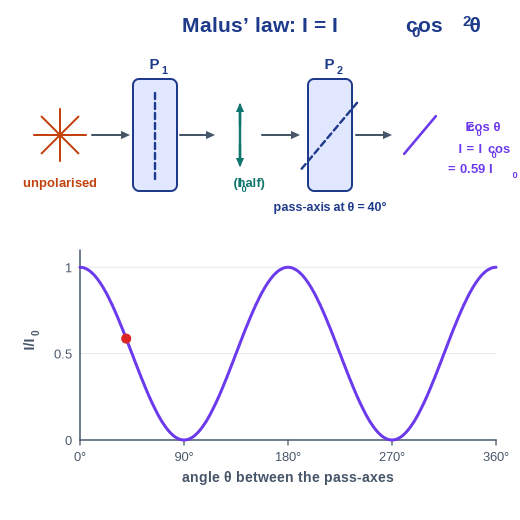
Light is also transverse: its electric field is always perpendicular to its direction of travel. Ordinary light (from the sun or a sodium lamp) is unpolarised: the electric field direction changes rapidly and randomly in the transverse plane. A polaroid sheet contains long-chain molecules lined up in one direction; it absorbs the electric field along the molecules and passes the component across them, along its pass-axis.
- One polaroid P₁ halves the intensity of unpolarised light, and turning P₁ changes nothing.
- Add a second polaroid P₂. Turning one of them now matters a lot: when the pass-axes are at angle θ, only the component E₀ cos θ gets through, so
I = I₀ cos²θ (Malus’ law)
where I₀ is the intensity of the polarised light leaving the first polaroid. The light is cut to almost nothing when the axes are crossed (90°) and passes almost fully when they are parallel; one full turn gives two maxima and two minima. Polaroids are used to control intensity in sunglasses and windowpanes, and in cameras, including 3D movie cameras.
Example 10.2 (page 271) puts a third polaroid P₂ between two crossed polaroids P₁ and P₃. If P₂ is at angle θ to P₁, it is at (π/2 − θ) to P₃, so the light leaving P₃ is I₀ cos²θ sin²θ = (I₀/4) sin²2θ, largest (I₀/4) at θ = π/4. Solved in full in the NCERT solutions.
Which quantities and units belong to this chapter?
- Speed v and c in m/s; refractive index n = c/v has no unit.
- Wavelength λ in m (often nm = 10⁻⁹ m); frequency ν in Hz; k = 2π/λ in rad/m; ω = 2πν in rad/s.
- Phase difference φ in radians; path difference in m, with 2π ↔ λ.
- Slit separation d, slit width a, screen distance D, fringe position x and fringe width β: all lengths, in m.
- Intensity I in W/m², usually compared as I/I₀.
Before we move on
Treat light as a wave and Huygens’ wavelets give the laws of reflection and refraction; add two coherent waves and you get I = 4I₀ cos²(φ/2), which Young’s slits turn into equally spaced fringes β = λD/d; let a wave pass one slit and it spreads, with minima at θ ≈ nλ/a; and the fact that polaroids can block light shows that light waves are transverse. All six exercises and both worked examples are solved in the NCERT solutions for Chapter 10.
Key terms
| Term | Meaning |
|---|---|
| Wavefront | A surface on which every point of a wave oscillates in the same phase. A point source gives spherical wavefronts; far from the source a small part of one is nearly a plane. |
| Huygens principle | Every point of a wavefront acts as a source of secondary wavelets that spread at the wave speed; the forward envelope (common tangent) of these wavelets is the wavefront a little later. |
| Ray | A line drawn perpendicular to the wavefronts, along which the energy of the wave travels. |
| Refractive index (n) | n = c/v, the speed of light in vacuum divided by its speed in the medium. Snell’s law reads n₁ sin i = n₂ sin r. |
| Coherent sources | Sources whose phase difference at any point stays the same with time, so that a steady interference pattern forms. Two independent lamps are incoherent. |
| Interference | The adding of displacements from two or more waves at the same point (superposition), which gives bright regions where they reinforce and dark regions where they cancel. |
| Path difference and phase difference | A path difference of λ corresponds to a phase difference of 2π. Bright: path difference nλ; dark: (n + ½)λ. |
| Fringe width (β) | The distance between two neighbouring bright (or dark) fringes in Young’s experiment: β = λD/d. |
| Diffraction | The spreading of a wave around the edges of an obstacle or opening, which puts bright and dark bands near the edge of a shadow. |
| Polaroid and pass-axis | A sheet of long aligned molecules that lets through only the electric-field component along one direction, its pass-axis, giving linearly polarised light. |
| Malus’ law | I = I₀ cos²θ: the intensity of polarised light of intensity I₀ after a polaroid whose pass-axis makes angle θ with the light’s direction of polarisation. |
Topics in this chapter
Practice
-
According to the wave theory, when light bends towards the normal on entering a medium, its speed in that medium is:
Show answer
Answer: (b) smaller
-
When light passes from air into glass, which quantity stays the same?
Show answer
Answer: (c) frequency
-
Two coherent waves, each of intensity I₀, meet with a phase difference of π/2. The resultant intensity is:
Show answer
Answer: (c) 2I₀
-
In Young’s experiment the slits are 0.5 mm apart and the screen is 1.0 m away. For light of 600 nm the fringe width is:
Show answer
Answer: (b) 1.2 mm
-
For a single slit of width a, the first minimum is at an angle of about:
Show answer
Answer: (b) λ/a
-
Polarised light of intensity I₀ falls on a polaroid whose pass-axis is at 60° to the light’s polarisation. The transmitted intensity is:
Show answer
Answer: (b) I₀/4
Questions students ask
What are the main topics of Class 12 Physics Chapter 10?
Huygens principle, reflection and refraction of plane waves using it, coherent and incoherent addition of waves, interference and Young’s double-slit experiment, diffraction at a single slit, and polarisation with polaroids and Malus’ law. Examples 10.1 and 10.2 and six exercises close the chapter.
Are Brewster’s law, resolving power and the Doppler effect in this chapter?
Not in the 2026-27 reprint of the NCERT book. Its polarisation section covers polaroids and Malus’ law only, and its diffraction section covers the single slit, with only a mention that diffraction limits the resolution of telescopes and microscopes.
Why do two separate bulbs not give interference fringes?
Light from an ordinary source changes its phase abruptly, roughly every 10⁻¹⁰ s. Two independent sources therefore have no fixed phase relation, so the pattern shifts far too fast to see, and only the average intensity, 2I₀, is observed.
Which formulas should I remember from this chapter?
sin i/sin r = v₁/v₂ = n₂/n₁; n = c/v; v₁/λ₁ = v₂/λ₂; I = 4I₀ cos²(φ/2); bright x_n = nλD/d, dark x_n = (n + ½)λD/d, β = λD/d; single-slit minima θ ≈ nλ/a; Malus’ law I = I₀ cos²θ.
Does interference destroy light energy at the dark fringes?
No. The energy is only redistributed: what is missing at a dark fringe appears in the bright fringes, so the total is conserved.
Stuck on a question?
Take a photo and Lagnever AI explains it step by step. Try it for 7 days for ₹2.
Get it on Google Play Open in browser
For parents: after the trial, the plan renews monthly by UPI or card autopay. You can cancel anytime in the app.