
What is Young’s double slit experiment?
Answer in short
In Young’s experiment one pinhole lights two close pinholes S₁ and S₂, which act as coherent sources. On a screen at distance D, points where the path difference xd/D is a whole number of wavelengths are bright, at x = nλD/d; dark fringes lie half-way between. The fringe width is β = λD/d.
Stuck on a question? Take a photo and Lagnever AI explains it step by step. Try it for 7 days for ₹2. Get it on Google Play
Adding two waves: superposition
When two waves pass through the same point, the displacement there is the sum of the displacements each would produce alone. This is the principle of superposition, and interference is built entirely on it.
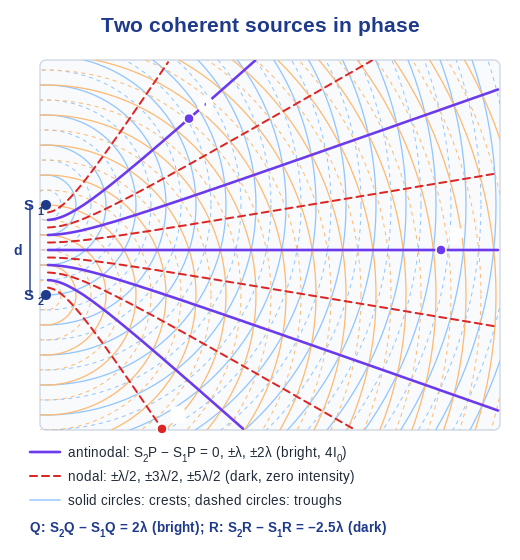
Picture two needles S₁ and S₂ dipping up and down in step in a water trough. Each sends out circular ripples. At any point the two ripples arrive with some phase difference; if that difference does not change with time, the sources are called coherent. Some places then always get crest-on-crest (big waves); others always get crest-on-trough (still water).
How big is the resultant?
Let the waves reaching a point P be y₁ = a cos ωt and y₂ = a cos(ωt + φ), where φ is their phase difference. Adding, with the identity cos A + cos B = 2 cos[(A − B)/2] cos[(A + B)/2],
y = y₁ + y₂ = 2a cos(φ/2) cos(ωt + φ/2)
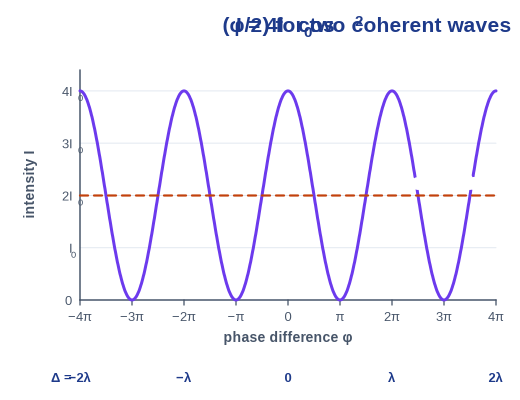
The resultant oscillates with amplitude 2a cos(φ/2). Intensity goes as amplitude squared, and each wave alone gives I₀ ∝ a², so
I = 4I₀ cos²(φ/2)
| Path difference S₁P ~ S₂P | Phase difference φ | Intensity | Type |
|---|---|---|---|
| 0, λ, 2λ, … (nλ) | 0, 2π, 4π, … | 4I₀ | constructive (bright) |
| λ/2, 3λ/2, … ((n + ½)λ) | π, 3π, … | 0 | destructive (dark) |
| anything else | φ | between 0 and 4I₀ | partial |
For instance, on the perpendicular bisector of S₁S₂ the paths are equal and I = 4I₀. At a point Q where S₂Q − S₁Q = 2λ the waves arrive two whole cycles apart, still in step: I = 4I₀. At a point R where the difference is 2.5λ they arrive exactly out of step and cancel.
Coherent versus incoherent
If the phase difference between the sources jumps around rapidly, the bright and dark positions jump around too. The eye (or any detector) sees only the average of cos²(φ/2) over time, which is ½. Then
I = 2I₀ everywhere
which is just I₀ + I₀: the intensities add and there is no pattern. Sources like this are incoherent. Two separate lamps on one wall behave this way. Coherent sources do not create or destroy energy either: the dark fringes lose exactly what the bright ones gain, and the average over the pattern is still 2I₀.
Why two lamps fail and Young’s trick works
An ordinary source such as a sodium lamp emits light whose phase changes abruptly in times of the order of 10⁻¹⁰ s. Two separate lamps therefore never keep a fixed phase relation, and two pinholes lit by them give no fringes.
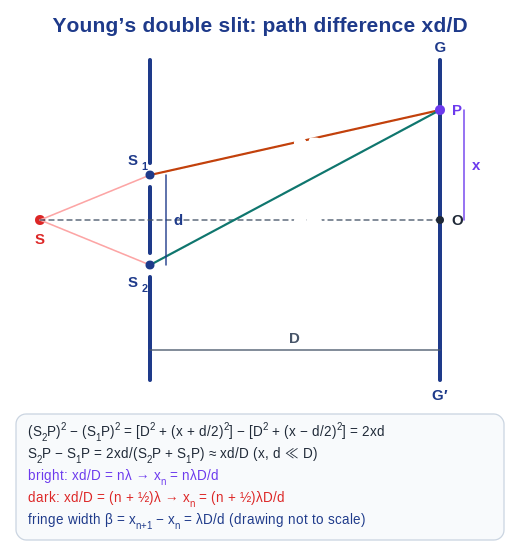
Thomas Young (1801) made two pinholes S₁ and S₂, very close together, and lit both from one more pinhole S, itself lit by a bright source. The light at S₁ and at S₂ comes from the same source, so any sudden phase change at S shows up at both together. S₁ and S₂ are locked in phase: coherent, like the two needles. Their spherical waves overlap on a screen GG′ and produce steady fringes.
Where are the fringes?
Let the slits be a distance d apart and the screen a distance D away, with O the point on the screen opposite the middle of the slits and P a point at height x above O. Usually d is a fraction of a millimetre while D is of the order of a metre.
The path difference (Extra: the book uses the result xd/D without these steps). From the right triangles to P,
(S₂P)² = D² + (x + d/2)² and (S₁P)² = D² + (x − d/2)²
Subtracting, (S₂P)² − (S₁P)² = 2xd. Factor the left side as (S₂P − S₁P)(S₂P + S₁P). When x and d are small compared with D, S₂P + S₁P ≈ 2D, so
S₂P − S₁P ≈ xd/D
Bright fringes: xd/D = nλ, so x_n = nλD/d (n = 0, ±1, ±2, …)
Dark fringes: xd/D = (n + ½)λ, so x_n = (n + ½)λD/d (n = 0, ±1, ±2, …)
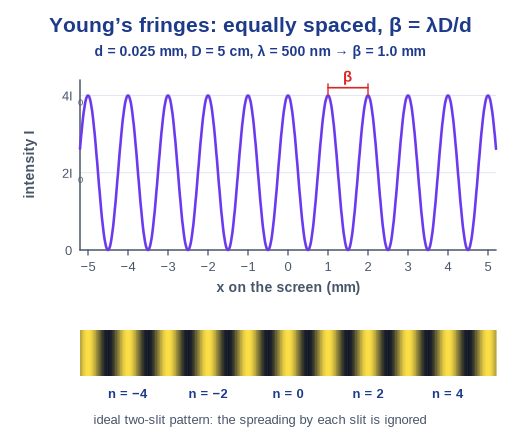
Two neighbouring bright fringes are λD/d apart, and so are two neighbouring dark fringes. This spacing is the fringe width
β = λD/d
and the bands are equally spaced, with a dark band exactly half-way between two bright ones. The book’s computer-drawn pattern uses D = 5 cm, d = 0.025 mm and λ = 5 × 10⁻⁵ cm (500 nm), which gives β = (5 × 10⁻⁷ × 0.05)/(2.5 × 10⁻⁵) = 1 × 10⁻³ m = 1 mm.
What changes the fringe width?
From β = λD/d:
- a longer wavelength (red rather than blue) gives wider fringes;
- moving the screen farther away (larger D) spreads them out;
- bringing the slits closer together (smaller d) also spreads them out.
Worked examples (Exercises 10.4 and 10.5)
Exercise 10.4: d = 0.28 mm, D = 1.4 m, and the fourth bright fringe is 1.2 cm from the central one. Since x₄ = 4λD/d,
λ = x₄d/(4D) = (1.2 × 10⁻² × 0.28 × 10⁻³)/(4 × 1.4) = 6.0 × 10⁻⁷ m = 600 nm
Exercise 10.5: at path difference λ the phase difference is 2π, so K = 4I₀ cos²(π) = 4I₀. At path difference λ/3 the phase difference is 2π/3, so I = 4I₀ cos²(π/3) = 4I₀ × ¼ = I₀ = K/4.
All six exercises are solved in the NCERT solutions, and the rest of the chapter is in the Chapter 10 notes.
Practice
-
If the slit separation d is doubled while D and λ stay the same, the fringe width:
Show answer
Answer: (b) halves
-
At a point where the path difference is λ/2, two coherent waves of equal intensity I₀ give:
Show answer
Answer: (d) zero
-
Young’s experiment uses λ = 500 nm, d = 0.25 mm and D = 1.0 m. The fringe width is:
Show answer
Answer: (c) 2 mm
-
In Young’s experiment λ = 600 nm, d = 0.5 mm and D = 1.0 m. Find the positions of the second bright and second dark fringes.
Show answer
Answer: β = λD/d = (600 × 10⁻⁹ × 1.0)/(0.5 × 10⁻³) = 1.2 mm. Second bright: x₂ = 2β = 2.4 mm. Second dark (n = 1 in (n + ½)λD/d): x = 1.5β = 1.8 mm.
-
Why does the whole fringe pattern shift if the experiment is done in water instead of air? Which way does β change?
Show answer
Answer: In water the wavelength becomes λ/n (n = 1.33), so β = λD/(nd) shrinks to about three-quarters of its value in air; the fringes crowd closer together.
Questions students ask
Why are the fringes equally spaced?
Each bright fringe is where the path difference grows by one more wavelength. Since the path difference xd/D grows in proportion to x, each extra λ needs the same extra distance λD/d on the screen.
What happens with white light?
The book’s exercises use monochromatic light. With white light each colour makes its own fringes, with red wider than blue, so the central fringe is white and the others are coloured (Extra: not discussed in the 2026-27 chapter).
Is the double-slit pattern purely interference?
Not quite. The book notes that the pattern on the screen is the double-slit interference pattern combined with the single-slit diffraction of each slit.
Stuck on a question?
Take a photo and Lagnever AI explains it step by step. Try it for 7 days for ₹2.
Get it on Google Play Open in browser
For parents: after the trial, the plan renews monthly by UPI or card autopay. You can cancel anytime in the app.