
What is Huygens principle?
Answer in short
Huygens principle treats every point of a wavefront as a tiny source of secondary wavelets spreading at the wave speed; their forward envelope is the wavefront a moment later. At a boundary it gives Snell’s law, sin i/sin r = v₁/v₂ = n₂/n₁, and the law of reflection, i = r.
Stuck on a question? Take a photo and Lagnever AI explains it step by step. Try it for 7 days for ₹2. Get it on Google Play
What is a wavefront?
When a stone drops into a calm pond, rings spread from the point of impact. All the points on one ring are equally far from the source, so they rise and fall together, in step. A surface through points that oscillate in the same phase is called a wavefront. It moves outwards at the speed of the wave, and the energy of the wave flows at right angles to it. The direction of that flow is a ray, so rays are always perpendicular to wavefronts.
- A small source sending waves equally in all directions makes spherical wavefronts.
- At a large distance, any small piece of a sphere is nearly flat: a plane wavefront with parallel rays.
Huygens construction step by step
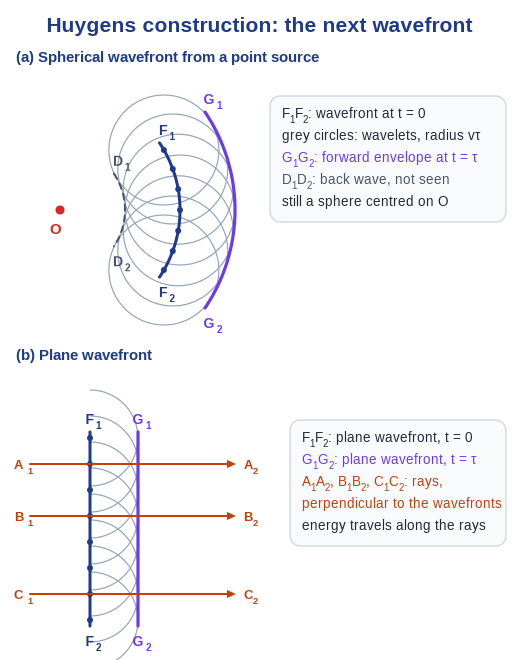
Suppose we know a wavefront F₁F₂ at t = 0 and want it at a later time τ.
- Pick many points on F₁F₂ and treat each as a source of secondary wavelets.
- Around each point draw a sphere of radius vτ, where v is the wave speed in that medium.
- Draw the surface that touches all these spheres on the forward side. This envelope, G₁G₂, is the new wavefront.
For a spherical wavefront centred on O, G₁G₂ is again a sphere centred on O, larger by vτ. For a plane wavefront, G₁G₂ is a parallel plane a distance vτ ahead, and the rays (A₁A₂, B₁B₂, …) cross both planes at right angles.
The spheres also touch a backward surface, D₁D₂: a wave going back to the source, which is never observed. Huygens simply assumed the wavelets vanish backwards; the book calls this ad hoc, justified only by a deeper wave theory.
Refraction of a plane wave
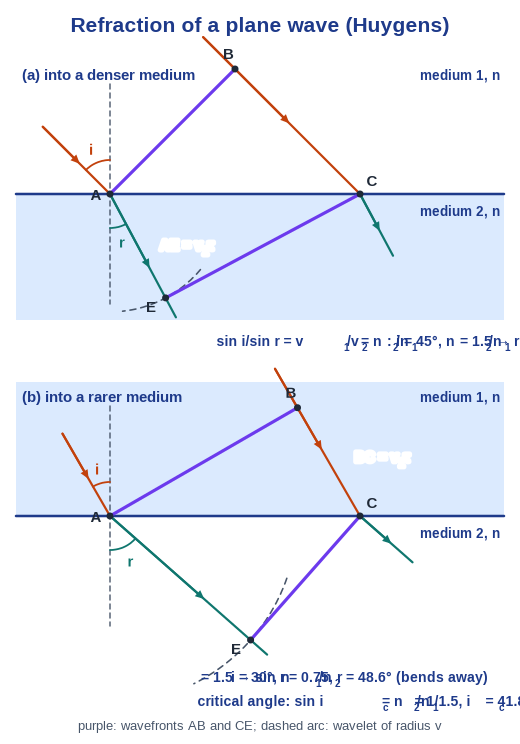
Take a flat boundary PP′ between medium 1, where light travels at v₁, and medium 2, where it travels at v₂. A plane wavefront AB arrives at angle of incidence i, with A on the boundary.
- Let τ be the time the far end B takes to reach the boundary at C. Then BC = v₁τ.
- During that time the wavelet from A spreads into medium 2 with speed v₂, so its radius is AE = v₂τ.
- The plane through C that touches this wavelet, CE, is the refracted wavefront.
In right triangle ABC, the angle at A equals i, so sin i = BC/AC. In right triangle AEC, the angle at C equals r, so sin r = AE/AC. Dividing,
sin i/sin r = v₁τ/v₂τ = v₁/v₂
Writing the refractive indices as n₁ = c/v₁ and n₂ = c/v₂, the ratio v₁/v₂ equals n₂/n₁, and
n₁ sin i = n₂ sin r (Snell’s law)
Now the important prediction: if the ray bends towards the normal, r < i, so sin r < sin i and v₂ < v₁. Light must go more slowly in the denser medium. The corpuscular model had predicted the opposite, and experiment (Foucault, 1850) sided with the waves.
What happens to wavelength and frequency?
Choose the time τ so that BC is exactly one wavelength λ₁ in medium 1. A crest that started at B reaches C; the crest that started at A at the same moment reaches E. So AE is one wavelength λ₂ in medium 2, and
λ₁/λ₂ = BC/AE = v₁/v₂, or v₁/λ₁ = v₂/λ₂
Since v/λ is the frequency ν, the frequency is the same in both media; only the speed and the wavelength change. Light of 600 nm in air has a wavelength of 600/1.5 = 400 nm in glass of n = 1.5, and its colour (set by its frequency) is unchanged.
Refraction into a rarer medium
If v₂ > v₁ (glass to air, say), AE comes out longer than BC, and the refracted wavefront bends away from the normal: r > i. Snell’s law still holds. As i grows, r reaches 90° at the critical angle i_c given by
sin i_c = n₂/n₁
For any larger angle of incidence there is no refracted wave and the light is totally internally reflected (Chapter 9). For glass (1.5) to air, i_c = 41.8°.
Reflection of a plane wave
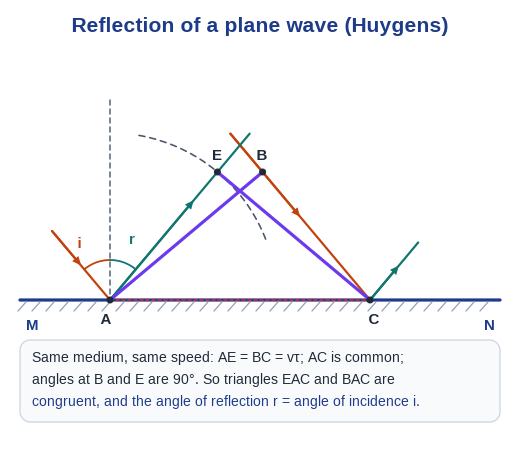
For reflection the wave stays in the same medium, so it has one speed v. A plane wavefront AB meets a mirror MN at angle i.
- In time τ, B moves to C on the mirror: BC = vτ.
- In the same time the wavelet from A grows to radius AE = vτ, back into the same medium.
- The plane CE touching this wavelet is the reflected wavefront.
Triangles BAC and EAC both have a right angle (at B and at E), the same hypotenuse AC, and equal sides BC = AE. They are congruent, so the angle the incident wavefront makes with the mirror equals the angle the reflected one makes: i = r, the law of reflection.
Wavefronts through a prism, a lens and a mirror
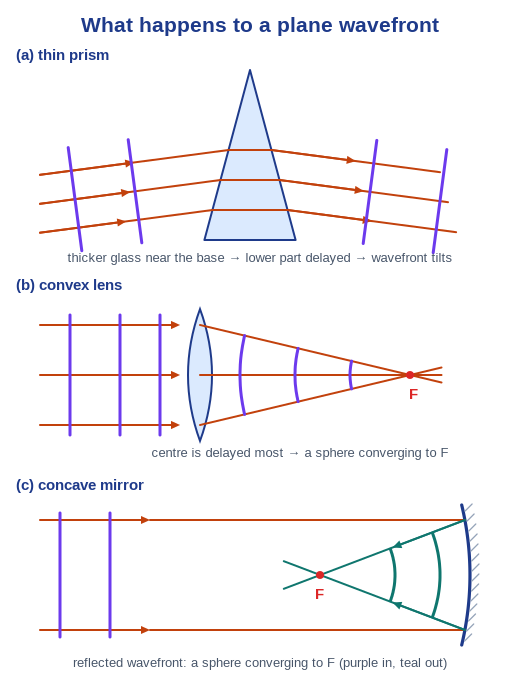
The wavefront picture shows why ray optics works. In a thin prism the part of the wavefront crossing the thick base is delayed, so the wavefront tilts and the beam turns towards the base. In a convex lens the centre is delayed most, so the wavefront comes out as a sphere converging to the focus; a concave mirror does the same by reflection. The travel time from an object point to its image point is equal along every ray: the central ray’s short path in slow glass takes as long as an edge ray’s longer path mostly in air.
Try it
Exercise 10.1 applies these results to light of 589 nm entering water: the frequency stays 5.09 × 10¹⁴ Hz while the speed and wavelength drop by the factor 1.33. It and every other exercise are worked in the NCERT solutions; the rest of the chapter is in the Chapter 10 notes.
Practice
-
A wavefront is a surface on which all points have the same:
Show answer
Answer: (b) phase
-
Light from a distant star reaching the Earth has wavefronts that are nearly:
Show answer
Answer: (b) plane
-
Light of wavelength 600 nm in air enters glass of refractive index 1.5. Its wavelength in the glass is:
Show answer
Answer: (c) 400 nm
-
Using the Huygens construction, show that i = r for reflection at a plane mirror.
Show answer
Answer: In time τ the end B of the incident wavefront AB moves to C on the mirror, BC = vτ, while the wavelet from A grows to AE = vτ. CE is the reflected wavefront. Right triangles EAC and BAC have the same hypotenuse AC and AE = BC, so they are congruent, and the angles i and r are equal.
-
Light goes from glass (n = 1.5) into water (n = 1.33). Find the ratio of its speeds and the critical angle.
Show answer
Answer: v_glass/v_water = n_water/n_glass = 1.33/1.5 = 0.887, so light is slower in the glass. sin i_c = n₂/n₁ = 1.33/1.5 = 0.887, so i_c = 62.5°.
Questions students ask
Why is there no backward wave in the Huygens construction?
The construction alone would give one. Huygens assumed the wavelets are strongest in the forward direction and zero backwards; the book says this ad hoc assumption is justified only by a more rigorous wave theory.
How did the speed of light in water decide between the particle and wave models?
Both models give Snell’s law, but for a ray bending towards the normal the particle model needs light to be faster in water and the wave model needs it slower. Foucault’s experiment of 1850 found it slower, supporting the wave model.
Why does a convex lens make a plane wavefront converge?
The middle of the wavefront goes through the thickest glass, where light is slowest, so it lags behind the edges. The emerging wavefront is curved inwards: a sphere that shrinks to the focus.
Stuck on a question?
Take a photo and Lagnever AI explains it step by step. Try it for 7 days for ₹2.
Get it on Google Play Open in browser
For parents: after the trial, the plan renews monthly by UPI or card autopay. You can cancel anytime in the app.