
What are diffraction and polarisation of light?
Answer in short
Diffraction is the spreading of light around edges and through narrow openings. A slit of width a gives a broad central maximum with minima at θ ≈ nλ/a. Polarisation shows that light is transverse: a polaroid passes only the field along its pass-axis, halving unpolarised light, and a second one at angle θ passes I = I₀ cos²θ (Malus’ law).
Stuck on a question? Take a photo and Lagnever AI explains it step by step. Try it for 7 days for ₹2. Get it on Google Play
What is diffraction?
Look very closely at the edge of a shadow cast by an opaque object: instead of a sharp line there are faint bright and dark bands. Light bends a little around edges and through narrow gaps into the region that should be dark. This spreading is diffraction, and every kind of wave shows it: sound, water waves, light and matter waves. You hear someone round a corner because sound waves, metres long, diffract easily; light, with a wavelength near 500 nm, shows the effect only close to the edges of shadows. Diffraction limits the finest detail that the eye, a telescope or a microscope can resolve, and it gives the colours seen on a CD.
The single slit
Replace the two slits of Young’s experiment by one narrow slit LN of width a, lit by a parallel beam of one colour falling straight on it. On a distant screen you see a wide, bright central band, with alternate dark and fainter bright bands on each side, fading as you go out.
To understand it, the book divides the slit into many tiny strips and treats each as a secondary source (Huygens again). Since the incoming wavefront is parallel to the slit, all these sources start in phase. Light leaving at angle θ to the normal MC heads for a point P on the screen, and the contributions from all the strips are added with their phase differences. The observed result:
- central maximum at θ = 0, where every strip’s light arrives in step;
- minima (zero intensity) at θ ≈ nλ/a, with n = ±1, ±2, ±3, …;
- secondary maxima near θ ≈ (n + ½)λ/a, each weaker than the one before.
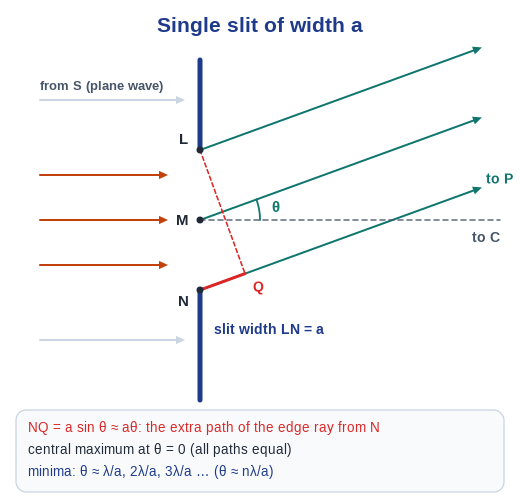
Why the first minimum is at λ/a (Extra: the book gives only the result). The edge ray from N travels NQ = a sin θ ≈ aθ farther than the one from L; at θ = λ/a that is one wavelength. Pair each strip of the upper half with the strip a/2 below it: their paths differ by λ/2, so every pair cancels. At 2λ/a, use quarters instead.
So the central maximum spans −λ/a to +λ/a, an angular width of 2λ/a, twice that of the side bands: a narrower slit spreads the light more.
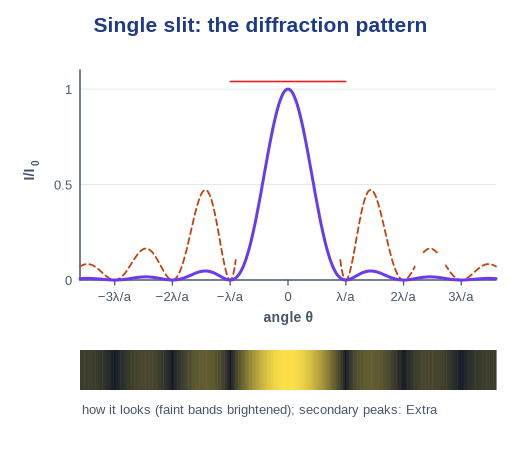
The graph uses the standard formula I = I₀(sin β/β)², β = πaθ/λ (Extra: not in the book). Its side maxima sit near 1.43λ/a (4.7% of the centre) and 2.46λ/a (1.6%), close to the book’s (n + ½)λ/a. The book adds, quoting Feynman, that interference and diffraction differ only in usage: a few sources versus very many. Young’s fringes are in fact two-slit interference combined with each slit’s diffraction.
Seeing it (only with a teacher): the book describes looking at a straight bulb filament through a narrow slit between two razor blades held parallel. Blades are sharp and bulbs get hot, so do this only with a teacher, and never use the Sun or its reflection as the source.
What is polarisation?
Shake one end of a long string up and down and a wave y(x, t) = a sin(kx − ωt) runs along x (k = 2π/λ, ω = 2πν). Each bit of string moves along y, at right angles to the direction of travel: a transverse wave. Since every point moves along one line and the string stays in the x-y plane, the wave is linearly (or plane) polarised. If the direction of shaking changed at random many times a second, the wave would be unpolarised, though still transverse.
Light is transverse too: its electric field is always perpendicular to its direction of travel. Light from the sun or a sodium lamp is unpolarised: its electric field direction changes rapidly and at random in the transverse plane.
Polaroids and Malus’ law
A polaroid is a thin plastic-like sheet in which long-chain molecules are lined up in one direction. The electric field along the molecules is absorbed; the component at right angles to them passes. That direction is the pass-axis, and the light that comes out is linearly polarised along it.
One polaroid: unpolarised light comes out at half its intensity, and rotating the polaroid changes nothing, because unpolarised light has no preferred direction.
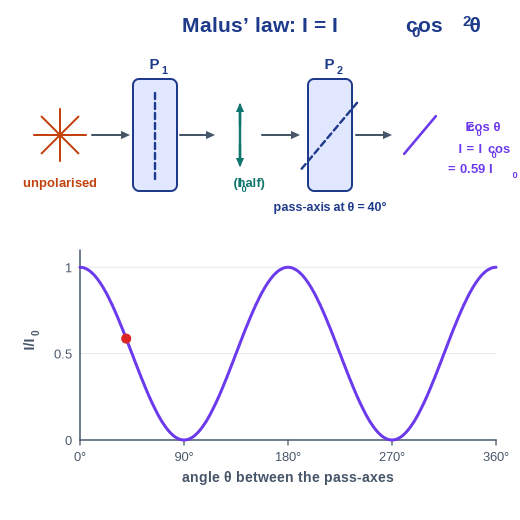
Two polaroids: let the first, P₁, produce polarised light of intensity I₀ with field amplitude E₀. If the second, P₂, has its pass-axis at angle θ to that of P₁, only the component E₀ cos θ along P₂’s axis gets through. Intensity goes as the square of the amplitude, so
I = I₀ cos²θ (Malus’ law)
- θ = 0°: I = I₀ (axes parallel, full transmission).
- θ = 90°: I = 0 (axes crossed, almost no light).
- θ = 45°: I = I₀/2; θ = 60°: I = I₀/4.
- In one full turn of P₂ the light rises and falls twice: two maxima (0°, 180°) and two minima (90°, 270°).
So two polaroids can set the light anywhere from 50% of the unpolarised intensity down to zero; they are used in sunglasses, windowpanes and cameras. Interference and diffraction occur even for longitudinal sound waves, but only transverse waves can be polarised.
Worked example (Example 10.2, page 271)
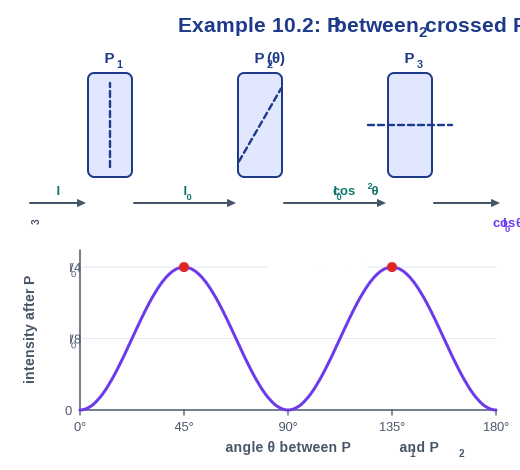
A polaroid P₂ is turned between two crossed polaroids P₁ and P₃. How does the light coming out change?
Let I₀ be the intensity after P₁. If P₂ makes angle θ with P₁, the light after P₂ is I₀ cos²θ (Malus’ law). P₁ and P₃ are crossed, so P₂ makes angle (π/2 − θ) with P₃, and the light after P₃ is
I = I₀ cos²θ cos²(π/2 − θ) = I₀ cos²θ sin²θ = (I₀/4) sin²2θ
It is zero when P₂ lines up with P₁ or P₃ (θ = 0 or π/2) and largest, I₀/4, at θ = π/4.
All the exercises are worked in the NCERT solutions, and the rest of the chapter is in the Chapter 10 notes.
Practice
-
A single slit of width 0.2 mm is lit by light of 600 nm. The first minimum is at an angle of:
Show answer
Answer: (a) 3 × 10⁻³ rad
-
Unpolarised light of intensity I passes through two polaroids whose pass-axes are at 60°. The final intensity is:
Show answer
Answer: (c) I/8
-
Which of these shows that light waves are transverse?
Show answer
Answer: (c) polarisation
-
Light of 600 nm passes a slit 0.2 mm wide onto a screen 1.0 m away. How wide is the central bright band?
Show answer
Answer: The first minima are at θ = ±λ/a = ±(600 × 10⁻⁹)/(0.2 × 10⁻³) = ±3 × 10⁻³ rad. On a screen 1.0 m away they are ±3 mm from the centre, so the central band is 6 mm wide.
-
Three polaroids: P₁ and P₃ crossed, P₂ at 30° to P₁. Unpolarised light of intensity I enters P₁. Find the intensity leaving P₃.
Show answer
Answer: After P₁: I₀ = I/2. After P₂: I₀ cos²30° = 0.75 I₀. P₂ is at 60° to P₃, so after P₃: 0.75 I₀ × cos²60° = 0.1875 I₀ = 0.094 I (about 9% of I).
Questions students ask
What is the difference between interference and diffraction?
The book quotes Feynman: there is no real physical difference. When a few sources combine we usually say interference; when very many do, as across the width of a slit, we usually say diffraction.
Why do polaroid sunglasses cut glare?
The book lists sunglasses among the uses of polaroids, to control intensity. Glare from water or roads is largely polarised, so a polaroid with the right pass-axis removes much of it (Extra: the 2026-27 book does not discuss polarisation by reflection).
Are Brewster’s law and polarisation by scattering in the syllabus book?
Not in the 2026-27 reprint of the NCERT Physics Part II. Its section 10.7 covers transverse waves, polaroids and Malus’ law only.
Stuck on a question?
Take a photo and Lagnever AI explains it step by step. Try it for 7 days for ₹2.
Get it on Google Play Open in browser
For parents: after the trial, the plan renews monthly by UPI or card autopay. You can cancel anytime in the app.