
Class 12 Physics Chapter 10: Wave Optics Notes Hinglish mein
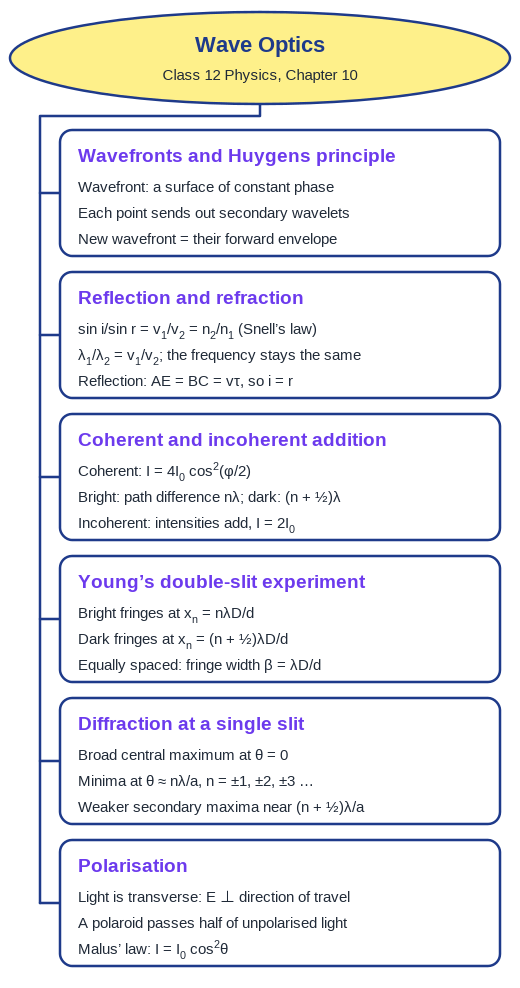
Ye chapter 5 lines mein
Wave optics light ko wave maanti hai. Huygens principle har naya wavefront secondary wavelets se banata hai aur reflection aur refraction ke laws deta hai, jisme denser medium mein light dheemi hoti hai. Do coherent sources I = 4I₀ cos²(φ/2) dete hain: Young ke experiment mein bright fringes x = nλD/d par hoti hain, barabar doori β = λD/d par. Width a ki single slit chauda central maximum deti hai, minima θ ≈ nλ/a par. Polaroids dikhate hain ki light transverse hai: Malus ka law, I = I₀ cos²θ.
Ye chapter kis baare mein hai?
Chapter 9 ne light ko seedhi line mein chalti rays maana. Ye isliye chalta hai kyunki light ki wavelength, lagbhag aadha micrometre, mirrors aur lenses ke saamne bahut chhoti hai. Ye chapter (book pages 255 se 273) light ko wave maanta hai, jo wo effects samjhata hai jo rays nahi samjha sakti: interference, diffraction aur polarisation.
Book ka itihaas aise chalta hai. Descartes (1637) aur phir Newton ne light ko particles ki dhaara maana (corpuscular model). Christiaan Huygens ne 1678 mein wave theory di. Dono models reflection aur refraction samjhate hain, par speed par alag hain: jab light normal ki taraf mudti hai, particle model ko doosre medium mein light tez chahiye aur wave model ko dheemi. 1850 mein Foucault ne paaya ki paani mein light air se dheemi hai, jaisa wave model kehta hai. Thomas Young ke 1801 ke interference experiment ne tay kar diya ki light wave hai, aur Maxwell ki theory ne dikhaya ki ye electromagnetic wave hai (Chapter 8), isliye ye vacuum paar kar sakti hai.
Safety: Sun ko kabhi mat dekho, na seedha, na slit, lens, mirror ya filter se, aur laser beam mein kabhi mat dekho ya kisi par mat chamkao. Slit, polaroid ya interference wali har activity sirf teacher ke saath karo.
Wavefront kya hai?
Shaant paani mein kankar daalo to rings phailti hain. Ek ring ke saare points source se barabar door hain, isliye sab saath upar-neeche hote hain. Same phase mein oscillate karte points ko jodne wali surface wavefront hai. Wave ki energy wavefront ke perpendicular chalti hai, aur us direction ki line ray hai.
- Khule medium mein point source spherical wavefronts deta hai.
- Source se bahut door, sphere ka chhota hissa lagbhag flat hota hai, isliye plane wavefront milta hai (jaise hum tak aane wali sunlight ya starlight).
Huygens principle kya hai?
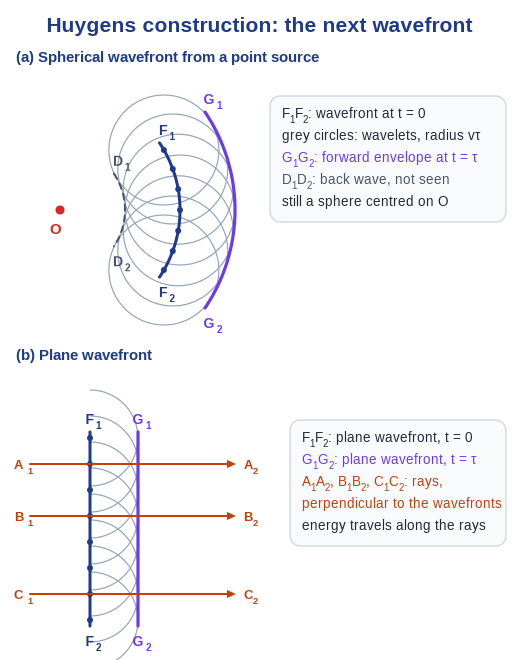
Huygens principle ek geometrical rule hai jo batata hai ki wavefront baad mein kahan hoga, agar abhi ki jagah pata ho:
- Abhi ke wavefront ke har point ko secondary wavelets ka source maano.
- Time τ mein har wavelet radius vτ ka sphere ban jaati hai, jahan v wave ki speed hai.
- In spheres ka aage ki taraf common tangent (envelope) kheencho: wahi naya wavefront hai.
Spherical wavefront ke liye naya wavefront same centre ka bada sphere hai; plane wavefront ke liye vτ aage ek parallel plane. Construction ek peeche wala envelope bhi deta hai, yaani source ki taraf wapas jaati wave, jo kabhi dikhti nahi. Huygens ne bas maan liya ki wavelets aage sabse taakatwar aur peeche zero hoti hain; book kehti hai ki is missing back wave ko poori wave theory sahi saabit karti hai. Padho Huygens principle.
Huygens principle se refraction ka law kaise milta hai?
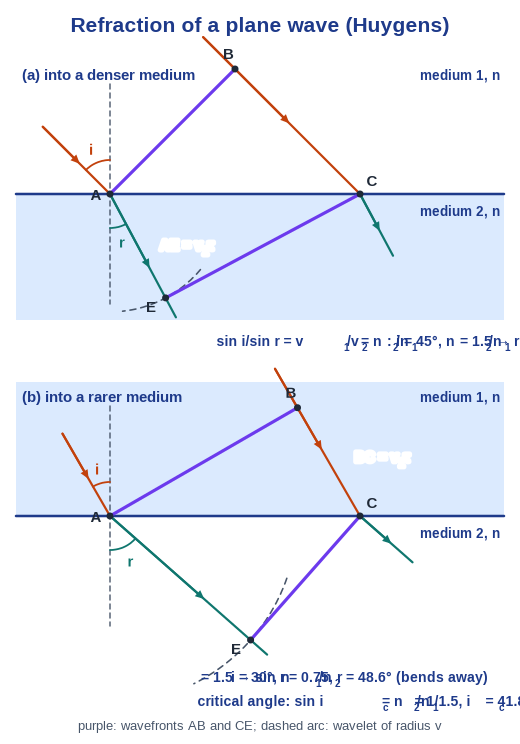
Maano ek plane wavefront AB medium 1 (speed v₁) aur medium 2 (speed v₂) ki boundary par angle i se milta hai, aur A boundary ko chhoo chuka hai. Jitne time τ mein siraa B boundary par C tak pahunchta hai, yaani BC = v₁τ, utne mein A ki wavelet medium 2 mein radius AE = v₂τ tak phail jaati hai. C se is wavelet par tangent CE refracted wavefront hai. Triangles ABC aur AEC ki side AC common hai, aur
sin i = BC/AC = v₁τ/AC aur sin r = AE/AC = v₂τ/AC
isliye sin i/sin r = v₁/v₂. Refractive indices n₁ = c/v₁ aur n₂ = c/v₂ se ye Snell ka law, n₁ sin i = n₂ sin r ban jaata hai.
Isse do baatein nikalti hain:
- Agar ray normal ki taraf mude (r < i), to v₂ < v₁: denser medium mein light dheemi hai, jo experiment se pakka hua.
- Agar BC ek wavelength λ₁ hai, to AE ek wavelength λ₂ hai, isliye λ₁/v₁ = λ₂/v₂. Wavelength speed ke saath badalti hai, aur frequency ν = v/λ same rehti hai.
Rarer medium mein (v₂ > v₁) yahi construction r > i deta hai: wave normal se door mudti hai. sin i_c = n₂/n₁ wale angle i_c par r 90° ho jaata hai; usse aage koi refracted wave nahi hoti aur total internal reflection hota hai (Chapter 9).
Isse reflection ka law kaise milta hai?
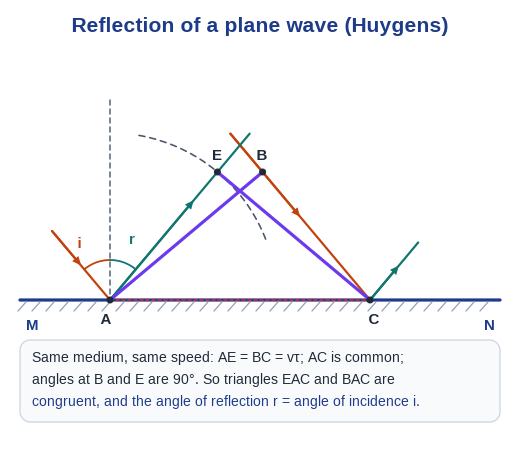
Ab wave ek hi medium mein rehti hai, speed v. Wavefront AB mirror MN se milta hai; time τ mein siraa B C par pahunchta hai (BC = vτ) aur A ki wavelet AE = vτ tak phailti hai. Tangent CE reflected wavefront hai. Right-angled triangles EAC aur BAC mein AE = BC aur hypotenuse AC common hai, isliye wo congruent hain aur angle of reflection angle of incidence ke barabar hai.
Prism, lens aur mirror mein wavefronts ka kya hota hai?
Wave picture Chapter 9 ke ray results samjhaati hai:
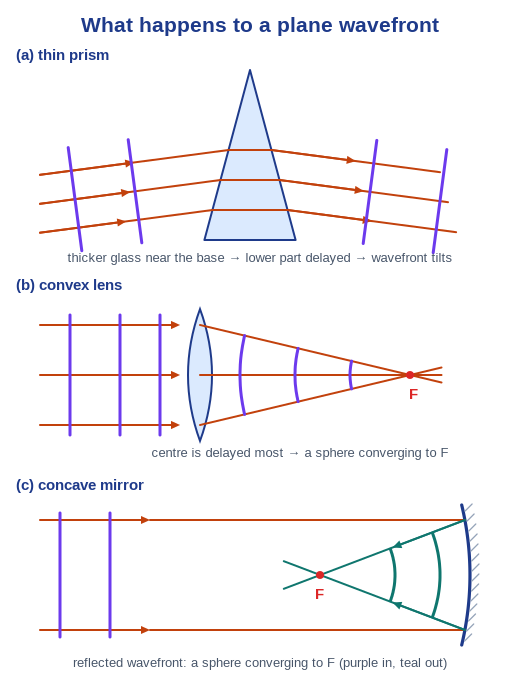
- Patla prism: plane wavefront ka jo hissa moti base se guzarta hai wo sabse zyada late hota hai, isliye nikalta wavefront tilt ho jaata hai aur beam base ki taraf mud jaati hai.
- Convex lens: wavefront ka beech wala hissa sabse mote glass se guzarta hai aur sabse zyada peeche reh jaata hai, isliye nikalta wavefront andar ki taraf muda hota hai: ek sphere jo focus F par converge hota hai.
- Concave mirror: reflected wavefront focus par converge hota sphere hai.
Kyunki object point se chala wavefront image point par ek saath pahunchta hai, har ray par travel time same hota hai. Lens mein central ray ka path sabse chhota hai par wo sabse zyada glass mein dheere chalti hai; kinare ki rays lamba raasta zyadatar air mein leti hain, aur sab barabar time leti hain.
Example 10.1 (page 262) is section par teen chhote sawal poochta hai. Reflected aur refracted light incident frequency rakhti hai kyunki material ke atoms usi frequency par drive hote hain aur usi par light chhodte hain. Kam speed ka matlab kam energy nahi, kyunki wave ki energy uske amplitude par depend karti hai. Photon picture mein intensity unit area se har second guzarne wale photons ki sankhya se tay hoti hai. Poore jawab NCERT solutions mein hain.
Coherent aur incoherent sources ka matlab kya hai?
Jab do waves ek hi point par pahunchti hain, total displacement dono ka sum hota hai (principle of superposition). Paani ke tray mein saath upar-neeche hoti do suiyan socho. Agar har point par unki do waves ka phase difference time ke saath fixed rahe, to sources coherent hain.
Maano har source akela ek point par displacement a cos ωt aur intensity I₀ (a² ke proportional) deta hai. Agar doosri wave phase difference φ ke saath aaye, to sum hai
y = a cos ωt + a cos(ωt + φ) = 2a cos(φ/2) cos(ωt + φ/2)
Amplitude 2a cos(φ/2) hai, isliye intensity hai
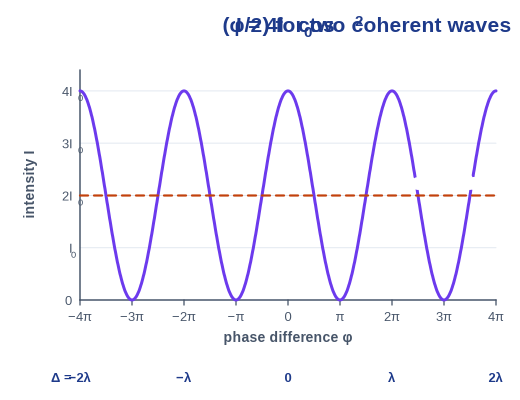
I = 4I₀ cos²(φ/2)
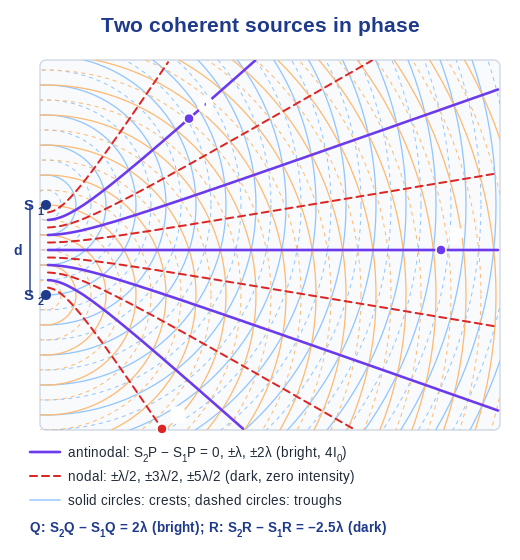
- Constructive interference: path difference S₁P ~ S₂P = nλ (φ = 0, ±2π, ±4π, …) par I = 4I₀. S₁S₂ ke perpendicular bisector ka har point aisa hai.
- Destructive interference: path difference (n + ½)λ (φ = ±π, ±3π, …) par I = 0.
λ ka path difference 2π ke phase difference ke barabar hai. Jaise, jis point par path difference 2λ hai wahan dono waves bilkul saath pahunchti hain; 2.5λ par bilkul ulti pahunchkar cancel ho jaati hain.
Agar sources ka phase difference tezi se aur random badle, to bright aur dark jagah itni tezi se khiskti hain ki dikhti nahi. Aankh ko cos²(φ/2) ka time average milta hai, jo ½ hai, isliye har jagah I = 2I₀: intensities bas jud jaati hain. Aise sources incoherent hain. Deewar par do alag lamps aise hi behave karte hain. Padho Young ka double slit experiment.
Young ne coherent light kaise paayi?
Do pinholes ke peeche do sodium lamps koi fringes nahi dete: aam source ki light ka phase lagbhag har 10⁻¹⁰ s mein achanak badalta hai, isliye do lamps ka koi fixed phase relation nahi hota. Young ki chaal thi dono pinholes S₁ aur S₂ (ek opaque screen mein paas-paas) ko ek hi pinhole S se roshan karna. S par koi bhi achanak phase change S₁ aur S₂ dono tak same pahunchta hai, isliye dono coherent sources ki tarah kaam karte hain, suiyon ki tarah phase mein “lock”.
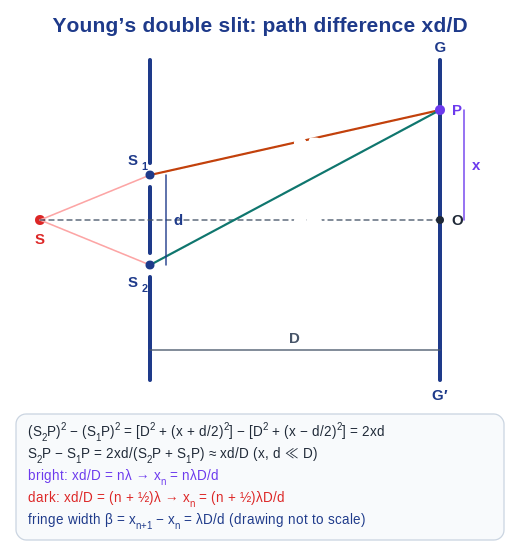
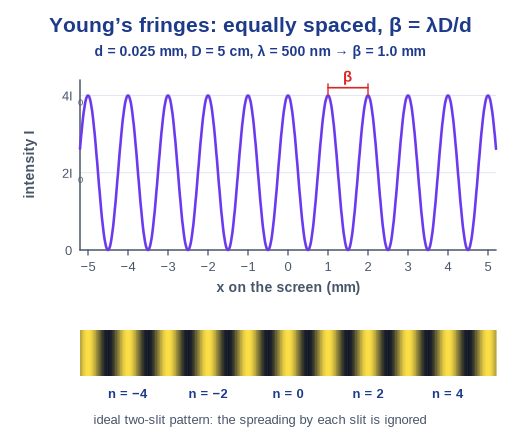
Screen par centre O se x upar ek point P ke liye, slit separation d aur screen distance D ke saath (x aur d dono D se bahut chhote), path difference hai
S₂P − S₁P ≈ xd/D
isliye fringes yahan hain:
- bright: xd/D = nλ, to x_n = nλD/d (n = 0, ±1, ±2, …)
- dark: xd/D = (n + ½)λ, to x_n = (n + ½)λD/d
Padosi bright fringes, aur padosi dark fringes, barabar doori par hain: fringe width β = λD/d. Book ke computer se bane pattern ke numbers (D = 5 cm, d = 0.025 mm, λ = 5 × 10⁻⁵ cm = 500 nm) se β = 1 mm aata hai.
Diffraction kya hai?
Shadow ke kinare ko dhyaan se dekho to light aur dark bands dikhte hain, kaafi had tak interference fringes jaise. Light kinaron ke aaspaas aur patle openings se geometrical shadow ke ilaake mein phail jaati hai. Ye diffraction hai, aur har tarah ki wave ise dikhati hai: sound, paani ki waves, light, yahan tak ki matter waves bhi. Light ke saath hum ise kam notice karte hain kyunki uski wavelength zyadatar cheezon se bahut chhoti hai; sound to hum kone ke peeche se bhi sun lete hain. Diffraction ye bhi limit karta hai ki aankh, telescope ya microscope kitni baareek detail dekh sakte hain, aur CD par dikhne wale rang diffraction se aate hain.
Single slit
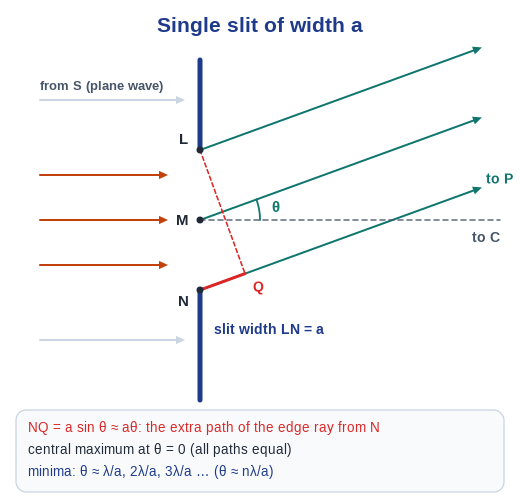
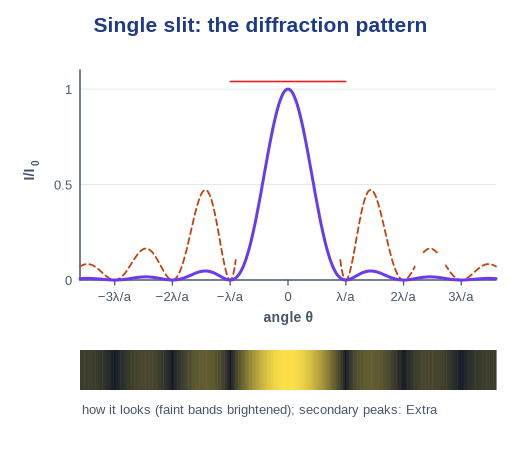
Maano ek parallel monochromatic beam width a ki single patli slit LN par seedhi girti hai. Slit ko secondary sources ki ek line maana jaata hai, sab phase mein, kyunki aane wala plane wavefront slit ke parallel hai. Normal se θ angle par nikalti light door ki screen ke point P tak pahunchti hai, aur slit ke saare hisson ke contributions unke phase differences ke saath jode jaate hain. Dekha gaya pattern:
- θ = 0 par chauda, bright central maximum;
- minima (zero intensity) θ ≈ nλ/a par, n = ±1, ±2, ±3, …;
- (n + ½)λ/a ke paas kamzor hote secondary maxima.
Isliye central maximum −λ/a se +λ/a tak phaila hai, angular width 2λ/a: slit jitni patli, phailaav utna zyada. Padho diffraction aur polarisation.
Interference ya diffraction?
Book Richard Feynman ki raay deti hai ki dono ke beech koi santoshjanak line kisi ne nahi kheenchi: kuch sources hon to hum interference kehte hain, bahut saare hon to diffraction. Young ke experiment mein screen ka pattern asal mein double-slit interference aur har slit ke single-slit diffraction ka mel hai.
Khud dekhna (sirf teacher ke saath)
Book ek simple tareeka batati hai: do razor blades kinare se kinara milakar patli slit banao, aur use aankh ke paas rakhkar seedhe filament wale saaf bulb ko dekho, filament slit ke parallel. Filament pehli slit ka kaam karta hai aur aankh ka lens pattern retina par focus karta hai; red aur blue filters dikhate hain ki red fringes chaudi hoti hain. Razor blades tez hote hain aur bulbs garam hote hain, isliye ye sirf teacher ke saath karo, aur Sun ya uske kisi reflection ko kabhi source mat banao. Interference aur diffraction dono mein light ki energy sirf bright aur dark bands ke beech ghoomti hai; na banti hai na khoti hai.
Polarisation kya hai?
Ek lambi khinchi string ka ek sira upar-neeche hilao: ek wave y = a sin(kx − ωt) x ke saath chalti hai, jahan k = 2π/λ aur ω = 2πν. String ka har hissa y ke saath hilta hai, chalne ki direction ke perpendicular, isliye wave transverse hai. Kyunki har point ek seedhi line par hilta hai aur string x-y plane mein rehti hai, ise linearly polarised ya plane polarised kehte hain (yahan y-polarised; side mein hilane se z-polarised wave milti). Agar hilane ka plane har second kai baar random badle, to wave unpolarised hogi.
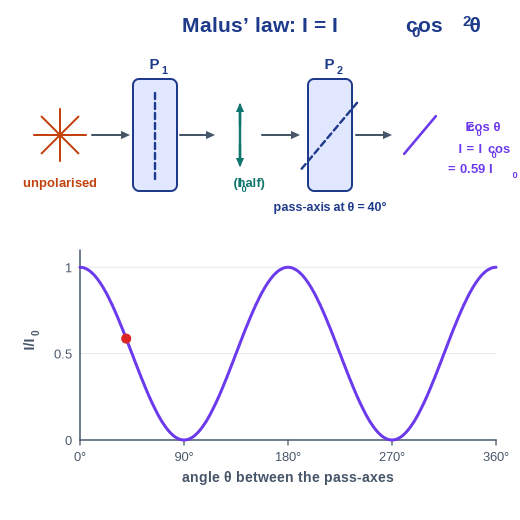
Light bhi transverse hai: uska electric field hamesha chalne ki direction ke perpendicular hota hai. Aam light (sun ya sodium lamp ki) unpolarised hai: electric field ki direction transverse plane mein tezi se aur random badalti hai. Polaroid sheet mein lambe chain wale molecules ek direction mein lage hote hain; ye molecules ke saath wala electric field absorb karti hai aur unke perpendicular wala component, apni pass-axis ke saath, jaane deti hai.
- Ek polaroid P₁ unpolarised light ki intensity aadhi kar deta hai, aur P₁ ghumane se kuch nahi badalta.
- Doosra polaroid P₂ lagao. Ab kisi ko ghumana bahut farak daalta hai: pass-axes θ angle par hon to sirf component E₀ cos θ guzarta hai, isliye
I = I₀ cos²θ (Malus ka law)
jahan I₀ pehle polaroid se nikalti polarised light ki intensity hai. Axes crossed (90°) hon to light lagbhag khatam ho jaati hai, parallel hon to lagbhag poori guzarti hai; ek poore chakkar mein do maxima aur do minima aate hain. Polaroids sunglasses aur windowpanes mein intensity control karne, aur cameras, 3D movie cameras samet, mein use hote hain.
Example 10.2 (page 271) do crossed polaroids P₁ aur P₃ ke beech teesra polaroid P₂ rakhta hai. Agar P₂, P₁ se θ par hai, to P₃ se (π/2 − θ) par hai, isliye P₃ se nikalti light I₀ cos²θ sin²θ = (I₀/4) sin²2θ hai, jo θ = π/4 par sabse zyada (I₀/4) hai. Poora hal NCERT solutions mein hai.
Is chapter ki quantities aur units kaunsi hain?
- Speed v aur c m/s mein; refractive index n = c/v ka koi unit nahi.
- Wavelength λ m mein (aksar nm = 10⁻⁹ m); frequency ν Hz mein; k = 2π/λ rad/m mein; ω = 2πν rad/s mein.
- Phase difference φ radians mein; path difference m mein, 2π ↔ λ.
- Slit separation d, slit width a, screen distance D, fringe position x aur fringe width β: sab lengths, m mein.
- Intensity I W/m² mein, aksar I/I₀ ke roop mein compare ki jaati hai.
Aage badhne se pehle
Light ko wave maano to Huygens ki wavelets reflection aur refraction ke laws deti hain; do coherent waves jodo to I = 4I₀ cos²(φ/2) milta hai, jise Young ki slits barabar doori ki fringes β = λD/d mein badal deti hain; ek slit se wave guzre to phailti hai, minima θ ≈ nλ/a par; aur polaroids light rok sakte hain, ye dikhata hai ki light waves transverse hain. Saari chhe exercises aur dono worked examples Chapter 10 ke NCERT solutions mein hal hain.
Key terms (zaroori shabd)
| Term | Matlab |
|---|---|
| Wavefront | Wo surface jis par wave ka har point same phase mein oscillate karta hai. Point source spherical wavefronts deta hai; source se bahut door uska chhota hissa lagbhag plane hota hai. |
| Huygens principle | Wavefront ka har point secondary wavelets ka source hai jo wave ki speed se phailti hain; in wavelets ka aage wala envelope (common tangent) thodi der baad ka wavefront hai. |
| Ray | Wavefronts ke perpendicular kheenchi line, jiske saath wave ki energy chalti hai. |
| Refractive index (n) | n = c/v, vacuum mein light ki speed bata medium mein speed. Snell ka law: n₁ sin i = n₂ sin r. |
| Coherent sources | Aise sources jinka kisi bhi point par phase difference time ke saath nahi badalta, isliye steady interference pattern banta hai. Do alag lamps incoherent hote hain. |
| Interference | Ek hi point par do ya zyada waves ke displacements ka judna (superposition), jisse kahin bright aur kahin dark regions bante hain. |
| Path difference aur phase difference | λ ka path difference 2π ke phase difference ke barabar hai. Bright: path difference nλ; dark: (n + ½)λ. |
| Fringe width (β) | Young ke experiment mein do padosi bright (ya dark) fringes ke beech ki doori: β = λD/d. |
| Diffraction | Kisi obstacle ke kinaron ya patle opening se wave ka phailna, jisse shadow ke kinare par bright aur dark bands bante hain. |
| Polaroid aur pass-axis | Ek direction mein line mein lage lambe molecules wali sheet, jo electric field ka sirf ek direction (pass-axis) wala component jaane deti hai aur linearly polarised light deti hai. |
| Malus ka law | I = I₀ cos²θ: I₀ intensity ki polarised light ki intensity, us polaroid ke baad jiski pass-axis light ki polarisation se θ angle par hai. |
Is chapter ke topics
Practice karo
-
Wave theory ke hisaab se, kisi medium mein jaate waqt light normal ki taraf mude, to us medium mein uski speed hoti hai:
Jawab dekho
Jawab: (b) kam
-
Light air se glass mein jaaye to kaunsi quantity same rehti hai?
Jawab dekho
Jawab: (c) frequency
-
Do coherent waves, har ek ki intensity I₀, π/2 ke phase difference se milti hain. Resultant intensity hai:
Jawab dekho
Jawab: (c) 2I₀
-
Young ke experiment mein slits 0.5 mm door hain aur screen 1.0 m door hai. 600 nm ki light ke liye fringe width hai:
Jawab dekho
Jawab: (b) 1.2 mm
-
Width a ki single slit ke liye pehla minimum lagbhag kis angle par hai?
Jawab dekho
Jawab: (b) λ/a
-
I₀ intensity ki polarised light ek polaroid par girti hai jiski pass-axis light ki polarisation se 60° par hai. Transmitted intensity hai:
Jawab dekho
Jawab: (b) I₀/4
Students ke sawal
Class 12 Physics Chapter 10 ke main topics kya hain?
Huygens principle, usse plane waves ka reflection aur refraction, waves ka coherent aur incoherent addition, interference aur Young ka double-slit experiment, single slit par diffraction, aur polaroids aur Malus ke law ke saath polarisation. Chapter Examples 10.1, 10.2 aur chhe exercises par khatam hota hai.
Kya Brewster ka law, resolving power aur Doppler effect is chapter mein hain?
NCERT book ke 2026-27 reprint mein nahi. Iska polarisation section sirf polaroids aur Malus ka law leta hai, aur diffraction section single slit leta hai, bas itna batate hue ki diffraction telescopes aur microscopes ka resolution limit karta hai.
Do alag bulb interference fringes kyun nahi dete?
Aam source ki light ka phase achanak badalta rehta hai, lagbhag har 10⁻¹⁰ s mein. Isliye do independent sources ka koi fixed phase relation nahi hota, pattern dekhne ke liye bahut tezi se badalta hai, aur sirf average intensity 2I₀ dikhti hai.
Is chapter ke kaunse formulas yaad rakhne hain?
sin i/sin r = v₁/v₂ = n₂/n₁; n = c/v; v₁/λ₁ = v₂/λ₂; I = 4I₀ cos²(φ/2); bright x_n = nλD/d, dark x_n = (n + ½)λD/d, β = λD/d; single-slit minima θ ≈ nλ/a; Malus ka law I = I₀ cos²θ.
Kya dark fringes par interference light ki energy khatam kar deta hai?
Nahi. Energy sirf jagah badalti hai: dark fringe par jo kam hai wo bright fringes mein aa jaati hai, isliye total energy conserve rehti hai.
Koi sawal atak gaya?
Photo lo, Lagnever AI step-by-step samjhayega. 7 din ka trial sirf ₹2.
Google Play se app lo Browser mein kholo
Parents ke liye: trial ke baad plan har mahine UPI ya card autopay se renew hota hai. App mein kabhi bhi cancel kar sakte hain.