
NCERT Solutions Class 12 Physics Chapter 12: Atoms
Answers to all 9 end-of-chapter exercises and the four worked examples of Chapter 12, Atoms, of Physics Part II, the Class 12 NCERT textbook. Page numbers follow the 2026-27 reprint (pages 290–305). The exercises come first, quoted from the book; the examples follow, restated in short. Every number was also checked by computer. Short notes: Chapter 12 notes.
We use the book’s values: e = 1.6 × 10⁻¹⁹ C, 1/4πε₀ = 9.0 × 10⁹ N m² C⁻², m = 9.1 × 10⁻³¹ kg, h = 6.6 × 10⁻³⁴ J s, c = 3.0 × 10⁸ m/s and 1 eV = 1.6 × 10⁻¹⁹ J. For hydrogen, Eₙ = −13.6/n² eV.
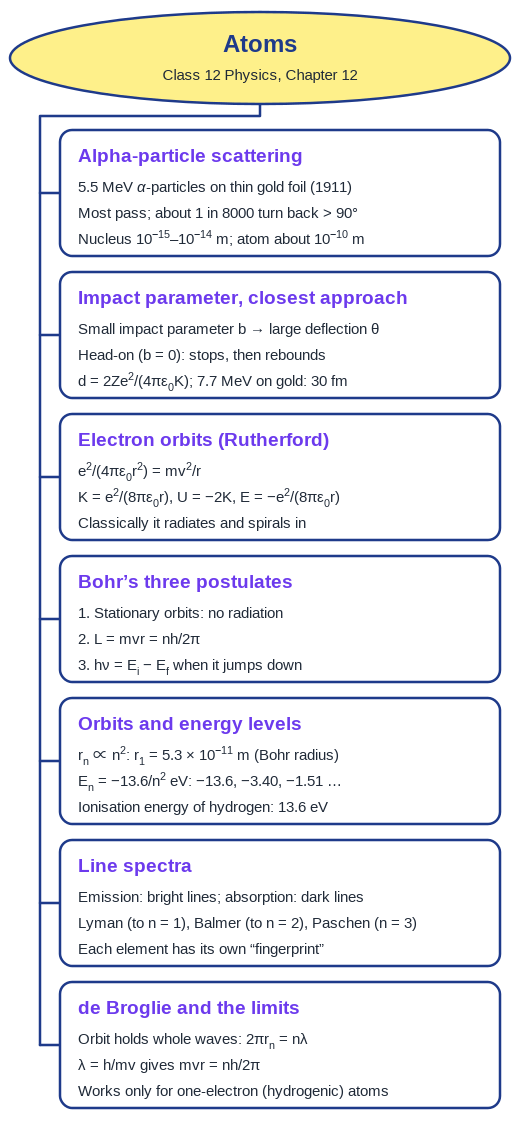
Exercises 12.1 and 12.2: models of the atom
12.1 “Choose the correct alternative from the clues given at the end of the each statement: (a) The size of the atom in Thomson’s model is … the atomic size in Rutherford’s model. (much greater than/no different from/much less than.) (b) In the ground state of … electrons are in stable equilibrium, while in … electrons always experience a net force. (Thomson’s model/ Rutherford’s model.) (c) A classical atom based on … is doomed to collapse. (Thomson’s model/ Rutherford’s model.) (d) An atom has a nearly continuous mass distribution in a … but has a highly non-uniform mass distribution in … (Thomson’s model/ Rutherford’s model.) (e) The positively charged part of the atom possesses most of the mass in … (Rutherford’s model/both the models.)”
(a) no different from. Both models describe an atom of the same overall size, about 10⁻¹⁰ m; they differ only in how the charge and mass are arranged inside it.
(b) Thomson’s model; Rutherford’s model. In Thomson’s model the electrons sit at rest at points where the pull of the spread-out positive charge and the push of the other electrons balance. In Rutherford’s model the electrons move in orbits, so the attraction of the nucleus always acts on them as a net (centripetal) force.
(c) Rutherford’s model. An orbiting electron accelerates, so by classical theory it radiates and spirals into the nucleus.
(d) Thomson’s model; Rutherford’s model. Thomson spreads the positive charge and mass through the whole atom; Rutherford packs them into the tiny nucleus, leaving the rest nearly empty.
(e) both the models. The electrons are very light, so in both models most of the mass belongs to the positive part.
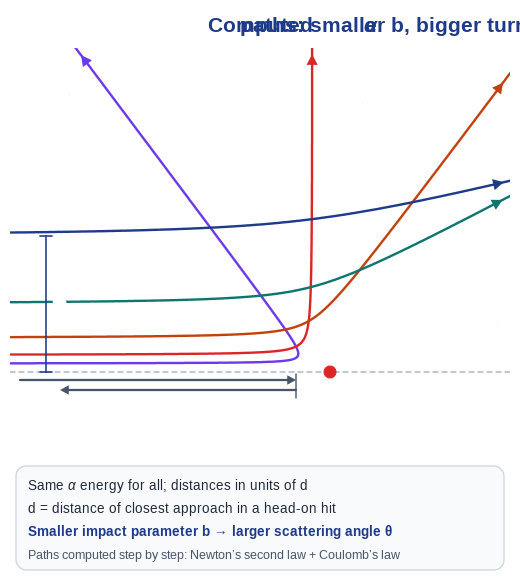
12.2 “Suppose you are given a chance to repeat the alpha-particle scattering experiment using a thin sheet of solid hydrogen in place of the gold foil. (Hydrogen is a solid at temperatures below 14 K.) What results do you expect?”
- The nucleus of a hydrogen atom is a single proton, about 1.67 × 10⁻²⁷ kg.
- An α-particle is about 6.64 × 10⁻²⁷ kg, roughly four times heavier (masses as given in the book’s answer key).
- When a heavy particle hits a lighter one, even head-on, it cannot be sent back. It pushes the proton forward and carries on, just as a football hitting a table-tennis ball at rest keeps going.
- The target’s charge is also only e instead of 79e (gold), so the repulsion is much weaker.
Answer: we expect no large-angle scattering: no α-particles turned back, only small deflections. So the experiment could not reveal a nucleus this way. (Extra: in an elastic collision the largest possible deflection is given by sin θ = 1.67/6.64, about 15°.)
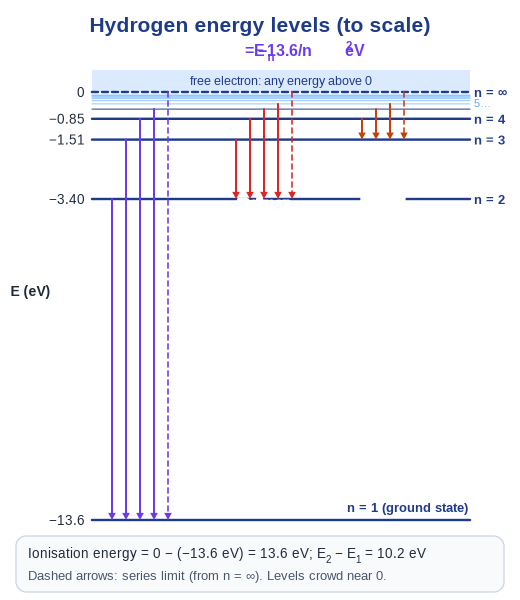
Exercises 12.3 to 12.5: energies and photons
12.3 “A difference of 2.3 eV separates two energy levels in an atom. What is the frequency of radiation emitted when the atom make a transition from the upper level to the lower level?”
E = 2.3 eV = 2.3 × 1.6 × 10⁻¹⁹ J = 3.68 × 10⁻¹⁹ J
ν = E/h = (3.68 × 10⁻¹⁹ J)/(6.6 × 10⁻³⁴ J s) = 5.6 × 10¹⁴ Hz
12.4 “The ground state energy of hydrogen atom is –13.6 eV. What are the kinetic and potential energies of the electron in this state?”
For an electron in an orbit, K = e²/(8πε₀r) and U = −e²/(4πε₀r) = −2K, so E = K + U = −K. Hence
K = −E = 13.6 eV and U = 2E = −27.2 eV
(Check: 13.6 + (−27.2) = −13.6 eV.)
12.5 “A hydrogen atom initially in the ground level absorbs a photon, which excites it to the n = 4 level. Determine the wavelength and frequency of photon.”
E₁ = −13.6 eV and E₄ = −13.6/16 = −0.85 eV, so the photon energy is
E = E₄ − E₁ = −0.85 − (−13.6) = 12.75 eV = 12.75 × 1.6 × 10⁻¹⁹ J = 2.04 × 10⁻¹⁸ J
ν = E/h = (2.04 × 10⁻¹⁸)/(6.6 × 10⁻³⁴) = 3.1 × 10¹⁵ Hz
λ = c/ν = (3.0 × 10⁸)/(3.09 × 10¹⁵) = 9.7 × 10⁻⁸ m (97 nm, in the Lyman region)
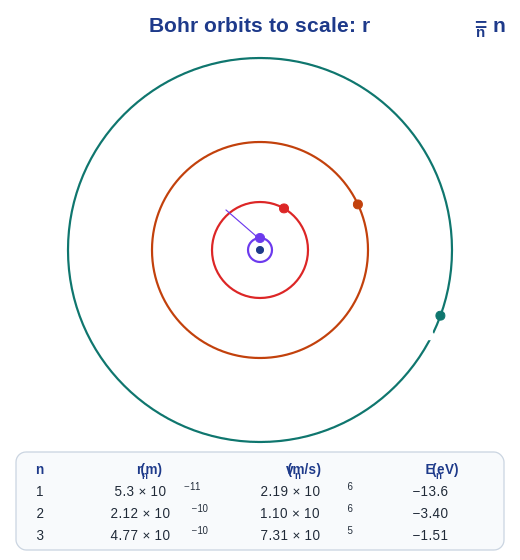
Exercises 12.6 and 12.7: speeds, periods and radii
12.6 “(a) Using the Bohr’s model calculate the speed of the electron in a hydrogen atom in the n = 1, 2, and 3 levels. (b) Calculate the orbital period in each of these levels.”
(a) We need two facts.
- Bohr’s second postulate (the angular momentum rule): mvr = nh/2π.
- The electric pull supplies the centripetal force: mv²/r = e²/(4πε₀r²), that is mv²r = e²/(4πε₀).
- Divide the second equation by the first. m and r cancel and v = (e²/4πε₀) × 2π/(nh), so vₙ = 2π(1/4πε₀)e²/(nh). The speed falls as 1/n.
- v₁ = (2π × 9.0 × 10⁹ × (1.6 × 10⁻¹⁹)²)/(6.6 × 10⁻³⁴) = 2.19 × 10⁶ m/s; then v₂ = v₁/2 and v₃ = v₁/3.
Answer (a): v₁ = 2.19 × 10⁶ m/s, v₂ = 1.10 × 10⁶ m/s, v₃ = 7.31 × 10⁵ m/s
(b) The period is Tₙ = 2πrₙ/vₙ, with rₙ = n²r₁ and r₁ = 5.3 × 10⁻¹¹ m. Since rₙ ∝ n² and vₙ ∝ 1/n, Tₙ ∝ n³.
T₁ = (2π × 5.3 × 10⁻¹¹)/(2.19 × 10⁶) = 1.52 × 10⁻¹⁶ s
T₂ = 8T₁ = 1.22 × 10⁻¹⁵ s, T₃ = 27T₁ = 4.10 × 10⁻¹⁵ s
Answer (b): T₁ = 1.52 × 10⁻¹⁶ s, T₂ = 1.22 × 10⁻¹⁵ s, T₃ = 4.10 × 10⁻¹⁵ s
12.7 “The radius of the innermost electron orbit of a hydrogen atom is 5.3×10⁻¹¹ m. What are the radii of the n = 2 and n = 3 orbits?”
rₙ = n²r₁, so
r₂ = 4 × 5.3 × 10⁻¹¹ m = 2.12 × 10⁻¹⁰ m and r₃ = 9 × 5.3 × 10⁻¹¹ m = 4.77 × 10⁻¹⁰ m
Exercises 12.8 and 12.9: spectra and the earth’s orbit
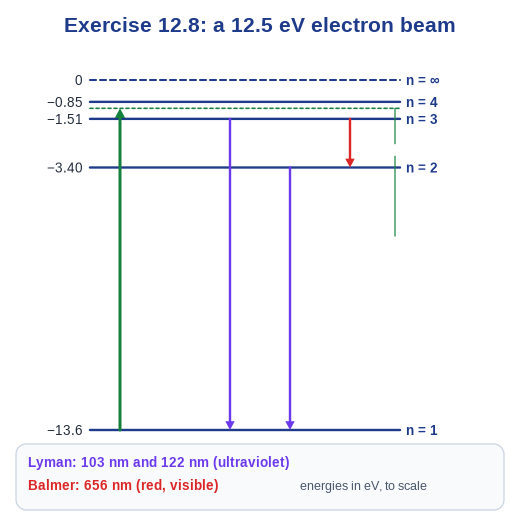
12.8 “A 12.5 eV electron beam is used to bombard gaseous hydrogen at room temperature. What series of wavelengths will be emitted?”
- At room temperature the atoms are in the ground state, E₁ = −13.6 eV.
- A 12.5 eV electron can give an atom at most 12.5 eV, lifting it to −13.6 + 12.5 = −1.1 eV.
- That is above E₃ = −1.51 eV but below E₄ = −0.85 eV (reaching n = 4 needs 12.75 eV). So the atoms are excited up to n = 3 at most.
- Falling back, they can give three lines. Each wavelength is λ = hc/ΔE, with hc = 6.6 × 10⁻³⁴ × 3.0 × 10⁸ = 1.98 × 10⁻²⁵ J m:
- 3 → 1: ΔE = 12.09 eV = 1.93 × 10⁻¹⁸ J, λ = 102 nm (Lyman series)
- 2 → 1: ΔE = 10.2 eV = 1.63 × 10⁻¹⁸ J, λ = 121 nm (Lyman series)
- 3 → 2: ΔE = 1.89 eV = 3.02 × 10⁻¹⁹ J, λ = 655 nm (Balmer series)
Answer: two lines of the Lyman series (102 nm and 121 nm) and one line of the Balmer series (655 nm) are emitted. With the measured Rydberg constant (Extra) the same lines come out at 102.6, 121.5 and 656.3 nm, which the answer key gives as 103 nm, 122 nm and 656 nm; the tiny differences come only from the rounded constants.
12.9 “In accordance with the Bohr’s model, find the quantum number that characterises the earth’s revolution around the sun in an orbit of radius 1.5 × 10¹¹ m with orbital speed 3 × 10⁴ m/s. (Mass of earth = 6.0 × 10²⁴ kg.)”
Bohr’s condition is mvr = nh/2π, so n = 2πmvr/h.
mvr = 6.0 × 10²⁴ × 3 × 10⁴ × 1.5 × 10¹¹ = 2.7 × 10⁴⁰ J s
n = (2π × 2.7 × 10⁴⁰)/(6.6 × 10⁻³⁴) = 2.6 × 10⁷⁴
The number is so enormous that neighbouring allowed orbits are practically continuous: quantisation makes no noticeable difference for a planet.
Worked examples 12.1 to 12.4
Example 12.1 (page 294): Scale the solar system to an atom’s proportions. Is the earth then nearer to the sun or farther from it than now?
In the atom the electron’s orbit (about 10⁻¹⁰ m) is (10⁻¹⁰)/(10⁻¹⁵) = 10⁵ times the nuclear radius. Scaling the sun’s radius, 7 × 10⁸ m, by 10⁵ gives an earth orbit of 7 × 10¹³ m. The actual orbit is 1.5 × 10¹¹ m, so the scaled one is about 470 times larger, which is more than 100 times larger: the earth would be much farther away. An atom is far emptier than the solar system.
Example 12.2 (page 295): How close does a 7.7 MeV α-particle get to a gold nucleus before it stops and turns back?
At the stopping point all the kinetic energy has become potential energy: K = (1/4πε₀)(2e)(Ze)/d, so d = 2Ze²/(4πε₀K). With K = 7.7 MeV = 1.2 × 10⁻¹² J,
d = (2 × 9.0 × 10⁹ × (1.6 × 10⁻¹⁹)²)/(1.2 × 10⁻¹²) × Z = 3.84 × 10⁻¹⁶ Z m
For gold, Z = 79: d ≈ 3.0 × 10⁻¹⁴ m = 30 fm. So the gold nucleus is smaller than 30 fm. Its actual radius is about 6 fm, so the α-particle turns back without touching it.
Example 12.3 (page 296): Pulling a hydrogen atom apart into its proton and electron takes 13.6 eV. Find the radius of the electron’s orbit and its speed.
E = −13.6 eV = −13.6 × 1.6 × 10⁻¹⁹ J = −2.18 × 10⁻¹⁸ J. From E = −e²/(8πε₀r),
r = −e²/(8πε₀E) = (9.0 × 10⁹ × (1.6 × 10⁻¹⁹)²)/(2 × 2.18 × 10⁻¹⁸) = 5.3 × 10⁻¹¹ m
v = e/√(4πε₀mr) = √(9.0 × 10⁹ × (1.6 × 10⁻¹⁹)²/(9.1 × 10⁻³¹ × 5.3 × 10⁻¹¹)) = 2.2 × 10⁶ m/s
Example 12.4 (page 298): By classical theory, what frequency of light would the orbiting electron of hydrogen give out at first?
Classically the light has the electron’s frequency of revolution:
ν = v/2πr = (2.2 × 10⁶ m/s)/(2π × 5.3 × 10⁻¹¹ m) ≈ 6.6 × 10¹⁵ Hz
As the electron spiralled in, this frequency would keep changing, which is why the classical atom would give a continuous spectrum.
Notes for checking
- The answer key agrees with Exercises 12.1, 12.3, 12.4, 12.5, 12.7 and 12.9.
- 12.6: the key gives 2.18 × 10⁶, 1.09 × 10⁶ and 7.27 × 10⁵ m/s and periods 1.52 × 10⁻¹⁶, 1.22 × 10⁻¹⁵ and 4.11 × 10⁻¹⁵ s. These come from h = 6.63 × 10⁻³⁴ J s with rounding at each step (for example 7.27 × 10⁵ = 2.18 × 10⁶/3); with the book’s h = 6.6 × 10⁻³⁴ J s the speeds are 2.19 × 10⁶, 1.10 × 10⁶ and 7.31 × 10⁵ m/s and T₃ = 4.10 × 10⁻¹⁵ s. The differences are under 1%.
- 12.8: the key’s 103, 122 and 656 nm come from the measured Rydberg constant; the book’s rounded h and eV give 102, 121 and 655 nm. Both describe the same three lines.
- 12.2: the masses of the proton and the α-particle are taken from the answer key; the chapter text does not give them.
- Page 298, Example 12.4: the text gives the speed as “2.2 × 10⁻⁶ m/s”; it should be 2.2 × 10⁶ m/s, as the formula line beneath it shows.
- Page 302: the text refers to “[Eq. (12.15)]” for Bohr’s quantum condition, which is Eq. (12.5), and to “Section 12.5” for the orbits and energy levels, which are in Section 12.4.
- Page 296, Example 12.3: with E rounded to −2.2 × 10⁻¹⁸ J the radius comes out 5.2 × 10⁻¹¹ m; the book’s 5.3 × 10⁻¹¹ m follows from the unrounded −2.18 × 10⁻¹⁸ J used above.
Practice
-
The electron in a hydrogen atom drops from n = 2 to n = 1. The energy of the photon emitted is:
Show answer
Answer: (b) 10.2 eV
-
The kinetic energy of the electron in the n = 2 state of hydrogen is:
Show answer
Answer: (b) 3.4 eV
-
The ratio of the radii of the n = 3 and n = 1 orbits of hydrogen is:
Show answer
Answer: (c) 9
-
Find the frequency of the photon emitted when a hydrogen atom goes from n = 2 to n = 1. Take h = 6.6 × 10⁻³⁴ J s.
Show answer
Answer: E₂ − E₁ = −3.40 − (−13.6) = 10.2 eV = 10.2 × 1.6 × 10⁻¹⁹ J = 1.63 × 10⁻¹⁸ J. ν = E/h = 1.63 × 10⁻¹⁸/6.6 × 10⁻³⁴ = 2.47 × 10¹⁵ Hz.
-
What is the angular momentum of the electron in the n = 2 orbit of hydrogen? Take h = 6.6 × 10⁻³⁴ J s.
Show answer
Answer: L = nh/2π = 2 × 6.6 × 10⁻³⁴/(2π) = 2.1 × 10⁻³⁴ J s.
Stuck on a question?
Take a photo and Lagnever AI explains it step by step. Try it for 7 days for ₹2.
Get it on Google Play Open in browser
For parents: after the trial, the plan renews monthly by UPI or card autopay. You can cancel anytime in the app.