
Class 12 Physics Chapter 12: Atoms Notes
This chapter in five lines
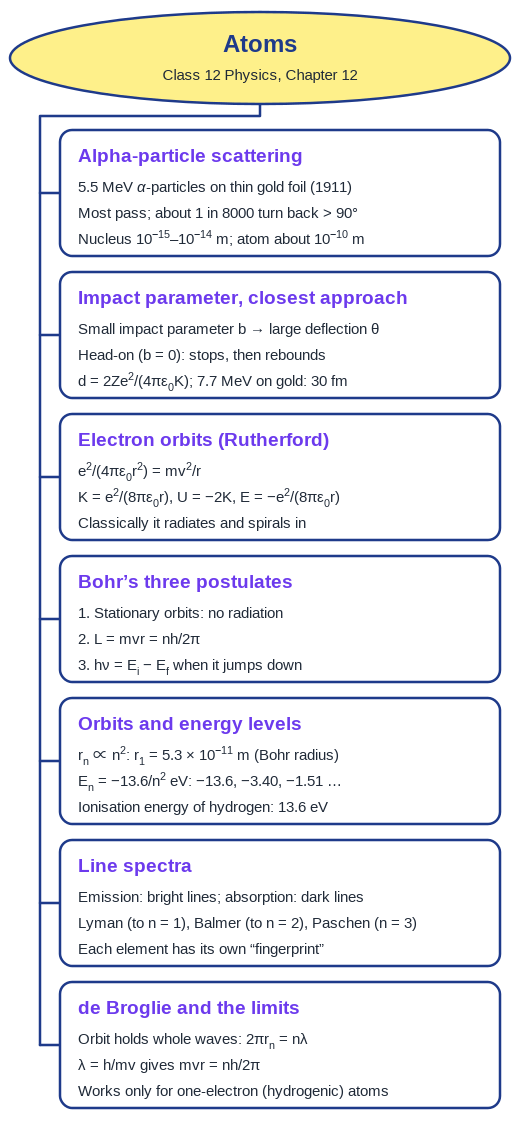
Alpha-particle scattering from gold foil showed that an atom’s positive charge and most of its mass sit in a tiny nucleus, about 10⁻¹⁵ to 10⁻¹⁴ m across, inside an atom of about 10⁻¹⁰ m. Bohr added three postulates: stationary orbits, L = nh/2π and hν = Eᵢ − E_f. For hydrogen they give rₙ ∝ n² and Eₙ = −13.6/n² eV, which explain its line spectrum. de Broglie explained L = nh/2π with standing electron waves.
What is this chapter about?
By 1897 J. J. Thomson had shown that every atom contains electrons, identical for all elements. An atom as a whole is neutral, so it must also hold an equal positive charge. How are the two arranged? This chapter (book pages 290 to 305) follows the answer from Thomson’s model to Rutherford’s nucleus and then to Bohr’s model of hydrogen.
In Thomson’s model (1898) the positive charge fills the whole atom evenly and the electrons sit in it like the seeds of a watermelon: the “plum pudding” model. Experiments soon showed that the real arrangement is very different.
Spectra give a second clue. Hot solids, liquids and dense gases give out light of all wavelengths, a continuous spectrum, because neighbouring atoms push and pull on one another. A rarefied gas, such as the gas in a neon sign or a mercury lamp, gives out only certain wavelengths, seen as bright lines. There the atoms are far apart, so the light comes from single atoms, and each element has its own set of lines. Hydrogen, the simplest atom, always gives the same set; in 1885 Balmer found a simple formula for a group of them. The structure of an atom must be the reason for its spectrum.
Safety: radioactive sources and high-voltage discharge tubes are used only by trained staff in a laboratory. Nothing in this chapter is an activity to try at home.
How was the alpha-particle scattering experiment done?
In 1911, at Rutherford’s suggestion, Hans Geiger and Ernest Marsden fired α-particles at a very thin gold foil.
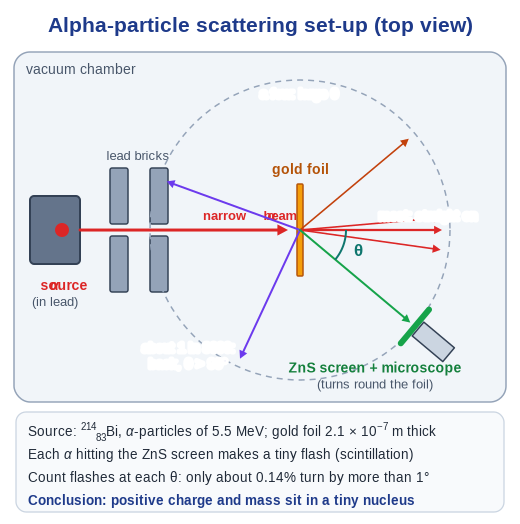
- A radioactive source, ²¹⁴₈₃Bi, gave α-particles of 5.5 MeV. Lead bricks with a narrow gap shaped them into a thin beam.
- The beam struck a gold foil only 2.1 × 10⁻⁷ m thick.
- A detector, a zinc sulphide screen with a microscope, could be turned to any angle θ round the foil. Each α-particle that struck the screen made a tiny flash (a scintillation), so the flashes could be counted at each angle.
- The whole apparatus was inside a vacuum chamber, so that air did not stop the α-particles.
What did the experiment show?
Most α-particles went straight through the foil. Only about 0.14% were turned by over 1°, and roughly 1 in 8000 came back through more than 90°. Rutherford argued that sending a heavy, fast α-particle backwards needs a very large repulsive force. That is possible only if the atom’s positive charge and most of its mass are packed into a tiny region at its centre, so that an α-particle can get very close to all of that charge at once. Thomson’s spread-out charge could never push that hard.
This is Rutherford’s nuclear model: a tiny, heavy, positive nucleus at the centre with the electrons moving round it far away, like planets round the sun. The experiments put the nuclear size at about 10⁻¹⁵ to 10⁻¹⁴ m, while the atom is about 10⁻¹⁰ m, some 10,000 to 100,000 times larger. So the atom is mostly empty space, which is why most α-particles pass straight through. The electrons are far too light to deflect an α-particle noticeably.
Example 12.1 (page 294) scales the solar system to the same proportions: with the earth’s orbit 10⁵ times the sun’s radius of 7 × 10⁸ m, it would be 7 × 10¹³ m across instead of 1.5 × 10¹¹ m, so an atom is far emptier than the solar system.
What is the impact parameter?
The foil is so thin that each α-particle meets at most one nucleus, so it is enough to follow one α-particle (charge 2e) moving past one gold nucleus (charge Ze, Z = 79). The gold nucleus is about 50 times heavier, so it can be treated as fixed. The force between them is Coulomb’s repulsion,
F = (1/4πε₀)(2e)(Ze)/r²
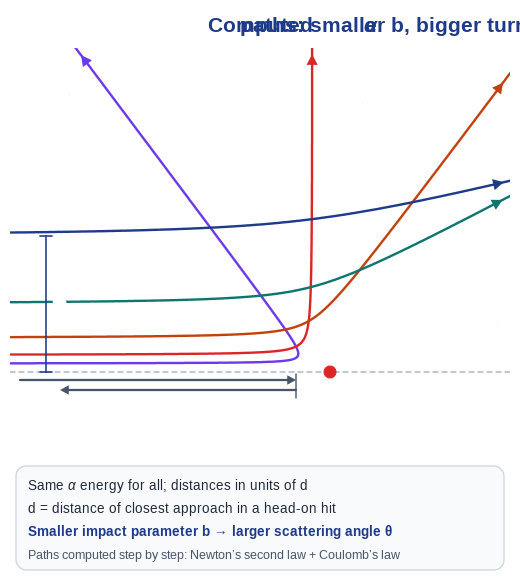
and Newton’s second law then fixes the path. The path depends on the impact parameter b: the perpendicular distance from the nucleus to the line along which the α-particle was first moving.
- Large b: the α-particle passes far away and is hardly deflected (θ ≈ 0).
- Small b: it comes close and is turned through a large angle.
- b = 0 (head-on): it stops and comes straight back (θ ≈ π).
Since only a few particles bounce back, head-on hits are rare, so the nucleus must be very small. Rutherford scattering therefore sets an upper limit to the size of a nucleus. Read Rutherford’s nuclear model.
How close can an alpha-particle get?
In a head-on collision the α-particle slows down, stops for an instant at a distance d from the centre of the nucleus, and turns back. Energy is conserved, so at that moment all its kinetic energy K has become electric potential energy:
K = (1/4πε₀)(2e)(Ze)/d, so d = 2Ze²/(4πε₀K)
Example 12.2 (page 295) uses the largest natural α energy, 7.7 MeV = 1.2 × 10⁻¹² J: d = 3.84 × 10⁻¹⁶ Z m, and for gold (Z = 79) d ≈ 3.0 × 10⁻¹⁴ m = 30 fm. The gold nucleus must be smaller than this. Its actual radius is about 6 fm: the α-particle turns back well before it touches the nucleus.
How does an electron move round the nucleus?
In Rutherford’s picture the electron in hydrogen moves in a circle, and the electric attraction of the nucleus supplies the centripetal force:
e²/(4πε₀r²) = mv²/r, so r = e²/(4πε₀mv²)
From this, the kinetic and potential energies are
K = ½mv² = e²/(8πε₀r) and U = −e²/(4πε₀r)
and the total energy is
E = K + U = −e²/(8πε₀r)
E is negative: the electron is bound to the nucleus. With positive E it would not stay in a closed orbit. Example 12.3 (page 296) starts from the measured 13.6 eV needed to split a hydrogen atom, so E = −13.6 eV = −2.18 × 10⁻¹⁸ J. Then r = e²/(8πε₀|E|) = 5.3 × 10⁻¹¹ m and v = e/√(4πε₀mr) = 2.2 × 10⁶ m/s.
What are emission and absorption spectra?
When an atomic gas at low pressure is excited, usually by an electric current, it gives out light of only certain wavelengths. Through a spectrometer this emission line spectrum shows bright lines on a dark background, and it works like a fingerprint for identifying the gas. If white light is passed through the same cool gas instead, the transmitted light shows dark lines at exactly the same wavelengths: the absorption spectrum.
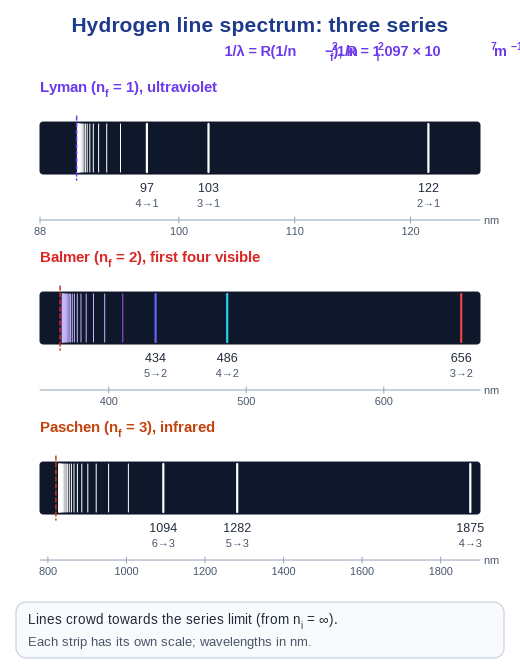
Fig. 12.5 of the book shows the hydrogen lines in groups, called series: the Lyman series (from about 91 to 122 nm), the Balmer series (365 to 656 nm) and the Paschen series (820 to 1875 nm). In each series the lines crowd together towards a limit.
Why did Rutherford’s model need changing?
A charge moving in a circle is accelerating, and classical electromagnetic theory says an accelerating charge radiates. The orbiting electron should therefore lose energy and spiral into the nucleus, so the atom could not be stable. As it spiralled in, its frequency of revolution, and so the frequency of the light, would change smoothly, giving a continuous spectrum, not lines. Example 12.4 (page 298) finds the starting frequency for hydrogen: ν = v/2πr = 2.2 × 10⁶/(2π × 5.3 × 10⁻¹¹) ≈ 6.6 × 10¹⁵ Hz. Real atoms are stable and give sharp lines, so classical ideas are not enough inside the atom.
What are Bohr’s three postulates?
Niels Bohr worked in Rutherford’s laboratory in 1912. In 1913 he kept the nucleus but added quantum ideas as three postulates:
- Stationary orbits. An electron can move in certain stable orbits without radiating. Each such state of the atom has a definite total energy.
- Quantised angular momentum. The allowed orbits are those in which the angular momentum is a whole-number multiple of h/2π: L = nh/2π, n = 1, 2, 3, … (h = 6.6 × 10⁻³⁴ J s).
- Photon emission. An electron can jump from one allowed orbit to another of lower energy, giving out one photon whose energy is the difference: hν = Eᵢ − E_f.
What are the radius and energy of the nth orbit?
Putting L = mvr = nh/2π into the orbit condition gives the allowed radii:
rₙ = (n²/m)(h/2π)²(4πε₀/e²)
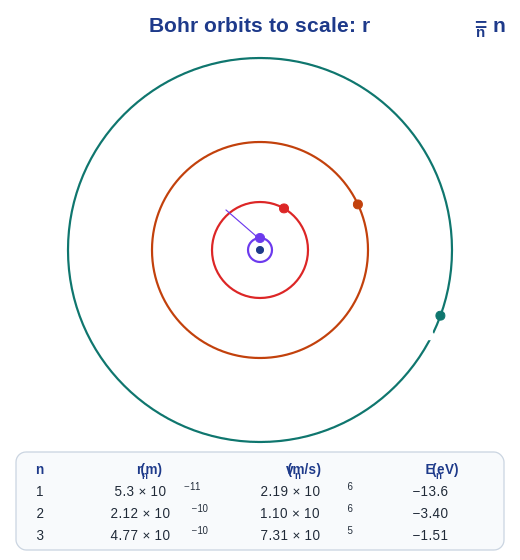
so rₙ ∝ n². The smallest, r₁ = a₀ ≈ 5.3 × 10⁻¹¹ m, is the Bohr radius; then r₂ = 4a₀ and r₃ = 9a₀. Putting rₙ into E = −e²/(8πε₀r) gives the energies:
Eₙ = −me⁴/(8n²ε₀²h²) = −2.18 × 10⁻¹⁸/n² J = −13.6/n² eV
What does the energy-level diagram show?
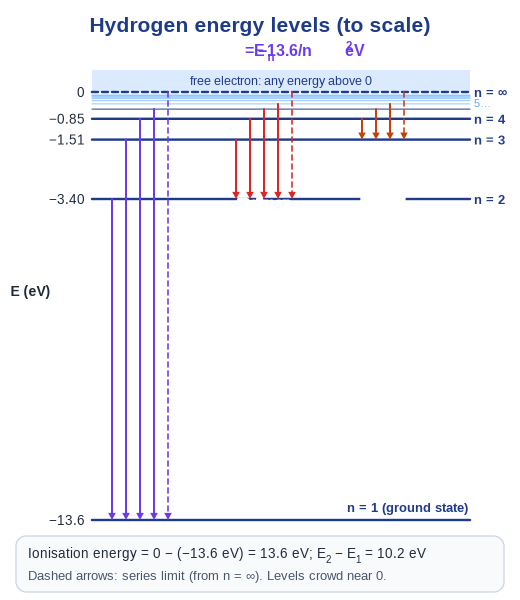
- Ground state, n = 1: E₁ = −13.6 eV, the lowest energy, with the electron in the smallest orbit. At room temperature almost all hydrogen atoms are in this state.
- Ionisation energy: 13.6 eV is the least energy that removes the electron completely, in excellent agreement with experiment.
- Excited states: E₂ = −3.40 eV, E₃ = −1.51 eV, E₄ = −0.85 eV, … Exciting the atom to n = 2 needs E₂ − E₁ = 10.2 eV; to n = 3, 12.09 eV. Collisions with electrons can supply this.
- At n = ∞ the energy is 0: the electron has been removed and is at rest. Above 0 eV the electron is unbound and can have any energy (a continuum).
- The levels crowd closer and closer together as n grows.
How does the Bohr model explain the line spectrum?
When the electron drops from level nᵢ to a lower level n_f, the photon carries the energy difference:
hν = E(nᵢ) − E(n_f)
Since n is a whole number, only certain differences, and so only certain frequencies, are possible: a line spectrum. An atom can also absorb a photon of exactly one of these energies and jump up, which gives the dark absorption lines. Jumps ending on n = 1 form the Lyman series, on n = 2 the Balmer series, and on n = 3 the Paschen series. This success earned Bohr the Nobel Prize in Physics in 1922. Read the Bohr model.
Extra (not in the 2026-27 text): with λ = c/ν and Eₙ = −13.6/n² eV the result becomes 1/λ = R(1/n_f² − 1/nᵢ²). With the book’s constants, R = 13.6 eV/hc ≈ 1.10 × 10⁷ m⁻¹; the measured value, the Rydberg constant, is 1.097 × 10⁷ m⁻¹. The labels ultraviolet, visible and infrared in the next diagram are also Extra.
How did de Broglie explain the second postulate?
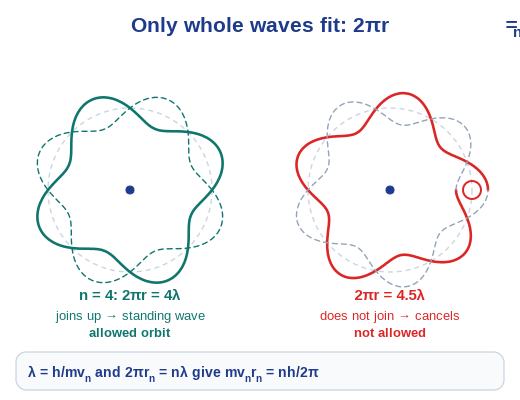
Why should angular momentum come only in multiples of h/2π? In 1923 Louis de Broglie gave an answer: the electron also behaves as a wave (Chapter 11, Dual Nature of Radiation and Matter; confirmed by Davisson and Germer in 1927). On a plucked string only the waves that fit a whole number of times survive as standing waves; the rest cancel themselves. In the same way, an electron wave can last on an orbit only if a whole number of wavelengths fit round it:
2πrₙ = nλ, n = 1, 2, 3, …
With λ = h/p = h/mvₙ (for speeds much less than c), this gives 2πrₙ = nh/mvₙ, that is mvₙrₙ = nh/2π: exactly Bohr’s second postulate. The allowed orbits are the ones that hold standing electron waves.
What are the limits of Bohr’s model?
- It works only for hydrogenic (one-electron) atoms: H, He⁺, Li²⁺ and so on. Even helium, with two electrons, cannot be treated, because the model has no place for the repulsion between electrons, which is about as strong as the pull of the nucleus.
- It gives the frequencies of hydrogen’s lines correctly but cannot explain their relative intensities: why some lines are bright and others faint.
- Its sharp orbits do not fit the uncertainty principle; in quantum mechanics an orbit becomes a region where the electron is likely to be found.
Even so, the model is still taught: three postulates explain nearly all the main features of the hydrogen spectrum, and it uses many ideas of classical physics.
Which quantities and units belong to this chapter?
- Charge e = 1.6 × 10⁻¹⁹ C; 1/4πε₀ = 9.0 × 10⁹ N m² C⁻²; electron mass m = 9.1 × 10⁻³¹ kg; h = 6.6 × 10⁻³⁴ J s.
- Energy in J or eV: 1 eV = 1.6 × 10⁻¹⁹ J; 1 MeV = 10⁶ eV.
- Distances: 1 fm (fermi) = 10⁻¹⁵ m; nuclear sizes in fm, atomic sizes about 10⁻¹⁰ m.
- Angular momentum L in J s (the same unit as h); frequency ν in Hz; wavelength λ in m or nm.
Before we move on
Fire α-particles at gold and a few bounce back, so the atom has a tiny, heavy nucleus; let the electron orbit it and classical physics says the atom should collapse; add Bohr’s postulates and hydrogen gets orbits rₙ = n²a₀ and energies −13.6/n² eV, whose differences are its spectral lines; and let the electron be a wave, and only orbits holding whole waves survive. All nine exercises and the four worked examples are solved in the NCERT solutions for Chapter 12.
Key terms
| Term | Meaning |
|---|---|
| Plum pudding model | J. J. Thomson’s model (1898): the positive charge is spread evenly through the whole atom, with the electrons sitting in it like the seeds of a watermelon. |
| Nuclear (planetary) model | Rutherford’s model: all the positive charge and nearly all the mass are packed into a tiny central nucleus, and the electrons move round it at a large distance, so most of the atom is empty. |
| Impact parameter (b) | The perpendicular distance from the centre of the nucleus to the line of the α-particle’s initial velocity. A small b gives a large deflection; b = 0 is a head-on collision. |
| Distance of closest approach (d) | In a head-on collision, the distance at which the α-particle stops for an instant before turning back: all its kinetic energy has become electric potential energy, so d = 2Ze²/(4πε₀K). |
| Stationary state | An allowed orbit (state) of the electron in which, by Bohr’s first postulate, it does not radiate. Each stationary state has a definite total energy. |
| Principal quantum number (n) | The whole number 1, 2, 3, … that labels the Bohr orbits and energy levels; it fixes L = nh/2π, rₙ ∝ n² and Eₙ = −13.6/n² eV. |
| Bohr radius (a₀) | The radius of the smallest (n = 1) orbit of hydrogen, about 5.3 × 10⁻¹¹ m. |
| Ground state and excited state | The ground state is the lowest-energy state (n = 1, −13.6 eV for hydrogen); states with n > 1 are excited states. |
| Ionisation energy | The least energy needed to remove the electron completely from an atom in its ground state; 13.6 eV for hydrogen. |
| Emission and absorption spectrum | A hot rarefied gas gives bright lines on a dark background (emission); white light passed through the cool gas shows dark lines at exactly the same wavelengths (absorption). |
| Spectral series | A family of lines whose transitions end on the same lower level: Lyman (on n = 1), Balmer (on n = 2) and Paschen (on n = 3) for hydrogen. |
| Hydrogenic atom | An atom or ion with a nucleus of charge +Ze and a single electron, such as H, He⁺ or Li²⁺. Bohr’s model works only for these. |
Topics in this chapter
Practice
-
In the Geiger–Marsden experiment, about what fraction of α-particles turned through more than 90°?
Show answer
Answer: (c) about 1 in 8000
-
An α-particle with a smaller impact parameter is:
Show answer
Answer: (b) scattered through a larger angle
-
The energy of the electron in the n = 2 orbit of hydrogen is:
Show answer
Answer: (c) −3.40 eV
-
If the radius of the first Bohr orbit is r₁, the radius of the third orbit is:
Show answer
Answer: (c) 9r₁
-
Lines of the Balmer series of hydrogen come from transitions that end on:
Show answer
Answer: (b) n = 2
-
According to Bohr’s second postulate, the angular momentum of the electron in the nth orbit is:
Show answer
Answer: (b) nh/2π
Questions students ask
What are the main topics of Class 12 Physics Chapter 12?
Thomson’s and Rutherford’s models, the Geiger–Marsden α-particle scattering experiment with the impact parameter and the distance of closest approach, electron orbits, emission and absorption spectra, Bohr’s three postulates, the radius and energy of the orbits, the energy-level diagram and line spectra of hydrogen, and de Broglie’s explanation of the second postulate. Examples 12.1 to 12.4 and nine exercises close the chapter.
Is the Rydberg formula in the 2026-27 NCERT book?
No. The chapter names the Lyman, Balmer and Paschen series in Fig. 12.5 and gives hν = Eᵢ − E_f with Eₙ = −13.6/n² eV, from which every line can be worked out. The Rydberg form of this result, 1/λ = R(1/n_f² − 1/nᵢ²), is shown on these pages as an Extra.
Why is the total energy of the electron negative?
The potential energy, −e²/(4πε₀r), is twice as large as the kinetic energy and has the opposite sign, so their sum is negative. A negative total energy means the electron is bound: energy must be supplied to pull it out to infinity, where E = 0.
Which formulas should I remember from this chapter?
d = 2Ze²/(4πε₀K); e²/(4πε₀r²) = mv²/r; E = −e²/(8πε₀r); L = nh/2π; hν = Eᵢ − E_f; rₙ = n²(h/2π)²(4πε₀)/(me²) = n²a₀; Eₙ = −me⁴/(8n²ε₀²h²) = −13.6/n² eV; 2πrₙ = nλ.
Why does Bohr’s model not work for helium?
It includes only the electric force between the nucleus and one electron. In helium each electron also repels the other, and that force is about as strong as the pull of the nucleus, so the planet-like picture breaks down. The model also cannot explain why some lines are brighter than others.
Stuck on a question?
Take a photo and Lagnever AI explains it step by step. Try it for 7 days for ₹2.
Get it on Google Play Open in browser
For parents: after the trial, the plan renews monthly by UPI or card autopay. You can cancel anytime in the app.