
What is the Bohr model of the hydrogen atom?
Answer in short
Bohr kept Rutherford’s nucleus and added three postulates: the electron moves in stationary orbits without radiating, its angular momentum is nh/2π, and it emits a photon hν = Eᵢ − E_f when it drops to a lower orbit. For hydrogen this gives rₙ = n² × 5.3 × 10⁻¹¹ m and Eₙ = −13.6/n² eV.
Stuck on a question? Take a photo and Lagnever AI explains it step by step. Try it for 7 days for ₹2. Get it on Google Play
Why Bohr needed new rules
Rutherford’s nuclear atom has a problem: by classical electromagnetic theory, an orbiting electron radiates, loses energy and spirals into the nucleus, giving a continuous spectrum on the way. Real hydrogen atoms are stable and give sharp lines. Niels Bohr, who had worked in Rutherford’s laboratory in 1912, concluded in 1913 that classical theory cannot be applied inside an atom, and gave three postulates.
The three postulates
- Stationary orbits. The electron can move in certain stable orbits without giving out radiation. In each of these stationary states the atom has a definite total energy.
- Quantum condition. The allowed orbits are those in which the electron’s angular momentum is a whole-number multiple of h/2π: L = mvr = nh/2π, n = 1, 2, 3, … Here h = 6.6 × 10⁻³⁴ J s is Planck’s constant and n is the principal quantum number.
- Frequency condition. The electron can jump from an allowed orbit to one of lower energy, giving out one photon that carries the energy difference: hν = Eᵢ − E_f
Radius of the nth orbit
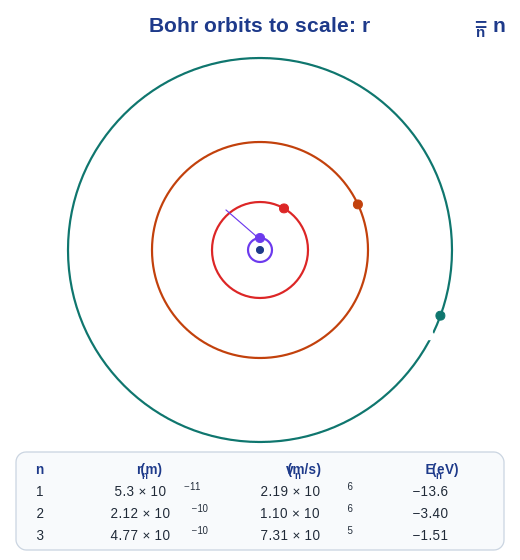
Two equations fix each orbit. The electric pull supplies the centripetal force, e²/(4πε₀r²) = mv²/r, and the second postulate gives v = nh/(2πmr). Putting this v into the first equation and solving for r:
rₙ = (n²/m)(h/2π)²(4πε₀/e²)
The radius grows as n². The smallest orbit, n = 1, is the Bohr radius a₀ ≈ 5.3 × 10⁻¹¹ m, so r₂ = 4a₀ = 2.12 × 10⁻¹⁰ m and r₃ = 9a₀ = 4.77 × 10⁻¹⁰ m. The speed, v = nh/(2πmr), falls as 1/n.
Energy of the nth orbit
The total energy of the electron in an orbit of radius r is E = −e²/(8πε₀r). Putting in rₙ:
Eₙ = −me⁴/(8n²ε₀²h²)
With the values of m, e, ε₀ and h this is Eₙ = −2.18 × 10⁻¹⁸/n² J, or, since 1 eV = 1.6 × 10⁻¹⁹ J,
Eₙ = −13.6/n² eV
The minus sign means the electron is bound; energy has to be supplied to take it out to infinity, where E = 0.
Energy levels
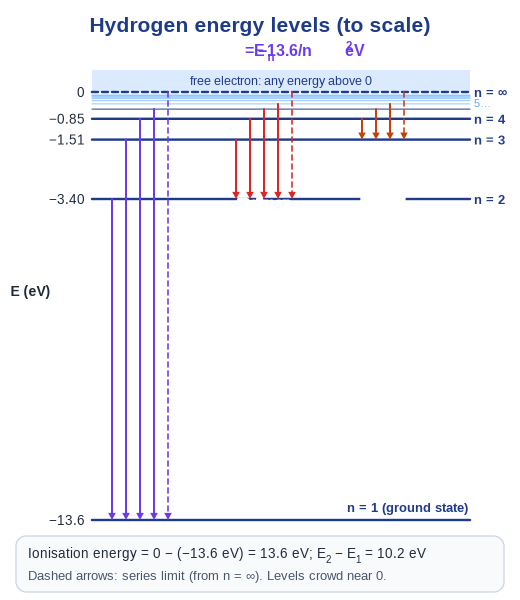
- n = 1, the ground state: −13.6 eV. Most hydrogen atoms at room temperature are in this state.
- n = 2: −3.40 eV; n = 3: −1.51 eV; n = 4: −0.85 eV. These are excited states.
- The ionisation energy, the least energy that removes the electron from the ground state, is 13.6 eV, in excellent agreement with experiment.
- Raising the atom from n = 1 to n = 2 needs 10.2 eV; to n = 3, 12.09 eV. Collisions with electrons can supply such energy.
- The levels get closer and closer together as n increases and reach 0 eV at n = ∞. Above 0 eV the electron is unbound and can have any energy.
Line spectra of hydrogen
When the electron drops from level nᵢ to a lower level n_f, the third postulate gives the photon’s frequency:
hν = E(nᵢ) − E(n_f) = 13.6 eV × (1/n_f² − 1/nᵢ²)
Only whole numbers are allowed, so only certain frequencies appear: bright emission lines. In the opposite process an atom absorbs a photon of exactly the right energy and moves up; white light passed through hydrogen then shows dark absorption lines at the same places. Lines that end on n = 1 form the Lyman series, on n = 2 the Balmer series, on n = 3 the Paschen series. For example, 3 → 2 gives 1.89 eV, a red line near 656 nm.
Extra: dividing by hc gives 1/λ = R(1/n_f² − 1/nᵢ²); the measured value of R, the Rydberg constant, is 1.097 × 10⁷ m⁻¹. This form is not in the 2026-27 text.
de Broglie’s explanation of the second postulate
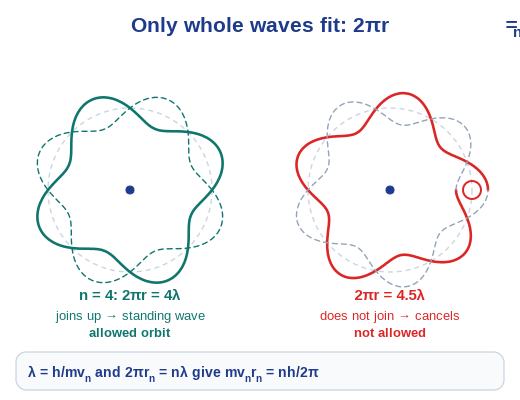
Why should angular momentum be quantised at all? In 1923 de Broglie suggested that the electron behaves as a wave (Chapter 11, Dual Nature of Radiation and Matter). On a string, only waves that fit a whole number of times form lasting standing waves. On a circular orbit the wave must likewise join up with itself after one turn, so the circumference must hold a whole number of wavelengths:
2πrₙ = nλ
With λ = h/mvₙ, this becomes 2πrₙ = nh/mvₙ, or mvₙrₙ = nh/2π, Bohr’s second postulate. The allowed orbits are simply those that carry standing electron waves.
Limits of the model
The model works only for one-electron (hydrogenic) atoms such as H, He⁺ and Li²⁺. It ignores the forces between electrons, which in helium are as strong as the pull of the nucleus, and it cannot explain why some spectral lines are brighter than others. Quantum mechanics replaced it, but its three postulates still explain almost all the main features of the hydrogen spectrum.
Try it
Exercises 12.4 to 12.9 use these formulas, including the lines from a 12.5 eV electron beam in Exercise 12.8. They are solved in the NCERT solutions; the alpha-scattering side of the chapter is in Rutherford’s nuclear model and everything else in the Chapter 12 notes.
Practice
-
The energy needed to ionise a hydrogen atom from its ground state is:
Show answer
Answer: (c) 13.6 eV
-
The speed of the electron in the nth Bohr orbit is proportional to:
Show answer
Answer: (b) 1/n
-
How many de Broglie wavelengths fit round the third Bohr orbit?
Show answer
Answer: (b) 3
-
Find the energy and wavelength of the photon emitted when the electron in hydrogen drops from n = 3 to n = 2. Take h = 6.6 × 10⁻³⁴ J s and c = 3 × 10⁸ m/s.
Show answer
Answer: E₃ − E₂ = −1.51 − (−3.40) = 1.89 eV = 3.02 × 10⁻¹⁹ J. λ = hc/E = (6.6 × 10⁻³⁴ × 3 × 10⁸)/(3.02 × 10⁻¹⁹) = 6.55 × 10⁻⁷ m ≈ 655 nm, a red Balmer line (the measured value is 656 nm).
-
Show that the kinetic energy of the electron in a Bohr orbit equals −E and its potential energy equals 2E.
Show answer
Answer: From e²/(4πε₀r²) = mv²/r, K = ½mv² = e²/(8πε₀r). U = −e²/(4πε₀r) = −2K. So E = K + U = −K, giving K = −E and U = −2K = 2E.
Questions students ask
Why is the energy of a hydrogen atom quantised?
Bohr’s second postulate lets only orbits with L = nh/2π exist. Each allowed orbit has its own radius, rₙ ∝ n², and its own energy, Eₙ = −13.6/n² eV, so the atom can have only these energies.
Why do the energy levels crowd together near 0 eV?
Eₙ = −13.6/n² eV changes by less and less as n grows: the gap from n = 1 to 2 is 10.2 eV, but from 4 to 5 only 0.31 eV. All the levels approach 0 eV, the energy of an electron just removed from the atom.
How did de Broglie explain Bohr’s second postulate?
He treated the electron as a wave. A wave on a closed orbit survives only if a whole number of wavelengths fit round it, 2πrₙ = nλ. With λ = h/mvₙ this becomes mvₙrₙ = nh/2π, which is Bohr’s condition.
Stuck on a question?
Take a photo and Lagnever AI explains it step by step. Try it for 7 days for ₹2.
Get it on Google Play Open in browser
For parents: after the trial, the plan renews monthly by UPI or card autopay. You can cancel anytime in the app.