
What is Rutherford’s nuclear model of the atom?
Answer in short
Rutherford’s model puts all the positive charge and nearly all the mass of an atom in a tiny nucleus, about 10⁻¹⁵ to 10⁻¹⁴ m across, with electrons orbiting far away. It came from the Geiger–Marsden experiment: most α-particles crossed a thin gold foil undeflected, but about 1 in 8000 turned back by more than 90°.
Stuck on a question? Take a photo and Lagnever AI explains it step by step. Try it for 7 days for ₹2. Get it on Google Play
From plum pudding to nucleus
J. J. Thomson’s experiments of 1897 showed that all atoms contain identical, negatively charged electrons. Atoms are neutral, so they must hold an equal positive charge too. Thomson’s own model (1898) spread this positive charge evenly through the whole atom, with the electrons sitting in it like the seeds of a watermelon. To test how the charge is really arranged, Rutherford proposed firing fast α-particles at atoms and watching how they scatter.
The Geiger–Marsden experiment
The experiment was done in 1911 by Hans Geiger and Ernest Marsden, who was then a 20-year-old student.
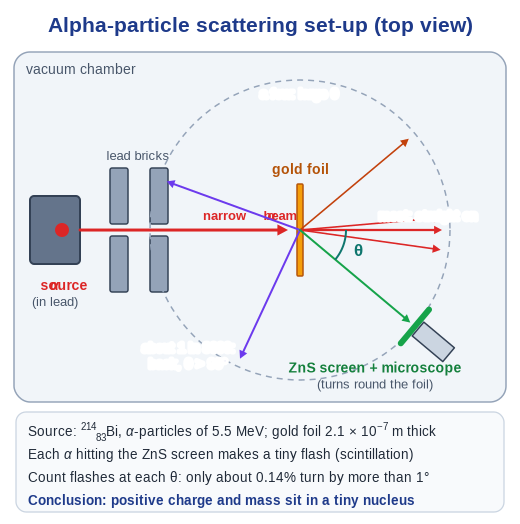
- A radioactive source, ²¹⁴₈₃Bi, gave out α-particles of 5.5 MeV.
- Lead bricks with a narrow slit let through only a thin beam.
- The beam struck a gold foil 2.1 × 10⁻⁷ m thick.
- A zinc sulphide screen with a microscope could be turned round the foil. Each α-particle hitting the screen made a brief flash, a scintillation, which an observer counted.
- Counting flashes at many angles gave the number of α-particles scattered through each angle θ. Everything was inside a vacuum chamber.
What the counts showed
- Most α-particles went straight through, as if the foil were not there.
- Only about 0.14% were deflected by more than 1°.
- About 1 in 8000 came back, deflected by more than 90°.
Rutherford reasoned that to turn a fast, heavy α-particle backwards, there must be a huge repulsive force. Spread-out positive charge cannot give such a force. But if all the positive charge and most of the mass are squeezed into a tiny central nucleus, an α-particle can come very close to the whole charge, and then the force becomes enormous. The calculated curve of counts against angle for such a nucleus matched the measured points, so Rutherford is credited with discovering the nucleus.
The numbers give a striking picture. The nucleus is about 10⁻¹⁵ to 10⁻¹⁴ m across, while the atom is about 10⁻¹⁰ m, roughly 10,000 to 100,000 times larger. The atom is mostly empty space, which is why most α-particles pass straight through.
The impact parameter
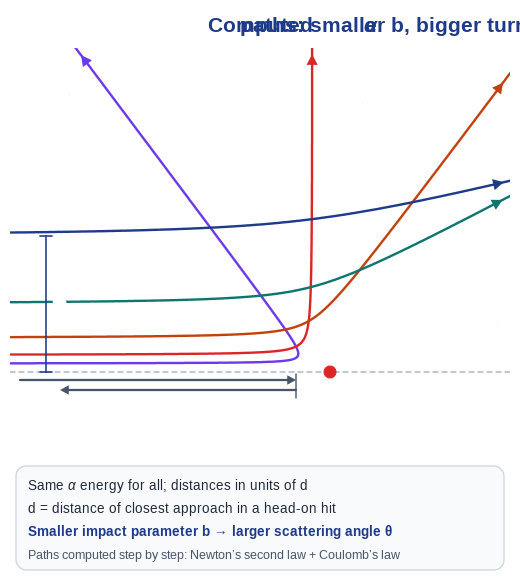
Because the foil is so thin, an α-particle meets at most one nucleus. The α-particle (charge 2e) and the gold nucleus (charge Ze, Z = 79) repel with the force
F = (1/4πε₀)(2e)(Ze)/r²
along the line joining them. The gold nucleus has about 50 times the mass of the α-particle, so we treat it as fixed and use Newton’s second law to follow the α-particle.
The path depends on the impact parameter b, the perpendicular distance from the centre of the nucleus to the line of the α-particle’s initial velocity. In a beam all α-particles have nearly the same energy but different b. A large b means a gentle push and a small deflection; a small b means a close pass and a large deflection; b = 0 means a head-on hit and a rebound. Since so few α-particles rebound, head-on hits must be rare, so the nucleus must be tiny.
Distance of closest approach
In a head-on collision the α-particle stops for an instant at a distance d from the centre of the nucleus. The total mechanical energy is conserved, so its starting kinetic energy K has all become electric potential energy:
K = (1/4πε₀)(2e)(Ze)/d, which gives d = 2Ze²/(4πε₀K)
For the most energetic natural α-particles, 7.7 MeV (1.2 × 10⁻¹² J), this gives d = 3.84 × 10⁻¹⁶ Z m, and for gold d ≈ 3.0 × 10⁻¹⁴ m = 30 fm (Example 12.2). The nucleus must be smaller than d; its actual radius is about 6 fm, so the α-particle turns back without touching it. That is why scattering gives only an upper limit to nuclear size.
Electron orbits in the nuclear model
Rutherford pictured the electrons orbiting the nucleus like planets. For hydrogen, the electric attraction provides the centripetal force:
e²/(4πε₀r²) = mv²/r
This gives K = e²/(8πε₀r), U = −e²/(4πε₀r) and a total energy E = −e²/(8πε₀r). The negative sign shows that the electron is bound. From the measured 13.6 eV needed to ionise hydrogen, r = 5.3 × 10⁻¹¹ m and v = 2.2 × 10⁶ m/s (Example 12.3).
Why the model was not enough
An orbiting electron accelerates towards the centre, and by classical electromagnetic theory an accelerating charge radiates. It would lose energy, spiral into the nucleus and make the atom unstable. While spiralling in, its frequency of revolution would keep changing, so it would give a continuous spectrum, not sharp lines. Bohr kept the nucleus but added new rules; see the Bohr model.
Try it
Exercise 12.2 asks what happens if the gold foil is replaced by solid hydrogen. It and the other exercises are solved in the NCERT solutions; the full summary is in the Chapter 12 notes.
Practice
-
Most α-particles pass straight through a thin gold foil because:
Show answer
Answer: (b) the atom is mostly empty space
-
In a head-on collision the impact parameter is:
Show answer
Answer: (a) zero
-
If the kinetic energy of the α-particle is doubled, the distance of closest approach becomes:
Show answer
Answer: (b) half
-
Find the distance of closest approach of a 5.5 MeV α-particle to a gold nucleus (Z = 79). Take 1/4πε₀ = 9.0 × 10⁹ N m² C⁻² and e = 1.6 × 10⁻¹⁹ C.
Show answer
Answer: K = 5.5 × 10⁶ × 1.6 × 10⁻¹⁹ J = 8.8 × 10⁻¹³ J. d = 2Ze²/(4πε₀K) = (2 × 79 × 9.0 × 10⁹ × (1.6 × 10⁻¹⁹)²)/(8.8 × 10⁻¹³) = 4.1 × 10⁻¹⁴ m ≈ 41 fm.
-
Why did Rutherford conclude that the positive charge of an atom is concentrated in a tiny nucleus?
Show answer
Answer: A few α-particles were turned back through more than 90°. Reversing a heavy, fast α-particle needs a very large repulsive force, which is possible only if all the positive charge and most of the mass sit in a tiny region that the α-particle can approach very closely.
Questions students ask
Why was a very thin gold foil used?
In a very thin foil an α-particle meets at most one nucleus, so each deflection comes from a single encounter, and the path past one nucleus can be calculated with Newton’s second law and Coulomb’s law.
Why can the gold nucleus be treated as fixed?
Its mass is about 50 times that of an α-particle, so it hardly moves during the encounter.
What was wrong with Rutherford’s model?
An electron moving in a circle is accelerating, and classically it should radiate energy and spiral into the nucleus, so the atom would not be stable. The light given out would change frequency smoothly, giving a continuous spectrum instead of the sharp lines that atoms actually give. Bohr’s postulates solved both problems for hydrogen.
Stuck on a question?
Take a photo and Lagnever AI explains it step by step. Try it for 7 days for ₹2.
Get it on Google Play Open in browser
For parents: after the trial, the plan renews monthly by UPI or card autopay. You can cancel anytime in the app.