
NCERT Solutions Class 12 Physics Chapter 13: Nuclei
Answers to all 10 end-of-chapter exercises and the four worked examples of Chapter 13, Nuclei, of Physics Part II, the Class 12 NCERT textbook. Page numbers follow the 2026-27 reprint (pages 306–322). The exercises come first, quoted from the book; the examples follow, restated in short. Every number was also checked by computer. Short notes: Chapter 13 notes.
We use the data printed before the exercises: e = 1.6 × 10⁻¹⁹ C, 1/4πε₀ = 9 × 10⁹ N m²/C², 1 MeV = 1.6 × 10⁻¹³ J, 1 u = 931.5 MeV/c², N = 6.023 × 10²³ per mole, 1 year = 3.154 × 10⁷ s, m_H = 1.007825 u, m_n = 1.008665 u, m(⁴₂He) = 4.002603 u, m_e = 0.000548 u.
Two words used below. The binding energy E_b of a nucleus is the energy needed to pull it apart into separate protons and neutrons. The mass defect ΔM is how much lighter the nucleus is than those separate nucleons; E_b = ΔM × 931.5 MeV per u.
Atomic masses. The book gives atomic masses. Using m_H (a hydrogen atom) for each proton makes the electrons cancel, so ΔM = Zm_H + (A − Z)m_n − m(atom).
Exercises 13.1 to 13.3: binding energies
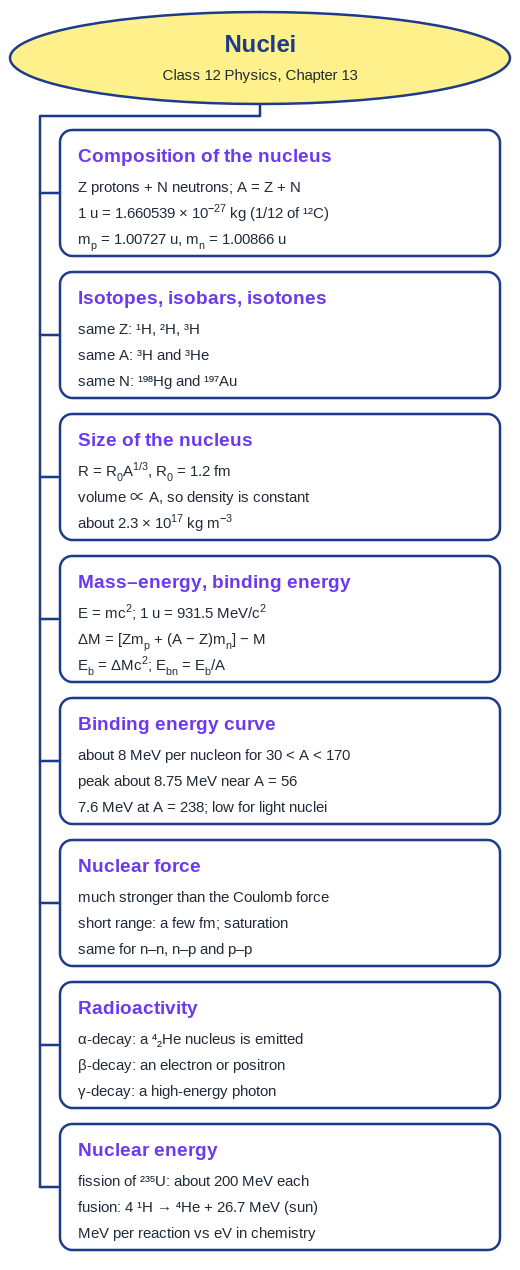
13.1 “Obtain the binding energy (in MeV) of a nitrogen nucleus (¹⁴₇N), given m (¹⁴₇N) =14.00307 u”
Z = 7, A − Z = 7.
Zm_H + (A − Z)m_n = 7 × 1.007825 + 7 × 1.008665 = 7.054775 + 7.060655 = 14.115430 u
ΔM = 14.115430 − 14.00307 = 0.11236 u
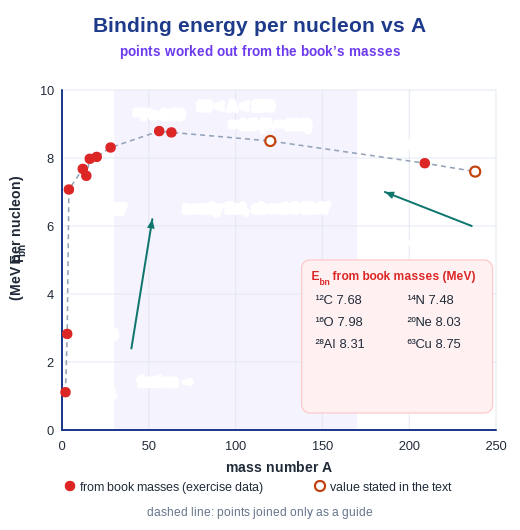
E_b = 0.11236 × 931.5 MeV = 104.7 MeV (7.48 MeV per nucleon)
13.2 “Obtain the binding energy of the nuclei ⁵⁶₂₆Fe and ²⁰⁹₈₃Bi in units of MeV from the following data: m (⁵⁶₂₆Fe) = 55.934939 u m (²⁰⁹₈₃Bi) = 208.980388 u”
Iron: Z = 26, A − Z = 30.
26 × 1.007825 + 30 × 1.008665 = 26.203450 + 30.259950 = 56.463400 u
ΔM = 56.463400 − 55.934939 = 0.528461 u; E_b = 0.528461 × 931.5 = 492.3 MeV, so E_bn = 492.3/56 = 8.79 MeV
Bismuth: Z = 83, A − Z = 126.
83 × 1.007825 + 126 × 1.008665 = 83.649475 + 127.091790 = 210.741265 u
ΔM = 210.741265 − 208.980388 = 1.760877 u; E_b = 1.760877 × 931.5 = 1640.3 MeV, so E_bn = 1640.3/209 = 7.85 MeV
Iron is more tightly bound per nucleon than bismuth, as the binding energy curve shows.
13.3 “A given coin has a mass of 3.0 g. Calculate the nuclear energy that would be required to separate all the neutrons and protons from each other. For simplicity assume that the coin is entirely made of ⁶³₂₉Cu atoms (of mass 62.92960 u).”
Binding energy of one ⁶³Cu nucleus (Z = 29, A − Z = 34):
29 × 1.007825 + 34 × 1.008665 = 29.226925 + 34.294610 = 63.521535 u
ΔM = 63.521535 − 62.92960 = 0.591935 u; E_b = 0.591935 × 931.5 = 551.39 MeV
Number of atoms in 3.0 g (molar mass 62.92960 g):
n = (3.0/62.92960) × 6.023 × 10²³ = 2.871 × 10²² atoms
Total energy = 2.871 × 10²² × 551.39 MeV = 1.583 × 10²⁵ MeV = 1.583 × 10²⁵ × 1.6 × 10⁻¹³ J = 2.53 × 10¹² J
Exercises 13.4 and 13.5: radii and Q-values
13.4 “Obtain approximately the ratio of the nuclear radii of the gold isotope ¹⁹⁷₇₉Au and the silver isotope ¹⁰⁷₄₇Ag.”
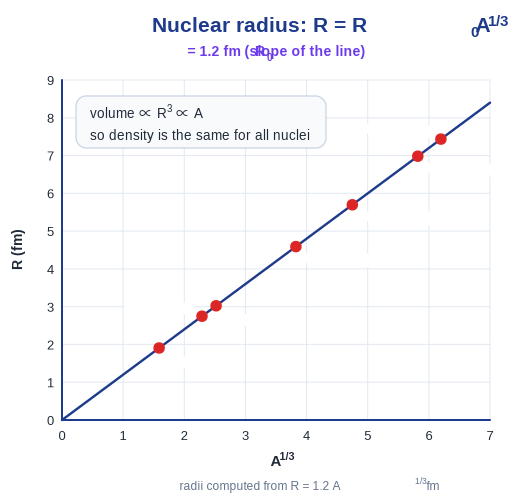
R = R₀A^(1/3), so R_Au/R_Ag = (197/107)^(1/3) = (1.841)^(1/3) ≈ 1.23
13.5 “The Q value of a nuclear reaction A + b → C + d is defined by Q = [ m_A + m_b – m_C – m_d]c² where the masses refer to the respective nuclei. Determine from the given data the Q-value of the following reactions and state whether the reactions are exothermic or endothermic. (i) ¹₁H+³₁H → ²₁H+²₁H (ii) ¹²₆C+¹²₆C → ²⁰₁₀Ne+⁴₂He Atomic masses are given to be m (²₁H) = 2.014102 u m (³₁H) = 3.016049 u m (¹²₆C) = 12.000000 u m (²⁰₁₀Ne) = 19.992439 u”
The data are atomic masses. In each reaction the total Z is the same on both sides (1 + 1 = 1 + 1; 6 + 6 = 10 + 2), so the electron masses cancel and atomic masses give the same Q.
(i) Initial: 1.007825 + 3.016049 = 4.023874 u. Final: 2 × 2.014102 = 4.028204 u.
Q = (4.023874 − 4.028204) × 931.5 = −0.004330 × 931.5 = −4.03 MeV: Q is negative, so the reaction is endothermic.
(ii) Initial: 2 × 12.000000 = 24.000000 u. Final: 19.992439 + 4.002603 = 23.995042 u.
Q = (24.000000 − 23.995042) × 931.5 = 0.004958 × 931.5 = +4.62 MeV: Q is positive, so the reaction is exothermic.
Exercises 13.6 to 13.8: fission and fusion energy
13.6 “Suppose, we think of fission of a ⁵⁶₂₆Fe nucleus into two equal fragments, ²⁸₁₃Al. Is the fission energetically possible? Argue by working out Q of the process. Given m (⁵⁶₂₆Fe) = 55.93494 u and m (²⁸₁₃Al) = 27.98191 u.”
⁵⁶₂₆Fe → ²⁸₁₃Al + ²⁸₁₃Al (charges 26 = 13 + 13, so electron masses cancel)
Q = [m(Fe) − 2m(Al)] × 931.5 = (55.93494 − 55.96382) × 931.5 = −0.02888 × 931.5 = −26.90 MeV
Q is negative: the two Al nuclei together weigh more than the Fe nucleus. Energy would have to be supplied, so this fission is not energetically possible. This fits the binding energy curve: ⁵⁶Fe is at the peak, so splitting it lowers the binding energy per nucleon.
13.7 “The fission properties of ²³⁹₉₄Pu are very similar to those of ²³⁵₉₂U. The average energy released per fission is 180 MeV. How much energy, in MeV, is released if all the atoms in 1 kg of pure ²³⁹₉₄Pu undergo fission?”
Number of atoms in 1 kg = 1000 g: n = (1000/239) × 6.023 × 10²³ = 2.520 × 10²⁴
Energy = 2.520 × 10²⁴ × 180 MeV = 4.536 × 10²⁶ MeV
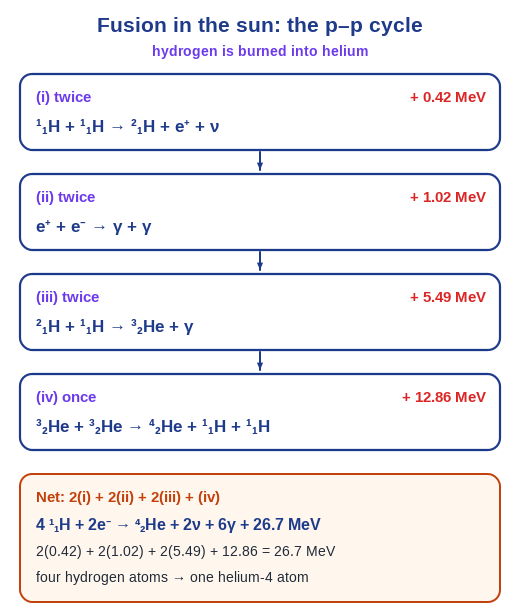
13.8 “How long can an electric lamp of 100W be kept glowing by fusion of 2.0 kg of deuterium? Take the fusion reaction as ²₁H+²₁H → ³₂He+n+3.27 MeV”
Number of deuterium atoms in 2.0 kg (about 2 g per mole): n = (2000/2) × 6.023 × 10²³ = 6.023 × 10²⁶
Each reaction uses two deuterons, so the number of reactions = 3.0115 × 10²⁶.
Energy = 3.0115 × 10²⁶ × 3.27 MeV = 9.848 × 10²⁶ MeV = 9.848 × 10²⁶ × 1.6 × 10⁻¹³ J = 1.576 × 10¹⁴ J
Time = energy/power = 1.576 × 10¹⁴/100 = 1.576 × 10¹² s = (1.576 × 10¹²)/(3.154 × 10⁷) y ≈ 5.0 × 10⁴ years (about 50,000 years)
Exercises 13.9 and 13.10: the Coulomb barrier and nuclear density
13.9 “Calculate the height of the potential barrier for a head on collision of two deuterons. (Hint: The height of the potential barrier is given by the Coulomb repulsion between the two deuterons when they just touch each other. Assume that they can be taken as hard spheres of radius 2.0 fm.)”
When the two spheres just touch, their centres are r = 2 × 2.0 fm = 4.0 × 10⁻¹⁵ m apart. Each deuteron has charge e.
U = (1/4πε₀) e²/r = (9 × 10⁹ × (1.6 × 10⁻¹⁹)²)/(4.0 × 10⁻¹⁵) = 5.76 × 10⁻¹⁴ J
In eV: (5.76 × 10⁻¹⁴)/(1.6 × 10⁻¹⁹) = 3.6 × 10⁵ eV = 360 keV
13.10 “From the relation R = R₀A^(1/3), where R₀ is a constant and A is the mass number of a nucleus, show that the nuclear matter density is nearly constant (i.e. independent of A).”
- Let m be the mass of one nucleon (about 1 u, since m_p ≈ m_n). A nucleus of mass number A has A nucleons, so its mass is about Am.
- Its volume is V = (4/3)πR³ = (4/3)π(R₀A^(1/3))³ = (4/3)πR₀³A. The volume grows in step with A.
- Density = mass/volume: ρ = Am/[(4/3)πR₀³A] = 3m/(4πR₀³).
Answer: ρ = 3m/(4πR₀³). A cancels, and m and R₀ are the same for every nucleus, so the density is the same for all nuclei. Putting in m = 1.66 × 10⁻²⁷ kg and R₀ = 1.2 × 10⁻¹⁵ m gives ρ ≈ 2.3 × 10¹⁷ kg/m³. (Small differences come only because the mass of a nucleus is not exactly A u.)
Worked examples 13.1 to 13.4
Example 13.1 (page 310): Find the density of an iron nucleus of mass 55.85 u and A = 56.
m = 55.85 u = 9.27 × 10⁻²⁶ kg; V = (4π/3)(1.2 × 10⁻¹⁵)³ × 56 = 4.05 × 10⁻⁴³ m³
ρ = 9.27 × 10⁻²⁶/4.05 × 10⁻⁴³ = 2.29 × 10¹⁷ kg/m³, about as dense as matter in a neutron star.
Example 13.2 (page 310): What energy is equivalent to 1 g of matter?
E = mc² = 10⁻³ × (3 × 10⁸)² = 9 × 10¹³ J
Example 13.3 (page 311): Express 1 u in joules and MeV, and the mass defect of ¹⁶O in MeV/c².
E = 1.6605 × 10⁻²⁷ × (2.9979 × 10⁸)² = 1.4924 × 10⁻¹⁰ J = (1.4924 × 10⁻¹⁰)/(1.602 × 10⁻¹⁹) eV = 9.316 × 10⁸ eV ≈ 931.5 MeV, so 1 u = 931.5 MeV/c².
For ¹⁶O, ΔM = 0.13691 u = 0.13691 × 931.5 MeV/c² = 127.5 MeV/c², so the energy needed to split ¹⁶O into its nucleons is 127.5 MeV.
Example 13.4 (pages 317–318): (a) In what sense are nuclear reaction equations balanced? (b) If protons and neutrons are conserved, how is mass turned into energy? (c) Does mass–energy conversion happen in chemical reactions too?
(a) A chemical equation keeps the number of atoms of each element the same. A nuclear reaction can change one element into another, so it need not do that, but it keeps the number of protons and the number of neutrons the same on both sides. (At very high energies, strictly, total charge and baryon number are what stay fixed.)
(b) The binding energy of a nucleus lowers its mass (the mass defect). The total mass of the separate nucleons is the same on both sides, but the total binding energy need not be. The difference in binding energy is released or absorbed, and it appears as the difference in the total mass of the nuclei.
(c) Yes, in principle. Chemical binding energy also lowers the mass of atoms and molecules, so the energy of a chemical reaction also comes from a tiny mass difference. That mass difference is about a million times smaller than in nuclear reactions, which is why it is usually overlooked.
Notes for checking
- The answer key agrees with Exercises 13.1, 13.4, 13.5, 13.7 and 13.9. Exercise 13.10 has no key answer.
- 13.2: bismuth comes to 7.848 MeV per nucleon, which rounds to 7.85 MeV; the key prints 7.84 MeV.
- 13.3: with the molar mass 62.92960 g we get 1.583 × 10²⁵ MeV and 2.533 × 10¹² J; the key gives 1.584 × 10²⁵ MeV and 2.535 × 10¹² J. The difference is under 0.1% (rounding).
- 13.6: the key prints Q = 26.90 MeV and “not possible”; the value is −26.90 MeV. The minus sign is what makes the fission impossible.
- 13.8: the data give 4.996 × 10⁴ years, about 5.0 × 10⁴ years; the key gives “about 4.9 × 10⁴ y”.
- Page 311, Example 13.3: the last line gives the energy needed to separate ¹⁶O as “127.5 MeV/c²”; an energy should be in MeV (127.5 MeV/c² is the mass defect).
- Page 311: the list for the “expected mass” of ¹⁶O includes 8 electrons, but the total 8 × 2.01593 u = 16.12744 u counts only the 8 protons and 8 neutrons, and it is compared with the nuclear mass 15.99053 u. The mass defect 0.13691 u is right.
- Page 318, Summary point 2 gives 1 u = 1.660563 × 10⁻²⁷ kg; Eq. (13.1) on page 307 gives 1.660539 × 10⁻²⁷ kg.
- Page 310, Example 13.1 prints “m_Fe = 55.85, u = 9.27 × 10⁻²⁶ kg”; it means m_Fe = 55.85 u = 9.27 × 10⁻²⁶ kg.
Practice
-
The ratio of the radii of two nuclei with mass numbers 27 and 64 is:
Show answer
Answer: (b) 3 : 4
-
A reaction has Q = −4.03 MeV. This means the reaction:
Show answer
Answer: (b) needs 4.03 MeV to be supplied
-
The ratio of the densities of the nuclei ²⁷Al and ²³⁸U is about:
Show answer
Answer: (a) 1 : 1
-
Find the binding energy of the deuteron, ²₁H. Use m(²H) = 2.014102 u, m_H = 1.007825 u, m_n = 1.008665 u and 1 u = 931.5 MeV/c².
Show answer
Answer: ΔM = 1.007825 + 1.008665 − 2.014102 = 0.002388 u. E_b = 0.002388 × 931.5 = 2.22 MeV, or 1.11 MeV per nucleon.
-
How many fissions per second produce a power of 1 W if each releases 200 MeV? Take 1 MeV = 1.6 × 10⁻¹³ J.
Show answer
Answer: Energy per fission = 200 × 1.6 × 10⁻¹³ = 3.2 × 10⁻¹¹ J. Fissions per second = 1/(3.2 × 10⁻¹¹) = 3.1 × 10¹⁰.
Stuck on a question?
Take a photo and Lagnever AI explains it step by step. Try it for 7 days for ₹2.
Get it on Google Play Open in browser
For parents: after the trial, the plan renews monthly by UPI or card autopay. You can cancel anytime in the app.