
Class 12 Physics Chapter 13: Nuclei Notes
This chapter in five lines
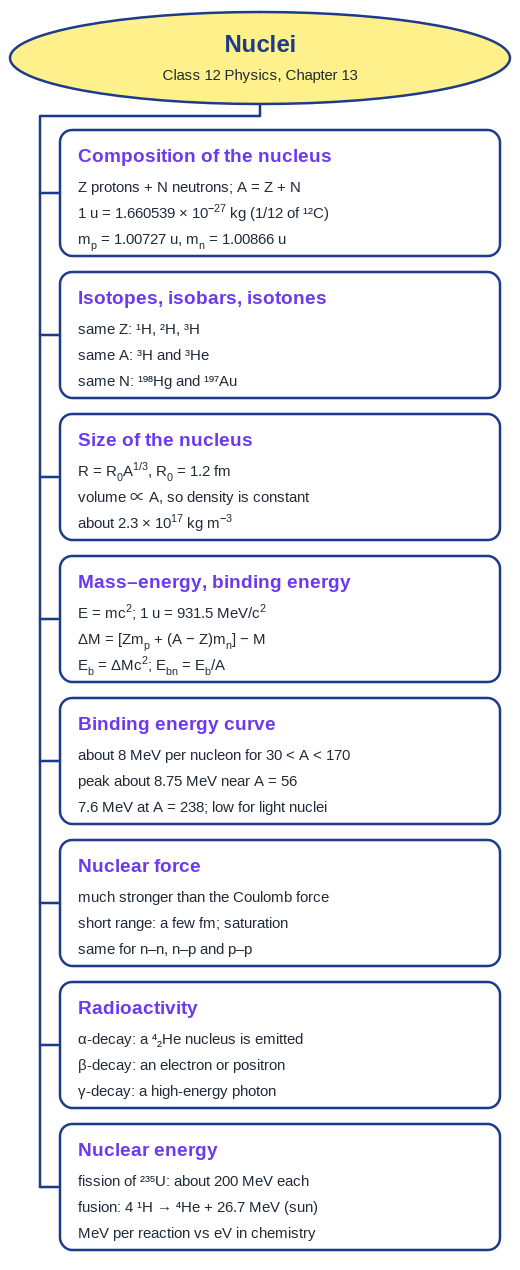
A nucleus holds Z protons and N neutrons (A = Z + N nucleons). Its radius is R = R₀A^(1/3) with R₀ = 1.2 fm, so every nucleus has about the same density, 2.3 × 10¹⁷ kg/m³. A nucleus weighs less than its separate nucleons; this mass defect ΔM gives the binding energy E_b = ΔMc², about 8 MeV per nucleon for most nuclei. Energy is released when a heavy nucleus splits (fission) or light nuclei join (fusion).
What is this chapter about?
Chapter 12 showed that an atom has a tiny, heavy nucleus. This chapter (book pages 306 to 322) asks what that nucleus is made of, how big it is, what holds it together, and how energy can be drawn from it.
The nucleus is tiny: its radius is about 10⁴ times smaller than the atom’s, so its volume is only about 10⁻¹² of the atom’s volume. If an atom were as big as a classroom, its nucleus would be the size of a pinhead. Yet more than 99.9% of the atom’s mass is in the nucleus.
Safety: radioactive materials and nuclear reactions are handled only by trained staff in licensed facilities. Nothing in this chapter is an activity to try.
What is the atomic mass unit?
A kilogram is far too large for atoms; one ¹²C atom is only 1.992647 × 10⁻²⁶ kg. So atomic masses are given in the atomic mass unit, defined as one-twelfth of the mass of one ¹²C atom:
1 u = (mass of one ¹²C atom)/12 = 1.660539 × 10⁻²⁷ kg
Atomic masses are measured accurately with a mass spectrometer. Most come out close to whole-number multiples of the hydrogen atom’s mass, but some do not: chlorine is 35.46 u. The reason is isotopes: atoms of the same element that behave the same chemically but differ in mass. Chlorine is a mixture of two isotopes, 34.98 u (75.4%) and 36.98 u (24.6%), and their weighted average is
(75.4 × 34.98 + 24.6 × 36.98)/100 = 35.47 u
which matches the measured atomic mass. Even hydrogen has three isotopes, of masses 1.0078 u, 2.0141 u and 3.0160 u. The lightest of them makes up 99.985% of natural hydrogen, and its nucleus is the proton: m_p = 1.00727 u = 1.67262 × 10⁻²⁷ kg, which is the hydrogen atom’s mass (1.00783 u) minus one electron (0.00055 u). The heavier two are deuterium and tritium; tritium is unstable and is made artificially.
What is a nucleus made of?
The nucleus carries all the atom’s positive charge, +Ze, in the form of Z protons, each with charge +e. All Z electrons sit outside the nucleus.
Deuterium and tritium each have one proton, yet their nuclei are about two and three times as heavy as hydrogen’s. So nuclei must also contain neutral matter. In 1932 James Chadwick found it: beryllium struck by α-particles gave out a neutral radiation that could knock protons out of light nuclei. Photons could not do this with the energy available, so Chadwick concluded that the radiation was a new neutral particle, the neutron, almost as heavy as a proton:
m_n = 1.00866 u = 1.6749 × 10⁻²⁷ kg
He received the 1935 Nobel Prize in Physics for it. Outside a nucleus a neutron is unstable: it decays into a proton, an electron and an antineutrino, with a mean life of about 1000 s. Inside a nucleus it is stable.
The terms used for a nucleus:
- Z, atomic number = number of protons
- N, neutron number = number of neutrons
- A, mass number = Z + N = total number of nucleons (protons and neutrons)
A nuclide is written ᴬ_Z X, where X is the chemical symbol. The gold nucleus ¹⁹⁷₇₉Au has 197 nucleons: 79 protons and 118 neutrons.
What are isotopes, isobars and isotones?
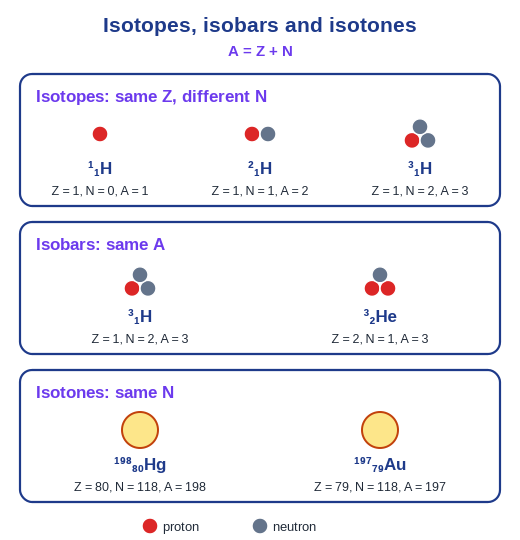
- Isotopes have the same Z but different N. Hydrogen ¹₁H has no neutron, deuterium ²₁H has one, tritium ³₁H has two. Gold has 32 isotopes, from A = 173 to A = 204. Isotopes have the same electron arrangement, so they behave alike chemically and share one place in the periodic table.
- Isobars have the same A: ³₁H and ³₂He.
- Isotones have the same N but different Z: ¹⁹⁸₈₀Hg and ¹⁹⁷₇₉Au both have 118 neutrons.
How big is a nucleus?
Geiger and Marsden found that a 5.5 MeV α-particle gets to about 4.0 × 10⁻¹⁴ m from a gold nucleus before turning back, so the gold nucleus must be smaller than that. With faster α-particles the closest approach shrinks, and at some point the scattering stops following Rutherford’s pure-Coulomb formula because the short-range nuclear force starts to act; the distance where this happens tells us the nuclear size. Today nuclear sizes are measured accurately by scattering fast electrons off nuclei. The result is
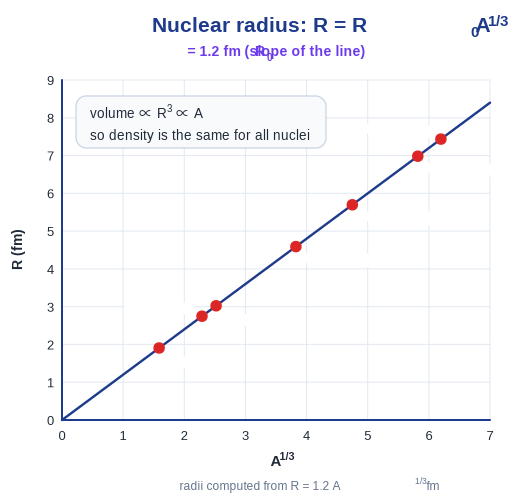
R = R₀A^(1/3), with R₀ = 1.2 fm (1 fm = 10⁻¹⁵ m)
So the volume, (4/3)πR³, is proportional to A: every nucleon takes up the same space. That means nuclear density is the same for all nuclei, like drops of one liquid. It is about 2.3 × 10¹⁷ kg/m³, compared with 10³ kg/m³ for water: ordinary matter is mostly empty space.
Example 13.1 (page 310): an iron nucleus has mass 55.85 u = 9.27 × 10⁻²⁶ kg and A = 56. Density = 9.27 × 10⁻²⁶/[(4π/3)(1.2 × 10⁻¹⁵)³ × 56] = 2.29 × 10¹⁷ kg/m³. Matter in neutron stars is about this dense, as if the whole star were one giant nucleus.
What does E = mc² say about mass and energy?
Einstein’s special relativity showed that mass is a form of energy. Before that, mass and energy were thought to be conserved separately; now there is one law, the conservation of mass–energy. The energy equivalent of a mass m is
E = mc², with c ≈ 3 × 10⁸ m/s
Example 13.2 (page 310): 1 g of matter is equivalent to E = 10⁻³ × (3 × 10⁸)² = 9 × 10¹³ J, an enormous amount. This relation has been checked many times in nuclear reactions.
Example 13.3 (page 311): 1 u = 1.6605 × 10⁻²⁷ kg is equivalent to 1.6605 × 10⁻²⁷ × (2.9979 × 10⁸)² = 1.4924 × 10⁻¹⁰ J = 931.5 MeV. So 1 u = 931.5 MeV/c², a handy conversion for the whole chapter.
What are mass defect and binding energy?
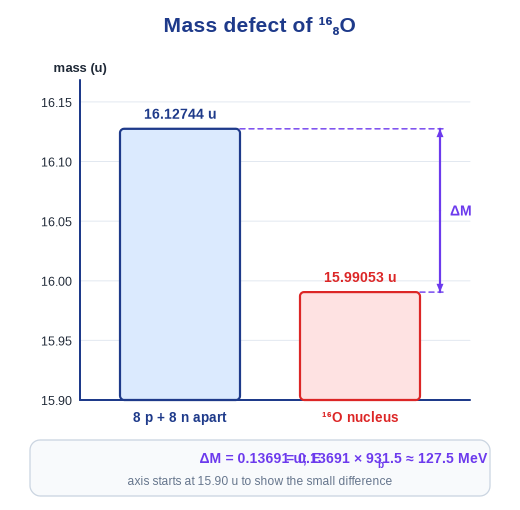
You might expect a nucleus to weigh the same as its protons and neutrons, but it always weighs less. Take ¹⁶₈O, with 8 protons and 8 neutrons:
- 8 protons + 8 neutrons, apart: 8 × 1.00727 u + 8 × 1.00866 u = 16.12744 u
- ¹⁶O nucleus: atomic mass 15.99493 u minus 8 electrons (8 × 0.00055 u) = 15.99053 u
The nucleus is lighter by 0.13691 u. This difference is the mass defect:
ΔM = [Zm_p + (A − Z)m_n] − M
By E = mc², the bound nucleus has less energy than its separate nucleons. To pull the nucleus apart, the energy ΔMc² must be supplied; when the nucleons come together, the same energy is released. This is the binding energy:
E_b = ΔMc²
For ¹⁶O: E_b = 0.13691 × 931.5 ≈ 127.5 MeV (Example 13.3). Read mass defect and binding energy.
What does the binding energy curve show?
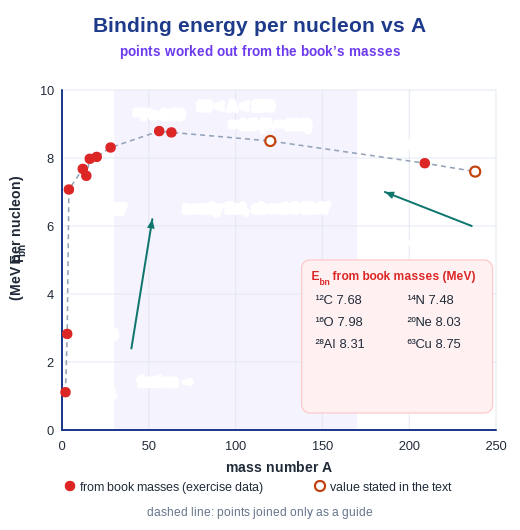
A better measure of how tightly a nucleus is held is the binding energy per nucleon, E_bn = E_b/A, the average energy needed to remove one nucleon. Fig. 13.1 of the book plots it against A for many nuclei. Its main features:
- E_bn is nearly constant, about 8 MeV, for middle-mass nuclei, 30 < A < 170. It has a maximum of about 8.75 MeV at A = 56 and is 7.6 MeV at A = 238.
- E_bn is lower for light nuclei (A < 30) and for heavy nuclei (A > 170).
What this tells us:
- The nuclear force is attractive and strong enough to give a few MeV per nucleon.
- The flat middle comes from the short range of the nuclear force. A nucleon deep inside a large nucleus feels only the neighbours within that range, so adding more nucleons elsewhere does not change its binding. This is called saturation.
- A heavy nucleus (A = 240) is less tightly bound per nucleon than one of A = 120. If it splits into two such pieces, the nucleons become more tightly bound and energy is released: fission.
- Two very light nuclei (A ≤ 10) that join make a more tightly bound nucleus, which also releases energy: fusion, the energy source of the sun.
The chart below uses the atomic masses printed in the chapter’s exercises to work out E_bn for eleven nuclei; the book’s own curve has the same shape.
What is special about the nuclear force?
Binding energies of about 8 MeV per nucleon are far larger than atomic binding energies (a few eV), and the protons repel each other. So a different, strong attractive force must hold the nucleus together. Experiments between 1930 and 1950 showed:
- It is much stronger than the Coulomb force between charges, and gravity is far weaker still.
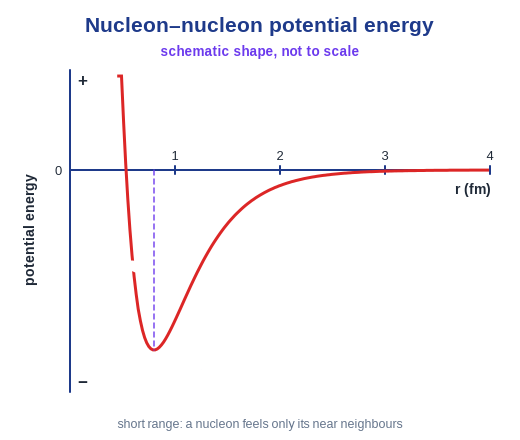
- It has a short range: it falls rapidly to zero once two nucleons are more than a few femtometres apart. This causes saturation and the flat part of the binding energy curve.
- The potential energy of a pair of nucleons is lowest at a separation r₀ of about 0.8 fm. Beyond r₀ the force is attractive; closer than r₀ it is strongly repulsive.
- It is about the same for neutron–neutron, proton–neutron and proton–proton pairs: it does not depend on electric charge.
Unlike Coulomb’s law or Newton’s law of gravitation, the nuclear force has no simple formula.
What is radioactivity?
A. H. Becquerel discovered radioactivity by accident in 1896. Pieces of a uranium compound, wrapped in black paper and separated from a photographic plate by silver, still blackened the plate: something from the compound passed through both. Later work showed that radioactivity is a nuclear process: an unstable nucleus decays. Three kinds of decay occur in nature:
- α-decay: a helium nucleus, ⁴₂He, is emitted.
- β-decay: an electron or a positron (same mass as an electron, opposite charge) is emitted.
- γ-decay: a high-energy photon (hundreds of keV or more) is emitted.
The 2026-27 chapter stops here; the law of radioactive decay is no longer part of it.
How do nuclei release energy?
The greater a nucleus’s binding energy, the smaller its mass. So when nuclei with less total binding energy change into nuclei with more, the extra binding energy is released, whether a heavy nucleus splits or light nuclei join.
The scale is very different from chemistry. Burning coal or petroleum involves energies of a few eV per reaction; nuclear reactions release MeV, about a million times more for the same amount of matter. Fission of 1 kg of uranium gives about 10¹⁴ J; burning 1 kg of coal gives about 10⁷ J.
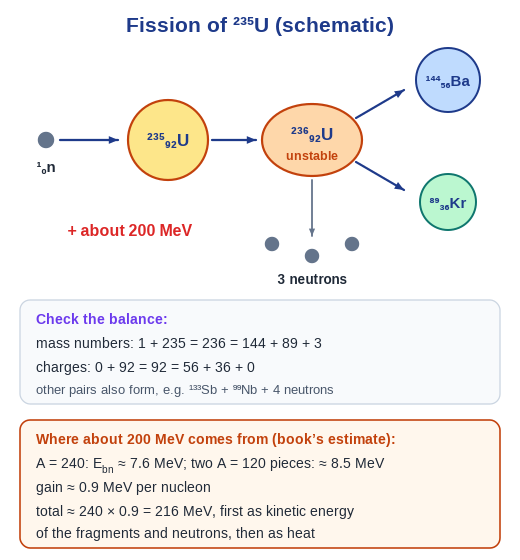
Fission. A ²³⁵₉₂U nucleus that absorbs a neutron becomes ²³⁶₉₂U, which splits into two middle-mass fragments and a few neutrons, for example
¹₀n + ²³⁵₉₂U → ²³⁶₉₂U → ¹⁴⁴₅₆Ba + ⁸⁹₃₆Kr + 3 ¹₀n
Other pairs, such as ¹³³Sb + ⁹⁹Nb, or ¹⁴⁰Xe + ⁹⁴Sr, can also form. The fragments are radioactive and give out β-particles until they become stable. Each fission releases about 200 MeV: a nucleus of A = 240 at 7.6 MeV per nucleon becoming two of A = 120 at about 8.5 MeV per nucleon gains 0.9 MeV per nucleon, or 240 × 0.9 = 216 MeV. This energy appears first as kinetic energy of the fragments and neutrons and then as heat. Nuclear reactors that make electricity use fission.
Fusion. Light nuclei joining release energy, for example two deuterons giving ³₂He and a neutron with 3.27 MeV. Nuclei repel each other, so they must be very hot to get close enough: two protons face a Coulomb barrier of about 400 keV, which by (3/2)kT ≈ 400 keV means T ~ 3 × 10⁹ K. Fusion driven by high temperature is thermonuclear fusion. The sun’s core is only about 1.5 × 10⁷ K, so fusion there involves the protons with much more than the average energy. Its proton–proton cycle turns four hydrogen atoms into one helium atom, releasing 26.7 MeV. Read nuclear fission and fusion.
What happens inside stars?
Thermonuclear fusion powers every star. In the sun, hydrogen in the core is the fuel. When the core’s hydrogen has turned to helium, the core cools, the star contracts under gravity and its core heats up; at about 10⁸ K helium nuclei fuse into carbon. Step by step heavier elements can form this way, but not elements heavier than those near the peak of the binding energy curve. The sun is about 5 × 10⁹ years old and has hydrogen for about another 5 billion years; after that it will swell into a red giant.
Scientists in several countries, including India, are working on controlled fusion: heating fuel to about 10⁸ K, where it becomes a plasma of ions and electrons. No material container can hold something that hot, so confining the plasma is the main challenge.
How are nuclear reactions balanced?
Example 13.4 (pages 317–318) compares nuclear and chemical reactions:
- A chemical equation keeps the number of atoms of each element the same. A nuclear reaction can change one element into another, but it keeps the number of protons and the number of neutrons the same on both sides (in Eq. 13.10: 92 protons and 144 neutrons on each side).
- Since nucleon numbers do not change, the energy comes from the difference in binding energy between the nuclei on the two sides; this difference shows up as a difference in mass.
- Chemical reactions also convert mass to energy, because chemical binding also lowers the mass slightly. But the mass changes are about a million times smaller, which is why people often think it happens only in nuclear reactions.
The Q-value of a reaction is the final kinetic energy minus the initial kinetic energy; by mass–energy conservation, Q = (sum of initial masses − sum of final masses)c². Positive Q means energy is released (exothermic); negative Q means energy must be supplied (endothermic).
Which quantities and units belong to this chapter?
- Mass: 1 u = 1.660539 × 10⁻²⁷ kg = 931.5 MeV/c²; m_p = 1.00727 u, m_n = 1.00866 u, m_e = 0.00055 u.
- Length: 1 fm (femtometre, fermi) = 10⁻¹⁵ m; R₀ = 1.2 fm.
- Energy: 1 MeV = 10⁶ eV = 1.6 × 10⁻¹³ J (exercise value).
- c ≈ 3 × 10⁸ m/s; Boltzmann constant k = 1.381 × 10⁻²³ J/K.
Before we move on
A nucleus is Z protons and N neutrons packed at the same density in every nucleus, R = 1.2A^(1/3) fm; it weighs less than its parts, and that mass defect, times c², is the binding energy that a short-range, very strong force provides; the binding per nucleon peaks near iron, so splitting heavy nuclei and joining light ones both release energy, in reactors and in the stars. All ten exercises and the four worked examples are solved in the NCERT solutions for Chapter 13.
Key terms
| Term | Meaning |
|---|---|
| Atomic mass unit (u) | One-twelfth of the mass of a carbon-12 atom: 1 u = 1.660539 × 10⁻²⁷ kg. Its energy equivalent is 931.5 MeV. |
| Atomic number (Z), neutron number (N), mass number (A) | Z is the number of protons, N the number of neutrons, and A = Z + N the total number of nucleons. A nuclide is written ᴬ_Z X, for example ¹⁹⁷₇₉Au. |
| Nucleon | A proton or a neutron, the two particles that make up a nucleus. |
| Isotopes | Nuclides of the same element: same Z, different N. Their atoms have the same chemistry, for example ¹H, ²H (deuterium) and ³H (tritium). |
| Isobars | Nuclides with the same mass number A, for example ³₁H and ³₂He. |
| Isotones | Nuclides with the same neutron number N but different Z, for example ¹⁹⁸₈₀Hg and ¹⁹⁷₇₉Au (both N = 118). |
| Mass defect (ΔM) | The total mass of the separate protons and neutrons minus the mass of the nucleus: ΔM = [Zm_p + (A − Z)m_n] − M. It is always positive. |
| Binding energy (E_b) | The energy needed to pull a nucleus apart into its nucleons, or the energy released when they come together: E_b = ΔMc². |
| Binding energy per nucleon (E_bn) | E_bn = E_b/A, the average energy needed to remove one nucleon. It measures how tightly a nucleus is held together. |
| Nuclear force | The strong, short-range attraction between nucleons that holds a nucleus together. It acts only over a few femtometres and is the same for proton–proton, proton–neutron and neutron–neutron pairs. |
| Nuclear fission | The splitting of a heavy nucleus, such as ²³⁵U after it absorbs a neutron, into two middle-mass fragments, releasing about 200 MeV. |
| Nuclear fusion | The joining of light nuclei into a heavier one, which releases energy. Thermonuclear fusion of hydrogen into helium powers the sun and other stars. |
Topics in this chapter
Practice
-
The radius of a nucleus of mass number A is proportional to:
Show answer
Answer: (c) A^(1/3)
-
³₁H and ³₂He are:
Show answer
Answer: (b) isobars
-
The binding energy per nucleon is largest for nuclei near:
Show answer
Answer: (b) A = 56
-
The energy equivalent of 1 u is about:
Show answer
Answer: (b) 931.5 MeV
-
Compared with ordinary matter such as water, nuclear matter is denser by a factor of about:
Show answer
Answer: (c) 10¹⁴
-
Which statement about the nuclear force is NOT true?
Show answer
Answer: (c) It is stronger between two protons than between two neutrons
Questions students ask
What are the main topics of Class 12 Physics Chapter 13?
The atomic mass unit, isotopes and the discovery of the neutron, the terms Z, N and A with isotopes, isobars and isotones, the size of the nucleus and nuclear density, mass–energy equivalence, mass defect and binding energy, the binding-energy-per-nucleon curve, the nuclear force, the three kinds of radioactive decay, and nuclear energy from fission and fusion, including energy in stars. Examples 13.1 to 13.4 and ten exercises close the chapter (book pages 306 to 322).
Is the law of radioactive decay or half-life in the 2026-27 book?
No. The rationalised chapter keeps radioactivity only as a short section naming α-, β- and γ-decay. The decay law, half-life and mean life no longer appear in the text or the exercises, although the table of physical quantities at the end of the chapter still lists them.
Why does a nucleus weigh less than its protons and neutrons?
Energy is given out when nucleons bind together, and by E = mc² that energy carries mass away with it. So the bound nucleus has less mass than its parts; the missing mass ΔM times c² is the binding energy.
Why is energy released in both fission and fusion?
The binding energy per nucleon is highest for middle-mass nuclei near A = 56. A heavy nucleus that splits, or light nuclei that join, both end up more tightly bound, and the extra binding energy is released.
Which formulas should I remember from this chapter?
A = Z + N; R = R₀A^(1/3) with R₀ = 1.2 fm; E = mc²; 1 u = 931.5 MeV/c²; ΔM = [Zm_p + (A − Z)m_n] − M; E_b = ΔMc²; E_bn = E_b/A; Q = (sum of initial masses − sum of final masses)c².
Stuck on a question?
Take a photo and Lagnever AI explains it step by step. Try it for 7 days for ₹2.
Get it on Google Play Open in browser
For parents: after the trial, the plan renews monthly by UPI or card autopay. You can cancel anytime in the app.