
What are nuclear fission and fusion?
Answer in short
In fission a heavy nucleus such as ²³⁵U absorbs a neutron and splits into two middle-mass fragments and a few neutrons, releasing about 200 MeV. In fusion light nuclei join into a heavier one; the sun turns four hydrogen atoms into one helium atom with 26.7 MeV. Both release energy because the products are more tightly bound.
Stuck on a question? Take a photo and Lagnever AI explains it step by step. Try it for 7 days for ₹2. Get it on Google Play
Why nuclear reactions release energy
The binding energy per nucleon, E_bn, is highest for middle-mass nuclei, about 8 MeV for 30 < A < 170 and largest near A = 56. A larger binding energy means a smaller mass. So whenever nuclei with less total binding energy change into nuclei with more, the difference is released as energy. There are two ways to do this:
- Fission: a heavy nucleus splits into middle-mass fragments.
- Fusion: light nuclei join into a heavier nucleus.
Nuclear energies are of the order of MeV per reaction, while chemical reactions (burning coal or petroleum) release only a few eV. Fission of 1 kg of uranium gives about 10¹⁴ J; burning 1 kg of coal gives about 10⁷ J.
Safety: nuclear fuels and reactors are handled only by trained staff in licensed facilities. This page explains the physics only.
Fission of uranium-235
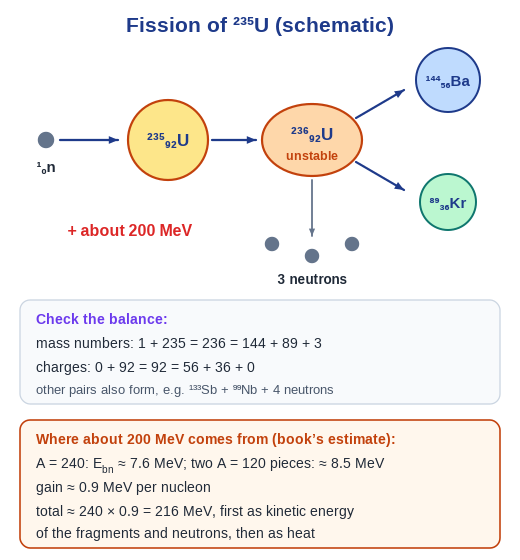
When a ²³⁵₉₂U nucleus is struck by a neutron, it absorbs it, forms ²³⁶₉₂U and splits into two middle-mass fragments:
¹₀n + ²³⁵₉₂U → ²³⁶₉₂U → ¹⁴⁴₅₆Ba + ⁸⁹₃₆Kr + 3 ¹₀n
The same reaction can give other pairs:
- ¹₀n + ²³⁵₉₂U → ²³⁶₉₂U → ¹³³₅₁Sb + ⁹⁹₄₁Nb + 4 ¹₀n
- ¹₀n + ²³⁵₉₂U → ¹⁴⁰₅₄Xe + ⁹⁴₃₈Sr + 2 ¹₀n
In each, the mass numbers and charges balance (for the first: 1 + 235 = 144 + 89 + 3 and 92 = 56 + 36). The fragments are radioactive and give out β-particles one after another until they become stable nuclei.
How much energy? The 200 MeV estimate
Take a nucleus of A = 240 splitting into two fragments of A = 120:
- E_bn for A = 240 ≈ 7.6 MeV
- E_bn for A = 120 ≈ 8.5 MeV
- Gain ≈ 0.9 MeV per nucleon
- Total ≈ 240 × 0.9 = 216 MeV
So fission releases about 200 MeV per nucleus (the Q-value). It appears first as kinetic energy of the fragments and neutrons; as they slow down in the surrounding material it turns into heat. Nuclear reactors that make electricity use this heat. The book also notes that an uncontrolled release of fission energy is what makes an atom bomb so destructive.
Fusion of light nuclei
Light nuclei that join give a more tightly bound nucleus, so energy is released. Examples from the book:
- ¹₁H + ¹₁H → ²₁H + e⁺ + ν + 0.42 MeV (two protons make a deuteron and a positron)
- ²₁H + ²₁H → ³₂He + n + 3.27 MeV (two deuterons make light helium)
- ²₁H + ²₁H → ³₁H + ¹₁H + 4.03 MeV (two deuterons make a triton and a proton)
Why fusion needs very high temperatures
For fusion the nuclei must come within reach of the short-range nuclear force. But both are positive, so they repel: they must have enough energy to climb this Coulomb barrier. Its height grows with the charges and depends on the radii; for two protons it is about 400 keV.
If protons in a gas had that much energy on average, (3/2)kT ≈ 400 keV, which gives T ~ 3 × 10⁹ K. Fusion brought about by heating is called thermonuclear fusion.
Fusion in the sun: the proton–proton cycle
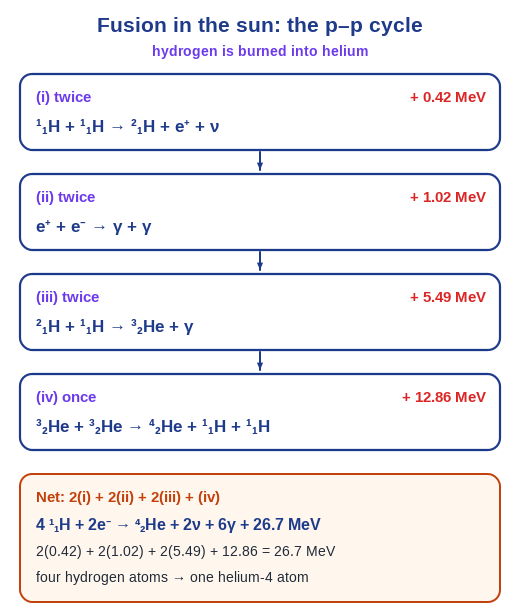
Thermonuclear fusion powers the stars. The sun’s core is at about 1.5 × 10⁷ K, far below 3 × 10⁹ K, so only the protons with much more than the average energy take part. Hydrogen in the core is the fuel, and it is turned into helium in steps:
- ¹₁H + ¹₁H → ²₁H + e⁺ + ν + 0.42 MeV
- e⁺ + e⁻ → γ + γ + 1.02 MeV
- ²₁H + ¹₁H → ³₂He + γ + 5.49 MeV
- ³₂He + ³₂He → ⁴₂He + ¹₁H + ¹₁H + 12.86 MeV
Step 4 needs two ³He nuclei, so steps 1 to 3 must each happen twice. Adding 2(i) + 2(ii) + 2(iii) + (iv):
4 ¹₁H + 2e⁻ → ⁴₂He + 2ν + 6γ + 26.7 MeV
that is, four hydrogen atoms make one helium atom and release 26.7 MeV.
The life of a star
When the hydrogen in a star’s core has become helium, the core cools and the star contracts under its own gravity, which heats the core again. At about 10⁸ K helium nuclei fuse into carbon. In this way heavier and heavier elements can be built, but only up to those near the peak of the binding energy curve; heavier ones cannot be made by fusion that releases energy.
The sun is about 5 × 10⁹ years old and has enough hydrogen for about another 5 billion years. Then its core will contract and heat up while its outer layers swell, and it will become a red giant.
Controlled fusion
A fusion reactor would copy a star: heat the fuel to about 10⁸ K, where it becomes a plasma of positive ions and electrons, and draw steady power from it. The hard part is holding the plasma, because no container can survive that temperature. Several countries, India among them, are developing ways to confine it. If this works, fusion could supply power on a very large scale. Back to the Chapter 13 notes.
Practice
-
In the fission of ²³⁵U, the energy released per nucleus is of the order of:
Show answer
Answer: (c) 200 MeV
-
The energy of the sun comes mainly from:
Show answer
Answer: (b) fusion of hydrogen into helium
-
Fusion needs very high temperatures because:
Show answer
Answer: (b) nuclei repel each other electrically
-
In ¹₀n + ²³⁵₉₂U → ¹⁴⁰₅₄Xe + ⁹⁴₃₈Sr + x ¹₀n, find x.
Show answer
Answer: Mass numbers: 1 + 235 = 140 + 94 + x, so 236 = 234 + x and x = 2. Charges check: 92 = 54 + 38.
-
Using the energies of the p–p cycle, show that the net energy released is 26.7 MeV.
Show answer
Answer: Steps (i), (ii) and (iii) occur twice and step (iv) once: 2(0.42) + 2(1.02) + 2(5.49) + 12.86 = 0.84 + 2.04 + 10.98 + 12.86 = 26.72 MeV ≈ 26.7 MeV.
Questions students ask
Why does fission release so much more energy than burning fuel?
Chemical reactions change the binding of electrons in atoms, which is a few eV per reaction. Fission changes the binding of nucleons, which is about 200 MeV per nucleus. For the same mass of fuel that is roughly a million times more.
Why is fusion so hard to achieve on earth?
The nuclei must be heated to about 10⁸ K so that they can overcome their electric repulsion. At that temperature the fuel is a plasma, and no material container can hold it, so the plasma has to be confined in other ways. Several countries, including India, are working on this.
Why can stars not make elements heavier than iron by fusion?
Fusion releases energy only while the product is more tightly bound than the nuclei that join. Beyond the peak of the binding energy curve, near A = 56, joining nuclei would need energy instead of releasing it.
Stuck on a question?
Take a photo and Lagnever AI explains it step by step. Try it for 7 days for ₹2.
Get it on Google Play Open in browser
For parents: after the trial, the plan renews monthly by UPI or card autopay. You can cancel anytime in the app.