
What are mass defect and binding energy?
Answer in short
A nucleus always weighs less than its separate protons and neutrons. This mass defect, ΔM = [Zm_p + (A − Z)m_n] − M, gives the binding energy E_b = ΔMc², the energy needed to pull the nucleus apart. With 1 u = 931.5 MeV/c², ¹⁶O has ΔM = 0.13691 u and E_b ≈ 127.5 MeV.
Stuck on a question? Take a photo and Lagnever AI explains it step by step. Try it for 7 days for ₹2. Get it on Google Play
A nucleus weighs less than its parts
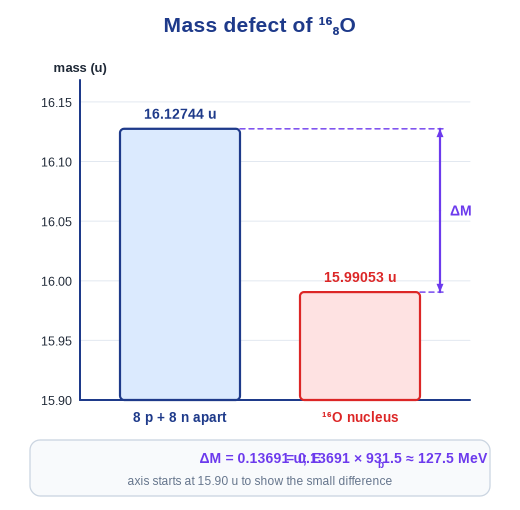
Add up the masses of 8 protons (1.00727 u each) and 8 neutrons (1.00866 u each) and you get 16.12744 u. The measured mass of the ¹⁶O nucleus is 15.99053 u (its atomic mass, 15.99493 u, less 8 electrons of 0.00055 u). The nucleus is lighter by 0.13691 u. This is true of every nucleus.
The difference is the mass defect:
ΔM = [Zm_p + (A − Z)m_n] − M
where M is the mass of the nucleus.
Mass defect as energy
Einstein’s relation E = mc² says mass and energy are two forms of the same thing. A bound nucleus has less mass, so it has less energy than its separate nucleons. To break it into protons and neutrons you would have to supply the difference; when the nucleons come together the same energy is released. This energy is the binding energy:
E_b = ΔMc²
You cannot actually tear a nucleus apart nucleon by nucleon, but E_b is still a convenient measure of how firmly it is held together.
The handy conversion: 1 u = 931.5 MeV
Using 1 u = 1.6605 × 10⁻²⁷ kg and c = 2.9979 × 10⁸ m/s:
E = 1.6605 × 10⁻²⁷ × (2.9979 × 10⁸)² = 1.4924 × 10⁻¹⁰ J = (1.4924 × 10⁻¹⁰)/(1.602 × 10⁻¹⁹) eV = 931.5 MeV
So a mass defect in u, times 931.5, gives the binding energy in MeV. For ¹⁶O, E_b = 0.13691 × 931.5 ≈ 127.5 MeV.
Using atomic masses
The exercises give atomic masses, which include the electrons. Use the hydrogen atom’s mass, m_H = 1.007825 u, for each proton:
ΔM = [Zm_H + (A − Z)m_n] − m(atom)
The Z electrons inside the Z hydrogen atoms cancel the Z electrons of the atom, so the answer is the same. (The tiny difference in electron binding energy is far too small to matter here.)
Worked example: ¹⁴₇N (Exercise 13.1): ΔM = 7 × 1.007825 + 7 × 1.008665 − 14.00307 = 14.11543 − 14.00307 = 0.11236 u, so E_b = 0.11236 × 931.5 = 104.7 MeV, or 7.48 MeV per nucleon.
Binding energy per nucleon
Bigger nuclei have more nucleons and so a bigger total E_b. To compare nuclei fairly, divide by A:
E_bn = E_b/A
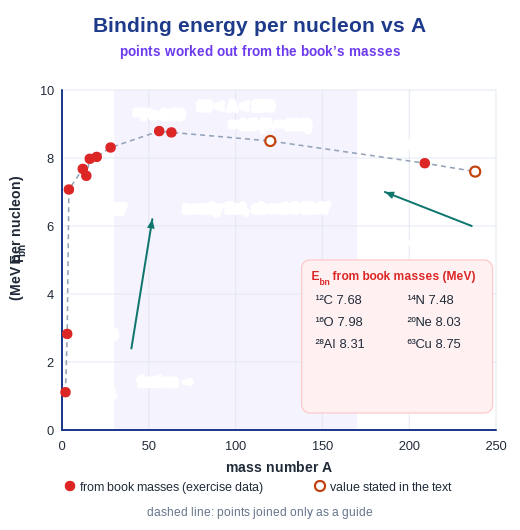
This is the average energy needed to remove one nucleon. The values below are worked out from the masses printed in the chapter (m_H = 1.007825 u, m_n = 1.008665 u):
| Nuclide | A | E_b (MeV) | E_bn (MeV) |
|---|---|---|---|
| ²H | 2 | 2.22 | 1.11 |
| ⁴He | 4 | 28.30 | 7.07 |
| ¹²C | 12 | 92.16 | 7.68 |
| ¹⁶O | 16 | 127.6 | 7.98 |
| ⁵⁶Fe | 56 | 492.3 | 8.79 |
| ⁶³Cu | 63 | 551.4 | 8.75 |
| ²⁰⁹Bi | 209 | 1640.3 | 7.85 |
(For ¹⁶O these exercise masses give 127.6 MeV; the text’s slightly different proton and neutron masses give 127.5 MeV.)
The shape of the curve
- Steep rise for light nuclei (A < 30), with ⁴He standing out above its neighbours.
- Nearly flat, about 8 MeV per nucleon, for 30 < A < 170, with a broad maximum of about 8.75 MeV near A = 56 (iron).
- Slow fall for heavy nuclei: about 7.6 MeV at A = 238.
The flat part comes from the short range of the nuclear force. A nucleon well inside a big nucleus feels only the few neighbours within range, so its binding does not grow when more nucleons are added: the force saturates. The book’s Points to Ponder note small peaks at ⁴He and ¹⁶O, taken as evidence of shells in the nucleus, like the electron shells of atoms.
What the curve predicts
Moving towards the peak always releases energy:
- Fission: a nucleus of A = 240 (E_bn ≈ 7.6 MeV) splitting into two of A = 120 (≈ 8.5 MeV) gains about 0.9 MeV per nucleon, about 216 MeV in all.
- Fusion: very light nuclei (A ≤ 10) that join make a nucleus with a higher E_bn, so energy is released. This powers the sun.
- Moving away from the peak needs energy. Exercise 13.6 shows that splitting ⁵⁶Fe into two ²⁸Al nuclei would need about 26.9 MeV, so it cannot happen on its own.
The energy released in any reaction is its Q-value:
Q = (sum of initial masses − sum of final masses)c²
Q > 0 means energy is released (exothermic); Q < 0 means energy must be supplied (endothermic). Back to the Chapter 13 notes.
Practice
-
The mass defect of a nucleus is 0.1 u. Its binding energy is about:
Show answer
Answer: (c) 93.15 MeV
-
Which nucleus is the most tightly bound per nucleon?
Show answer
Answer: (c) ⁵⁶Fe
-
If the binding energy per nucleon of a nucleus increases, its mass per nucleon:
Show answer
Answer: (b) decreases
-
Find the binding energy and the binding energy per nucleon of ⁴₂He. Use m(⁴He) = 4.002603 u, m_H = 1.007825 u, m_n = 1.008665 u and 1 u = 931.5 MeV/c².
Show answer
Answer: ΔM = 2 × 1.007825 + 2 × 1.008665 − 4.002603 = 4.032980 − 4.002603 = 0.030377 u. E_b = 0.030377 × 931.5 = 28.30 MeV. E_bn = 28.30/4 = 7.07 MeV.
-
Show that 1 u is equivalent to about 931.5 MeV. Use 1 u = 1.6605 × 10⁻²⁷ kg, c = 2.9979 × 10⁸ m/s and 1 eV = 1.602 × 10⁻¹⁹ J.
Show answer
Answer: E = mc² = 1.6605 × 10⁻²⁷ × (2.9979 × 10⁸)² = 1.4924 × 10⁻¹⁰ J. Dividing by 1.602 × 10⁻¹⁹ J/eV gives 9.315 × 10⁸ eV = 931.5 MeV.
Questions students ask
Where does the missing mass of a nucleus go?
When nucleons bind, energy is given out (as radiation or kinetic energy). By E = mc² this energy carries mass, so the nucleus left behind is lighter by ΔM = E_b/c².
Why use atomic masses instead of nuclear masses?
Tables and the book’s exercises give atomic masses. If you use the hydrogen atom’s mass m_H for each proton, the Z electrons on the two sides cancel, so ΔM = [Zm_H + (A − Z)m_n] − m(atom) gives the same answer as the nuclear formula.
Why is the binding energy per nucleon nearly constant for middle-mass nuclei?
The nuclear force reaches only a few femtometres, so a nucleon inside a large nucleus is bound only by its near neighbours. Adding more nucleons does not change how many neighbours each one has, so E_b/A stays close to 8 MeV. This is the saturation of the nuclear force.
Stuck on a question?
Take a photo and Lagnever AI explains it step by step. Try it for 7 days for ₹2.
Get it on Google Play Open in browser
For parents: after the trial, the plan renews monthly by UPI or card autopay. You can cancel anytime in the app.