
NCERT Solutions Class 12 Physics Chapter 2: Electrostatic Potential and Capacitance
Answers to all 11 end-of-chapter exercises and all 10 worked examples of Chapter 2, Electrostatic Potential and Capacitance, of Physics Part I, the Class 12 NCERT textbook. Page numbers follow the 2026-27 reprint (pages 45–80). The exercises come first, quoted from the book; the examples follow, restated in short. Short notes: Chapter 2 notes.
We use k = 1/(4πε₀) = 9 × 10⁹ N m² C⁻² and ε₀ = 8.854 × 10⁻¹² C² N⁻¹ m⁻², as the chapter does, unless an answer says otherwise.
Exercises 2.1 to 2.4: potential, equipotentials and a charged conductor
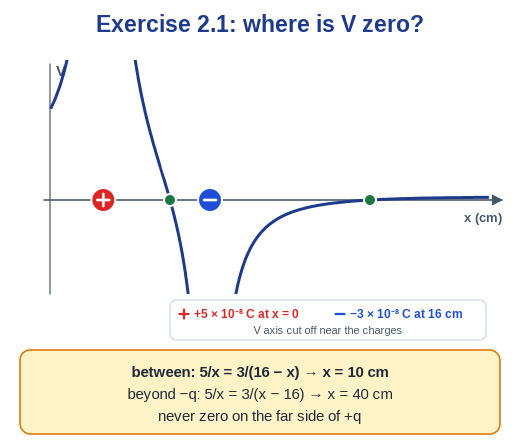
2.1 “Two charges 5 × 10⁻⁸ C and −3 × 10⁻⁸ C are located 16 cm apart. At what point(s) on the line joining the two charges is the electric potential zero? Take the potential at infinity to be zero.”
Put the positive charge at the origin and the negative charge at x = 16 cm. The potential at a point P on the line is zero when the two terms cancel:
k(5 × 10⁻⁸)/(distance from + charge) = k(3 × 10⁻⁸)/(distance from − charge)
So P must be nearer the smaller (negative) charge. On the far side of the positive charge it is always nearer the larger charge, so there is no zero there.
Between the charges (0 < x < 16, x in cm):
5/x = 3/(16 − x) → 80 − 5x = 3x → x = 10 cm
Beyond the negative charge (x > 16):
5/x = 3/(x − 16) → 5x − 80 = 3x → x = 40 cm
The potential is zero at two points, 10 cm and 40 cm from the positive charge, both towards the negative charge: one between the charges and one 24 cm past the negative charge.
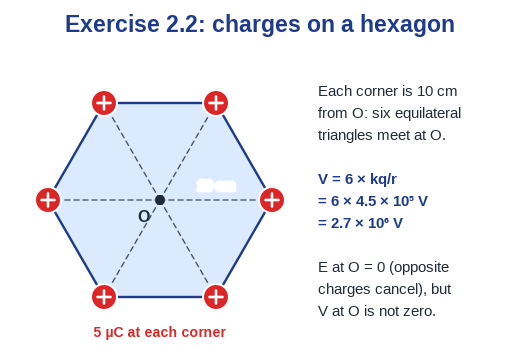
2.2 “A regular hexagon of side 10 cm has a charge 5 µC at each of its vertices. Calculate the potential at the centre of the hexagon.”
A regular hexagon is made of six equilateral triangles meeting at the centre, so every vertex is one side length, r = 0.10 m, from the centre. Potentials add as numbers:
V = 6 × kq/r = 6 × (9 × 10⁹)(5 × 10⁻⁶)/0.10
= 6 × 4.5 × 10⁵ V = 2.7 × 10⁶ V
(The field at the centre is zero, because opposite charges cancel in pairs, but the potential is not. Potential and field are different quantities.)
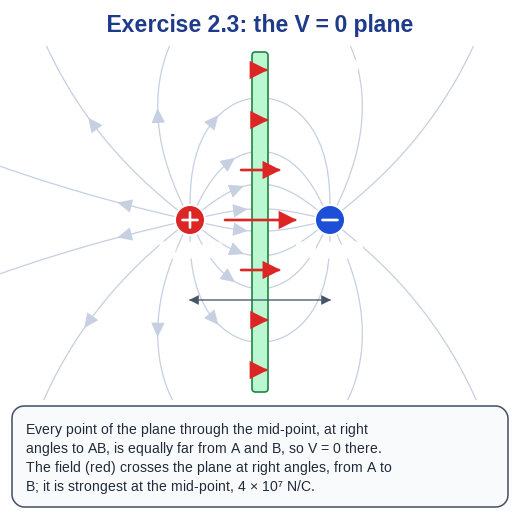
2.3 “Two charges 2 µC and −2 µC are placed at points A and B 6 cm apart. (a) Identify an equipotential surface of the system. (b) What is the direction of the electric field at every point on this surface?”
An equipotential surface is a surface on which the potential has the same value at every point.
(a) Every point on the plane that cuts AB at right angles through its mid-point is the same distance r from A and from B. There, V = k(2 µC)/r + k(−2 µC)/r = 0. So this plane is an equipotential surface, with V = 0 everywhere on it.
(b) The field is normal to an equipotential surface, so at every point of this plane it points at right angles to the plane, parallel to AB, in the direction from A to B (from the positive charge towards the negative one). At the mid-point, for example, E = 2 × (9 × 10⁹)(2 × 10⁻⁶)/(0.03)² = 4 × 10⁷ N/C, from A towards B.
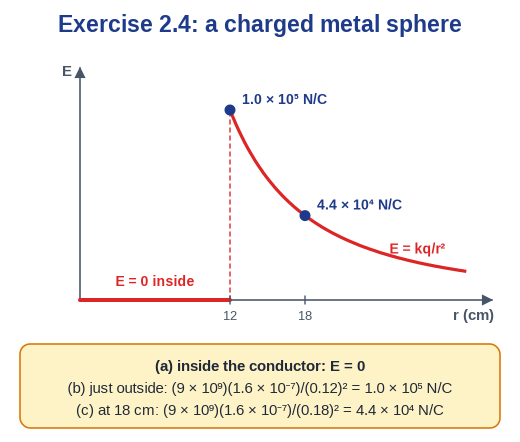
2.4 “A spherical conductor of radius 12 cm has a charge of 1.6 × 10⁻⁷C distributed uniformly on its surface. What is the electric field (a) inside the sphere (b) just outside the sphere (c) at a point 18 cm from the centre of the sphere?”
(a) Zero. In electrostatics the field inside a conductor is zero; all the charge sits on the surface, and a Gaussian sphere drawn inside encloses no charge.
(b) Just outside, the sphere acts as if all its charge were at the centre, so with R = 0.12 m:
E = kq/R² = (9 × 10⁹)(1.6 × 10⁻⁷)/(0.12)² = 1440/0.0144 = 1.0 × 10⁵ N/C
pointing radially outward, normal to the surface. (Check: σ = q/4πR² = 8.84 × 10⁻⁷ C/m², and σ/ε₀ = 1.0 × 10⁵ N/C.)
(c) At r = 0.18 m:
E = (9 × 10⁹)(1.6 × 10⁻⁷)/(0.18)² = 1440/0.0324 = 4.4 × 10⁴ N/C, radially outward
Exercises 2.5 to 2.11: capacitors
2.5 “A parallel plate capacitor with air between the plates has a capacitance of 8 pF (1pF = 10⁻¹² F). What will be the capacitance if the distance between the plates is reduced by half, and the space between them is filled with a substance of dielectric constant 6?”
With air, C₀ = ε₀A/d = 8 pF. The new capacitor has separation d/2 and a dielectric with K = 6:
C = Kε₀A/(d/2) = 2K × (ε₀A/d) = 2 × 6 × 8 pF = 96 pF
2.6 “Three capacitors each of capacitance 9 pF are connected in series. (a) What is the total capacitance of the combination? (b) What is the potential difference across each capacitor if the combination is connected to a 120 V supply?”
(a) 1/C = 1/9 + 1/9 + 1/9 = 3/9 pF⁻¹, so C = 3 pF.
(b) In series every capacitor carries the same charge:
Q = CV = 3 × 10⁻¹² F × 120 V = 3.6 × 10⁻¹⁰ C
V across each = Q/C₁ = 3.6 × 10⁻¹⁰/(9 × 10⁻¹²) = 40 V. (The three equal capacitors share the 120 V equally.)
2.7 “Three capacitors of capacitances 2 pF, 3 pF and 4 pF are connected in parallel. (a) What is the total capacitance of the combination? (b) Determine the charge on each capacitor if the combination is connected to a 100 V supply.”
(a) C = 2 + 3 + 4 = 9 pF.
(b) Each capacitor has the full 100 V across it, so Q = CV:
- 2 pF: Q = 2 × 10⁻¹² × 100 = 2 × 10⁻¹⁰ C
- 3 pF: Q = 3 × 10⁻¹⁰ C
- 4 pF: Q = 4 × 10⁻¹⁰ C
The total, 9 × 10⁻¹⁰ C, equals (9 pF)(100 V), as it should.
2.8 “In a parallel plate capacitor with air between the plates, each plate has an area of 6 × 10⁻³ m² and the distance between the plates is 3 mm. Calculate the capacitance of the capacitor. If this capacitor is connected to a 100 V supply, what is the charge on each plate of the capacitor?”
C = ε₀A/d = (8.854 × 10⁻¹²)(6 × 10⁻³)/(3 × 10⁻³)
= 1.77 × 10⁻¹¹ F = 17.7 pF (about 18 pF)
Q = CV = 1.77 × 10⁻¹¹ × 100 = 1.77 × 10⁻⁹ C (about 1.8 × 10⁻⁹ C)
One plate carries +1.77 × 10⁻⁹ C and the other −1.77 × 10⁻⁹ C.
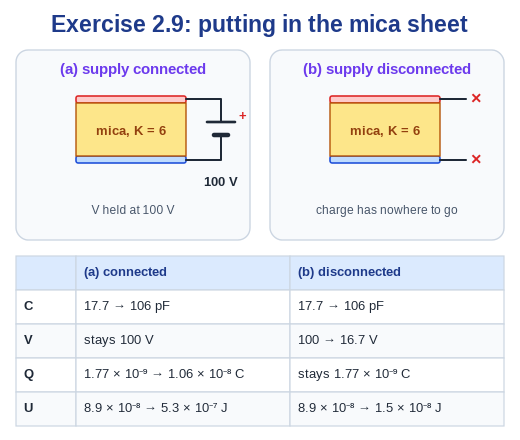
2.9 “Explain what would happen if in the capacitor given in Exercise 2.8, a 3 mm thick mica sheet (of dielectric constant = 6) were inserted between the plates, (a) while the voltage supply remained connected. (b) after the supply was disconnected.”
The 3 mm sheet fills the whole gap, so in both cases the capacitance rises K times:
C = KC₀ = 6 × 17.7 pF = 106 pF (1.06 × 10⁻¹⁰ F)
(a) Supply connected: the supply holds the voltage at V = 100 V. The charge rises six times, the extra charge flowing in from the supply:
Q = CV = 1.06 × 10⁻¹⁰ × 100 = 1.06 × 10⁻⁸ C
(b) Supply disconnected: the plates are isolated, so the charge cannot change: Q = 1.77 × 10⁻⁹ C. The voltage falls six times:
V = Q/C = 1.77 × 10⁻⁹/1.06 × 10⁻¹⁰ = 100/6 = 16.7 V
The field in the gap falls in the same ratio, from 3.3 × 10⁴ V/m to 5.6 × 10³ V/m.
Answer: (a) V = 100 V, C = 106 pF, Q = 1.06 × 10⁻⁸ C. (b) Q = 1.77 × 10⁻⁹ C, C = 106 pF, V = 16.7 V.
Note on the answer key:
- It gives C = 108 pF and Q = 1.08 × 10⁻⁸ C, because it starts from the rounded 18 pF. With C₀ = 17.7 pF the values are 106 pF and 1.06 × 10⁻⁸ C.
- For (b) it prints V = 16.6 V. But 100/6 = 16.67, which rounds to 16.7 V. The key’s own numbers (1.8 × 10⁻⁹ C ÷ 108 pF) also give 16.7 V.
Going further: in (a) the stored energy ½CV² rises from 8.9 × 10⁻⁸ J to 5.3 × 10⁻⁷ J, the supply doing the extra work. In (b) it falls to Q²/2C = 1.5 × 10⁻⁸ J, because the field pulls the sheet in and does work on it.
2.10 “A 12pF capacitor is connected to a 50V battery. How much electrostatic energy is stored in the capacitor?”
U = ½CV² = ½ × 12 × 10⁻¹² × (50)²
= 6 × 10⁻¹² × 2500 = 1.5 × 10⁻⁸ J
(The charge is Q = CV = 6 × 10⁻¹⁰ C, and ½QV gives the same energy.)
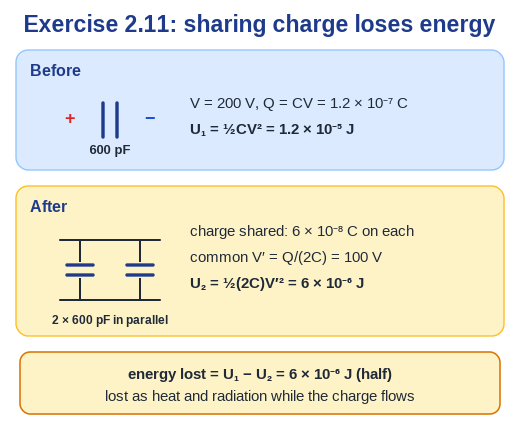
2.11 “A 600pF capacitor is charged by a 200V supply. It is then disconnected from the supply and is connected to another uncharged 600 pF capacitor. How much electrostatic energy is lost in the process?”
Before: Q = CV = 600 × 10⁻¹² × 200 = 1.2 × 10⁻⁷ C, and
U₁ = ½CV² = ½ × 600 × 10⁻¹² × (200)² = 1.2 × 10⁻⁵ J
After: the two equal capacitors are in parallel and share the charge equally (charge is conserved), so each has 6 × 10⁻⁸ C and the common voltage is
V′ = Q/(2C) = 1.2 × 10⁻⁷/(1200 × 10⁻¹²) = 100 V
U₂ = ½(2C)V′² = ½ × 1200 × 10⁻¹² × (100)² = 6 × 10⁻⁶ J
Energy lost = U₁ − U₂ = 1.2 × 10⁻⁵ − 6 × 10⁻⁶ = 6 × 10⁻⁶ J, exactly half the starting energy. It is given out as heat in the connecting wires and as electromagnetic radiation while the charge flows from one capacitor to the other.
Worked examples 2.1 to 2.3 (pages 49–53)
The book solves these examples in the chapter. Here each one is restated in short and worked again.
Example 2.1 (page 49): Find the potential 9 cm from a charge of 4 × 10⁻⁷ C, and the work needed to bring 2 × 10⁻⁹ C from infinity to that point. Does the path matter?
V = kq/r = (9 × 10⁹)(4 × 10⁻⁷)/0.09 = 4 × 10⁴ V
W = qV = (2 × 10⁻⁹)(4 × 10⁴) = 8 × 10⁻⁵ J
The path does not matter. Any path can be broken into tiny steps along the radius and tiny steps across it; the steps across need no work, because the force is radial, and the radial steps add up to the same total on every path.
Example 2.2 (pages 52–53): A charge of 3 × 10⁻⁸ C and one of −2 × 10⁻⁸ C sit 15 cm apart. Find the points on their line where V = 0.
Put the positive charge at the origin and the negative one at x = 15 cm. There is no zero on the far side of the positive charge. Between them:
3/x = 2/(15 − x) → 45 − 3x = 2x → x = 9 cm
Beyond the negative charge:
3/x = 2/(x − 15) → 3x − 45 = 2x → x = 45 cm
Both distances are measured from the positive charge, towards the negative one.
Example 2.3 (page 53): Field lines are drawn for a positive point charge, with point P nearer to it than point Q, and for a negative point charge, with A nearer to it than B. Give the sign of (a) VP − VQ and of VB − VA; (b) the change in potential energy of a tiny negative test charge, comparing Q with P and A with B; (c) the field’s work when a tiny positive charge goes from Q to P; (d) an outside agent’s work when a tiny negative charge goes from B to A; (e) does that negative charge speed up or slow down between B and A?
(a) Near a positive charge V ∝ 1/r, so the nearer point P has the higher potential: VP − VQ is positive. Near a negative charge the potential is negative and larger in size closer in, so VA is more negative than VB: VB − VA is positive.
(b) For a negative charge U = qV is lowest where V is highest. So U at Q is greater than U at P, and U at A is greater than U at B. Both differences, UQ − UP and UA − UB, are positive.
(c) A positive charge moved from Q to P goes towards the positive source, against the repulsion. An external agent must push it, so the field’s own work is negative.
(d) A negative charge moved from B to A goes towards the negative source, against the repulsion. The external agent does positive work.
(e) Moving from B to A, the negative charge is pushed back by the repulsion, so it slows down: its kinetic energy decreases.
Worked examples 2.4 to 2.7 (pages 57–65)
Example 2.4 (pages 57–58): Charges +q, −q, +q and −q sit at the corners A, B, C and D of a square of side d. (a) How much work is needed to assemble them? (b) How much extra work brings a charge q₀ to the centre E?
(a) Add one term for every pair. The four sides (AB, BC, CD, DA) each join +q and −q at distance d; the two diagonals (AC and BD) each join like charges at distance d√2:
U = (1/4πε₀)[4 × (−q²/d) + 2 × (q²/(d√2))]
= (q²/4πε₀d)(−4 + √2) = −(q²/4πε₀d)(4 − √2) ≈ −2.59 q²/(4πε₀d)
Building the square step by step gives the same sum: bringing +q to A costs 0, −q to B costs −q²/(4πε₀d), +q to C costs −(q²/4πε₀d)(1 − 1/√2), and −q to D costs −(q²/4πε₀d)(2 − 1/√2). The total work is negative: the attractions win, and the agent has to hold the charges back.
(b) The centre E is the same distance, d/√2, from all four corners, and the charges add up to zero, so the potential at E is zero. The extra work q₀VE is zero.
Example 2.5 (pages 59–60): Charges 7 µC and −2 µC are at (−9 cm, 0, 0) and (9 cm, 0, 0). (a) Find their potential energy. (b) How much work separates them to infinity? (c) Find the energy of the pair in an external field E = A/r², with A = 9 × 10⁵ N C⁻¹ m².
(a) r = 18 cm = 0.18 m:
U = (9 × 10⁹)(7 × 10⁻⁶)(−2 × 10⁻⁶)/0.18 = −0.7 J
(b) W = U(final) − U(initial) = 0 − (−0.7) = 0.7 J
(c) The external field A/r² has the potential V = A/r. Both charges are 0.09 m from the origin, where V = 9 × 10⁵/0.09 = 1 × 10⁷ V:
q₁V(r₁) = 7 × 10⁻⁶ × 10⁷ = 70 J; q₂V(r₂) = −2 × 10⁻⁶ × 10⁷ = −20 J
U = 70 − 20 − 0.7 = 49.3 J
Example 2.6 (page 61): Each molecule of a substance has a permanent dipole moment of 10⁻²⁹ C m. One mole of it, fully lined up in a field of 10⁶ V/m (assume every dipole aligns), has the field direction suddenly turned through 60°. Estimate the heat released as the dipoles line up again.
Total dipole moment p = 6 × 10²³ × 10⁻²⁹ = 6 × 10⁻⁶ C m.
When aligned with the field: U = −pE cos 0° = −6 × 10⁻⁶ × 10⁶ = −6 J
Just after the field turns, the dipoles are at 60° to it: U = −pE cos 60° = −3 J
As they swing round to line up with the new field direction, U falls from −3 J back to −6 J. The 3 J lost as potential energy is released as heat.
Example 2.7 (pages 64–65): (a) Why does a comb run through dry hair attract bits of paper, and what changes with wet hair or on a rainy day? (b) Why are aircraft tyres made slightly conducting? (c) Why do vehicles carrying inflammable materials have metal ropes touching the ground? (d) Why is a bird on a bare high-voltage line safe, while a man on the ground who touches it gets a fatal shock?
(a) Rubbing charges the comb. Paper is an insulator, but the comb’s field polarises its molecules; the induced charges nearer the comb are pulled more strongly, so the paper is attracted. With wet hair, or on a rainy day, the friction between comb and hair is much less, so the comb gets little charge and does not attract the paper.
(b) Friction with the runway charges the tyres. Slightly conducting tyres let this charge flow to the ground, before a large static charge can build up and cause a spark and a fire.
(c) For the same reason: the rope carries the charge from friction to the ground, so no spark can set fire to the load.
(d) A current flows only when there is a potential difference. Both of the bird’s feet are on the same wire, at the same potential, so no current passes through it. A man on the ground is at zero potential while the line is at a very high potential, so a large current flows through his body.
Worked examples 2.8 to 2.10 (pages 71–76)
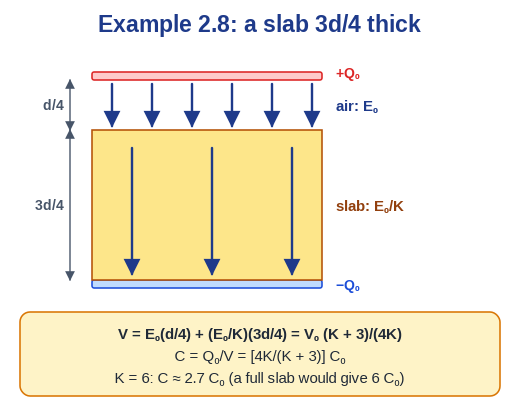
Example 2.8 (page 71): A slab of dielectric constant K, as large as the plates and 3d/4 thick, is put into a parallel plate capacitor with plate gap d. How does the capacitance change?
Let the charge stay Q₀, and let the field in the empty capacitor be E₀ = V₀/d. Inside the slab the field drops to E₀/K; in the remaining d/4 of air it stays E₀. So
V = E₀(d/4) + (E₀/K)(3d/4) = E₀d(1/4 + 3/(4K)) = V₀(K + 3)/(4K)
C = Q₀/V = [4K/(K + 3)] C₀
For K = 6, for instance, C = 24C₀/9 ≈ 2.7C₀, less than the 6C₀ of a slab filling the whole gap.
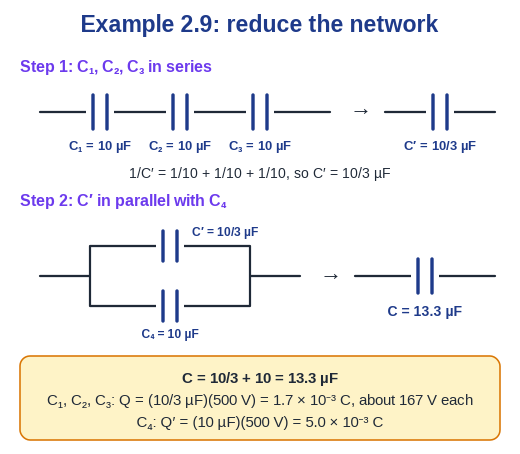
Example 2.9 (page 73): Four 10 µF capacitors are connected to a 500 V supply: C₁, C₂ and C₃ in series, and that chain in parallel with C₄. Find (a) the equivalent capacitance and (b) the charge on each capacitor.
(a) The series chain: 1/C′ = 1/10 + 1/10 + 1/10, so C′ = 10/3 µF. In parallel with C₄:
C = 10/3 + 10 = 13.3 µF
(b) C₁, C₂ and C₃ carry the same charge Q, and their voltages add to 500 V:
Q = C′ × 500 V = (10/3) × 10⁻⁶ × 500 = 1.7 × 10⁻³ C (each has about 167 V across it)
C₄ has the full 500 V across it:
Q′ = 10 × 10⁻⁶ × 500 = 5.0 × 10⁻³ C
Example 2.10 (pages 75–76): (a) How much energy does a 900 pF capacitor hold after a 100 V battery charges it? (b) Taken off the battery, it is joined to a second, uncharged 900 pF capacitor. Find the total energy now.
(a) Q = CV = 900 × 10⁻¹² × 100 = 9 × 10⁻⁸ C
U = ½QV = ½ × 9 × 10⁻⁸ × 100 = 4.5 × 10⁻⁶ J
(b) The two equal capacitors share the charge: each has Q/2, at V/2 = 50 V. The total energy is
2 × ½ × (Q/2)(V/2) = ¼QV = 2.25 × 10⁻⁶ J
Half the energy has gone, though no charge was lost. While the charges settle, a brief current flows from one capacitor to the other, and the missing energy leaves as heat and electromagnetic radiation. Exercise 2.11 is the same situation.
Practice
-
A charge of 5 µC is carried between two points with a potential difference of 12 V. The work done is:
Show answer
Answer: (a) 6 × 10⁻⁵ J
-
An alpha particle (charge 2e) is accelerated through 1000 V. It gains:
Show answer
Answer: (c) 2000 eV
-
A metal sphere of radius 10 cm is at a potential of 900 V. The charge on it is:
Show answer
Answer: (a) 1 × 10⁻⁸ C
-
A 4 µF capacitor is charged to 50 V. How much energy does it store?
Show answer
Answer: U = ½CV² = ½ × 4 × 10⁻⁶ × (50)² = 5 × 10⁻³ J.
-
Capacitors of 2 µF and 3 µF are in series across 10 V. Find the voltage across each.
Show answer
Answer: C = (2 × 3)/(2 + 3) = 1.2 µF, so Q = 1.2 µF × 10 V = 12 µC on each. V₁ = 12 µC/2 µF = 6 V and V₂ = 12 µC/3 µF = 4 V; together 10 V.
Stuck on a question?
Take a photo and Lagnever AI explains it step by step. Try it for 7 days for ₹2.
Get it on Google Play Open in browser
For parents: after the trial, the plan renews monthly by UPI or card autopay. You can cancel anytime in the app.