
Class 12 Physics Chapter 2: Electrostatic Potential and Capacitance Notes
This chapter in five lines
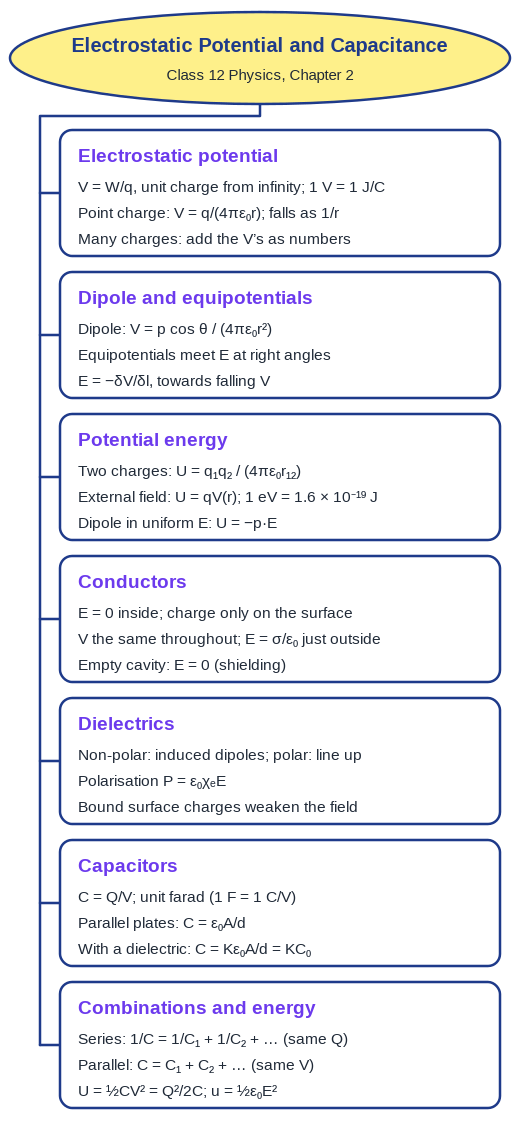
The electrostatic potential at a point equals the work needed, per unit positive charge, to bring a test charge from infinity to it: V = q/(4πε₀r) for a point charge. The field points where V falls fastest and meets equipotential surfaces at right angles. Charges have potential energy, U = q₁q₂/(4πε₀r). A capacitor stores charge Q = CV; for parallel plates C = Kε₀A/d, and its energy is ½CV².
What is this chapter about?
Chapter 1 described charges by forces and fields, which are vectors. This chapter adds a simpler, scalar way to describe the same field: the potential, measured in volts. The voltage written on a cell, the “high tension” warning on a pole and the rating of a house socket are all potential differences. The chapter then uses potential to explain conductors, insulators (dielectrics) and capacitors, the parts that store charge and energy in phone chargers and ceiling fans.
What is electrostatic potential?
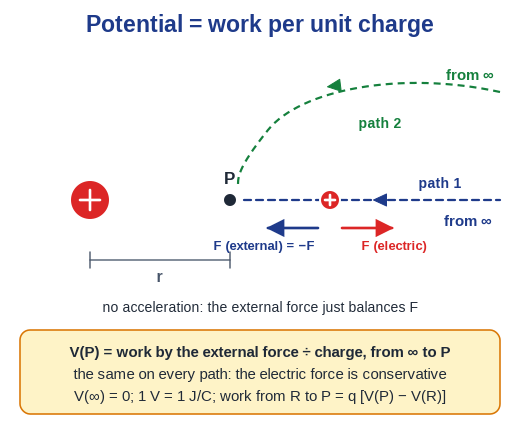
The Coulomb force, like gravity, is conservative: the work it does between two points depends only on the points, not on the path. So a charge in a field has potential energy, and only differences of potential energy matter. Dividing by the charge gives a quantity that belongs to the point alone. The electrostatic potential at P is the work done by an external force, per unit positive charge, to bring a test charge slowly (without acceleration) from infinity to P, where V is taken as zero. Its unit is the volt: 1 V = 1 J/C. Carrying a charge q from R to P takes work q(VP − VR). Read electrostatic potential and equipotential surfaces.
What is the potential of a point charge?
Bring a unit positive charge in along a radius from infinity to a distance r from Q. Adding up (integrating) the work against the force Q/(4πε₀r′²) from r′ = ∞ to r′ = r gives
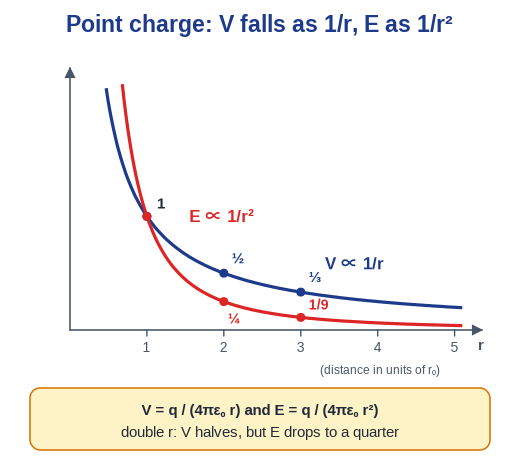
V(r) = Q/(4πε₀r)
The formula holds for either sign of Q: a negative charge gives a negative potential. The potential falls as 1/r, more slowly than the field, which falls as 1/r². For a set of charges the potentials simply add, with signs, because potential is a scalar: V = (1/4πε₀)(q₁/r₁ + q₂/r₂ + … + qₙ/rₙ). Outside a uniformly charged shell of radius R the potential is q/(4πε₀r), as if the charge sat at the centre; inside, the field is zero, so the potential stays at its surface value q/(4πε₀R).
What is the potential of an electric dipole?
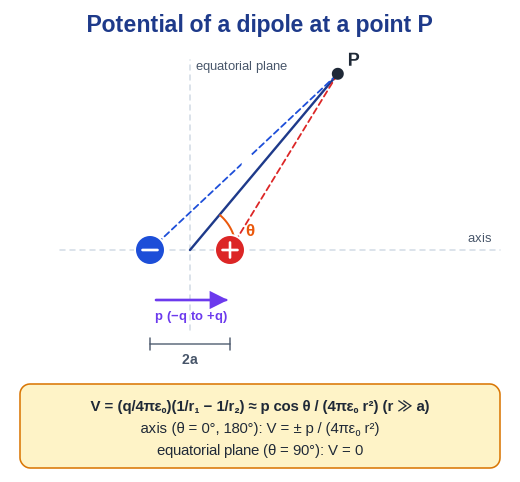
Take a dipole of moment p = q × 2a at the origin and a point P at distance r, where OP makes an angle θ with p. Adding the potentials of +q and −q and keeping terms up to first order in a/r (for r ≫ a) gives
V = p cos θ/(4πε₀r²) = p·r̂/(4πε₀r²)
On the axis (θ = 0° or 180°) V = ±p/(4πε₀r²); on the equatorial plane (θ = 90°) V = 0. Unlike the potential of a single charge, it depends on the angle, and it falls off faster, as 1/r².
What are equipotential surfaces?
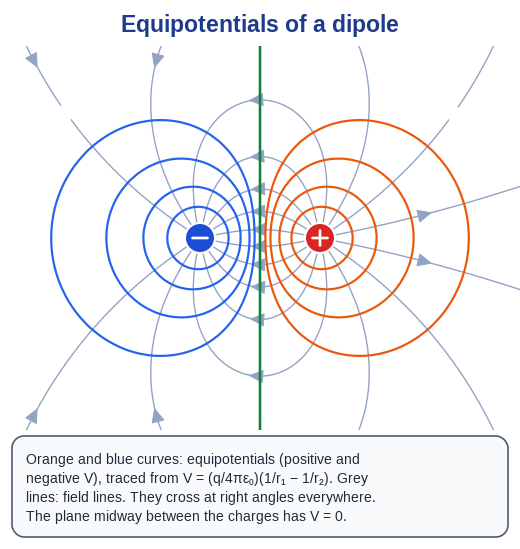
An equipotential surface joins points of equal potential. For a point charge they are spheres centred on the charge; for a uniform field they are flat planes at right angles to the field. Moving a charge along an equipotential needs no work, so the field can have no component along it: the field is always normal to the equipotential surface through a point. If two neighbouring equipotentials V and V + δV are δl apart, then
E = −δV/δl
so the field points the way the potential falls fastest, and it is strong where equipotentials crowd together. A field of 1000 V/m, for example, means the potential drops by 10 V over every centimetre along the field.
What is the potential energy of a group of charges?
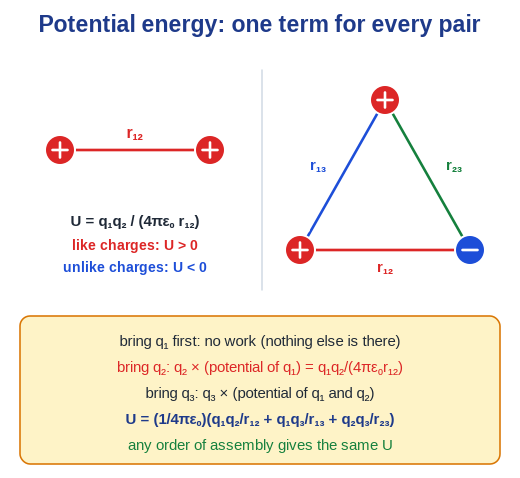
Build the system one charge at a time, starting with all of them far apart. Bringing q₁ needs no work. Bringing q₂ to a distance r₁₂ from it needs q₂ times the potential of q₁ there, so
U = q₁q₂/(4πε₀r₁₂)
U is positive for like charges (work was needed to push them together) and negative for unlike charges. For three charges U = (1/4πε₀)(q₁q₂/r₁₂ + q₁q₃/r₁₃ + q₂q₃/r₂₃): one term for every pair. Because the force is conservative, the order of assembly does not change U. Read electrostatic potential energy.
What is the energy of charges in an external field?
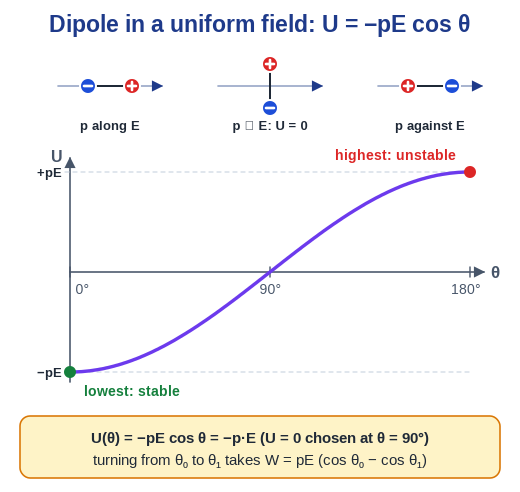
If the field comes from outside sources with potential V(r), a charge q placed at r has potential energy qV(r). An electron moved through 1 V gains 1.6 × 10⁻¹⁹ J, called one electron volt (eV). For two charges in an external field, U = q₁V(r₁) + q₂V(r₂) + q₁q₂/(4πε₀r₁₂). A dipole in a uniform field E has
U(θ) = −pE cos θ = −p·E
taking U = 0 when p is at right angles to E. It is lowest (−pE) when p points along E, which is the stable position.
What happens to charges on a conductor?
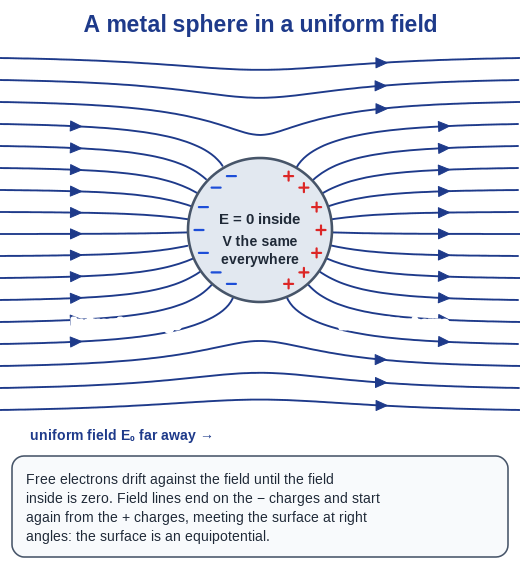
A metal has free electrons that drift whenever there is a field. They stop only when the field inside is zero, which gives the key results for a conductor at rest:
- The electrostatic field inside the conductor is zero.
- Just outside a charged conductor, the field is normal to the surface.
- Any excess charge sits on the surface; there is none inside.
- The potential is the same throughout the conductor and on its surface.
- The field just outside is E = (σ/ε₀) n̂, found with a small Gaussian pill box across the surface.
They also explain two safety measures: aircraft tyres are made slightly conducting, and tankers carrying fuel trail a metal rope to the ground, so that charge from friction drains away before it can spark.
What is electrostatic shielding?
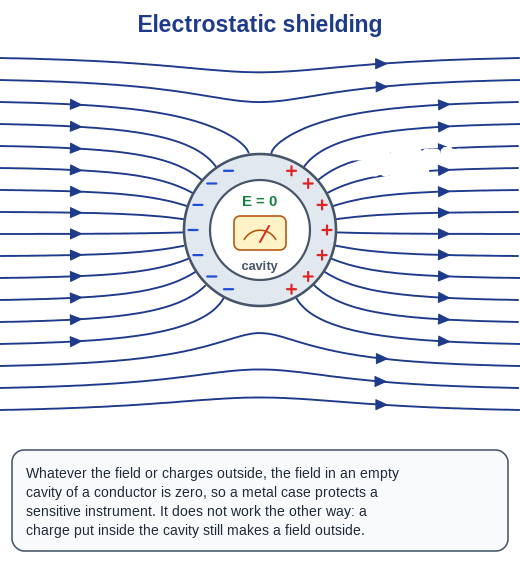
Inside an empty cavity of a conductor, the field is zero, whatever the shape of the cavity, the charge on the conductor or the field outside. Any charge sits on the outer surface. So a metal box keeps outside electric fields away from a sensitive instrument inside it. The shielding works one way only: charges placed inside the cavity still make a field outside the conductor.
What are dielectrics, and how do they get polarised?
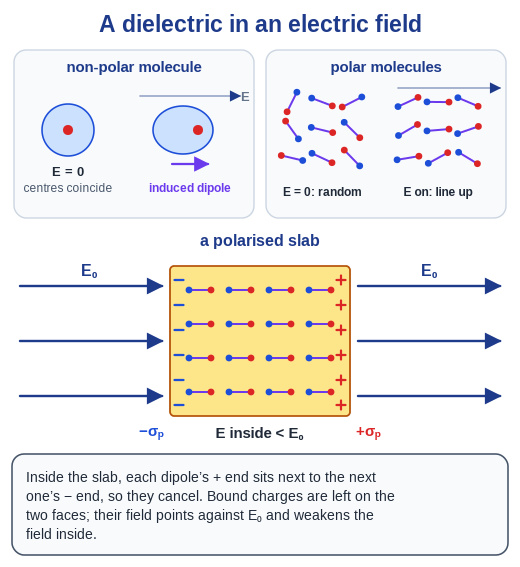
A dielectric is an insulator: its charges cannot move freely. In a non-polar molecule (O₂, H₂) the centres of positive and negative charge coincide, and a field pulls them slightly apart, giving an induced dipole. Polar molecules (H₂O, HCl) already carry a dipole moment, but heat keeps them pointing every which way; a field lines them up partly. Either way the dielectric gains a dipole moment per unit volume, the polarisation P = ε₀χₑE. Inside a uniformly polarised slab the dipoles cancel, but bound charges ±σp appear on the faces, and their field opposes and weakens the applied field.
What is a capacitor, and what is capacitance?
A capacitor is two conductors separated by an insulator, carrying +Q and −Q with a potential difference V. Doubling Q doubles the field and so doubles V, so their ratio is fixed:
C = Q/V
Capacitance depends only on the shapes, sizes and separation of the conductors and on the insulator between them. Its unit is the farad, 1 F = 1 C V⁻¹; in practice we use µF (10⁻⁶ F), nF and pF (10⁻¹² F). A large C stores a large charge at a small voltage. That matters because a high voltage means a strong field, and air breaks down near 3 × 10⁶ V m⁻¹, letting the charge leak away. Read capacitors and capacitance.
What is the capacitance of a parallel plate capacitor?
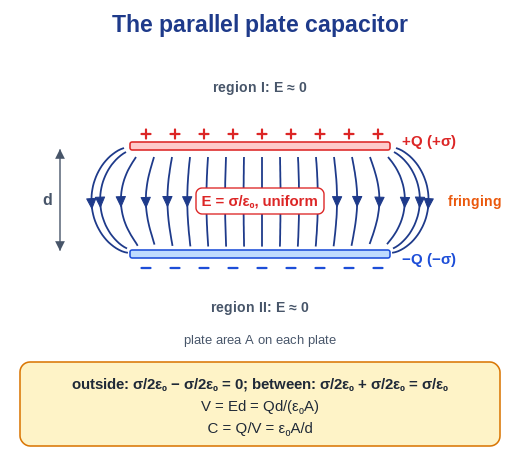
Two plates of area A, a small distance d apart, carry surface charge densities +σ and −σ, with σ = Q/A. Using the field of a plane sheet, σ/(2ε₀), the two fields cancel outside the plates and add between them, so E = σ/ε₀ = Q/(ε₀A), uniform between the plates (apart from fringing at the edges). Then V = Ed = Qd/(ε₀A) and
C = ε₀A/d
For A = 1 m² and d = 1 mm, C ≈ 8.85 × 10⁻⁹ F. A one-farad capacitor with plates 1 cm apart would need plates over 30 km on a side, which shows how large a farad is.
How does a dielectric change the capacitance?
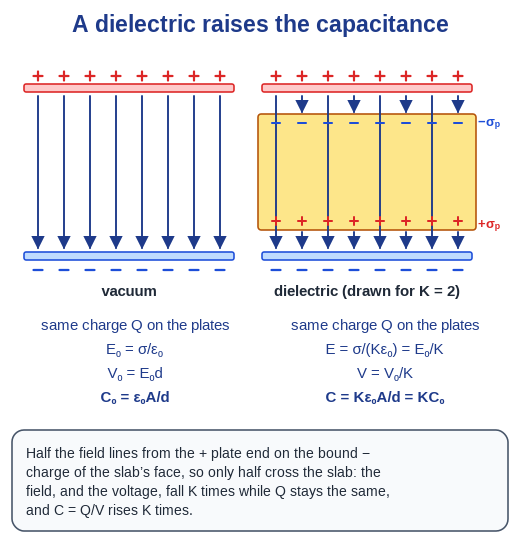
Fill the gap with a dielectric. The bound charges ±σp on its faces cut the effective charge density to σ − σp = σ/K, so the field and the potential difference fall by the factor K while the charge on the plates stays the same. The capacitance rises:
C = Kε₀A/d = KC₀
Here K = ε/ε₀ is the dielectric constant (K > 1), and ε = Kε₀ is the permittivity of the medium. The relation C = KC₀ holds for any capacitor and can be taken as the definition of K.
How do capacitors combine?
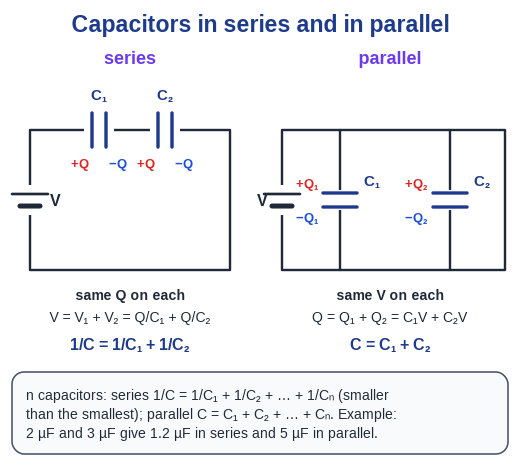
- Series: every capacitor carries the same charge Q, and the voltages add: V = Q/C₁ + Q/C₂ + … So 1/C = 1/C₁ + 1/C₂ + … + 1/Cₙ. The combination is smaller than the smallest capacitor.
- Parallel: every capacitor has the same voltage V, and the charges add: Q = C₁V + C₂V + … So C = C₁ + C₂ + … + Cₙ.
How much energy does a capacitor store?
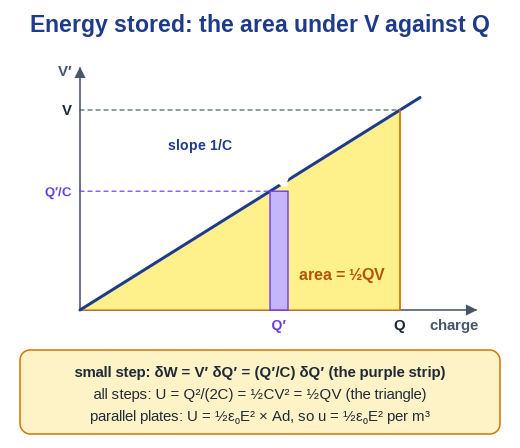
Charge the capacitor in tiny steps. When it holds Q′, its voltage is Q′/C, so moving a further δQ′ needs work (Q′/C)δQ′. Adding these steps from 0 to Q gives
U = Q²/(2C) = ½CV² = ½QV
For a parallel plate capacitor, U = ½ε₀E² × Ad, and Ad is the volume between the plates. So the energy can be pictured as stored in the field itself, with energy density u = ½ε₀E², a result that holds for any field.
Before we move on
Two ideas carry the whole chapter: potential is work per unit charge, and a capacitor holds charge in proportion to the voltage across it. Practise the derivations (point charge, dipole, E = −δV/δl, parallel plate capacitor, series and parallel, stored energy) with their diagrams. Every exercise and every worked example of the chapter is solved in the NCERT solutions for Chapter 2.
Key terms
| Term | Meaning |
|---|---|
| Electrostatic potential (V) | The work done by an external force per unit positive charge in bringing a test charge, without acceleration, from infinity to the point; unit volt (V = J/C). |
| Potential difference | V_P − V_R, the work per unit positive charge to move a charge from R to P; only differences of potential have physical meaning. |
| Conservative force | A force whose work between two points does not depend on the path; the electrostatic force is one, so potential energy can be defined. |
| Equipotential surface | A surface on which the potential has the same value everywhere; the field is normal to it at every point. |
| Electrostatic potential energy | The work done by an external agent to assemble a set of charges from infinity; for two charges U = q₁q₂/(4πε₀r₁₂). |
| Electron volt (eV) | The energy an electron gains through a potential difference of 1 V: 1 eV = 1.6 × 10⁻¹⁹ J. |
| Electrostatic shielding | The field inside an empty cavity of a conductor is zero, whatever the charges and fields outside. |
| Dielectric | An insulating substance; an applied field polarises it, and its surface charges reduce the field inside it. |
| Polarisation (P) | The dipole moment per unit volume of a dielectric; for a linear isotropic dielectric P = ε₀χₑE. |
| Dielectric constant (K) | K = ε/ε₀ > 1, the factor by which the capacitance rises when the dielectric fills the space between the plates. |
| Capacitor | Two conductors separated by an insulator, usually carrying charges +Q and −Q. |
| Capacitance (C) | C = Q/V, fixed by the shape, size and separation of the conductors and by the dielectric; unit farad, 1 F = 1 C V⁻¹. |
| Dielectric strength | The largest field an insulator can bear without breaking down; for air it is about 3 × 10⁶ V m⁻¹. |
| Energy density (u) | Energy stored per unit volume of an electric field, u = ½ε₀E². |
Topics in this chapter
Practice
-
The SI unit of electric potential is:
Show answer
Answer: (b) J/C
-
The potential due to a short dipole on its equatorial plane is:
Show answer
Answer: (c) zero
-
The electric field at a point is always:
Show answer
Answer: (b) normal to the equipotential surface
-
A slab of dielectric constant K fills the gap of an isolated charged capacitor. The potential difference across it:
Show answer
Answer: (b) falls to 1/K of its value
-
Two 6 µF capacitors are joined in series. The combination has a capacitance of:
Show answer
Answer: (c) 3 µF
-
The energy stored in a capacitor of capacitance C charged to a potential difference V is:
Show answer
Answer: (c) ½CV²
Questions students ask
What are the main topics of Class 12 Physics Chapter 2?
Electrostatic potential and potential difference, the potential of a point charge, a dipole and a system of charges, equipotential surfaces and the link between field and potential, potential energy of charges and of a dipole in a field, conductors and shielding, dielectrics and polarisation, and capacitors: the parallel plate capacitor, the effect of a dielectric, series and parallel combinations and stored energy.
Which derivations are in Class 12 Physics Chapter 2?
The potential of a point charge and of a dipole, the relation E = −δV/δl, the potential energy of two and three charges and of a dipole in a uniform field, the field at the surface of a conductor (E = σ/ε₀), the capacitance of a parallel plate capacitor with and without a dielectric, the formulas for series and parallel combinations, and the energy stored in a capacitor with the energy density ½ε₀E².
Is the Van de Graaff generator in the 2026-27 Class 12 Physics book?
No. The rationalised Chapter 2 of Physics Part I (Reprint 2026-27, pages 45 to 80) ends with the energy stored in a capacitor. Older guides that cover the Van de Graaff generator or the spherical capacitor follow the pre-2022 book.
What is the difference between potential and potential energy?
Potential belongs to a point in a field: it is work per unit charge, in volts. Potential energy belongs to a charge, or a set of charges, placed there: U = qV, in joules. Double the charge and the potential energy doubles, but the potential of the point does not change.
Stuck on a question?
Take a photo and Lagnever AI explains it step by step. Try it for 7 days for ₹2.
Get it on Google Play Open in browser
For parents: after the trial, the plan renews monthly by UPI or card autopay. You can cancel anytime in the app.