
What is electrostatic potential energy?
Answer in short
Electrostatic potential energy is the work an external agent does to assemble charges from infinity into their places. For two charges U = q₁q₂/(4πε₀r₁₂), positive for like charges and negative for unlike ones. A charge q where the outside potential is V has energy qV; a dipole in a uniform field has U = −p·E.
Stuck on a question? Take a photo and Lagnever AI explains it step by step. Try it for 7 days for ₹2. Get it on Google Play
What is electrostatic potential energy?
Two magnets pushed together, north to north, try to fly apart when you let go. The work you did in pushing them was stored, and it comes back as motion. Charges behave the same way. The electrostatic potential energy of a set of charges is the work an external agent must do to bring them, from far apart (infinity), to their final places without speeding them up. Because the electric force is conservative, this work is stored, and it depends only on where the charges end up.
What is the potential energy of two charges?
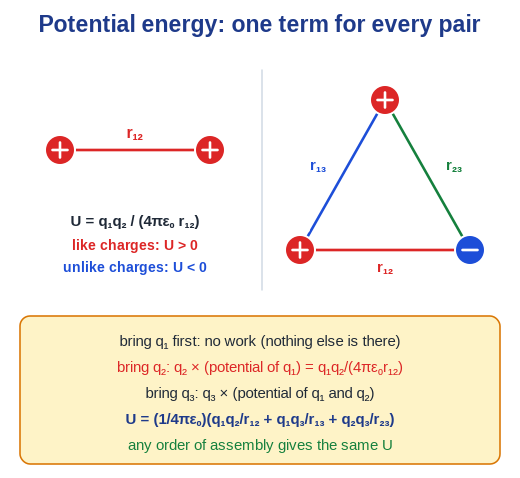
Start with q₁ and q₂ at infinity. Bringing q₁ to its place needs no work, since no other charge is there yet. Now q₁ sets up a potential q₁/(4πε₀r) around it. Bringing q₂ to a distance r₁₂ from q₁ costs q₂ times that potential:
U = q₁q₂/(4πε₀r₁₂)
The formula takes the signs of the charges:
- Like charges (q₁q₂ > 0): U > 0. They repel, so work had to be done to push them together.
- Unlike charges (q₁q₂ < 0): U < 0. They attract, so the agent only had to hold them back, and positive work is needed to separate them again.
Bringing q₂ first and q₁ second gives the same U. For example, +2 µC and +3 µC placed 30 cm apart have U = (9 × 10⁹)(2 × 10⁻⁶)(3 × 10⁻⁶)/0.30 = 0.18 J.
What about three or more charges?
Bring the charges in one by one. The third charge q₃ is brought against the potentials of both q₁ and q₂, so the work for that step is q₃[q₁/(4πε₀r₁₃) + q₂/(4πε₀r₂₃)]. Adding all the steps:
U = (1/4πε₀)(q₁q₂/r₁₂ + q₁q₃/r₁₃ + q₂q₃/r₂₃)
The rule is simple: one term for every pair of charges. Four charges have six pairs. For instance, three charges of +1 µC at the corners of an equilateral triangle of side 10 cm have three equal terms, so U = 3 × (9 × 10⁹)(10⁻⁶)²/0.10 = 0.27 J. Whatever order the charges are brought in, the total is the same, because the work of a conservative force depends only on the start and the end.
What is the energy of a charge in an external field?
Now ask a different question. The field E comes from outside sources, perhaps unknown, held fixed while we bring in a charge q. If the external potential at r is V(r), the work to bring q from infinity is
U = qV(r)
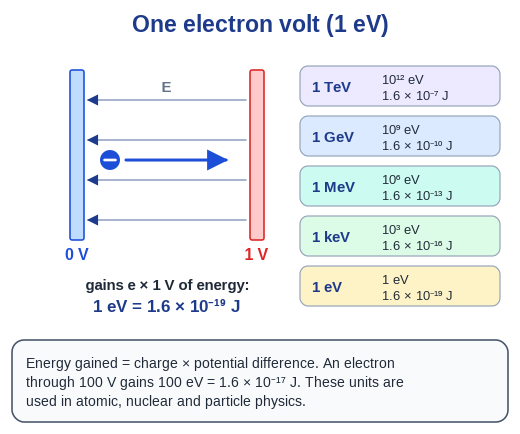
This is the energy of q in the external field, not the energy of the sources. An electron (charge e) moving through a potential difference of 1 V changes its energy by 1.6 × 10⁻¹⁹ J, called one electron volt (eV). Atomic and nuclear physics use 1 keV = 10³ eV, 1 MeV = 10⁶ eV, 1 GeV = 10⁹ eV and 1 TeV = 10¹² eV. An electron through 100 V gains 100 eV = 1.6 × 10⁻¹⁷ J.
What about two charges in an external field?
Bring q₁ first: it costs q₁V(r₁). Then bring q₂: it is pushed by the external field and by q₁, so the cost is q₂V(r₂) + q₁q₂/(4πε₀r₁₂). In total
U = q₁V(r₁) + q₂V(r₂) + q₁q₂/(4πε₀r₁₂)
The first two terms are each charge’s energy in the outside field; the last is their energy with each other.
What is the energy of a dipole in a uniform field?
A dipole in a uniform field feels no net force but a torque τ = p × E, of size pE sin θ. To turn it slowly from angle θ₀ to θ₁, an external torque must just balance this one, doing work
W = ∫ pE sin θ dθ (from θ₀ to θ₁) = pE(cos θ₀ − cos θ₁)
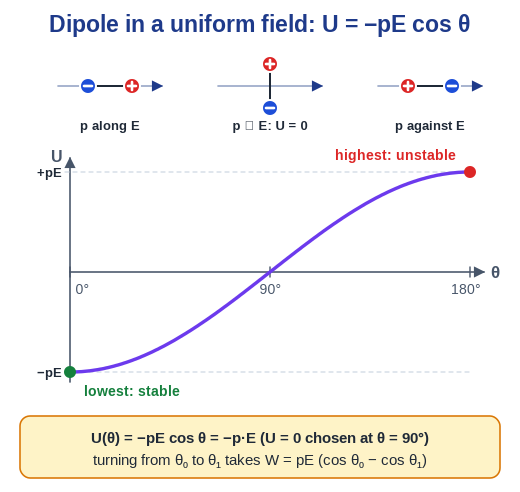
We may put U = 0 at any angle we like. The natural choice is θ₀ = 90°: then the works done on +q and −q in bringing them in against the field are equal and opposite, and cancel. With cos 90° = 0,
U(θ) = −pE cos θ = −p·E
- θ = 0° (p along E): U = −pE, the lowest value, so this is stable equilibrium.
- θ = 90°: U = 0.
- θ = 180° (p against E): U = +pE, the highest value, unstable equilibrium.
So a dipole of 2 × 10⁻⁸ C m in a field of 1 × 10⁴ N/C has energies from −2 × 10⁻⁴ J to +2 × 10⁻⁴ J, and turning it from 0° to 180° takes 4 × 10⁻⁴ J. If the field turns suddenly, the dipoles swing to follow it, and the energy they lose appears as heat.
Previous topic: electrostatic potential and equipotential surfaces. Next: capacitors and capacitance. See also the chapter notes and the NCERT solutions.
Practice
-
Two equal positive charges are moved closer together. Their potential energy:
Show answer
Answer: (a) increases
-
An electron moves through a potential difference of 100 V. The energy it gains is:
Show answer
Answer: (b) 1.6 × 10⁻¹⁷ J
-
A dipole in a uniform field is in stable equilibrium when the angle between p and E is:
Show answer
Answer: (a) 0°
-
Charges of +2 µC and +3 µC are 30 cm apart. Find their potential energy.
Show answer
Answer: U = (9 × 10⁹)(2 × 10⁻⁶)(3 × 10⁻⁶)/0.30 = 0.18 J. It is positive, because like charges repel.
-
A dipole of moment 2 × 10⁻⁸ C m lies along a uniform field of 1 × 10⁴ N/C. How much work turns it to point against the field?
Show answer
Answer: W = U(180°) − U(0°) = pE − (−pE) = 2pE = 2 × 2 × 10⁻⁸ × 1 × 10⁴ = 4 × 10⁻⁴ J.
Questions students ask
What is the formula for the potential energy of two point charges?
U = q₁q₂/(4πε₀r₁₂), where r₁₂ is the distance between them. Put the charges in with their signs: like charges give a positive U and unlike charges a negative U.
Why is the potential energy of unlike charges negative?
Unlike charges attract, so the field itself pulls them together from infinity. The external agent has to hold them back, and its work is negative. Equally, positive work is needed to pull them apart again.
What is one electron volt?
It is the energy an electron (or any particle with charge e) gains when it moves through a potential difference of 1 V: 1 eV = 1.6 × 10⁻¹⁹ J. Larger units are keV, MeV, GeV and TeV.
What is the energy of a dipole in a uniform electric field?
U = −pE cos θ = −p·E, taking U = 0 when the dipole is at right angles to the field. It is −pE when p points along E, which is stable, and +pE when it points against E.
Stuck on a question?
Take a photo and Lagnever AI explains it step by step. Try it for 7 days for ₹2.
Get it on Google Play Open in browser
For parents: after the trial, the plan renews monthly by UPI or card autopay. You can cancel anytime in the app.