
What is a capacitor, and what is capacitance?
Answer in short
A capacitor is two conductors separated by an insulator, holding charges +Q and −Q. Its capacitance is C = Q/V, measured in farads (1 F = 1 C/V). A parallel plate capacitor has C = ε₀A/d, rising to Kε₀A/d with a dielectric. Capacitors store energy U = ½CV² = Q²/(2C).
Stuck on a question? Take a photo and Lagnever AI explains it step by step. Try it for 7 days for ₹2. Get it on Google Play
What is a capacitor?
A capacitor is any pair of conductors with an insulator between them. Connected to a battery, one conductor takes charge +Q and the other −Q, with a potential difference V between them. We call Q “the charge on the capacitor”, although the total is zero.
The field between the conductors is proportional to Q (Coulomb’s law and superposition), so V is proportional to Q too. Their ratio is a constant, the capacitance:
C = Q/V
C depends only on the shape, size and separation of the conductors and on the insulator. Its unit is the farad, 1 F = 1 C V⁻¹. A farad is huge, so we use µF (10⁻⁶ F), nF (10⁻⁹ F) and pF (10⁻¹² F).
Why prefer a large C? A large C holds a large charge at a small voltage. High voltage means a strong field, and a strong field can ionise the air, letting the charge leak away. The largest field an insulator can bear is called its dielectric strength: roughly 3 × 10⁶ V m⁻¹ in air, so plates 1 cm apart in air can take only about 3 × 10⁴ V.
How do we get C for a parallel plate capacitor?
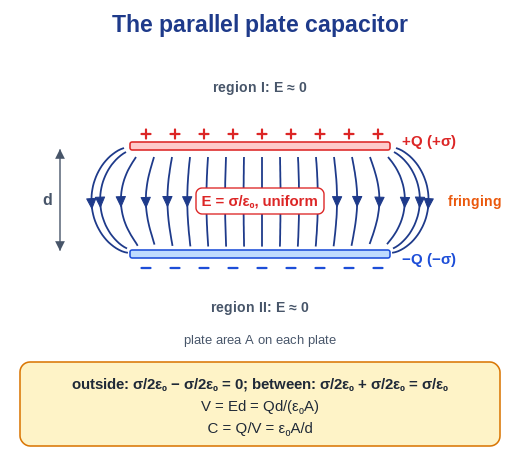
Take two large plates, each of area A, a distance d apart, with d² much smaller than A. They carry +Q and −Q, so the surface charge densities are ±σ with σ = Q/A. Each plate alone gives a field σ/(2ε₀) on both sides (the plane-sheet result of Chapter 1):
- Outside the plates, the two fields point opposite ways: E = 0.
- Between the plates, they point the same way, from + to −: E = σ/ε₀ = Q/(ε₀A).
Near the edges the lines bulge outward (fringing), but far from the edges the field is uniform. So
V = Ed = Qd/(ε₀A), and C = Q/V = ε₀A/d
With A = 1 m² and d = 1 mm, C is only about 8.85 × 10⁻⁹ F.
How does a dielectric change the capacitance?
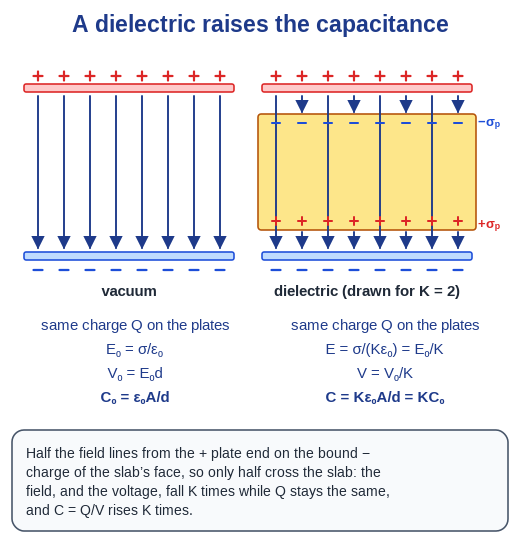
Fill the gap with an insulator. The field polarises it: non-polar molecules stretch into small dipoles, and polar molecules partly line up. Inside, neighbouring dipole ends cancel, but the faces of the slab are left with bound charges ±σp, each opposite to the plate beside it. The plates now act as if their charge density were σ − σp. For a linear dielectric this is proportional to σ, written σ/K, so
E = σ/(Kε₀), V = σd/(Kε₀), and C = Kε₀A/d = KC₀
K, the dielectric constant, is always greater than 1; ε = Kε₀ is the permittivity of the medium. For plates of 0.02 m² that are 1 mm apart, C₀ ≈ 177 pF; with K = 5 it becomes about 885 pF.
How do capacitors in series and in parallel combine?
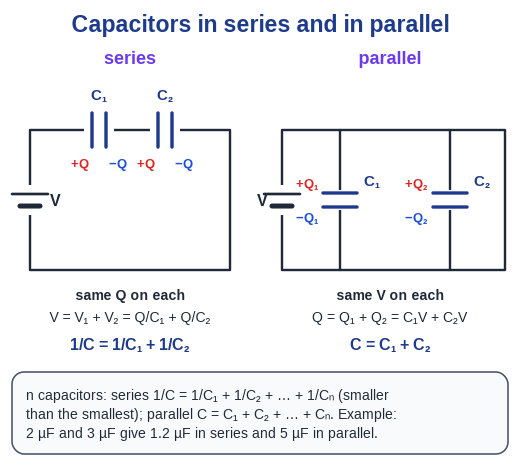
Series. The battery puts +Q on the first plate and −Q on the last. The inner plates, joined by a wire, must share their charge so that each capacitor has +Q and −Q; otherwise the wire would carry a field and charge would keep flowing. The voltages add:
V = Q/C₁ + Q/C₂ + … + Q/Cₙ, so 1/C = 1/C₁ + 1/C₂ + … + 1/Cₙ
2 µF and 3 µF in series give 1.2 µF; on 10 V each holds 12 µC, with 6 V across the 2 µF and 4 V across the 3 µF.
Parallel. Every capacitor gets the same V, and the charges add:
Q = C₁V + C₂V + … + CₙV, so C = C₁ + C₂ + … + Cₙ
How much energy does a capacitor store?
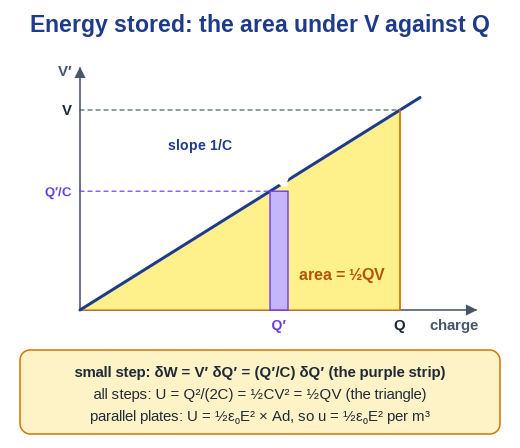
Charging means moving positive charge, bit by bit, from the lower-potential conductor to the higher one, against the field. When the charge is Q′, the voltage is Q′/C, so a further δQ′ costs (Q′/C)δQ′. Adding from 0 to Q:
U = Q²/(2C) = ½CV² = ½QV
The ½ appears because the voltage grows from 0 to V while charging; on a graph of V against Q, U is the area of the triangle. A 10 µF capacitor at 100 V stores 0.05 J.
For parallel plates, U = Q²/(2C) = ½ε₀E² × Ad. Since Ad is the volume between the plates, the field stores u = ½ε₀E² per unit volume, a result true for any field. In air at its breakdown field, 3 × 10⁶ V m⁻¹, that is about 40 J/m³.
Previous topic: electrostatic potential energy. See also the chapter notes and the NCERT solutions.
Practice
-
If the distance between the plates of a parallel plate capacitor is doubled, its capacitance:
Show answer
Answer: (b) halves
-
Capacitors of 2 µF and 3 µF are in series across 10 V. The charge on each is:
Show answer
Answer: (a) 12 µC
-
The energy stored in a capacitor is doubled when, at fixed C, the voltage is multiplied by:
Show answer
Answer: (b) √2
-
Plates of area 0.02 m² are 1 mm apart in air. Find C, and C with a dielectric of K = 5 filling the gap.
Show answer
Answer: C₀ = ε₀A/d = 8.854 × 10⁻¹² × 0.02/10⁻³ = 1.77 × 10⁻¹⁰ F = 177 pF. With K = 5, C = 5 × 177 pF ≈ 885 pF.
-
A 10 µF capacitor is charged to 100 V. Find its charge and stored energy.
Show answer
Answer: Q = CV = 10 × 10⁻⁶ × 100 = 1 × 10⁻³ C. U = ½CV² = ½ × 10 × 10⁻⁶ × (100)² = 0.05 J.
Questions students ask
What is the SI unit of capacitance?
The farad (F): 1 F = 1 coulomb per volt. A farad is very large, so practical capacitors are measured in microfarads (µF, 10⁻⁶ F), nanofarads (nF, 10⁻⁹ F) and picofarads (pF, 10⁻¹² F).
What does the capacitance of a parallel plate capacitor depend on?
On the plate area A, the separation d and the material between the plates: C = Kε₀A/d. It does not depend on the charge or the voltage.
Why does a dielectric increase capacitance?
The field polarises the dielectric, and bound charges appear on its faces, opposite to the charges on the plates next to them. They weaken the field inside by the factor K, so for the same charge the voltage is K times smaller and C = Q/V is K times larger.
Where is the energy of a capacitor stored?
Picture it as held by the field in the gap. For a parallel plate capacitor the energy is ½ε₀E² times the volume Ad, so each cubic metre of field holds ½ε₀E² joules.
Stuck on a question?
Take a photo and Lagnever AI explains it step by step. Try it for 7 days for ₹2.
Get it on Google Play Open in browser
For parents: after the trial, the plan renews monthly by UPI or card autopay. You can cancel anytime in the app.