
What is electrostatic potential, and what is an equipotential surface?
Answer in short
The electrostatic potential at a point equals the work needed, per unit positive charge, to bring a test charge slowly from infinity to it. Its unit is the volt (J/C). A point charge gives V = q/(4πε₀r). An equipotential surface has the same potential everywhere, and the field always crosses it at right angles.
Stuck on a question? Take a photo and Lagnever AI explains it step by step. Try it for 7 days for ₹2. Get it on Google Play
How is electrostatic potential defined?
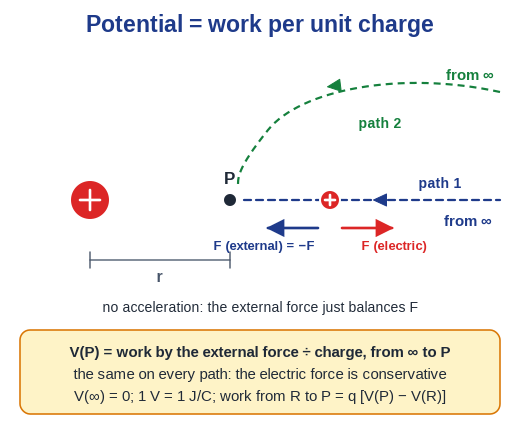
Lift a bag onto a shelf and the work you do is stored as potential energy. The Coulomb force behaves the same way, because it is conservative: the work done against it between two points depends only on those points, never on the path.
So imagine bringing a small test charge q, very slowly, from R to P against the field. The external force just balances the electric force, so no kinetic energy is gained and all the work becomes potential energy. Dividing by q gives a quantity that belongs to the point, not to the charge:
VP − VR = (work from R to P)/q
Choose V = 0 at infinity. Then the electrostatic potential at P is the work needed, for each unit of positive charge, to bring a test charge from infinity to P. Its unit is the volt, 1 V = 1 J/C. Only potential differences have physical meaning; a constant added everywhere changes nothing.
What is the potential of a point charge?
Put Q > 0 at the origin and bring a unit positive charge in along a radius. At distance r′ the repulsive force is Q/(4πε₀r′²). Moving in by a small step (δr′ is negative) costs work −[Q/(4πε₀r′²)] δr′. Adding all the steps from r′ = ∞ to r′ = r:
W = −∫ Q/(4πε₀r′²) dr′ (from ∞ to r) = Q/(4πε₀r)
So V(r) = Q/(4πε₀r). The result holds for negative Q too, and then V is negative: the field itself pulls the unit charge in. For example, 30 cm from a 2 nC charge, V = (9 × 10⁹)(2 × 10⁻⁹)/0.30 = 60 V.
What is the potential of a dipole?
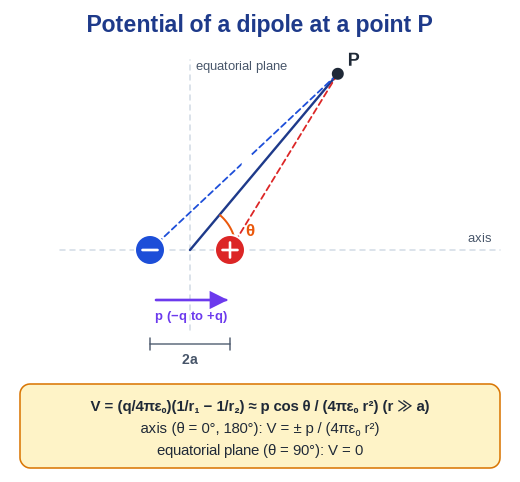
Place a dipole of moment p = q × 2a at the origin. A point P at distance r makes an angle θ with p, and lies r₁ from +q and r₂ from −q, with
r₁² = r² + a² − 2ar cos θ and r₂² = r² + a² + 2ar cos θ
For r ≫ a, keep only first-order terms in a/r: 1/r₁ ≈ (1/r)(1 + a cos θ/r) and 1/r₂ ≈ (1/r)(1 − a cos θ/r). Then
V = (q/4πε₀)(1/r₁ − 1/r₂) = 2qa cos θ/(4πε₀r²) = p cos θ/(4πε₀r²)
On the axis V = ±p/(4πε₀r²); on the equatorial plane V = 0. The dipole potential depends on direction and falls as 1/r², faster than a single charge’s 1/r. For a point dipole the formula is exact.
How do the potentials of many charges add?
Potentials obey superposition, and they are scalars. For charges q₁, q₂, …, qₙ at distances r₁, r₂, …, rₙ from P:
V = (1/4πε₀)(q₁/r₁ + q₂/r₂ + … + qₙ/rₙ)
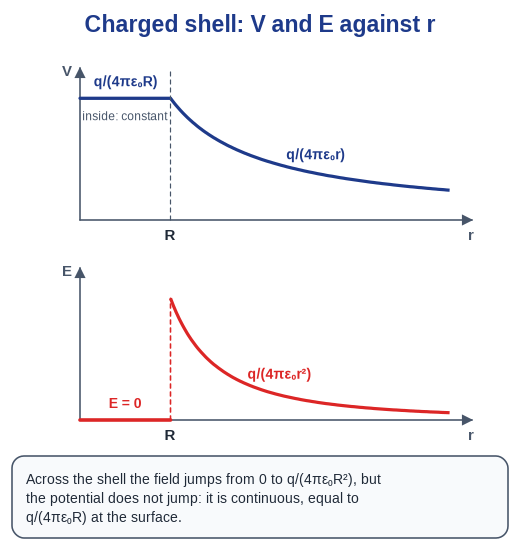
A uniformly charged spherical shell of radius R acts like a point charge outside, V = q/(4πε₀r). Inside, the field is zero, so no work is needed to move a charge about, and V stays at the surface value q/(4πε₀R) everywhere inside.
What is an equipotential surface?
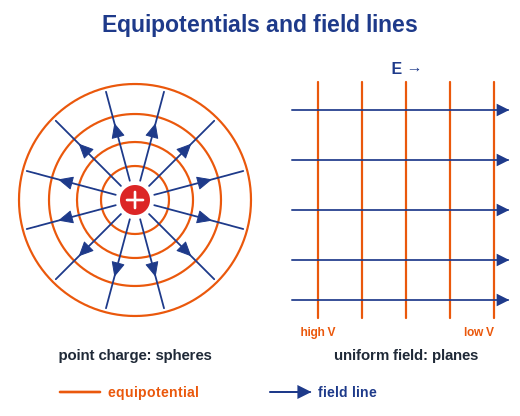
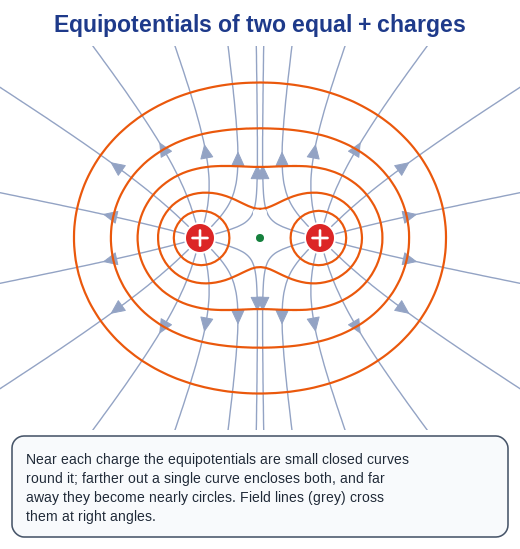
An equipotential surface has the same potential at every point. For a point charge, V depends only on r, so the equipotentials are spheres centred on the charge. For a uniform field they are planes at right angles to the field.
The field is normal to the equipotential through every point. Moving a charge along the surface needs no work, so the field can have no component along it. Field lines and equipotentials therefore always cross at right angles.
How are field and potential related?
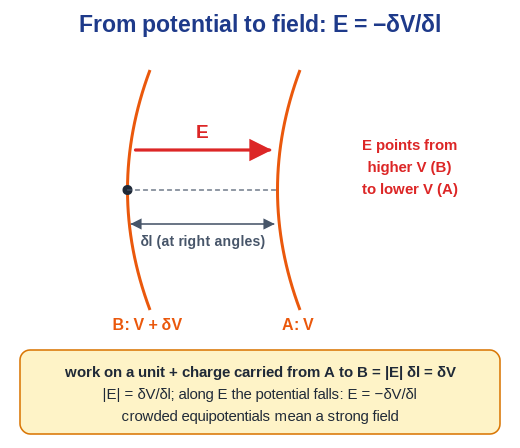
Take two close equipotentials, at V and at V + δV (δV > 0), a perpendicular distance δl apart. The field points from the higher one to the lower one. Carrying a unit positive charge from the lower surface to the higher one, against the field, takes work |E| δl, and this work equals the rise in potential δV. So |E| = δV/δl. Written with the sign, for a step δl taken along the field, where the potential changes by δV:
E = −δV/δl
So the field points in the direction in which the potential falls fastest, and its size is the drop in potential per metre, measured at right angles to the equipotentials. In a uniform field of 500 V/m, the potential drops by 20 V over 4 cm along the field.
Why is a conductor an equipotential?
In a conductor at rest the field inside is zero, and at the surface it is normal to the surface. So no work is needed to move a charge inside it or along its surface: the whole conductor, surface included, is at one potential. Its surface is an equipotential, which is why field lines always meet a conductor at right angles.
Next topic: electrostatic potential energy. See also the chapter notes and the NCERT solutions.
Practice
-
The potential 30 cm from a charge of 2 nC is:
Show answer
Answer: (b) 60 V
-
Equipotential surfaces of a uniform electric field are:
Show answer
Answer: (c) planes perpendicular to the field
-
How much work does the field do when a charge moves 5 cm along an equipotential surface?
Show answer
Answer: (b) zero
-
Equipotentials of 50 V and 30 V are flat, parallel and 2 cm apart. Find the field between them.
Show answer
Answer: E = δV/δl = (50 − 30) V ÷ 0.02 m = 1000 V/m, pointing from the 50 V surface towards the 30 V surface.
-
Charges of +4 nC and −1 nC are 30 cm apart. Where between them is the potential zero?
Show answer
Answer: At x from the +4 nC charge, 4/x = 1/(30 − x), so 120 − 4x = x and x = 24 cm. (A second zero lies outside, 40 cm from the +4 nC charge.)
Questions students ask
What is the SI unit of electric potential?
The volt (V). One volt is one joule of work per coulomb of charge, 1 V = 1 J C⁻¹. The field unit N/C is the same as V/m.
Why is the potential at infinity taken as zero?
Only differences of potential can be measured, so the zero can be put anywhere. Infinity is convenient because a charge has no effect there, and it gives the simple formula V = q/(4πε₀r).
Why is the electric field perpendicular to an equipotential surface?
Moving a charge along an equipotential needs no work, because its potential does not change. If the field had a part along the surface, that part would do work. So the field can only point across the surface, at right angles to it.
What is the potential of a dipole on its axis and on its equatorial line?
For r much larger than a, it is p/(4πε₀r²) on the axis on the side of +q, −p/(4πε₀r²) on the side of −q, and zero everywhere on the equatorial plane.
Stuck on a question?
Take a photo and Lagnever AI explains it step by step. Try it for 7 days for ₹2.
Get it on Google Play Open in browser
For parents: after the trial, the plan renews monthly by UPI or card autopay. You can cancel anytime in the app.