
NCERT Solutions Class 12 Physics Chapter 4: Moving Charges and Magnetism
Answers to all 13 end-of-chapter exercises and all 12 worked examples of Chapter 4, Moving Charges and Magnetism, of Physics Part I, the Class 12 NCERT textbook. Page numbers follow the 2026-27 reprint (pages 107–135). The exercises come first, quoted from the book; the examples follow, restated in short. Every number was also checked by computer. Short notes: Chapter 4 notes.
We use µ₀ = 4π × 10⁻⁷ T m A⁻¹, so µ₀/2π = 2 × 10⁻⁷ T m A⁻¹, and e = 1.6 × 10⁻¹⁹ C. Directions are worked out with the right-hand rules. A dot means “out of the page” and a cross means “into the page”.
Safety: Any circuit you build to check these ideas should run on cells or a low-voltage battery only, never on the mains. Exercise 4.4 is about an overhead power line: that is a calculation only, and nobody should go near such a line.
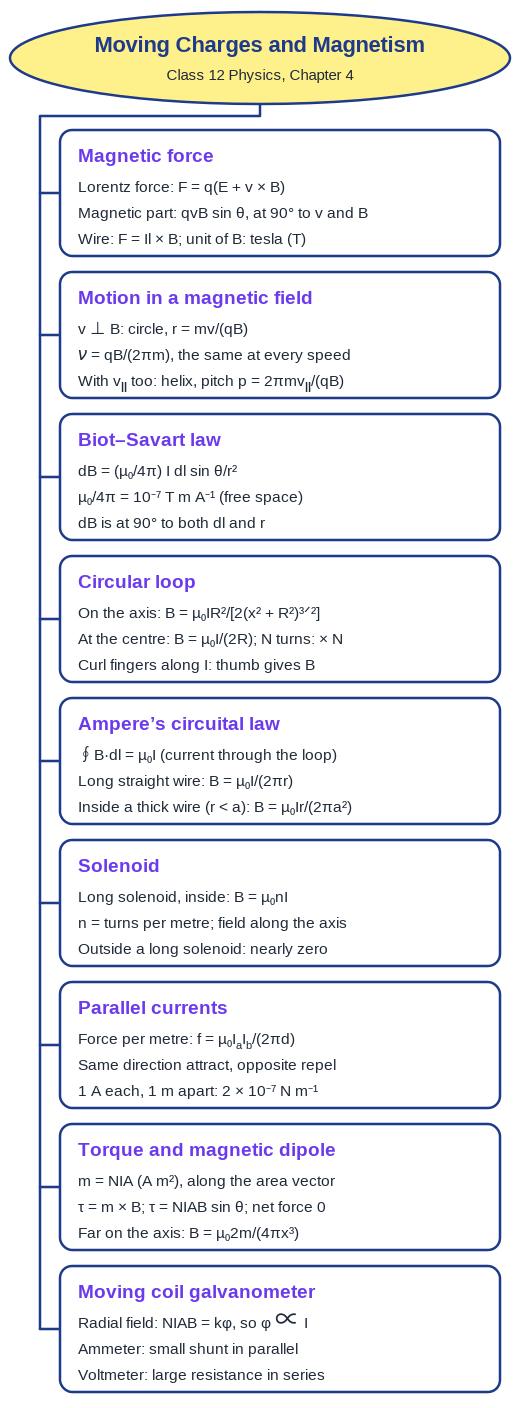
Exercises 4.1 to 4.4: fields of coils and straight wires
4.1 “A circular coil of wire consisting of 100 turns, each of radius 8.0 cm carries a current of 0.40 A. What is the magnitude of the magnetic field B at the centre of the coil?”
For N turns of radius R, the field at the centre is B = µ₀NI/(2R). With N = 100, I = 0.40 A and R = 0.080 m:
B = (4π × 10⁻⁷ × 100 × 0.40)/(2 × 0.080) = π × 10⁻⁴ T = 3.1 × 10⁻⁴ T
4.2 “A long straight wire carries a current of 35 A. What is the magnitude of the field B at a point 20 cm from the wire?”
B = µ₀I/(2πr) = (2 × 10⁻⁷ × 35)/0.20 = 3.5 × 10⁻⁵ T
4.3 “A long straight wire in the horizontal plane carries a current of 50 A in north to south direction. Give the magnitude and direction of B at a point 2.5 m east of the wire.”
B = µ₀I/(2πr) = (2 × 10⁻⁷ × 50)/2.5 = 4 × 10⁻⁶ T
Direction: hold the wire in the right hand with the thumb pointing south, along the current. On the east side of the wire the fingers come up out of the ground. So B at the point is vertically upwards.
4.4 “A horizontal overhead power line carries a current of 90 A in east to west direction. What is the magnitude and direction of the magnetic field due to the current 1.5 m below the line?”
B = µ₀I/(2πr) = (2 × 10⁻⁷ × 90)/1.5 = 1.2 × 10⁻⁵ T
Direction: with the right thumb pointing west, the fingers below the line point to the south. So B there is towards the south. (Looking west along the line, the current flows away from us and the field lines run clockwise; at the lowest point of a clockwise circle the direction is to our left, which is south.)
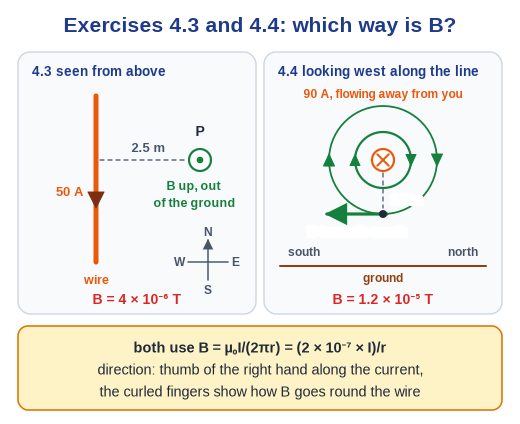
Exercises 4.5 to 4.8: forces on wires and a solenoid
4.5 “What is the magnitude of magnetic force per unit length on a wire carrying a current of 8 A and making an angle of 30° with the direction of a uniform magnetic field of 0.15 T?”
F = IlB sin θ, so the force per unit length is
f = IB sin θ = 8 × 0.15 × sin 30° = 8 × 0.15 × 0.5 = 0.6 N m⁻¹
4.6 “A 3.0 cm wire carrying a current of 10 A is placed inside a solenoid perpendicular to its axis. The magnetic field inside the solenoid is given to be 0.27 T. What is the magnetic force on the wire?”
The field inside a solenoid is along its axis, so the wire is at right angles to the field (sin θ = 1):
F = IlB = 10 × 0.030 × 0.27 = 8.1 × 10⁻² N
The force is at right angles to both the wire and the axis of the solenoid, in the direction of l × B (the answer key names Fleming’s left-hand rule, which gives the same direction).
4.7 “Two long and parallel straight wires A and B carrying currents of 8.0 A and 5.0 A in the same direction are separated by a distance of 4.0 cm. Estimate the force on a 10 cm section of wire A.”
Field of B at the position of A:
B = µ₀IB/(2πd) = (2 × 10⁻⁷ × 5.0)/0.040 = 2.5 × 10⁻⁵ T
Force on a length L = 0.10 m of A:
F = IALB = 8.0 × 0.10 × 2.5 × 10⁻⁵ = 2 × 10⁻⁵ N
The currents are in the same direction, so the force is attractive: it is at right angles to A and points towards B. (In one step: F = µ₀IAIBL/(2πd).)
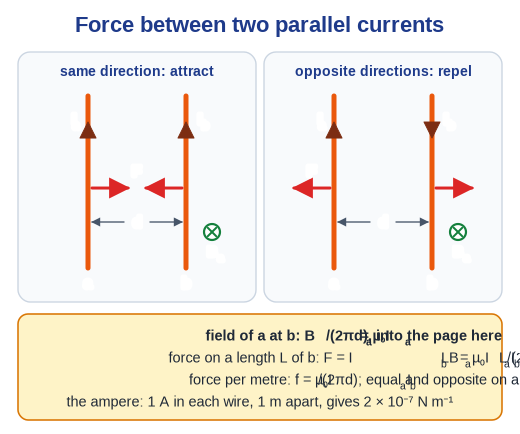
4.8 “A closely wound solenoid 80 cm long has 5 layers of windings of 400 turns each. The diameter of the solenoid is 1.8 cm. If the current carried is 8.0 A, estimate the magnitude of B inside the solenoid near its centre.”
Total turns = 5 × 400 = 2000 on a length of 0.80 m, so n = 2000/0.80 = 2500 turns per metre. The length (80 cm) is far larger than the radius (0.9 cm), so the long-solenoid formula holds:
B = µ₀nI = 4π × 10⁻⁷ × 2500 × 8.0 = 8π × 10⁻³ T = 2.5 × 10⁻² T
The field is along the axis. The diameter does not enter the formula.
Exercises 4.9 and 4.10: torque and meter sensitivity
4.9 “A square coil of side 10 cm consists of 20 turns and carries a current of 12 A. The coil is suspended vertically and the normal to the plane of the coil makes an angle of 30° with the direction of a uniform horizontal magnetic field of magnitude 0.80 T. What is the magnitude of torque experienced by the coil?”
Area A = (0.10 m)² = 1.0 × 10⁻² m². The angle between the normal (the direction of m) and B is θ = 30°:
τ = NIAB sin θ = 20 × 12 × 1.0 × 10⁻² × 0.80 × sin 30° = 1.92 × 0.5 = 0.96 N m
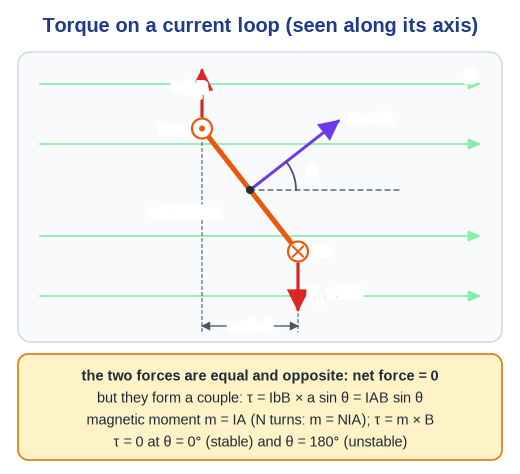
4.10 “Two moving coil meters, M₁ and M₂ have the following particulars: R₁ = 10 Ω, N₁ = 30, A₁ = 3.6 × 10⁻³ m², B₁ = 0.25 T; R₂ = 14 Ω, N₂ = 42, A₂ = 1.8 × 10⁻³ m², B₂ = 0.50 T (The spring constants are identical for the two meters). Determine the ratio of (a) current sensitivity and (b) voltage sensitivity of M₂ and M₁.”
Current sensitivity is the deflection per unit current, φ/I. Voltage sensitivity is the deflection per unit voltage, φ/V. For a moving coil meter with a spring of constant k (torsion constant):
(a) Current sensitivity = NAB/k. The spring constants are equal, so k cancels in the ratio:
ratio (M₂ to M₁) = N₂A₂B₂/(N₁A₁B₁) = (42 × 1.8 × 10⁻³ × 0.50)/(30 × 3.6 × 10⁻³ × 0.25) = 0.0378/0.027 = 1.4
(b) Voltage sensitivity = NAB/(kR), which is the current sensitivity divided by the resistance:
ratio = 1.4 × R₁/R₂ = 1.4 × 10/14 = 1
M₂ is 1.4 times as sensitive to current, but the two meters are equally sensitive to voltage.
Exercises 4.11 to 4.13: an electron in a field, and a circular coil
4.11 “In a chamber, a uniform magnetic field of 6.5 G (1 G = 10⁻⁴ T) is maintained. An electron is shot into the field with a speed of 4.8 × 10⁶ m s⁻¹ normal to the field. Explain why the path of the electron is a circle. Determine the radius of the circular orbit. (e = 1.5 × 10⁻¹⁹ C, mₑ = 9.1 × 10⁻³¹ kg)”
Why the path is a circle:
- The magnetic force on the electron, −e(v × B), is always at right angles to its velocity.
- A force at right angles to the motion does no work. So the speed v does not change.
- The size of the force, evB, therefore stays the same too.
- A force of constant size that always points sideways to the motion is a centripetal force (a force towards the centre of a circle). So the electron moves in a circle, in the plane at right angles to B.
Radius: the magnetic force supplies the centripetal force, evB = mₑv²/r, so r = mₑv/(eB). With B = 6.5 G = 6.5 × 10⁻⁴ T and the standard value e = 1.6 × 10⁻¹⁹ C:
r = (9.1 × 10⁻³¹ × 4.8 × 10⁶)/(1.6 × 10⁻¹⁹ × 6.5 × 10⁻⁴) = 4.37 × 10⁻²⁴/(1.04 × 10⁻²²) = 4.2 × 10⁻² m
Answer: r = 4.2 cm
(The 2026-27 reprint prints e = 1.5 × 10⁻¹⁹ C in this question. That looks like a misprint: the book’s own answer key, 4.2 cm, comes from the standard e = 1.6 × 10⁻¹⁹ C. With the printed 1.5 × 10⁻¹⁹ C, the radius works out to 4.5 cm.)
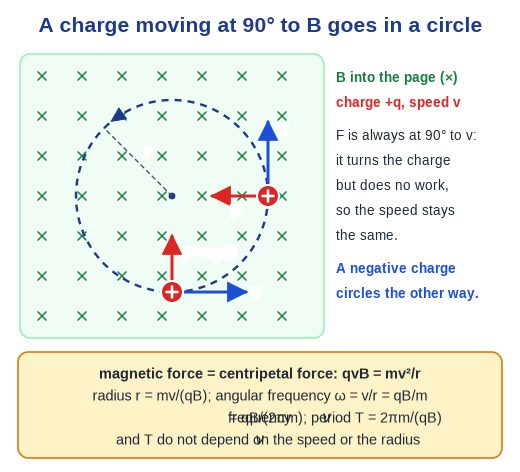
4.12 “In Exercise 4.11 obtain the frequency of revolution of the electron in its circular orbit. Does the answer depend on the speed of the electron? Explain.”
ν = eB/(2πmₑ) = (1.6 × 10⁻¹⁹ × 6.5 × 10⁻⁴)/(2π × 9.1 × 10⁻³¹) = 1.04 × 10⁻²²/(5.72 × 10⁻³⁰) = 1.8 × 10⁷ Hz = 18 MHz
(Check: v/(2πr) = 4.8 × 10⁶/(2π × 0.042) = 1.8 × 10⁷ Hz. With the printed e = 1.5 × 10⁻¹⁹ C it would be 17 MHz; the answer key gives 18 MHz.)
No, it does not depend on the speed. In ν = v/(2πr) the radius r = mv/(eB) is itself proportional to v, so v cancels. A faster electron travels round a larger circle in the same time.
4.13 “(a) A circular coil of 30 turns and radius 8.0 cm carrying a current of 6.0 A is suspended vertically in a uniform horizontal magnetic field of magnitude 1.0 T. The field lines make an angle of 60° with the normal of the coil. Calculate the magnitude of the counter torque that must be applied to prevent the coil from turning. (b) Would your answer change, if the circular coil in (a) were replaced by a planar coil of some irregular shape that encloses the same area? (All other particulars are also unaltered.)”
(a) Area A = πR² = π × (0.080)² = 2.01 × 10⁻² m². The magnetic torque is
τ = NIAB sin θ = 30 × 6.0 × 2.01 × 10⁻² × 1.0 × sin 60° = 3.62 × 0.866 = 3.1 N m
The counter torque must be equal to this and opposite in sense.
(b) No. The torque on a flat loop is τ = NIA × B. It depends on the area of the loop, not on its shape, so a planar coil of any shape with the same area feels the same torque.
Worked examples 4.1 to 4.3 (pages 111–113)
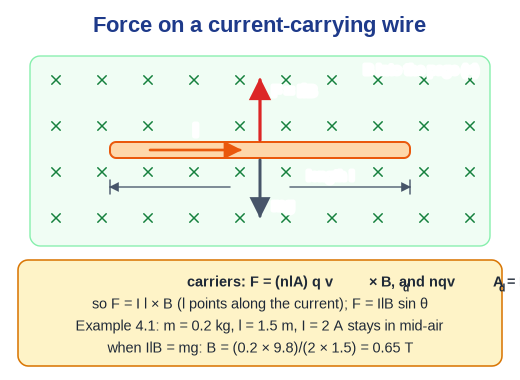
Example 4.1 (page 111): A straight wire 1.5 m long, of mass 200 g, has a current of 2 A in it. A uniform horizontal field B holds it up in mid-air. Find B.
The magnetic force IlB (the field is at right angles to the wire) must balance the weight:
IlB = mg, so B = mg/(Il) = (0.2 × 9.8)/(2 × 1.5) = 0.65 T
Only the mass per unit length, m/l, matters. The earth’s field, a few times 10⁻⁵ T, is far too small to count here.
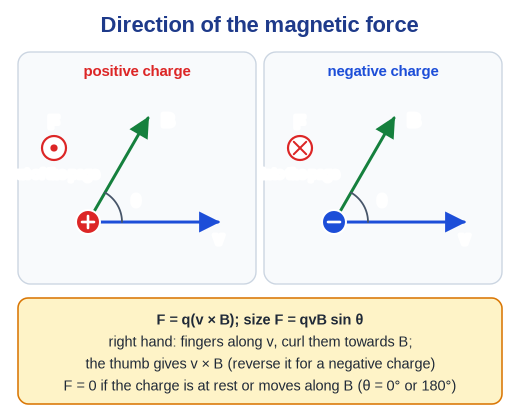
Example 4.2 (page 111): The field is along +y and a charged particle moves along +x. Which way is the Lorentz force on (a) an electron, (b) a proton?
v × B is along x̂ × ŷ = ẑ, that is +z. The force is q(v × B), so (a) for the electron (negative charge) it is along −z; (b) for the proton it is along +z.
Example 4.3 (page 113): An electron (m = 9 × 10⁻³¹ kg, charge 1.6 × 10⁻¹⁹ C) moves at 3 × 10⁷ m s⁻¹ at right angles to a field of 6 × 10⁻⁴ T. Find the radius of its path, its frequency and its energy in keV.
r = mv/(qB) = (9 × 10⁻³¹ × 3 × 10⁷)/(1.6 × 10⁻¹⁹ × 6 × 10⁻⁴) = 0.28 m = 28 cm
ν = v/(2πr) = 3 × 10⁷/(2π × 0.28) = 1.7 × 10⁷ Hz = 17 MHz (the same as qB/(2πm))
E = ½mv² = ½ × 9 × 10⁻³¹ × 9 × 10¹⁴ = 4.05 × 10⁻¹⁶ J = (4.05 × 10⁻¹⁶)/(1.6 × 10⁻¹⁹) eV = 2.5 keV
Worked examples 4.4 to 4.6 (pages 114–117)
Example 4.4 (pages 114–115): An element Δl = Δx î, with Δx = 1 cm, sits at the origin and carries I = 10 A. Find the field at a point on the y-axis 0.5 m away.
Here r = 0.5 m and the angle between the element and r is 90°:
dB = (µ₀/4π) I dl sin θ/r² = 10⁻⁷ × 10 × 10⁻²/(0.5)² = 4 × 10⁻⁸ T
Direction: dl × r is along î × ĵ = k̂, so the field is along +z. It is a very small field.
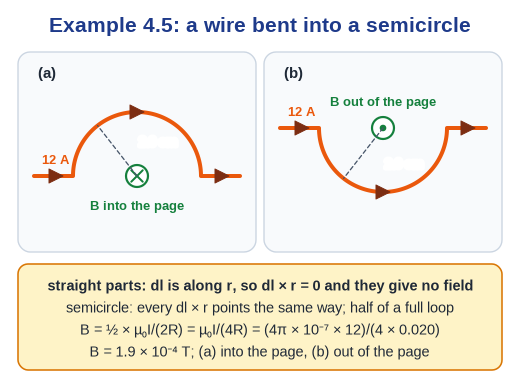
Example 4.5 (page 117): A straight wire carrying 12 A is bent into a semicircular arc of radius 2.0 cm. Consider B at the arc’s centre: (a) what do the straight parts contribute? (b) How does the semicircle compare with a full loop? (c) What changes if the wire is bent the other way?
(a) For every element of the straight parts, dl is along r, so dl × r = 0. They give no field at the centre.
(b) For every element of the arc, dl × r points the same way, so the contributions add, as in a full loop. But there is only half a loop, so the field is half as large:
B = ½ × µ₀I/(2R) = µ₀I/(4R) = (4π × 10⁻⁷ × 12)/(4 × 0.020) = 1.9 × 10⁻⁴ T
In the book’s Fig. 4.11(a), the current runs left to right over an arc that bulges upwards, clockwise round the centre, so B points into the page.
(c) The size is the same, but B points the other way (out of the page).
Example 4.6 (page 117): A tightly wound coil of 100 turns and radius 10 cm carries 1 A. Find the field at its centre.
All the turns have nearly the same radius R = 0.1 m, so
B = µ₀NI/(2R) = (4π × 10⁻⁷ × 100 × 1)/(2 × 0.1) = 2π × 10⁻⁴ T = 6.28 × 10⁻⁴ T
Worked examples 4.7 to 4.9 (pages 119–124)
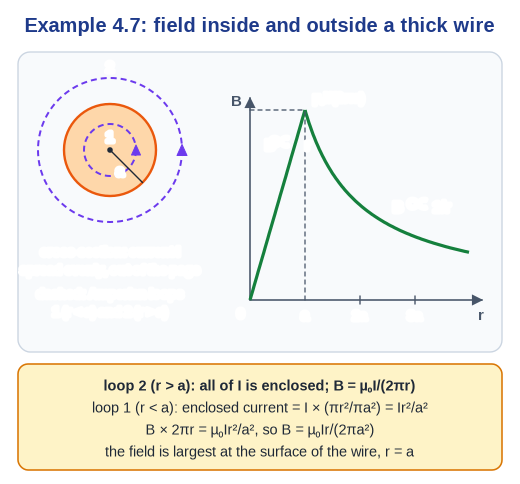
Example 4.7 (pages 119–120): A long straight wire of circular cross-section, radius a, carries a steady current I spread evenly over the cross-section. Find the field for r < a and for r > a.
Use circular Amperian loops centred on the axis; on each, B is constant and along the loop, so B × 2πr = µ₀Ie.
Outside (r > a): the loop encloses all the current, Ie = I, so B = µ₀I/(2πr), falling as 1/r.
Inside (r < a): the loop encloses the fraction πr²/πa² of the current, Ie = Ir²/a². Then B × 2πr = µ₀Ir²/a², so B = µ₀Ir/(2πa²), growing in proportion to r.
The two expressions agree at the surface, r = a, where the field is largest: µ₀I/(2πa).
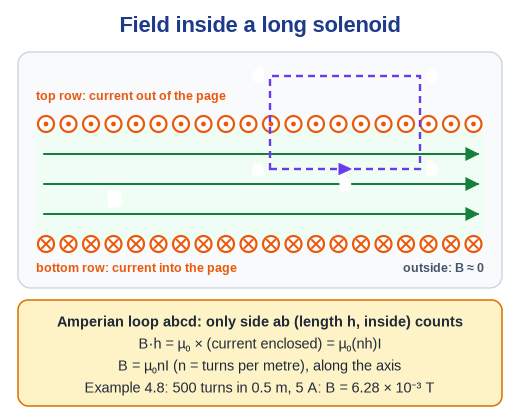
Example 4.8 (page 122): A solenoid 0.5 m long, of radius 1 cm, has 500 turns and carries 5 A. Find the field inside.
n = 500/0.5 = 1000 turns per metre. The length is 50 times the radius, so the long-solenoid formula B = µ₀nI applies (the book’s solution cites Eq. (4.20) here; the solenoid formula is its Eq. (4.16)):
B = 4π × 10⁻⁷ × 10³ × 5 = 6.28 × 10⁻³ T
Example 4.9 (page 124): At a place the horizontal part of the earth’s field is 3.0 × 10⁻⁵ T, pointing from geographic south to north. A very long straight wire on a horizontal table carries 1 A. Find the force per unit length when the current flows (a) from east to west, (b) from south to north.
Force per unit length: f = IB sin θ.
(a) East to west: θ = 90°, so f = 1 × 3.0 × 10⁻⁵ = 3 × 10⁻⁵ N m⁻¹. Direction: l × B is (west) × (north), which points downwards. This is 150 times the 2 × 10⁻⁷ N m⁻¹ in the definition of the ampere, so the earth’s field must be cancelled when the ampere is standardised.
(b) South to north: the current is along the field, θ = 0°, so f = 0.
Worked examples 4.10 to 4.12 (pages 126–132)
Example 4.10 (pages 126–127): A closely wound circular coil of 100 turns and radius 10 cm carries 3.2 A. (a) Find the field at its centre. (b) Find its magnetic moment. The coil hangs in a vertical plane and can turn about a horizontal diameter; a uniform horizontal field of 2 T acts, at first along the axis of the coil, and the coil turns through 90°. (c) Find the torque in the first and last positions. (d) Find the angular speed gained in turning through 90°, if the moment of inertia is 0.1 kg m².
(a) B = µ₀NI/(2R) = (4π × 10⁻⁷ × 100 × 3.2)/(2 × 0.1) = 2 × 10⁻³ T (the book takes π × 3.2 = 10).
(b) m = NIA = NIπr² = 100 × 3.2 × 3.14 × (0.1)² = 10 A m²
(c) τ = mB sin θ. First position: θ = 0, so τ = 0. Last position: θ = 90°, so τ = mB = 10 × 2 = 20 N m.
(d) Newton’s second law for rotation: J dω/dt = mB sin θ, where J = 0.1 kg m² is the moment of inertia (we write J to keep it apart from the current I). Writing dω/dt = ω dω/dθ gives Jω dω = mB sin θ dθ. Integrating from θ = 0 to π/2:
½Jω² = mB, so ω = √(2mB/J) = √(2 × 10 × 2/0.1) = 20 rad s⁻¹
(Energy check: the potential energy −mB cos θ differs by mB = 20 J between the two positions, and ½ × 0.1 × 20² = 20 J. A coil left to itself turns towards θ = 0, so 20 rad s⁻¹ is the speed with which a coil released from rest at θ = 90° passes through θ = 0.)
Example 4.11 (pages 127–128): (a) A circular loop with a current in it rests flat on a smooth table. Can a uniform field make it spin about the vertical axis? (b) What is the stable position of a loop that can turn in a uniform outside field, and what can be said about the flux there? (c) A flexible loop of irregular shape carries current in an outside field. Why does it become circular?
(a) No. That would need a torque along the vertical. But τ = IA × B, and A of a horizontal loop is vertical, so τ is always horizontal, whatever the direction of B.
(b) The loop is stable when its area vector A points along the outside field. In this position the loop’s own field inside it is in the same direction as the outside field, so the flux of the total field through the loop is as large as it can be.
(c) The wire takes the shape that gives the largest flux, with its plane at right angles to the field. For a given perimeter, a circle encloses more area than any other shape.
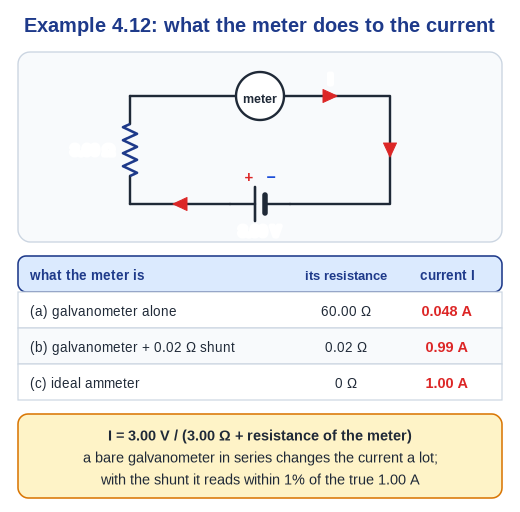
Example 4.12 (pages 131–132): A 3.00 V cell and a 3.00 Ω resistor are in series with a current meter. Find the current if the meter is (a) a galvanometer of resistance RG = 60.00 Ω; (b) the same galvanometer with a shunt rs = 0.02 Ω; (c) an ideal ammeter of zero resistance.
(a) Total resistance = 60.00 + 3.00 = 63.00 Ω, so I = 3.00/63.00 = 0.048 A.
(b) Resistance of the shunted galvanometer = RGrs/(RG + rs) = (60.00 × 0.02)/60.02 ≈ 0.02 Ω. Total = 3.02 Ω, so I = 3.00/3.02 = 0.99 A.
(c) I = 3.00/3.00 = 1.00 A.
A bare galvanometer in series cuts the current to less than a twentieth of its true value. With the shunt, the meter changes the current by less than 1 per cent.
Practice
-
The field at the centre of a circular coil of N turns and radius R carrying a current I is:
Show answer
Answer: (b) µ₀NI/(2R)
-
A long straight wire carries a current vertically upwards. At a point due east of the wire, the magnetic field points towards the:
Show answer
Answer: (a) north
-
An electron (m = 9.1 × 10⁻³¹ kg, e = 1.6 × 10⁻¹⁹ C) moves at 2 × 10⁷ m s⁻¹ at right angles to a field of 1 mT. Find the radius of its path.
Show answer
Answer: r = mv/(eB) = (9.1 × 10⁻³¹ × 2 × 10⁷)/(1.6 × 10⁻¹⁹ × 10⁻³) = 1.82 × 10⁻²³/(1.6 × 10⁻²²) = 0.114 m, about 11 cm.
-
A solenoid 0.5 m long has 1000 turns and carries 2 A. Find the field inside it near the middle.
Show answer
Answer: n = 1000/0.5 = 2000 m⁻¹. B = µ₀nI = 4π × 10⁻⁷ × 2000 × 2 = 5.0 × 10⁻³ T.
-
Two long parallel wires 3 cm apart carry 4 A and 6 A in opposite directions. Find the force on each metre of wire.
Show answer
Answer: f = µ₀I_aI_b/(2πd) = (2 × 10⁻⁷ × 4 × 6)/0.03 = 1.6 × 10⁻⁴ N m⁻¹. The currents are opposite, so the wires repel.
-
A coil of 100 turns and area 4 × 10⁻³ m² carries 0.5 A in a field of 0.2 T, with its plane along the field. Find the torque.
Show answer
Answer: The normal is at 90° to the field, so τ = NIAB = 100 × 0.5 × 4 × 10⁻³ × 0.2 = 0.04 N m.
Stuck on a question?
Take a photo and Lagnever AI explains it step by step. Try it for 7 days for ₹2.
Get it on Google Play Open in browser
For parents: after the trial, the plan renews monthly by UPI or card autopay. You can cancel anytime in the app.