
Class 12 Physics Chapter 4: Moving Charges and Magnetism Notes
This chapter in five lines
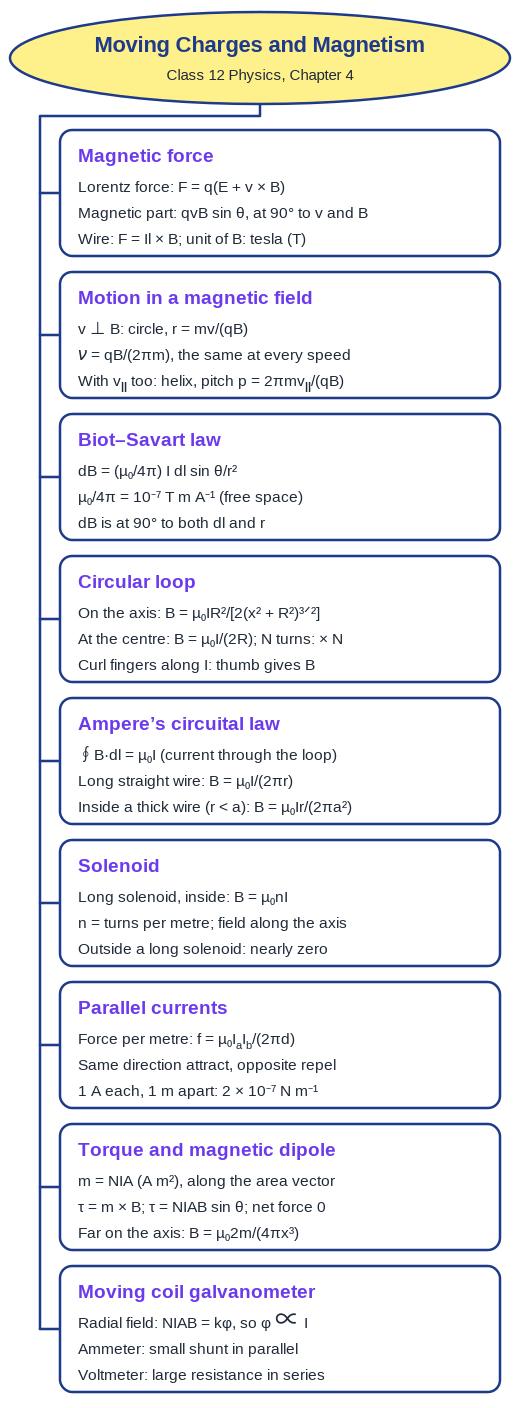
A moving charge feels the magnetic force F = q(v × B), which turns it in a circle of radius r = mv/(qB) without changing its speed. Currents make magnetic fields: the Biot–Savart law and Ampere’s circuital law give B = µ₀I/(2πr) for a long wire and B = µ₀nI inside a solenoid. A current loop is a magnetic dipole, m = NIA, with torque τ = m × B, the principle of the moving coil galvanometer.
What is this chapter about?
Until 1820, electricity and magnetism looked like two separate subjects. That year the Danish physicist Hans Christian Oersted saw that a compass needle placed near a wire turned when a current flowed in the wire. The needle set itself along the tangent to a circle drawn round the wire, and it swung the other way when the current was reversed. So a current, which is charge in motion, produces a magnetic field in the space round it.
This chapter has two halves. First, what a magnetic field does: it pushes on moving charges and on current-carrying wires. Second, how currents make magnetic fields: the Biot–Savart law and Ampere’s circuital law. At the end, both ideas meet in the moving coil galvanometer, the instrument behind ammeters and voltmeters.
Dot and cross. A field or a current coming out of the page is drawn as a dot (the tip of an arrow flying at you). One going into the page is drawn as a cross (the tail feathers of an arrow flying away).
Safety: Any experiment with wires, coils and compass needles from this chapter should run on cells or a low-voltage battery only. Never connect a wire, a coil or a meter to a mains socket.
What is the Lorentz force?
A charge q moving with velocity v where there is an electric field E and a magnetic field B feels the Lorentz force
F = q(E + v × B)
The magnetic part, q(v × B), has three features:
- it depends on the charge, the velocity and the field, and it reverses for a negative charge;
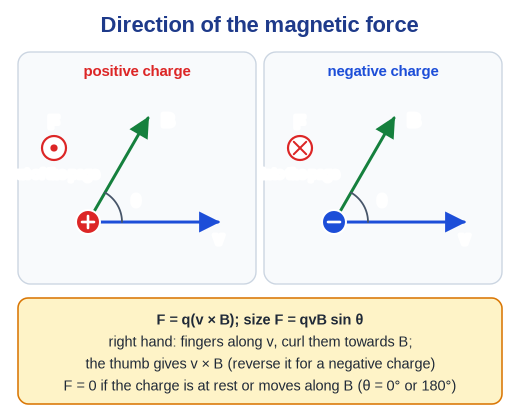
- its size is qvB sin θ, where θ is the angle between v and B, so it is zero when the charge moves along the field or against it;
- it is zero for a charge at rest. Only a moving charge feels a magnetic force.
The force is at right angles to both v and B. Point the fingers of your right hand along v and curl them towards B: the thumb gives the direction of v × B.
The force law defines the unit of B. The field is 1 tesla (T) if a charge of 1 C moving at 1 m s⁻¹ at right angles to it feels a force of 1 N, so 1 T = 1 N A⁻¹ m⁻¹. A tesla is a large unit: the earth’s field is only about 3.6 × 10⁻⁵ T. The smaller unit gauss is 10⁻⁴ T. Read the magnetic force on moving charges.
What is the force on a current-carrying wire?
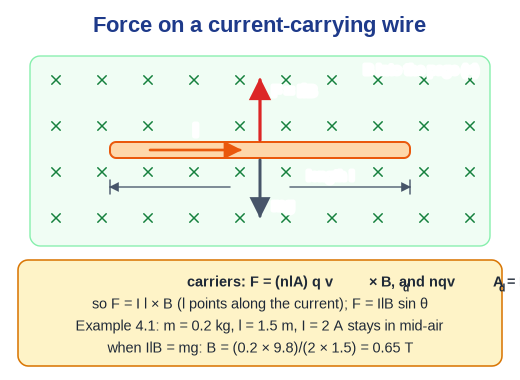
A current is a stream of moving charges, so a wire carrying a current in a magnetic field feels a force. Take a straight rod of length l and cross-section A with n mobile carriers per cubic metre, each of charge q and drift velocity vd. The rod holds nlA carriers, so the total force is (nlA)q vd × B. Since nqvdA is the current I,
F = I l × B, of size F = IlB sin θ
Here l has the length of the rod and points along the current. B is the outside field, not the field made by the rod itself. In Example 4.1, a 1.5 m wire of mass 200 g carrying 2 A floats in mid-air when IlB = mg, which needs B = 0.65 T.
How does a charge move in a magnetic field?
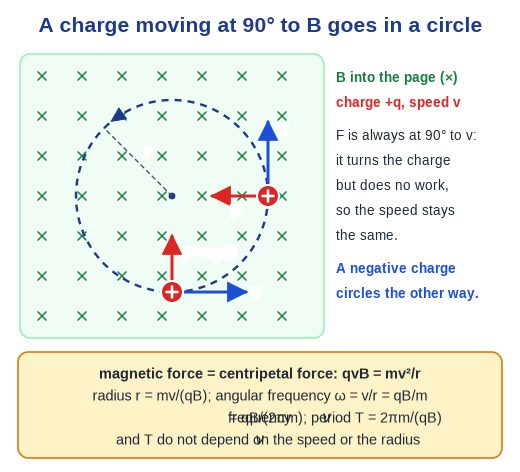
The magnetic force is always at right angles to the velocity. So it does no work: it changes the direction of motion but never the speed.
If v is at right angles to a uniform B, the force qvB acts as a centripetal force and the charge goes round a circle:
mv²/r = qvB, so r = mv/(qB)
The angular frequency is ω = v/r = qB/m, and the frequency of revolution is
ν = qB/(2πm)
This does not depend on the speed or the energy: a faster particle moves in a bigger circle and still takes the same time for one turn. The cyclotron, a machine that speeds up charged particles, uses this fact.
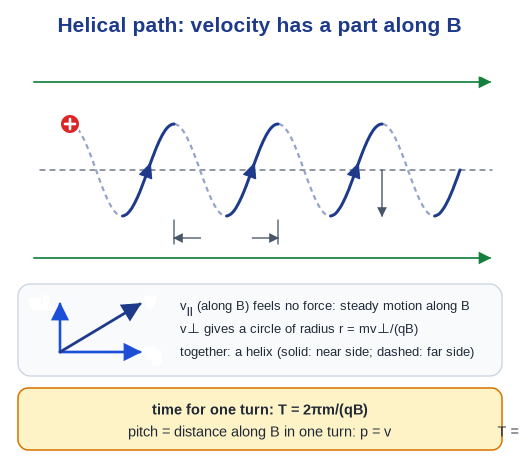
If the velocity also has a part v∥ along B, that part is not affected by the field. The charge circles and moves along the field at the same time, tracing a helix. The distance it moves along the field in one turn is the pitch:
p = v∥T = 2πmv∥/(qB)
What is the Biot–Savart law?
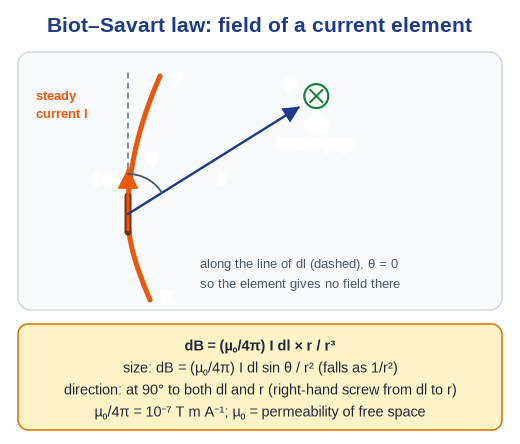
The Biot–Savart law gives the magnetic field of a small piece of a current-carrying wire. An element dl carrying a steady current I produces, at a point P a distance r away,
dB = (µ₀/4π) I dl × r/r³, of size dB = (µ₀/4π) I dl sin θ/r²
θ is the angle between dl and r, the vector from the element to P. The field is at right angles to the plane holding dl and r. The constant µ₀ is the permeability of free space: µ₀/4π = 10⁻⁷ T m A⁻¹.
Compare it with Coulomb’s law. Both fall as 1/r², and both obey superposition. But the source of the electric field is a scalar (charge), while the source of the magnetic field is a vector (I dl). The electric field points along the line from the source; the magnetic field is at right angles to it. And the magnetic field depends on the angle: along the line of the element itself (θ = 0) it is zero. The constants are linked: µ₀ε₀ = 1/c², where c is the speed of light in vacuum. Read the Biot–Savart law and Ampere’s circuital law.
What is the field on the axis of a circular loop?
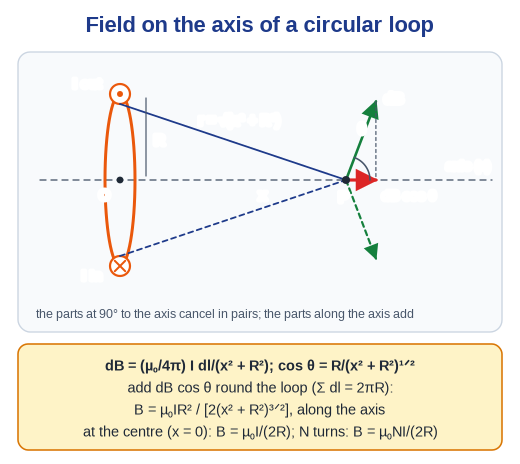
Take a loop of radius R carrying a current I, and a point P on its axis at a distance x from the centre. Every element of the loop is at the same distance r = √(x² + R²) from P and is at right angles to its r, so each gives dB = (µ₀/4π) I dl/(x² + R²). The parts of these fields at right angles to the axis cancel in pairs, element against the element opposite. The parts along the axis, dB cos θ with cos θ = R/√(x² + R²), add up. Summing dl round the loop gives 2πR:
B = µ₀IR²/[2(x² + R²)3/2], along the axis
At the centre (x = 0) this becomes B = µ₀I/(2R), and a coil of N close turns gives N times as much.
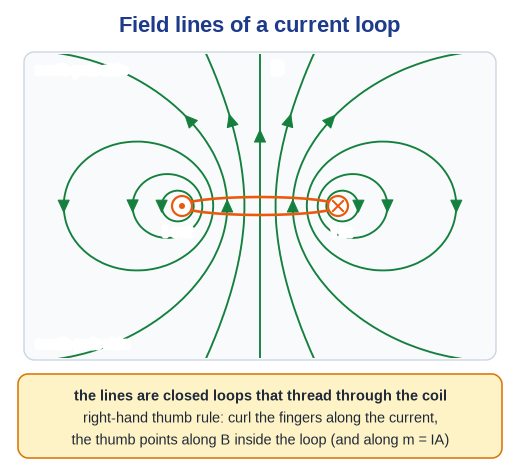
Right-hand thumb rule for a loop: curl the fingers of your right hand round the loop in the direction of the current; the thumb gives the direction of the field inside the loop. The field lines are closed curves that thread through the loop. One face of the loop acts like the north pole of a magnet and the other like the south pole.
What is Ampere’s circuital law?
Take any closed loop and an open surface that has the loop as its edge. Go round the loop adding up Bt dl, the component of the field along the loop times each small step. Ampere’s circuital law says
∮B·dl = µ₀I
where I is the total current passing through the surface. Sign rule: curl the fingers of the right hand the way you go round the loop; a current along the thumb counts as positive.
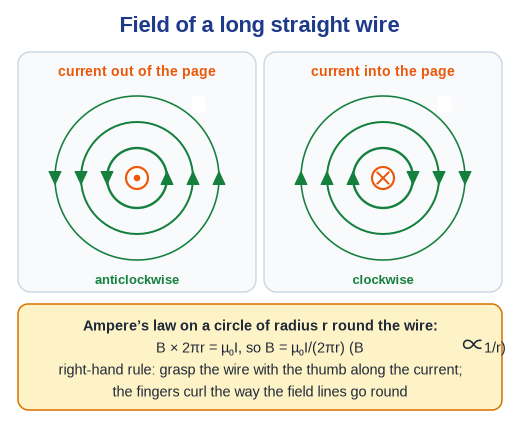
The law is most useful when symmetry lets us pick an Amperian loop on which B is constant and along the loop. Then BL = µ₀Ie, with Ie the current enclosed. For a long straight wire, take a circle of radius r round it:
B × 2πr = µ₀I, so B = µ₀I/(2πr)
The field lines are circles round the wire, which is what Oersted’s needle showed. Hold the wire in the right hand, thumb along the current: the fingers curl the way the field goes. Ampere’s law says nothing that the Biot–Savart law does not; it stands to that law as Gauss’s law stands to Coulomb’s law. Both hold for steady currents.
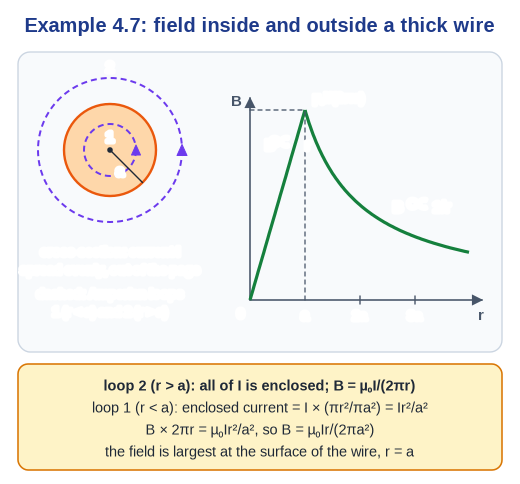
For a thick wire of radius a with the current spread evenly (Example 4.7), a loop inside the wire encloses only Ir²/a², so B = µ₀Ir/(2πa²) for r < a. The field grows in a straight line up to the surface and then falls as 1/r.
What is the field inside a solenoid?
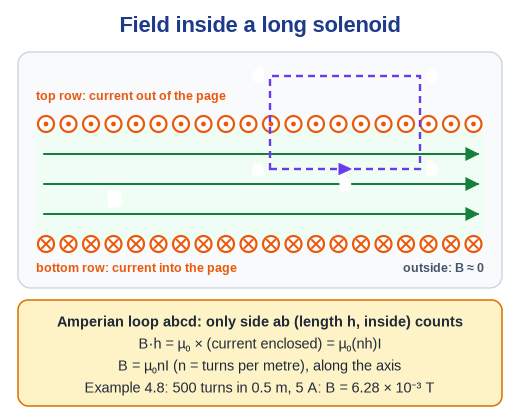
A solenoid is a long wire wound as a tight helix, with insulated (enamelled) turns. “Long” means its length is much larger than its radius. Each turn acts like a circular loop, and the fields of all the turns add. Inside, near the middle, the field is uniform, strong and along the axis. Outside, it is weak, and for an ideal long solenoid we take it as zero.
Apply Ampere’s law to a rectangle abcd with side ab, of length h, inside along the axis and cd outside. Only ab contributes. If there are n turns per metre, the rectangle encloses nh turns, each carrying I:
Bh = µ₀(nh)I, so B = µ₀nI
A soft-iron core inside the solenoid makes the field much larger (next chapter).
What is the force between two parallel currents?
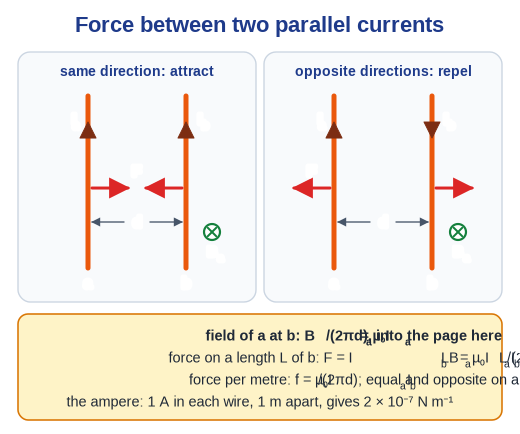
One wire makes a field; a second wire carrying current in that field feels a force. Let long parallel wires a and b, a distance d apart, carry currents Ia and Ib. Wire a makes the field Ba = µ₀Ia/(2πd) at wire b. The force on a length L of b is IbLBa, so the force on each metre is
f = µ₀IaIb/(2πd)
Wire b pulls on a with an equal and opposite force, as Newton’s third law needs. Currents in the same direction attract; currents in opposite directions repel. (Like charges repel, but like currents attract.)
This force defines the ampere: it is the steady current which, kept in each of two very long, straight, parallel wires of negligible cross-section placed 1 m apart in vacuum, gives a force of 2 × 10⁻⁷ N on each metre of the wires. The coulomb then follows: 1 C is the charge that passes in 1 s when the current is 1 A.
What is the torque on a current loop?
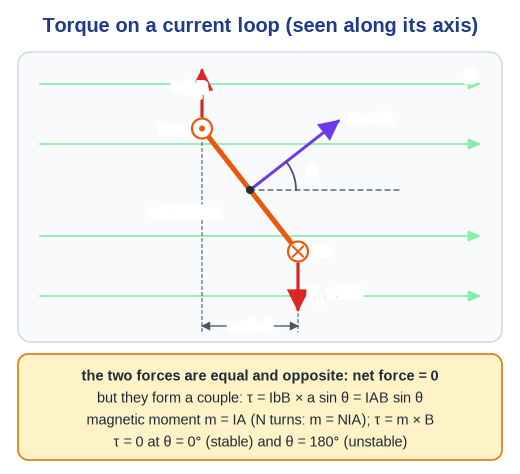
Put a rectangular loop with sides a and b, carrying a current I, in a uniform field B. The forces on opposite sides are equal and opposite, so the net force is zero. But the forces on the two sides of length b, each IbB, do not act along the same line. They form a couple. If the normal to the loop makes an angle θ with B, the two lines of force are a sin θ apart, and the torque is
τ = IbB × a sin θ = IAB sin θ, where A = ab
Define the magnetic moment of the loop as m = IA, with the area vector given by the right-hand thumb rule (m = NIA for N turns; unit A m²). Then
τ = m × B
just like τ = p × E for an electric dipole. The torque is zero when m is parallel to B (stable equilibrium) or antiparallel to it (unstable). Read the torque on a current loop and the moving coil galvanometer.
How is a current loop like a magnetic dipole?
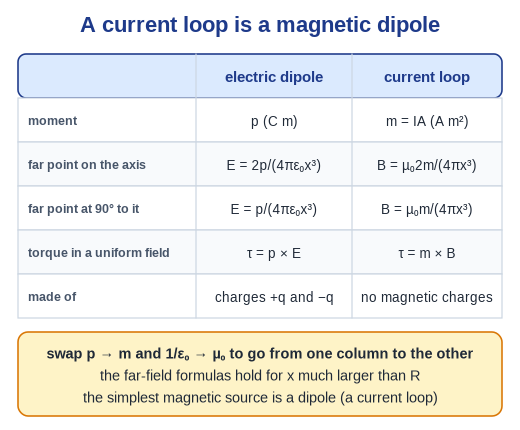
Far along the axis of a loop (x much larger than R), the axial field becomes B = µ₀IR²/(2x³). With m = IA = IπR²,
B = (µ₀/4π) 2m/x³
This has the same form as the field E = 2p/(4πε₀x³) on the axis of an electric dipole, with p → m and 1/ε₀ → µ₀. On the perpendicular line through the loop the match holds too: B = (µ₀/4π) m/x³. So a flat current loop behaves as a magnetic dipole. There is one basic difference: an electric dipole is built from two charges, but single magnetic poles (monopoles) are not known to exist. The simplest magnetic object is the dipole itself. Ampere suggested that all magnetism comes from circulating currents; this is partly true, though particles such as the electron and the proton also carry a magnetic moment of their own.
How does a moving coil galvanometer work?
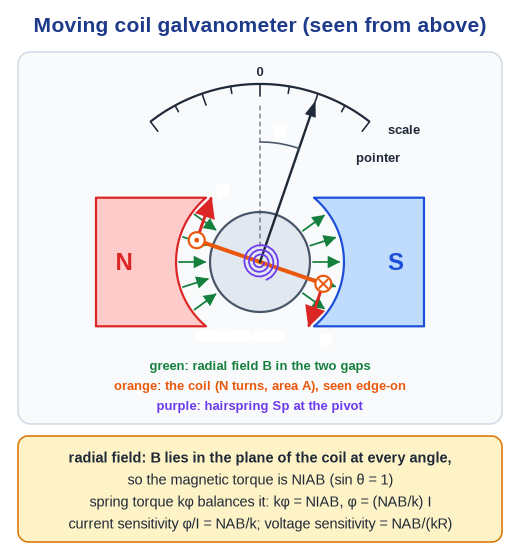
A moving coil galvanometer has a coil of many turns that can turn about a fixed axis between the curved poles of a magnet, round a cylindrical soft-iron core. The core makes the field radial (and stronger), so the plane of the coil always lies along the field and sin θ = 1. A current I gives the torque NIAB. A spring gives an opposing torque kφ, where k is its torsional constant. The coil settles where the two balance:
kφ = NIAB, so φ = (NAB/k) I
The deflection φ, read by a pointer on a scale, is proportional to the current. The current sensitivity is the deflection per unit current, φ/I = NAB/k. The voltage sensitivity is the deflection per unit voltage, φ/V = (NAB/k)(1/R), where R is the resistance of the galvanometer. Doubling the turns doubles the current sensitivity, but R doubles too, so the voltage sensitivity stays the same.
How is a galvanometer turned into an ammeter or a voltmeter?
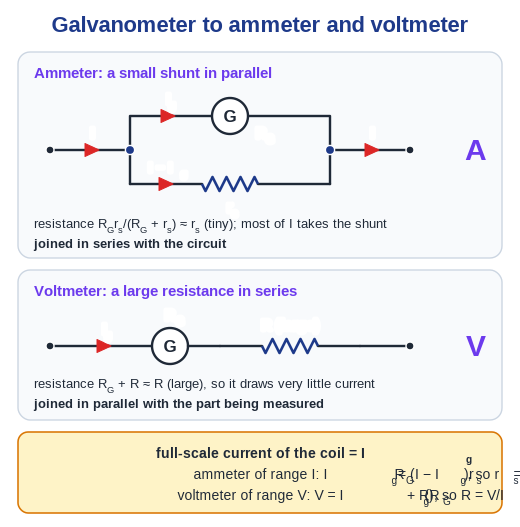
A galvanometer by itself is a poor ammeter: it shows full-scale deflection for a few microamperes, and its large resistance, placed in series, would change the current it is supposed to measure.
- Ammeter: join a small shunt resistance rs in parallel with the coil, so most of the current goes through the shunt. The combination has resistance RGrs/(RG + rs) ≈ rs, small enough not to disturb the circuit. An ammeter goes in series.
- Voltmeter: join a large resistance R in series with the coil. The total, RG + R, is large, so the meter draws very little current. A voltmeter goes in parallel with the part of the circuit being measured.
Before we move on
Keep three pictures in mind. A magnetic field pushes a moving charge sideways, F = q(v × B), so charges circle and wires feel F = I l × B. A current makes a field that curls round it, found from the Biot–Savart law or from Ampere’s law. And a current loop is a small magnet, m = NIA, that a field tries to turn. Practise the derivations with their diagrams and directions. All 13 exercises and all 12 worked examples are solved in the NCERT solutions for Chapter 4.
Key terms
| Term | Meaning |
|---|---|
| Magnetic field (B) | The vector field set up by moving charges and currents; SI unit tesla (T), 1 T = 1 N A⁻¹ m⁻¹. 1 gauss = 10⁻⁴ T. |
| Lorentz force | The total force on a charge q moving with velocity v in fields E and B: F = q(E + v × B). |
| Magnetic force | The part q(v × B); size qvB sin θ, at right angles to both v and B, so it does no work. |
| Cyclotron frequency (ν) | The frequency of the circular motion of a charge in a uniform field, ν = qB/(2πm); it does not depend on the speed. |
| Pitch (p) | The distance a charge on a helical path moves along B in one turn, p = 2πmv∥/(qB). |
| Biot–Savart law | The field of a current element: dB = (µ₀/4π) I dl × r/r³, of size (µ₀/4π) I dl sin θ/r². |
| Permeability of free space (µ₀) | The constant in the Biot–Savart law: µ₀ = 4π × 10⁻⁷ T m A⁻¹, so µ₀/4π = 10⁻⁷ T m A⁻¹. |
| Ampere’s circuital law | Round any closed loop, ∮B·dl = µ₀I, where I is the total current passing through the loop. |
| Amperian loop | A closed path chosen so that B is constant along it (or zero, or at right angles to it), which makes Ampere’s law easy to use. |
| Solenoid | A long wire wound as a close helix; inside a long solenoid B = µ₀nI along the axis, where n is the number of turns per metre. |
| Ampere (A) | The current which, in each of two long parallel wires 1 m apart in vacuum, gives a force of 2 × 10⁻⁷ N on each metre of wire. |
| Magnetic moment (m) | For a current loop, m = NIA, along the area vector given by the right-hand thumb rule; unit A m². |
| Moving coil galvanometer | A coil in a radial magnetic field, held by a spring; the deflection is φ = (NAB/k)I. |
| Shunt | A small resistance joined in parallel with a galvanometer to turn it into an ammeter. |
Topics in this chapter
Practice
-
A charge moves parallel to a uniform magnetic field. The magnetic force on it is:
Show answer
Answer: (c) zero
-
A proton moving at right angles to a uniform field B goes round a circle. If its speed is doubled, the radius of the circle:
Show answer
Answer: (c) doubles
-
The magnetic field at a distance of 0.1 m from a long straight wire carrying 10 A is:
Show answer
Answer: (a) 2 × 10⁻⁵ T
-
The magnetic field inside a long solenoid does not depend on:
Show answer
Answer: (c) the radius of the solenoid
-
Two long parallel wires carry currents in opposite directions. They:
Show answer
Answer: (b) repel each other
-
To turn a galvanometer into a voltmeter we connect:
Show answer
Answer: (d) a large resistance in series
Questions students ask
What are the main topics of Class 12 Physics Chapter 4?
The magnetic (Lorentz) force on a moving charge and on a current-carrying wire, circular and helical motion in a magnetic field, the Biot–Savart law and the field on the axis of a circular loop, Ampere’s circuital law, the solenoid, the force between two parallel currents and the ampere, the torque on a current loop and the magnetic dipole, and the moving coil galvanometer with its conversion to an ammeter and a voltmeter.
Which derivations are in Class 12 Physics Chapter 4?
F = I l × B for a wire, the radius r = mv/(qB) and frequency ν = qB/(2πm) of circular motion, the pitch of a helix, the field on the axis of a circular loop from the Biot–Savart law, the field of a long straight wire and of a thick wire from Ampere’s law, B = µ₀nI for a solenoid, the force per metre between parallel wires, the torque τ = NIAB sin θ on a loop, and the galvanometer relation φ = (NAB/k)I.
Are the cyclotron, the velocity selector and the toroid in the 2026-27 book?
The rationalised Chapter 4 of Physics Part I (Reprint 2026-27, pages 107 to 135) has no separate sections on the cyclotron, on a charge in crossed electric and magnetic fields (the velocity selector) or on the toroid. The cyclotron is only named as a machine that uses the fact that the frequency qB/(2πm) does not depend on the speed. Guides that teach these in full follow the pre-2022 book.
Why does a magnetic field not change the speed of a charge?
The magnetic force q(v × B) is always at right angles to the velocity. A force at right angles to the motion does no work, so the kinetic energy and the speed stay the same; only the direction of the velocity changes.
Stuck on a question?
Take a photo and Lagnever AI explains it step by step. Try it for 7 days for ₹2.
Get it on Google Play Open in browser
For parents: after the trial, the plan renews monthly by UPI or card autopay. You can cancel anytime in the app.