
What is the magnetic force on a moving charge?
Answer in short
A charge q moving with velocity v in a magnetic field B feels the force F = q(v × B), of size qvB sin θ, at right angles to both v and B. It does no work, so the speed stays constant. With v at right angles to B, the path is a circle of radius mv/(qB).
Stuck on a question? Take a photo and Lagnever AI explains it step by step. Try it for 7 days for ₹2. Get it on Google Play
Safety: Do any experiment with wires and magnets on cells or a low-voltage battery only, never on the mains.
What force does a magnetic field put on a charge?
Static charges make an electric field E. Moving charges and currents also make a magnetic field B. Like E, it is a vector field that has a value at every point and obeys superposition: the fields of several sources add as vectors.
A charge q moving with velocity v through both fields feels the Lorentz force
F = q(E + v × B)
The magnetic part is q(v × B). Its size is
F = qvB sin θ
where θ is the angle between v and B. So the force is largest when the charge moves at right angles to the field, and zero when it moves along the field. A charge at rest feels no magnetic force at all. An electron moving at 10⁶ m s⁻¹ at right angles to a field of 0.01 T feels 1.6 × 10⁻¹⁹ × 10⁶ × 0.01 = 1.6 × 10⁻¹⁵ N.
Which way does the force point?
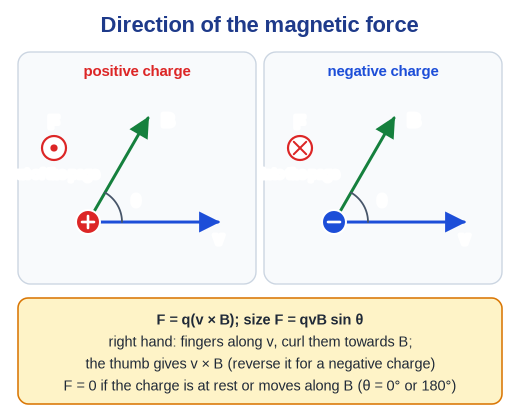
The force is at right angles to both v and B. Use the right hand: point the fingers along v, curl them towards B, and the thumb points along v × B. That is the force on a positive charge. For a negative charge, reverse it.
Example 4.2 of the book: a particle moves along +x and the field is along +y. Then v × B is along +z. A proton is pushed along +z and an electron along −z.
What is one tesla?
Put q = 1 C, v = 1 m s⁻¹ and F = 1 N into F = qvB, with v at right angles to B. The field is then 1 SI unit, the tesla (T): 1 T = 1 N s C⁻¹ m⁻¹ = 1 N A⁻¹ m⁻¹. The tesla is large. The earth’s field is about 3.6 × 10⁻⁵ T, which is 0.36 gauss (1 gauss = 10⁻⁴ T).
What is the force on a current-carrying wire?
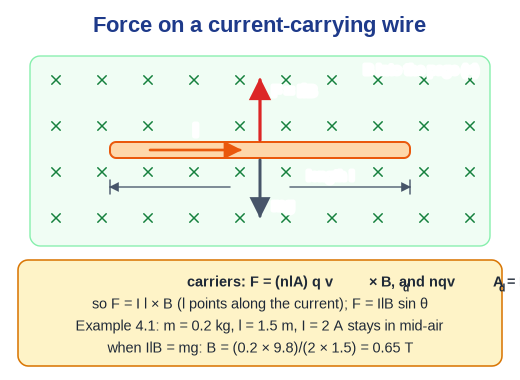
Take a straight rod of length l and cross-section A in an outside field B. Let it have n mobile carriers per cubic metre, each with charge q and drift velocity vd. The rod contains nlA carriers, so the total force is
F = (nlA) q vd × B
But nqvd is the current density j, and jA is the current I. So
F = I l × B, of size IlB sin θ
l is a vector along the current with the length of the rod (the current itself is not a vector). For a wire of any shape, add the forces I dl × B on its short pieces.
Why does the magnetic force do no work?
Work is done only by the part of a force that lies along the motion. The magnetic force is always at right angles to v, so it has no such part. It can change the direction of the momentum but not the kinetic energy. This is unlike the electric force qE, which can act along the motion and change the energy.
Why is the path a circle?
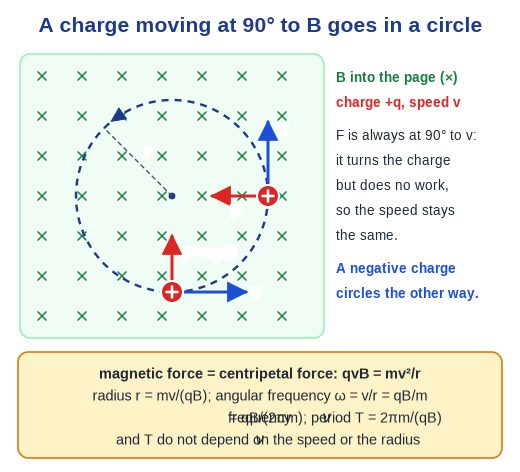
Let v be at right angles to a uniform B. The force qvB stays at right angles to the velocity and keeps the same size, so it is a centripetal force:
mv²/r = qvB, so r = mv/(qB)
A larger momentum mv gives a larger circle. Since v = ωr,
ω = qB/m, ν = qB/(2πm), T = 2πm/(qB)
The frequency ν does not contain v. A fast particle and a slow one of the same kind take the same time for one turn; the fast one just goes round a bigger circle. This is the fact the cyclotron uses to speed up charged particles.
In Example 4.3, an electron at 3 × 10⁷ m s⁻¹ in a field of 6 × 10⁻⁴ T moves in a circle of radius 28 cm, about 17 million times a second.
When is the path a helix?
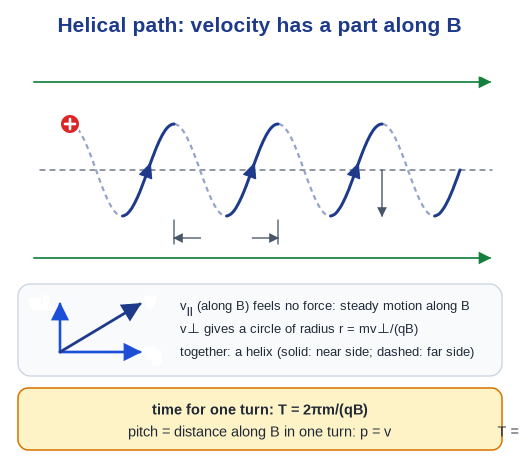
Suppose the velocity has a part v∥ along B and a part v⊥ at right angles to it. The field does nothing to v∥, so the charge moves steadily along the field. Meanwhile v⊥ gives a circle of radius r = mv⊥/(qB), called the radius of the helix. The two motions together make a helix. In one turn, taking a time T = 2πm/(qB), the charge advances along the field by the pitch
p = v∥T = 2πmv∥/(qB)
For an electron with v∥ = 10⁶ m s⁻¹ in a field of 1 mT, p = 2π × 9.1 × 10⁻³¹ × 10⁶/(1.6 × 10⁻¹⁹ × 10⁻³) = 3.6 cm.
Next topic: the Biot–Savart law and Ampere’s circuital law. See also the chapter notes and the NCERT solutions.
Practice
-
An electron moves along the +x axis in a magnetic field along the +y axis. The force on it is along:
Show answer
Answer: (b) −z
-
The work done by the magnetic force on a charge moving in a circle in a uniform field is:
Show answer
Answer: (c) zero
-
Two particles with the same charge and the same speed enter a uniform field at right angles. The one with twice the mass moves in a circle of:
Show answer
Answer: (c) twice the radius
-
A wire 0.5 m long carries 3 A at 30° to a uniform field of 0.2 T. Find the force on it.
Show answer
Answer: F = IlB sin θ = 3 × 0.5 × 0.2 × sin 30° = 0.3 × 0.5 = 0.15 N, at right angles to both the wire and the field.
-
A proton (m = 1.67 × 10⁻²⁷ kg, q = 1.6 × 10⁻¹⁹ C) moves at 2 × 10⁶ m s⁻¹ at right angles to a field of 0.5 T. Find the radius of its path.
Show answer
Answer: r = mv/(qB) = (1.67 × 10⁻²⁷ × 2 × 10⁶)/(1.6 × 10⁻¹⁹ × 0.5) = 3.34 × 10⁻²¹/(8 × 10⁻²⁰) = 4.2 × 10⁻² m, about 4.2 cm.
Questions students ask
What is the Lorentz force?
It is the total force on a charge q moving with velocity v where there is an electric field E and a magnetic field B: F = q(E + v × B). The first part, qE, acts on any charge; the second, q(v × B), acts only on a moving charge.
Why does a charge move in a circle in a magnetic field?
When the velocity is at right angles to a uniform field, the magnetic force qvB is always at right angles to the velocity and has a constant size. A force like that is a centripetal force, so the path is a circle with mv²/r = qvB.
When is the magnetic force on a moving charge zero?
When the charge moves along the field or exactly against it (θ = 0° or 180°, so sin θ = 0), and of course when the charge is at rest or there is no field.
What is the SI unit of the magnetic field?
The tesla (T). A field of 1 T puts a force of 1 N on a charge of 1 C moving at 1 m s⁻¹ at right angles to it, so 1 T = 1 N A⁻¹ m⁻¹. The smaller unit gauss equals 10⁻⁴ T.
Stuck on a question?
Take a photo and Lagnever AI explains it step by step. Try it for 7 days for ₹2.
Get it on Google Play Open in browser
For parents: after the trial, the plan renews monthly by UPI or card autopay. You can cancel anytime in the app.