
What are the Biot–Savart law and Ampere’s circuital law?
Answer in short
The Biot–Savart law gives the field of a current element: dB = (µ₀/4π) I dl sin θ/r², at right angles to dl and r. For a circular loop it gives µ₀I/(2R) at the centre. Ampere’s circuital law, ∮B·dl = µ₀I, gives µ₀I/(2πr) for a long straight wire and µ₀nI inside a long solenoid.
Stuck on a question? Take a photo and Lagnever AI explains it step by step. Try it for 7 days for ₹2. Get it on Google Play
Safety: Coils and wires for field experiments should run on cells or a low-voltage battery only, never on the mains.
What does the Biot–Savart law say?
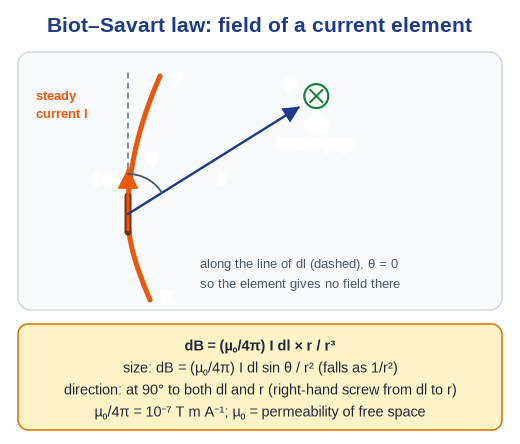
Magnetic fields have two kinds of source: currents, which are charges in motion, and the magnetic moments that particles carry by themselves. The Biot–Savart law tells us the field of one small piece of a wire. Let an element dl carry a steady current I, and let r be the vector from the element to a point P. Then, in vacuum,
dB = (µ₀/4π) I dl × r/r³
Its size is
dB = (µ₀/4π) I dl sin θ/r²
where θ is the angle between dl and r. The field is at right angles to the plane that holds dl and r. Turn a right-handed screw from dl towards r: it moves along dB.
The constant µ₀ is the permeability of free space. In SI units µ₀/4π = 10⁻⁷ T m A⁻¹. In Example 4.4, an element 1 cm long carrying 10 A gives only 10⁻⁷ × 10 × 10⁻²/(0.5)² = 4 × 10⁻⁸ T at a point 0.5 m away at right angles to it.
How does it compare with Coulomb’s law?
- Both are long-range, falling as 1/r², and both obey the principle of superposition.
- The electric field has a scalar source, the charge. The magnetic field has a vector source, I dl.
- The electric field lies along the line from the source to the point. The magnetic field is at right angles to that line and to the element.
- The magnetic field depends on the angle: along the line of the element, θ = 0 and dB = 0.
The two constants are linked through the speed of light in vacuum: µ₀ε₀ = 1/c².
What is the field on the axis of a circular loop?
A loop of radius R carries a current I. P is a point on the axis, at a distance x from the centre O.
- Every element dl of the loop is at right angles to its r, and r² = x² + R². So dB = (µ₀/4π) I dl/(x² + R²).
- dB is at right angles to r. Split it into a part along the axis and a part across it. The parts across the axis from two opposite elements cancel.
- The part along the axis is dB cos θ, with cos θ = R/(x² + R²)1/2.
- Add round the loop; the dl’s add up to 2πR:
B = µ₀IR²/[2(x² + R²)3/2]
At the centre, x = 0 and B = µ₀I/(2R). For N close turns, B = µ₀NI/(2R). At x = R the field has dropped to 1/(2√2), about 0.35, of its value at the centre.
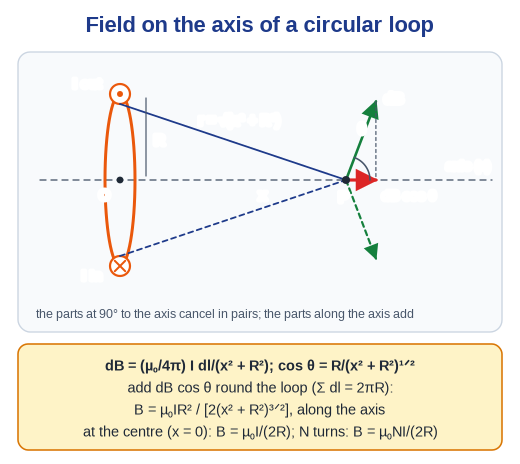
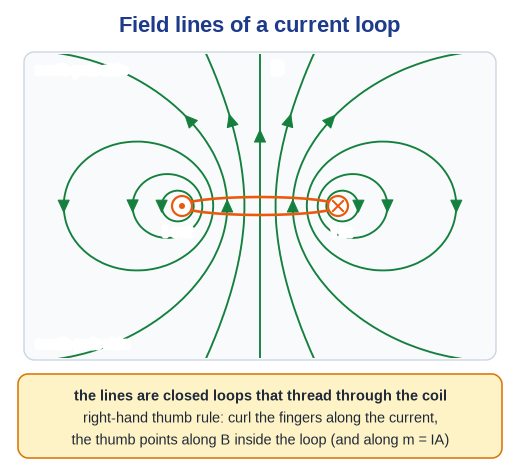
Direction: curl the fingers of the right hand along the current in the loop; the thumb points along B on the axis.
What does Ampere’s circuital law say?
Take a closed loop C and any open surface that has C as its edge. Then
∮B·dl = µ₀I
The left side adds up, round C, the component of B along each small step times the length of the step. On the right, I is the total current passing through the surface. A current counts as positive if it flows along the thumb when the right-hand fingers curl the way we go round C.
In problems we pick an Amperian loop so that, at each point of it, B is either along the loop with a constant size B, or at right angles to it, or zero. If L is the length where B is along the loop and Ie the current enclosed,
BL = µ₀Ie
What is the field of a long straight wire?
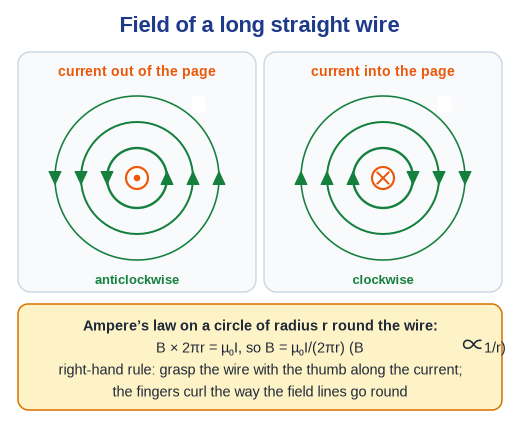
By symmetry the field lines are circles round the wire. On a circle of radius r, B is constant and along the circle, so
B × 2πr = µ₀I, giving B = µ₀I/(2πr)
The field is the same all round a circle (cylindrical symmetry), it falls as 1/r, and it stays finite at any distance even though the wire is infinitely long. Right-hand rule: grasp the wire with the thumb along the current; the fingers curl the way of the field.
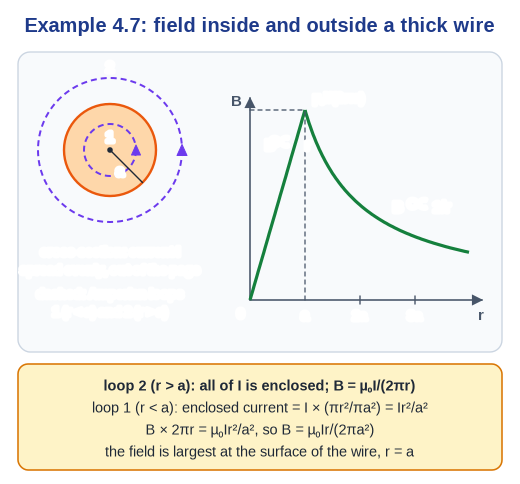
For a thick wire of radius a with the current spread evenly, a circle of radius r < a encloses only Ie = Ir²/a². Then B × 2πr = µ₀Ir²/a², so B = µ₀Ir/(2πa²): inside, B ∝ r; outside, B ∝ 1/r.
What is the field inside a solenoid?
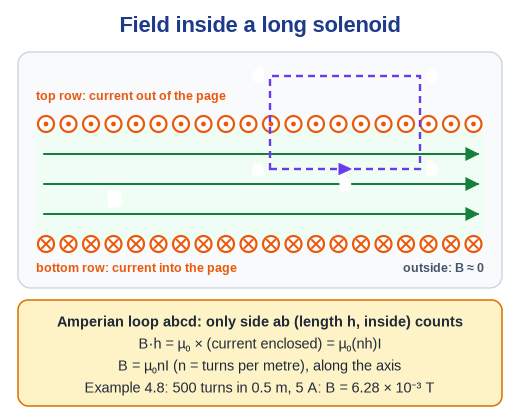
A long solenoid is a tight helix of insulated wire, much longer than it is wide. Inside, the field is uniform and along the axis. Outside, it is close to zero. Take a rectangular Amperian loop abcd: ab, of length h, lies inside along the axis; cd lies outside; bc and da cross the windings.
- Along cd, B = 0. Along bc and da, the field has no component along the path.
- Along ab, the contribution is Bh.
- With n turns per metre, the loop encloses nh turns, so Ie = nhI.
Bh = µ₀nhI, so B = µ₀nI
In Example 4.8, 500 turns on 0.5 m (n = 1000 m⁻¹) carrying 5 A give B = 4π × 10⁻⁷ × 10³ × 5 = 6.28 × 10⁻³ T.
Previous topic: the magnetic force on moving charges. Next topic: the torque on a current loop and the moving coil galvanometer. See also the chapter notes and the NCERT solutions.
Practice
-
The field of a current element at a point on the line of the element itself is:
Show answer
Answer: (b) zero
-
A circular coil of 10 turns and radius 0.1 m carries 1 A. The field at its centre is about:
Show answer
Answer: (b) 6.3 × 10⁻⁵ T
-
The distance from a long straight wire is doubled. The magnetic field becomes:
Show answer
Answer: (b) half
-
Find the field 2 cm from a long straight wire carrying 5 A.
Show answer
Answer: B = µ₀I/(2πr) = (2 × 10⁻⁷ × 5)/0.02 = 5 × 10⁻⁵ T, along the tangent to the circle of radius 2 cm round the wire.
-
A long solenoid has 2000 turns per metre and carries 3 A. Find the field inside it.
Show answer
Answer: B = µ₀nI = 4π × 10⁻⁷ × 2000 × 3 = 7.5 × 10⁻³ T, along the axis.
Questions students ask
How is the Biot–Savart law different from Coulomb’s law?
Both fall as 1/r² and obey superposition. But the source of the electric field is a scalar, the charge, while the source of the magnetic field is the vector I dl. The electric field points along the line from the source; the magnetic field is at right angles to the plane of dl and r, and it depends on the angle θ through sin θ.
Is Ampere’s circuital law a new law?
No. It carries the same physics as the Biot–Savart law and can be derived from it, just as Gauss’s law follows from Coulomb’s law. It is useful when the current has enough symmetry for a simple Amperian loop. Both laws, as used here, hold for steady currents.
Why can Ampere’s law not give the field at the centre of a circular loop easily?
The law is true for any closed path, but it gives B directly only when B is constant along the path chosen. Round a circular loop there is no such simple path, so we use the Biot–Savart law instead, which gives µ₀I/(2R).
What is the value of µ₀?
The permeability of free space is µ₀ = 4π × 10⁻⁷ T m A⁻¹, so µ₀/4π = 10⁻⁷ T m A⁻¹. It is tied to ε₀ and the speed of light by µ₀ε₀ = 1/c².
Stuck on a question?
Take a photo and Lagnever AI explains it step by step. Try it for 7 days for ₹2.
Get it on Google Play Open in browser
For parents: after the trial, the plan renews monthly by UPI or card autopay. You can cancel anytime in the app.