
What is the torque on a current loop, and how does a galvanometer use it?
Answer in short
Two parallel currents attract with a force µ₀I_aI_b/(2πd) on each metre, which defines the ampere. A current loop in a uniform field feels no net force but a torque m × B, where m = NIA is its magnetic moment. In a moving coil galvanometer a spring balances this torque, so φ = (NAB/k)I.
Stuck on a question? Take a photo and Lagnever AI explains it step by step. Try it for 7 days for ₹2. Get it on Google Play
Safety: Use cells or a low-voltage battery for any circuit with a galvanometer, an ammeter or a voltmeter. Never connect a meter to the mains.
What is the force between two parallel currents?
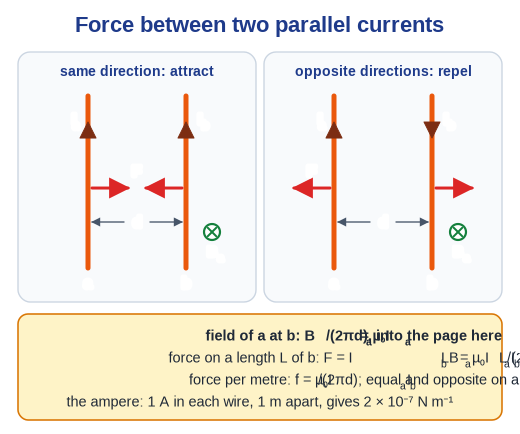
Each wire sits in the field of the other, so two current-carrying wires push on each other. Take long parallel wires a and b, a distance d apart, with currents Ia and Ib in the same direction.
- Wire a makes, all along wire b, the field Ba = µ₀Ia/(2πd), at right angles to b.
- The force on a length L of b is Fba = IbLBa = µ₀IaIbL/(2πd). The right-hand rule shows it points towards a.
- In the same way, the force on a due to b is equal in size and points towards b: Fba = −Fab, as Newton’s third law needs.
The force on each metre of wire is
f = µ₀IaIb/(2πd)
Parallel currents attract, and antiparallel currents repel.
How is the ampere defined?
The formula for f defines the ampere, one of the seven SI base units. Picture two very long, thin, straight wires lying parallel, 1 m apart in vacuum, with the same steady current in each. That current is one ampere if every metre of each wire feels a force of 2 × 10⁻⁷ N. The definition dates from 1946. In practice a current balance with many-turn coils measures the force, and the earth’s field must be cancelled: in Example 4.9 it alone gives 3 × 10⁻⁵ N m⁻¹ on a wire carrying 1 A.
The coulomb follows from the ampere: 1 C is the charge crossing a section of a conductor in 1 s when the current is 1 A.
Why does a current loop feel a torque?
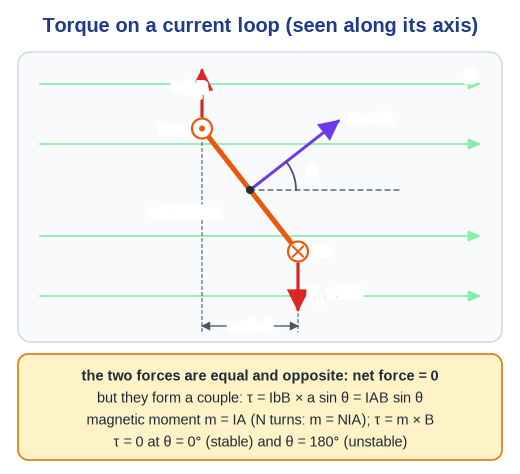
Put a rectangular loop ABCD, with sides a and b and current I, in a uniform field B.
Field in the plane of the loop. The two sides along the field feel no force. The two sides of length b, at right angles to the field, feel forces IbB in opposite directions, one into the page and one out of it. The net force is zero, but the pair forms a couple with arm a:
τ = IbB × a = IAB, where A = ab
General case. Let the normal to the loop make an angle θ with B. The forces on the sides of length b are still IbB each, but their lines of action are now only a sin θ apart. The forces on the other two sides act along the axis, in opposite directions, and cancel. So
τ = IAB sin θ
What is the magnetic moment?
Define the magnetic moment of the loop as m = IA. The area vector A is normal to the loop, in the direction of the right-hand thumb when the fingers curl along the current. For N close turns, m = NIA. Its unit is A m². Then both results above are one equation:
τ = m × B
This matches τ = p × E for an electric dipole. The torque vanishes when m is parallel to B, a stable equilibrium (a small turn brings a torque that restores it), and when m is antiparallel to B, an unstable one.
Why is a current loop called a magnetic dipole?
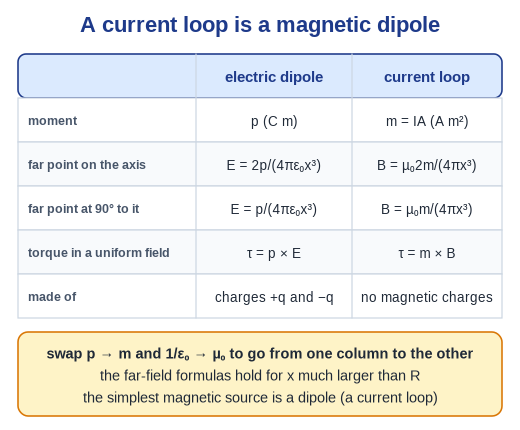
Far along the axis of a circular loop (x much larger than R), B = µ₀IR²/[2(x² + R²)3/2] becomes µ₀IR²/(2x³). Putting m = IπR²,
B = (µ₀/4π) 2m/x³
The electric field on the axis of an electric dipole is E = 2p/(4πε₀x³). Replace p by m and 1/ε₀ by µ₀ and one formula turns into the other. So a flat current loop is a magnetic dipole of moment m = IA. An electric dipole is made of two charges, but no magnetic monopole has ever been found.
How does a moving coil galvanometer work?
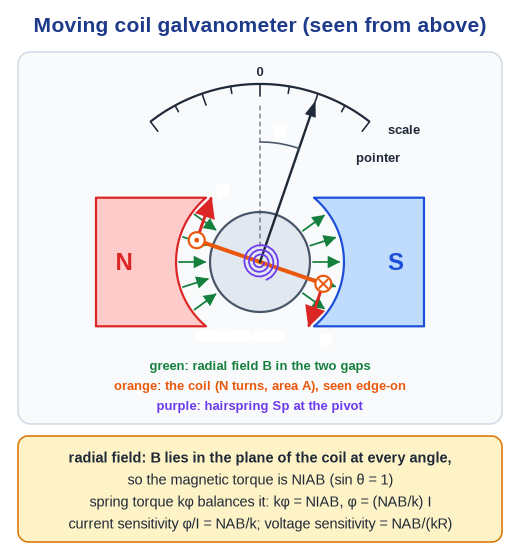
A coil of N turns and area A is pivoted between the curved poles of a magnet, round a cylindrical soft-iron core. The core makes the field radial, and stronger. In a radial field the plane of the coil lies along the field in every position, so the torque is NIAB with sin θ = 1. A spring opposes the turning with a torque kφ. At balance
kφ = NIAB, so φ = (NAB/k) I
- Current sensitivity = φ/I = NAB/k. Makers raise it by using more turns.
- Voltage sensitivity = φ/V = (NAB/k)(1/R), where R is the coil’s resistance. Doubling N doubles R as well, so it does not change.
How do we make an ammeter and a voltmeter?
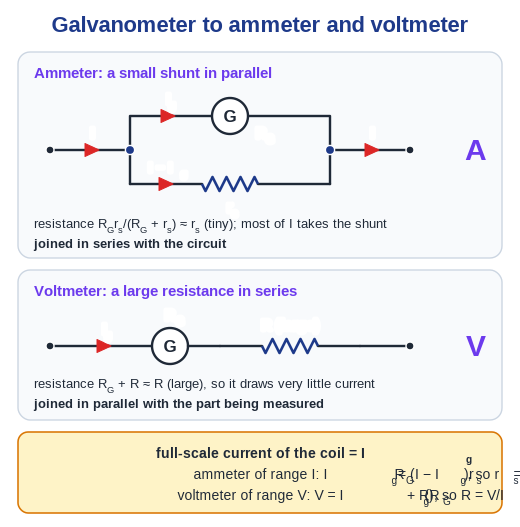
- Ammeter: a small shunt rs in parallel with the coil. Resistance RGrs/(RG + rs) ≈ rs. Connect it in series.
- Voltmeter: a large resistance R in series with the coil. Resistance RG + R ≈ R. Connect it in parallel.
The values follow from the series and parallel rules (standard results; the book gives only the idea). If Ig is the full-scale current of the coil, the shunt for a range I is rs = IgRG/(I − Ig), and the series resistance for a range V is R = V/Ig − RG.
Previous topic: the Biot–Savart law and Ampere’s circuital law. See also the chapter notes and the NCERT solutions.
Practice
-
Two long parallel wires 5 cm apart each carry 10 A in the same direction. The force on each metre of wire is:
Show answer
Answer: (a) 4 × 10⁻⁴ N, attractive
-
A current loop in a uniform magnetic field is in stable equilibrium when its magnetic moment is:
Show answer
Answer: (b) parallel to B
-
The field in a moving coil galvanometer is made radial so that:
Show answer
Answer: (b) the torque is NIAB at every position of the coil
-
A coil of 50 turns and area 0.02 m² carries 2 A in a field of 0.5 T, with its plane along the field. Find its magnetic moment and the torque on it.
Show answer
Answer: m = NIA = 50 × 2 × 0.02 = 2.0 A m². The plane is along the field, so the normal is at 90° to B and τ = mB sin 90° = 2.0 × 0.5 = 1.0 N m.
-
A galvanometer of resistance 100 Ω shows full-scale deflection for 1 mA. How can it be made into (a) an ammeter reading up to 1 A, (b) a voltmeter reading up to 10 V?
Show answer
Answer: (a) Shunt in parallel: r_s = I_gR_G/(I − I_g) = (10⁻³ × 100)/(1 − 10⁻³) = 0.10 Ω. (b) Series resistance: R = V/I_g − R_G = 10/10⁻³ − 100 = 9900 Ω.
Questions students ask
Why do parallel currents attract?
Each wire sits in the magnetic field of the other. For currents in the same direction, the right-hand rule and F = I l × B give a force on each wire that points towards the other wire. If one current is reversed, both forces reverse and the wires repel.
What is the magnetic moment of a current loop?
It is the vector m = NIA: the number of turns times the current times the area, along the normal to the loop given by the right-hand thumb rule (fingers along the current, thumb along m). Its unit is A m². In a uniform field B the torque on the loop is m × B.
Why is a galvanometer not used directly as an ammeter?
It is very sensitive, its pointer crossing the whole scale for only about a microampere, and its coil has a large resistance, which would change the current when the meter is put in series. A small shunt in parallel solves both problems.
Is the 1946 definition of the ampere still the official one?
Extra, beyond the book: since 2019 the SI defines the ampere by fixing the value of the elementary charge e. The book teaches the earlier definition, based on the force between two parallel wires, and that is the one to learn for this chapter.
Stuck on a question?
Take a photo and Lagnever AI explains it step by step. Try it for 7 days for ₹2.
Get it on Google Play Open in browser
For parents: after the trial, the plan renews monthly by UPI or card autopay. You can cancel anytime in the app.