
NCERT Solutions Class 12 Physics Chapter 5: Magnetism and Matter
Answers to all 7 end-of-chapter exercises and all 5 worked examples of Chapter 5, Magnetism and Matter, of Physics Part I, the Class 12 NCERT textbook. Page numbers follow the 2026-27 reprint (pages 136–153). The exercises come first, quoted from the book; the examples follow, restated in short. Every number was also checked by computer. Short notes: Chapter 5 notes.
We use µ₀/4π = 10⁻⁷ T m A⁻¹, so µ₀ = 4π × 10⁻⁷ T m A⁻¹ (the permeability of free space). The book gives magnetic moments in J T⁻¹; this is the same unit as A m². A torque is written in N m (the book sometimes writes J, which has the same dimensions).
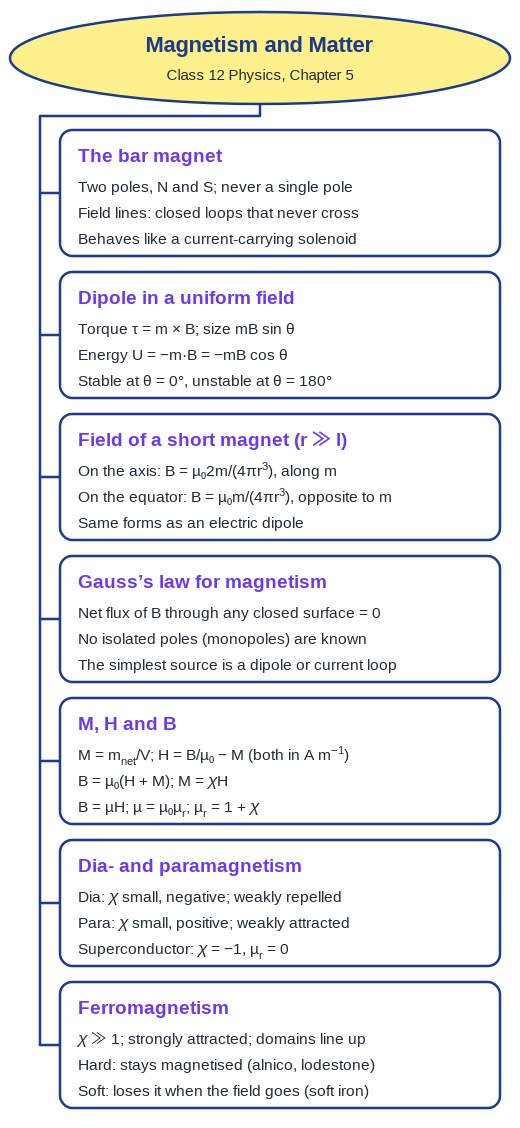
Exercises 5.1 and 5.2: torque and energy of a bar magnet
5.1 “A short bar magnet placed with its axis at 30° with a uniform external magnetic field of 0.25 T experiences a torque of magnitude equal to 4.5 × 10⁻² J. What is the magnitude of magnetic moment of the magnet?”
The torque on a dipole is τ = mB sin θ. Here τ = 4.5 × 10⁻² N m, B = 0.25 T and θ = 30°:
m = τ/(B sin θ) = 4.5 × 10⁻²/(0.25 × sin 30°) = 4.5 × 10⁻²/0.125 = 0.36 J T⁻¹ (or 0.36 A m²)
5.2 “A short bar magnet of magnetic moment m = 0.32 JT⁻¹ is placed in a uniform magnetic field of 0.15 T. If the bar is free to rotate in the plane of the field, which orientation would correspond to its (a) stable, and (b) unstable equilibrium? What is the potential energy of the magnet in each case?”
The potential energy is U = −mB cos θ, and mB = 0.32 × 0.15 = 0.048 J.
(a) Stable equilibrium: m parallel to B (θ = 0°). U = −mB = −4.8 × 10⁻² J, the lowest possible value. If the magnet is turned a little, the torque brings it back.
(b) Unstable equilibrium: m antiparallel to B (θ = 180°). U = +mB = +4.8 × 10⁻² J, the highest possible value. The torque is zero here too, but after the smallest turn it carries the magnet further away.
Exercises 5.3 and 5.4: a solenoid as a bar magnet
5.3 “A closely wound solenoid of 800 turns and area of cross section 2.5 × 10⁻⁴ m² carries a current of 3.0 A. Explain the sense in which the solenoid acts like a bar magnet. What is its associated magnetic moment?”
In what sense it is like a bar magnet:
- Each turn is a small current loop. Its magnetic moment IA points along the axis, and the moments of all 800 turns add up.
- The field lines leave one end of the solenoid and enter the other end, just as for a bar magnet. Far away, the field is the field of a magnetic dipole.
- So the solenoid acts like a bar magnet lying along its axis. The end where the current looks anticlockwise is its N pole; the other end is its S pole.
- In a uniform field it feels the same torque as a bar magnet of the same moment, and a freely hung solenoid settles along the field.
Magnetic moment:
m = NIA = 800 × 3.0 A × 2.5 × 10⁻⁴ m² = 0.60 A m² (0.60 J T⁻¹)
The moment points along the axis, in the direction given by the right-hand rule: curl the fingers along the current and the thumb shows m.
5.4 “If the solenoid in Exercise 5.5 is free to turn about the vertical direction and a uniform horizontal magnetic field of 0.25 T is applied, what is the magnitude of torque on the solenoid when its axis makes an angle of 30° with the direction of applied field?”
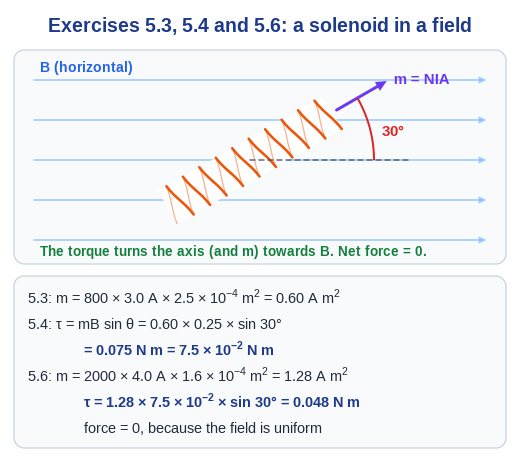
The question means the solenoid of Exercise 5.3 (the book prints “Exercise 5.5”, but Exercise 5.5 is about a bar magnet, and the answer key’s 7.5 × 10⁻² fits the solenoid’s 0.60 J T⁻¹). With m = 0.60 A m², B = 0.25 T and θ = 30°:
τ = mB sin θ = 0.60 × 0.25 × sin 30° = 0.60 × 0.25 × 0.5 = 7.5 × 10⁻² N m
The torque tends to turn the axis of the solenoid into the direction of the field.
Exercise 5.5: work and torque when a magnet is turned
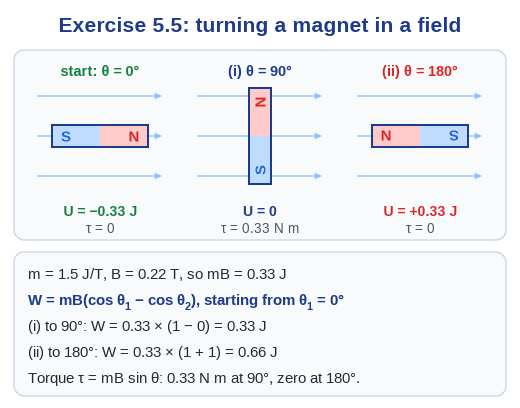
5.5 “A bar magnet of magnetic moment 1.5 J T⁻¹ lies aligned with the direction of a uniform magnetic field of 0.22 T. (a) What is the amount of work required by an external torque to turn the magnet so as to align its magnetic moment: (i) normal to the field direction, (ii) opposite to the field direction? (b) What is the torque on the magnet in cases (i) and (ii)?”
mB = 1.5 × 0.22 = 0.33 J. The work done by the external torque equals the gain in potential energy, W = U(θ₂) − U(θ₁) = mB(cos θ₁ − cos θ₂), with θ₁ = 0°.
(a) (i) To θ₂ = 90°: W = 0.33 × (cos 0° − cos 90°) = 0.33 × (1 − 0) = 0.33 J
(ii) To θ₂ = 180°: W = 0.33 × (cos 0° − cos 180°) = 0.33 × (1 + 1) = 0.66 J
(b) τ = mB sin θ.
(i) At 90°: τ = 0.33 × sin 90° = 0.33 N m. It acts so as to turn m back towards B.
(ii) At 180°: τ = 0.33 × sin 180° = 0. (This is the unstable equilibrium position.)
Exercise 5.6: force and torque on a solenoid
5.6 “A closely wound solenoid of 2000 turns and area of cross-section 1.6 × 10⁻⁴ m², carrying a current of 4.0 A, is suspended through its centre allowing it to turn in a horizontal plane. (a) What is the magnetic moment associated with the solenoid? (b) What is the force and torque on the solenoid if a uniform horizontal magnetic field of 7.5 × 10⁻² T is set up at an angle of 30° with the axis of the solenoid?”
(a) m = NIA = 2000 × 4.0 A × 1.6 × 10⁻⁴ m² = 1.28 A m², along the axis of the solenoid, in the direction fixed by the sense of the current (right-hand rule).
(b) Force: zero. In a uniform field the forces on the two ends of a dipole cancel.
Torque: τ = mB sin θ = 1.28 × 7.5 × 10⁻² × sin 30° = 0.096 × 0.5 = 0.048 N m
It tends to turn the solenoid until its axis (its magnetic moment) lies along B.
Exercise 5.7: the field of a short bar magnet
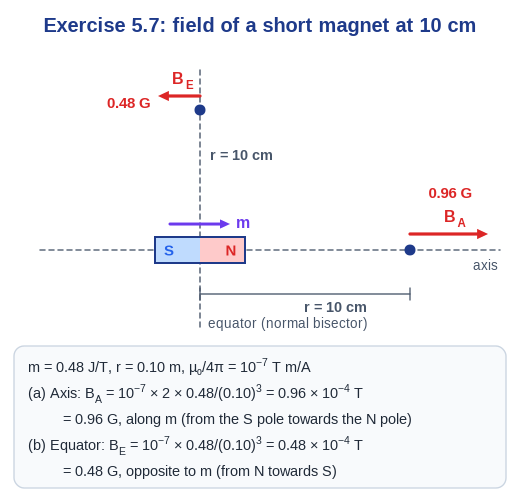
5.7 “A short bar magnet has a magnetic moment of 0.48 J T⁻¹. Give the direction and magnitude of the magnetic field produced by the magnet at a distance of 10 cm from the centre of the magnet on (a) the axis, (b) the equatorial lines (normal bisector) of the magnet.”
Here r = 0.10 m, so r³ = 1.0 × 10⁻³ m³.
(a) On the axis:
BA = (µ₀/4π) × 2m/r³ = 10⁻⁷ × 2 × 0.48/(1.0 × 10⁻³) = 0.96 × 10⁻⁴ T = 0.96 G
Its direction is along m, that is, along the S–N direction (from the S pole towards the N pole).
(b) On the equatorial line:
BE = (µ₀/4π) × m/r³ = 10⁻⁷ × 0.48/(1.0 × 10⁻³) = 0.48 × 10⁻⁴ T = 0.48 G
Its direction is opposite to m, that is, along the N–S direction (parallel to the magnet, from N towards S).
(1 G = 10⁻⁴ T. The answer key prints “0.96 g” in part (a); it means 0.96 G.)
Worked examples 5.1 and 5.2 (pages 139–142)
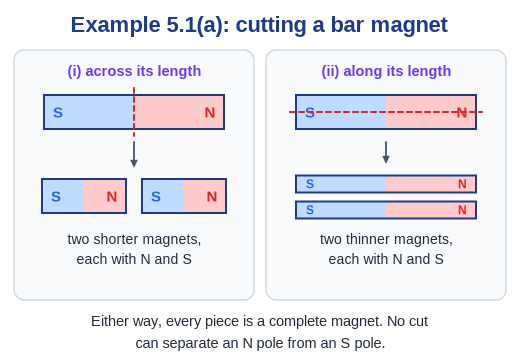
Example 5.1 (pages 139–140): (a) What do you get on cutting a bar magnet across its length, and lengthwise? (b) In a uniform field a magnetised needle feels a torque but no net force, yet an iron nail near a bar magnet is also pulled towards it. Why? (c) Must every magnetic arrangement have an N and an S pole? Think of a toroid. (d) Of two iron bars A and B that look alike, at least one is magnetised. Using only the two bars, how do you tell whether both are magnets and, if only one is, which one?
(a) Two magnets in either case, each with its own N and S pole.
(b) In a uniform field the forces on the two poles cancel. The field of a bar magnet is not uniform. It magnetises the nail, and the induced pole nearer the magnet (an S pole near the magnet’s N pole, say) is in a stronger field than the farther induced pole. Attraction of the near pole beats repulsion of the far one, so there is a net pull as well as a torque.
(c) No. Poles appear only when the source has a net magnetic moment. A toroid has none, and neither does a long straight wire: their field lines circle round without ever leaving or entering a “pole”.
(d) Bring different ends of the two bars together. If any pair of ends repels, both bars are magnets. If every pair attracts, only one is a magnet. To find which, use the fact that a bar magnet is strong at its ends and weak at its middle. Touch one end of A to an end of B and then to the middle of B. If the pull almost vanishes at the middle of B, then B is the magnet. If the pull is the same at B’s end and middle, then A is the magnet.
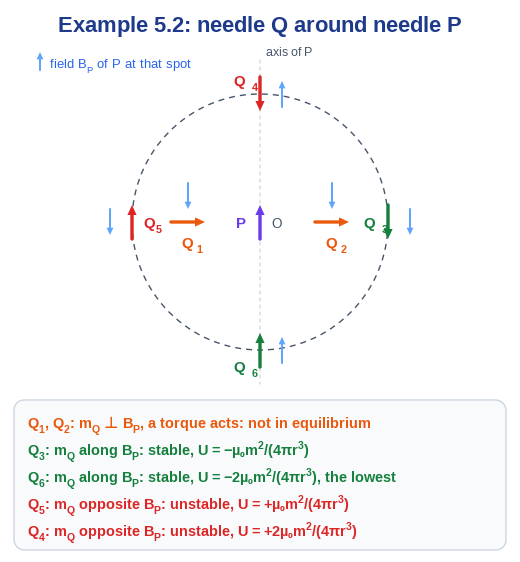
Example 5.2 (pages 141–142): A small magnetised needle P sits at O. An identical needle Q is placed in turn at six positions, Q₁ to Q₆, each with a given direction. (a) Which arrangements are not in equilibrium? (b) Which are in stable and which in unstable equilibrium? (c) Which has the lowest potential energy?
In Fig. 5.4, P points “up” the page. Q₁ and Q₂ lie to the left and right of P on its normal bisector and point sideways. Q₃ (right) and Q₅ (left) lie on the normal bisector, Q₃ pointing down and Q₅ up. Q₄ (above) and Q₆ (below) lie on P’s axis, Q₄ pointing down and Q₆ up.
The energy of the pair is the energy of Q in the field of P, U = −mQ·BP. The field of P is
- on its axis: BP = µ₀2mP/(4πr³), along mP (up)
- on its normal bisector: BP = −µ₀mP/(4πr³), opposite to mP (down)
Q is in stable equilibrium where mQ is parallel to BP, in unstable equilibrium where it is antiparallel, and not in equilibrium where it is at any other angle.
(a) PQ₁ and PQ₂ are not in equilibrium: Q is at right angles to the field of P, so a torque acts on it.
(b) (i) Stable: PQ₃ and PQ₆. Q₃ points down where the field is down; Q₆ points up where the field is up. (ii) Unstable: PQ₅ and PQ₄. Q₅ points up where the field is down; Q₄ points down where the field is up.
(c) PQ₆. With m the moment of each needle, at equal distances r: U(Q₆) = −2µ₀m²/(4πr³), U(Q₃) = −µ₀m²/(4πr³), U(Q₅) = +µ₀m²/(4πr³) and U(Q₄) = +2µ₀m²/(4πr³). The axial field is twice the equatorial field, so Q₆ is lowest.
Worked examples 5.3 and 5.4 (pages 143–145)
Example 5.3 (pages 143–144): Seven sketches of field lines, (a) to (g), are given in Fig. 5.6. Several of them cannot be magnetic field lines. Say what is wrong with each, and which could be electrostatic field lines.
(a) Lines spreading straight out from a long straight wire: wrong for a magnetic field. Lines cannot start from a point or a line, because the net flux of B through a surface round it would not be zero. The sketch does show the electric field round a long wire carrying positive charge. The magnetic lines of a current in the wire are circles round it.
(b) Lines that cross, with small closed loops in empty space: wrong. Field lines never cross. Also, a closed loop of static magnetic field must go round a region where a current passes; it cannot close round empty space. (Electrostatic lines never form closed loops at all.)
(c) Circular lines inside a toroid: right. The lines stay inside the winding, and each closed loop goes round the current in the turns. Only a few lines are drawn; the field fills the whole region inside the winding.
(d) Perfectly straight lines confined inside a solenoid and coming straight out of its ends: wrong. This would break Ampere’s law. The lines must bulge out at the ends and curve round to close.
(e) Lines outside and inside a bar magnet: right. Inside, the lines run from S to N; not every line comes out of the N face. Round either pole the net flux is zero.
(f) Lines that all come out of an upper plate and go into a lower plate: wrong for a magnetic field, since a surface round the upper plate would have a net outward flux. The sketch does show the electrostatic field between an upper plate with positive charge and a lower plate with negative charge.
(g) Perfectly straight lines between two pole pieces, right up to the edges: wrong. Some fringing at the edges cannot be avoided; a field that ends sharply would break Ampere’s law. The same is true of electric field lines.
Example 5.4 (pages 144–145): (a) Do magnetic field lines tell us which way a moving charge is pushed? (b) How would Gauss’s law for magnetism change if monopoles existed? (c) Can a bar magnet’s own field twist the magnet? Can one small piece of a wire carrying current push on a different piece of that wire? (d) Can a system with zero net charge have a magnetic moment?
(a) No. The force qv × B is always at right angles to B. The lines show how a small magnetised needle would point, so “lines of force” is a misleading name for them.
(b) The flux through a closed surface would no longer be zero. It would be proportional to the magnetic charge qm inside, Σ B·ΔS = µ₀qm, just as the electric flux is q/ε₀.
(c) No, a magnet does not turn itself, and no element feels a force from the field that it produces itself. But a piece of a wire is pushed by the field that a different piece of that wire sets up. (In a straight wire, though, that push vanishes.)
(d) Yes. The charges can add up to zero while the magnetic moments of the various current loops do not. Atoms of a paramagnetic material are an example: each is neutral yet has a net magnetic moment.
Worked example 5.5 (pages 146–147)
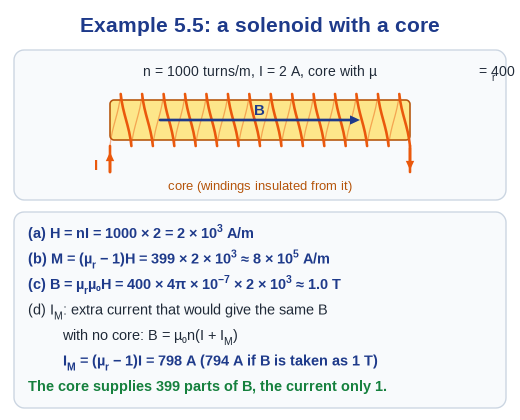
Example 5.5: A solenoid with 1000 turns per metre carries 2 A. Its core has relative permeability 400 and is insulated from the windings. Find H, M, B and the magnetising current IM (parts (a) to (d)).
(a) H depends only on the current, not on the core:
H = nI = 1000 m⁻¹ × 2 A = 2 × 10³ A m⁻¹
(b) M = (B − µ₀H)/µ₀ = (µr − 1)H = 399 × 2 × 10³ = 7.98 × 10⁵ ≈ 8 × 10⁵ A m⁻¹
(c) B = µrµ₀H = 400 × 4π × 10⁻⁷ × 2 × 10³ = 1.005 T ≈ 1.0 T
(d) The magnetising current is the extra current the windings would need, with no core, to give this same B: B = µ₀n(I + IM). So
I + IM = B/(µ₀n) = µrI = 800 A, and IM = (µr − 1)I = 798 A
The book’s 794 A comes from rounding B to 1 T first: 1/(4π × 10⁻⁷ × 1000) = 796 A, less 2 A. Two slips in the printed solution: part (a) should read that H is independent of the core material, and the formula in part (d) should have µ₀, not µr. A quick check: IM = M/n = 7.98 × 10⁵/1000 = 798 A.
Practice
-
A magnet held at 90° to a field of 0.30 T feels a torque of 0.9 N m. Its magnetic moment is:
Show answer
Answer: (c) 3.0 J T⁻¹
-
A magnet of moment 0.5 J T⁻¹ lies along a field of 0.4 T. The work needed to reverse it is:
Show answer
Answer: (c) 0.4 J
-
A core of relative permeability 100 sits in a solenoid where H = 2000 A m⁻¹. The field B in the core is about:
Show answer
Answer: (b) 0.25 T
-
A solenoid has 1000 turns of area 3.0 × 10⁻⁴ m² and carries 2.0 A. Find its magnetic moment and the largest torque on it in a field of 0.20 T.
Show answer
Answer: m = NIA = 1000 × 2.0 × 3.0 × 10⁻⁴ = 0.60 A m². The torque is largest at θ = 90°: τ = mB = 0.60 × 0.20 = 0.12 N m.
-
A short magnet has m = 1.0 A m². Find the field at 20 cm from its centre on its axis.
Show answer
Answer: B = (µ₀/4π) × 2m/r³ = 10⁻⁷ × 2 × 1.0/(0.20)³ = 2.5 × 10⁻⁵ T, along m.
Stuck on a question?
Take a photo and Lagnever AI explains it step by step. Try it for 7 days for ₹2.
Get it on Google Play Open in browser
For parents: after the trial, the plan renews monthly by UPI or card autopay. You can cancel anytime in the app.