
Class 12 Physics Chapter 5: Magnetism and Matter Notes
This chapter in five lines
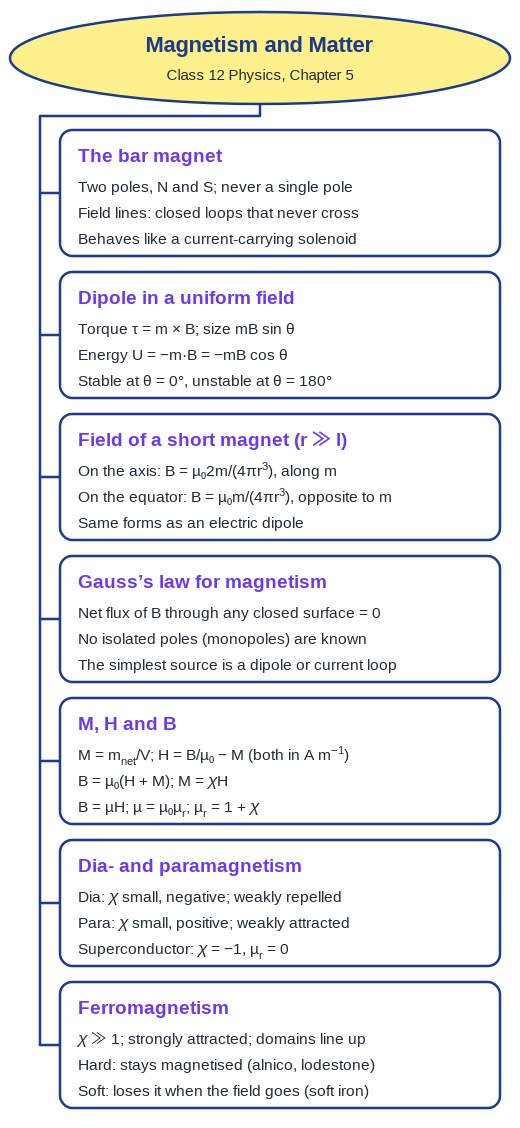
A bar magnet is a magnetic dipole with moment m, and it behaves like a current-carrying solenoid. In a uniform field B it feels a torque m × B and has energy −m·B. Magnetic field lines form closed loops, so the net magnetic flux through any closed surface is zero. Inside a material B = µ₀(H + M) with M = χH, and the sign and size of χ sort materials into diamagnetic, paramagnetic and ferromagnetic.
What is this chapter about?
Chapter 4 showed that moving charges and currents produce magnetic fields. This chapter looks at magnets themselves and at how ordinary matter responds to a magnetic field. It has two halves. The first treats a bar magnet as a magnetic dipole: its field lines, why it behaves like a solenoid, what a uniform field does to it, and Gauss’s law for magnetism. The second asks what happens inside a material placed in a field, and uses the answer to sort materials into three kinds.
The chapter starts from five familiar facts:
- The earth acts as a magnet, with its field pointing roughly from geographic south to north.
- A bar magnet hung so that it can turn settles along the north–south line. The end that points to geographic north is its north pole (N); the other is its south pole (S).
- Like poles repel each other and unlike poles attract.
- Poles cannot be separated. Breaking a magnet gives two weaker magnets, each with both poles. A lone pole, called a magnetic monopole, has never been found.
- Magnets can be made from iron and its alloys.
What are magnetic field lines?
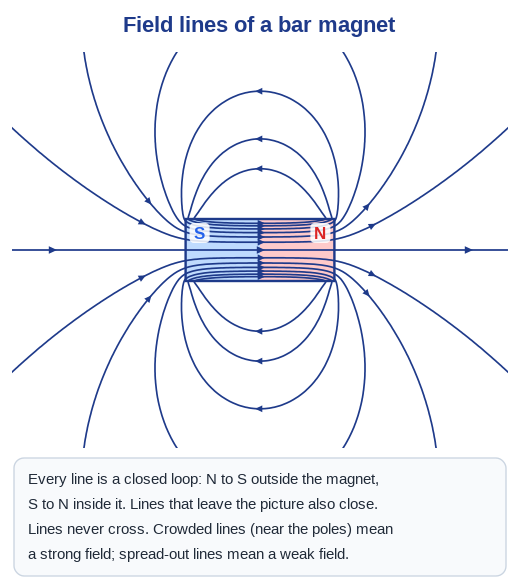
Sprinkle iron filings on a sheet over a short bar magnet and they arrange themselves in curves running from one end to the other. The same pattern appears round a current-carrying solenoid. The pattern suggests two poles, much like the two charges of an electric dipole, and it lets us draw magnetic field lines:
- They form continuous closed loops: outside the magnet from N to S, inside it from S back to N. Electric field lines are different: they start on positive charges and end on negative ones.
- The tangent to a line at any point gives the direction of the net field B there.
- The more lines cross a unit area, the stronger the field. Lines are crowded near the poles and spread out far away.
- Two lines never cross. At a crossing, B would have two directions at once.
A small compass needle moved from point to point also traces the lines. The lines show where a compass needle would point. They do not show the force on a moving charge, which is at right angles to B, so the book avoids the old name “lines of force”.
Why is a bar magnet like a solenoid?
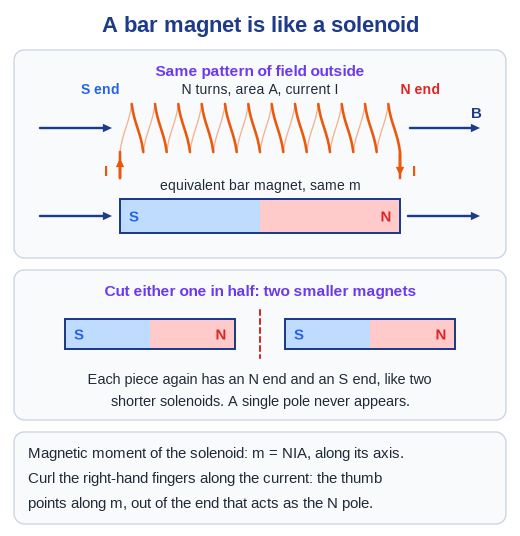
Ampere suggested that all magnetism comes from circulating currents. A bar magnet can then be pictured as a stack of tiny current loops, which is just what a solenoid is. Two observations support this. First, halving a magnet works out the same as halving a solenoid: both give two shorter pieces with weaker fields, each still with an N end and an S end. Second, a compass needle moved round a bar magnet and round a current-carrying solenoid of the same size turns in the same way.
A calculation settles it. For a solenoid of length 2l and radius a, with n turns per unit length and current I, the field at a far point on the axis (distance r from the centre, with r much larger than l and a) is
B = µ₀2m/(4πr³)
where m = n(2l)I(πa²) is its magnetic moment: the total number of turns × current × area, or m = NIA. A bar magnet has a far axial field of the same form. So a bar magnet’s magnetic moment is defined as the moment of the solenoid that would produce the same field. Read the bar magnet as a magnetic dipole.
What does a uniform field do to a magnetic dipole?
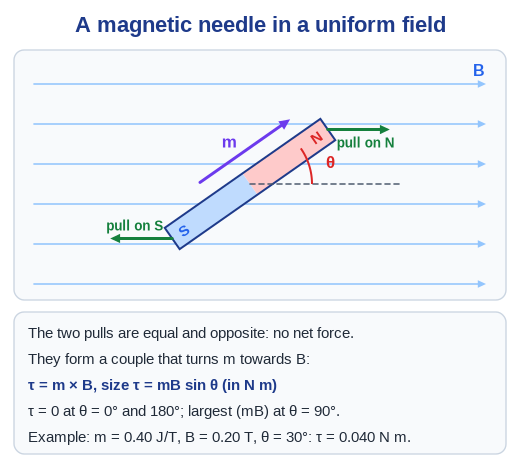
Place a small compass needle of magnetic moment m in a uniform field B, with angle θ between them. The forces on its two poles are equal and opposite, so there is no net force. But they do not act along the same line, so they form a couple with torque
τ = m × B, of size τ = mB sin θ
The torque is a restoring one: it always tries to turn m into the direction of B. It is zero at θ = 0° and 180° and largest, mB, at 90°. A magnet with m = 0.40 J T⁻¹ held at 30° to a field of 0.20 T feels 0.40 × 0.20 × 0.5 = 0.040 N m.
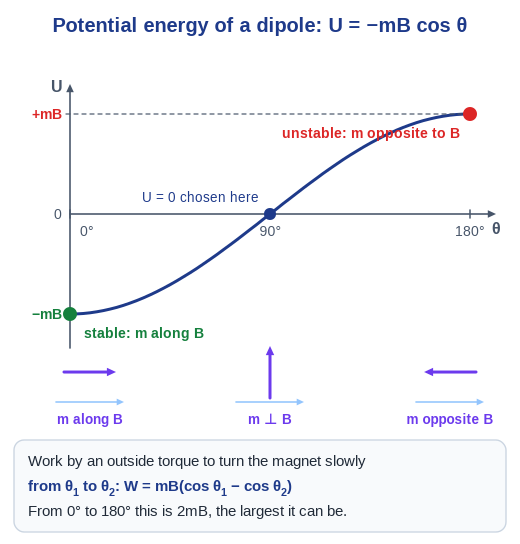
Turning the needle against this torque stores energy. Adding up τ dθ gives the magnetic potential energy
U = ∫ mB sin θ dθ = −mB cos θ = −m·B
Dropping the constant of integration puts the zero of energy at θ = 90°. Then:
- θ = 0°: U = −mB, the lowest value. This is stable equilibrium.
- θ = 180°: U = +mB, the highest value. This is unstable equilibrium: the torque is zero, but the slightest push turns the needle right round.
The work an outside torque must do to turn the magnet slowly from θ₁ to θ₂ is the change in U, W = mB(cos θ₁ − cos θ₂).
How is a magnetic dipole like an electric dipole?
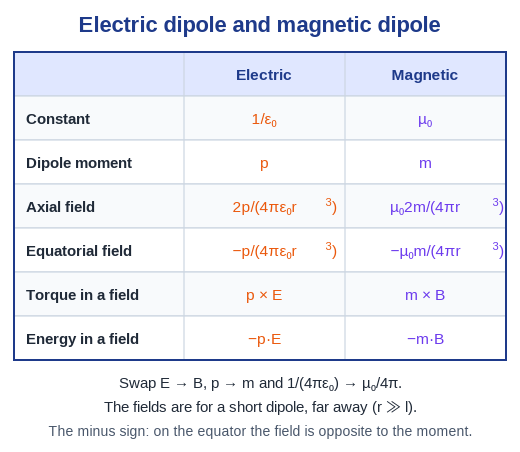
The three results above have the same form as those for an electric dipole p in Chapter 1. Every electric dipole formula turns into a magnetic one by the swaps
E → B, p → m, 1/(4πε₀) → µ₀/4π
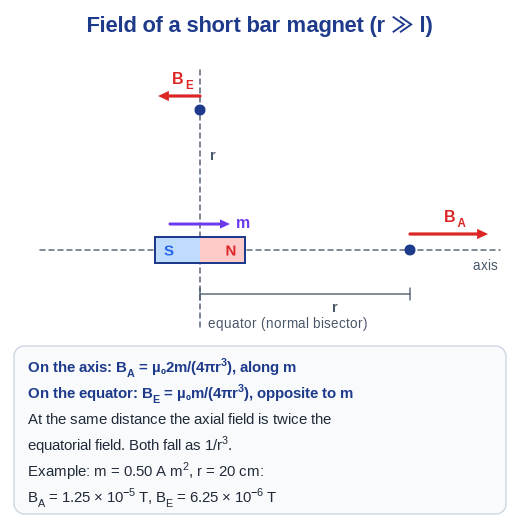
So, at a distance r much larger than the size l of the magnet:
- on the axis: BA = µ₀2m/(4πr³), in the direction of m
- on the equator (the normal bisector): BE = −µ₀m/(4πr³), opposite to m
At equal distances the axial field is twice the equatorial field, and both fall as 1/r³. With µ₀/4π = 10⁻⁷ T m A⁻¹, a magnet of m = 0.50 A m² gives 1.25 × 10⁻⁵ T at 20 cm on its axis and 6.25 × 10⁻⁶ T at 20 cm on its equator.
What is Gauss’s law for magnetism?
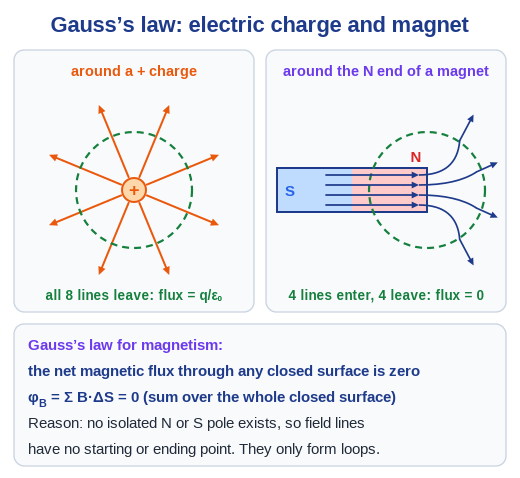
Draw any closed surface near a magnet. Because magnetic field lines are closed loops, every line that enters the surface must also leave it. Split the surface into small pieces ΔS; the flux through one piece is B·ΔS, and adding up all the pieces gives
φB = Σ B·ΔS = 0
Through any closed surface, the net magnetic flux is zero. Compare the electric case, Σ E·ΔS = q/ε₀, where the flux counts the charge inside. The right-hand side is zero for magnetism because there is no magnetic “charge”: isolated poles are not known to exist. The simplest source of a magnetic field is a dipole or a current loop, never a single pole.
What are magnetisation and magnetic intensity?
An electron going round inside an atom carries a magnetic moment. Within a piece of material these moments add up as vectors, and the sum may not be zero. The magnetisation is the net magnetic moment per unit volume:
M = mnet/V (a vector, unit A m⁻¹)
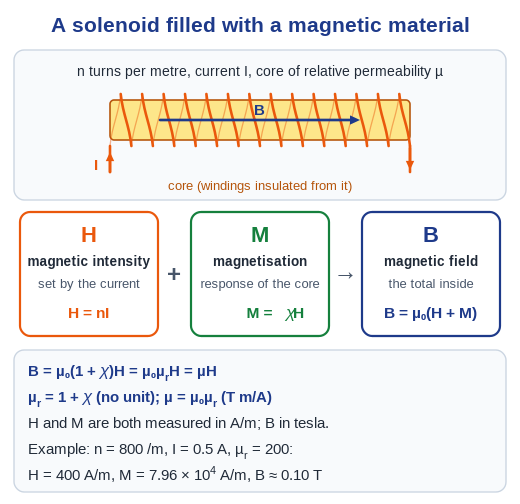
Take a long solenoid with n turns per metre carrying current I. Empty, the field inside is B₀ = µ₀nI. Fill it with a material and the field becomes B = B₀ + Bm, where the material’s share is Bm = µ₀M. It is useful to separate the cause that we control (the current) from the response of the material. So we define the magnetic intensity
H = B/µ₀ − M, which gives B = µ₀(H + M)
H has the same unit as M, A m⁻¹, and inside the solenoid H = nI whatever the core is made of. For many materials the response is proportional to the cause:
M = χH
The number χ is the magnetic susceptibility. Putting this into B = µ₀(H + M):
B = µ₀(1 + χ)H = µ₀µrH = µH
Here µr = 1 + χ is the relative magnetic permeability (no unit; it plays the part that the dielectric constant plays in electrostatics), and µ = µ₀µr is the magnetic permeability, with the same unit as µ₀, T m A⁻¹. Only one of χ, µr and µ is independent: know one and you have the other two. Here µ₀ = 4π × 10⁻⁷ T m A⁻¹ is the permeability of free space.
How are materials sorted by their magnetic behaviour?
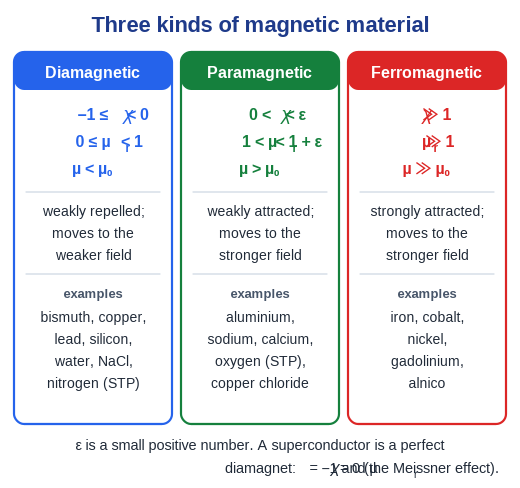
By the sign and size of χ. Negative χ means diamagnetic; positive but small means paramagnetic; positive and large means ferromagnetic. Read diamagnetic, paramagnetic and ferromagnetic materials.
Diamagnetism
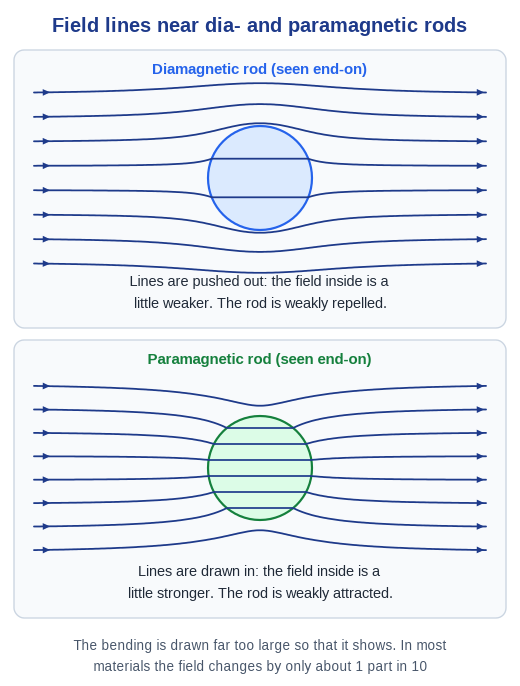
A diamagnetic substance moves from the stronger part of a field towards the weaker part, so a magnet weakly repels it. Field lines are pushed out a little and the field inside is slightly reduced, in most cases by about 1 part in 10⁵.
Why? In these atoms the orbital magnetic moments of the electrons cancel, so the atom has no net moment. When a field is switched on, electrons whose orbital moment is along the field slow down and those with the opposite moment speed up. This is an induced effect that follows Lenz’s law (Chapter 6). The result is a small net moment opposite to the field. Copper, lead, bismuth, silicon, water, sodium chloride and nitrogen (at STP) are diamagnetic. The effect exists in every substance, but in others it is hidden by stronger para- or ferromagnetism.
Superconductors, metals cooled to very low temperatures, are perfect diamagnets as well as perfect conductors. They expel the field completely, with χ = −1 and µr = 0. This is the Meissner effect. A superconductor and a magnet repel each other, which is used in magnetically levitated trains.
Paramagnetism
A paramagnetic substance is weakly magnetised along the field and moves from weak field towards strong field, so a magnet weakly attracts it. Each atom, ion or molecule has a permanent magnetic moment, but thermal motion keeps the moments pointing in random directions, so the sample has no net magnetisation. A field lines some of them up along itself. Field lines are drawn in a little and the field inside rises slightly, again by about 1 part in 10⁵. Sodium, calcium, aluminium, copper chloride and oxygen (at STP) are paramagnetic.
For a paramagnet, χ and µr depend on temperature too. A stronger field or a lower temperature gives more alignment, up to saturation, when every moment points along the field.
Ferromagnetism
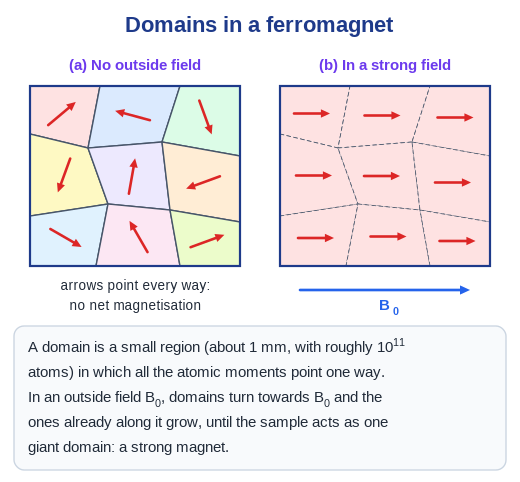
A ferromagnetic substance is strongly magnetised by a field and strongly attracted to a magnet. Its atoms have permanent moments, as in a paramagnet, but here neighbouring atoms interact so that their moments line up with each other over a region called a domain. (The reason is quantum mechanical and outside this book.) A typical domain is about 1 mm across and holds about 10¹¹ atoms. In an unmagnetised piece, different domains point different ways and cancel. In an outside field B₀ the domains turn towards B₀, and those already along it grow, until the piece behaves as one giant domain. The field lines are then very crowded inside, and µr is more than 1000. Iron, cobalt, nickel and gadolinium are ferromagnetic.
- Hard ferromagnets keep their magnetisation when the field is removed. Alnico (an alloy containing iron, nickel, cobalt, aluminium and copper) and natural lodestone are examples. They make permanent magnets, such as compass needles.
- Soft ferromagnets, such as soft iron, lose their magnetisation when the field is removed.
Heat a ferromagnet enough and the domains break up: it becomes a paramagnet.
Extra (not in this book): the temperature above which a ferromagnet turns paramagnetic is called its Curie temperature, and for a paramagnet the susceptibility is inversely proportional to the absolute temperature (Curie’s law). The 2026-27 book mentions the behaviour but not these names.
Which quantities and units belong to this chapter?
- Permeability of free space µ₀: scalar, T m A⁻¹; µ₀/4π = 10⁻⁷ T m A⁻¹.
- Magnetic field B: vector, tesla (T); 1 T = 10⁴ gauss (G).
- Magnetic moment m: vector, A m² (equal to J T⁻¹), dimensions [L²A].
- Magnetic flux φB: scalar, weber (Wb); 1 Wb = 1 T m².
- Magnetisation M and magnetic intensity H: vectors, A m⁻¹.
- Susceptibility χ and relative permeability µr: scalars with no unit.
- Permeability µ: scalar, T m A⁻¹ (or N A⁻²).
Before we move on
Four ideas carry the chapter. A magnet is a dipole, never a single pole. A uniform field turns a dipole (τ = m × B) and gives it an energy −m·B. Field lines close on themselves, so the flux through a closed surface is zero. And the response of a material is summed up by one number, χ, in B = µ₀(1 + χ)H. Practise the torque, energy and field numericals with their directions. All 7 exercises and all 5 worked examples are solved in the NCERT solutions for Chapter 5.
Key terms
| Term | Meaning |
|---|---|
| Magnetic dipole moment (m) | The vector that measures the strength of a magnet or current loop; it points from the S pole to the N pole. For a coil or solenoid m = NIA. Unit A m² (the same as J T⁻¹). |
| Magnetic field lines | Curves whose tangent gives the direction of B at each point. They form closed loops, never cross, and are crowded where the field is strong. |
| Torque on a dipole | In a uniform field τ = m × B, of size mB sin θ; it turns m towards B. The net force is zero. |
| Magnetic potential energy | U = −m·B = −mB cos θ, with the zero taken at θ = 90°; lowest (−mB) when m is along B. |
| Axial and equatorial field | For a short magnet at distance r: µ₀2m/(4πr³) along m on the axis, and µ₀m/(4πr³) opposite to m on the equator. |
| Gauss’s law for magnetism | Through any closed surface the net magnetic flux is zero, because isolated magnetic poles are not known to exist. |
| Magnetisation (M) | The net magnetic moment per unit volume of a material, M = m_net/V; a vector, in A m⁻¹. |
| Magnetic intensity (H) | H = B/µ₀ − M, the part of the field set by outside currents; in a solenoid H = nI. Unit A m⁻¹. |
| Magnetic susceptibility (χ) | The number in M = χH that tells how strongly a material is magnetised by a field; it has no unit. |
| Relative permeability (µ_r) | µ_r = 1 + χ, with no unit; the permeability is µ = µ₀µ_r, so that B = µH. |
| Diamagnetic | χ small and negative: weakly repelled by a magnet, moves towards the weaker field (bismuth, copper, water). |
| Paramagnetic | χ small and positive: weakly attracted by a magnet, moves towards the stronger field (aluminium, sodium, oxygen). |
| Ferromagnetic | χ very large and positive: strongly attracted; atomic moments line up in domains (iron, cobalt, nickel, gadolinium). |
| Domain | A small region of a ferromagnet, about 1 mm across, in which all the atomic moments point the same way. |
Topics in this chapter
Practice
-
A magnet of moment m lies at angle θ to a uniform field B. The torque on it has magnitude:
Show answer
Answer: (b) mB sin θ
-
The potential energy of a magnetic dipole in a uniform field is lowest when the angle between m and B is:
Show answer
Answer: (a) 0°
-
At the same distance from a short bar magnet, the ratio of the axial field to the equatorial field is:
Show answer
Answer: (c) 2 : 1
-
The net magnetic flux through a closed surface that encloses the N pole of a bar magnet is:
Show answer
Answer: (c) zero
-
A material has susceptibility χ = −1.0 × 10⁻⁵. It is:
Show answer
Answer: (c) diamagnetic
-
The SI unit of magnetisation M is:
Show answer
Answer: (b) A m⁻¹
Questions students ask
What are the main topics of Class 12 Physics Chapter 5?
The bar magnet and its field lines, the bar magnet as an equivalent solenoid, the torque on and potential energy of a magnetic dipole in a uniform field, the analogy with an electric dipole, Gauss’s law for magnetism, magnetisation M and magnetic intensity H with susceptibility and permeability, and diamagnetic, paramagnetic and ferromagnetic materials.
Is the earth’s magnetism in the 2026-27 Class 12 Physics book?
No. The rationalised Chapter 5 of Physics Part I (Reprint 2026-27, pages 136 to 153) has no section on the earth’s magnetism, so declination, dip and the horizontal component are not taught. Hysteresis, and permanent magnets and electromagnets as a separate section, are also not there. Guides that teach them follow the pre-2022 book.
Which formulas should I remember from this chapter?
τ = m × B with size mB sin θ; U = −m·B; the axial field µ₀2m/(4πr³) and the equatorial field µ₀m/(4πr³) of a short magnet; m = NIA for a solenoid; Gauss’s law Σ B·ΔS = 0; M = m_net/V; B = µ₀(H + M); M = χH; µ_r = 1 + χ and µ = µ₀µ_r.
Why can a magnet not have a single pole?
A magnet’s field comes from tiny circulating currents, and every current loop has both an N face and an S face. Cutting a magnet only gives smaller magnets with two poles each. This is why magnetic field lines have no start or end and form closed loops.
What is the difference between B and H?
H is the part of the field set by outside currents, such as nI in a solenoid, and is measured in A m⁻¹. B is the total field, which also includes the response of the material: B = µ₀(H + M), measured in tesla.
Stuck on a question?
Take a photo and Lagnever AI explains it step by step. Try it for 7 days for ₹2.
Get it on Google Play Open in browser
For parents: after the trial, the plan renews monthly by UPI or card autopay. You can cancel anytime in the app.