
What are diamagnetic, paramagnetic and ferromagnetic materials?
Answer in short
A material in a field gains a magnetisation M = χH, so inside it B = µ₀(H + M). Diamagnetic materials have a small negative χ and are weakly repelled by a magnet. Paramagnetic materials have a small positive χ and are weakly attracted. Ferromagnetic materials have a very large χ, as atomic moments align in domains, and are strongly attracted.
Stuck on a question? Take a photo and Lagnever AI explains it step by step. Try it for 7 days for ₹2. Get it on Google Play
What is magnetisation?
An electron moving round a nucleus is a tiny current loop with a magnetic moment. In a lump of material these moments add as vectors. If the sum is not zero, the lump is magnetised. The magnetisation is the net moment in each unit of volume:
M = mnet/V
M is a vector quantity; its dimensions are [L⁻¹A] and its unit is A m⁻¹. A bar of volume 5.0 cm³ with a moment of 4.0 A m² has M = 4.0/(5.0 × 10⁻⁶) = 8.0 × 10⁵ A m⁻¹.
What is magnetic intensity H?
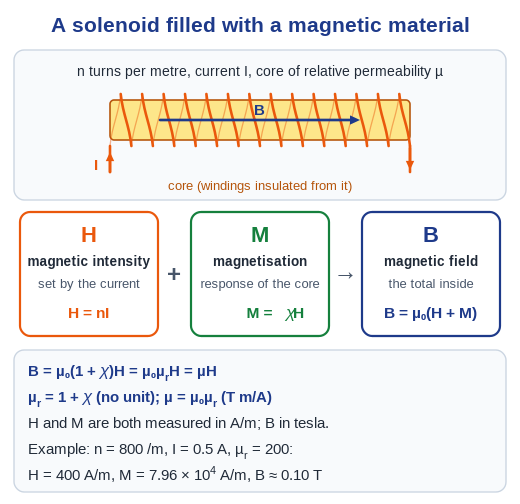
A long solenoid with n turns per metre and current I has the field B₀ = µ₀nI inside it when empty. With a material inside, the field is
B = B₀ + Bm, where Bm = µ₀M
is the part supplied by the material. To keep the two causes apart we define the magnetic intensity
H = B/µ₀ − M, so that B = µ₀(H + M)
H stands for the outside cause (in the solenoid H = nI, the same with or without a core); M stands for the material’s own response. Both are measured in A m⁻¹.
What are susceptibility and permeability?
For many materials M is proportional to H:
M = χH
χ, the magnetic susceptibility, is a pure number that measures how readily the material is magnetised. Then
B = µ₀(1 + χ)H = µ₀µrH = µH
with relative permeability µr = 1 + χ (no unit) and permeability µ = µ₀µr (unit T m A⁻¹, like µ₀, the permeability of free space). Given any one of χ, µr and µ, the other two follow.
Example: a solenoid with n = 800 turns per metre carries 0.5 A and has a core with µr = 200. Then H = nI = 400 A m⁻¹, χ = 199, M = χH = 7.96 × 10⁴ A m⁻¹ and B = µ₀µrH = 4π × 10⁻⁷ × 200 × 400 ≈ 0.10 T. Without the core the field would be only µ₀H ≈ 5.0 × 10⁻⁴ T.
How does χ sort materials?
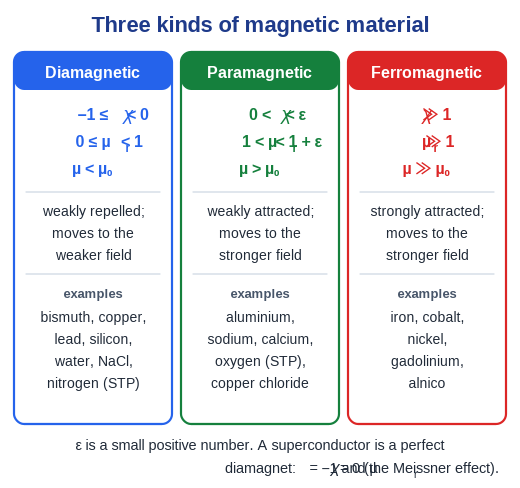
- Diamagnetic: −1 ≤ χ < 0, so 0 ≤ µr < 1 and µ < µ₀.
- Paramagnetic: 0 < χ < ε, so 1 < µr < 1 + ε and µ > µ₀ (ε is a small positive number).
- Ferromagnetic: χ ≫ 1, so µr ≫ 1 and µ ≫ µ₀.
A tiny change in χ makes a big difference in behaviour: a typical diamagnet has χ of about −10⁻⁵ and a typical paramagnet about +10⁻⁵, yet one is repelled and the other attracted.
What is diamagnetism?
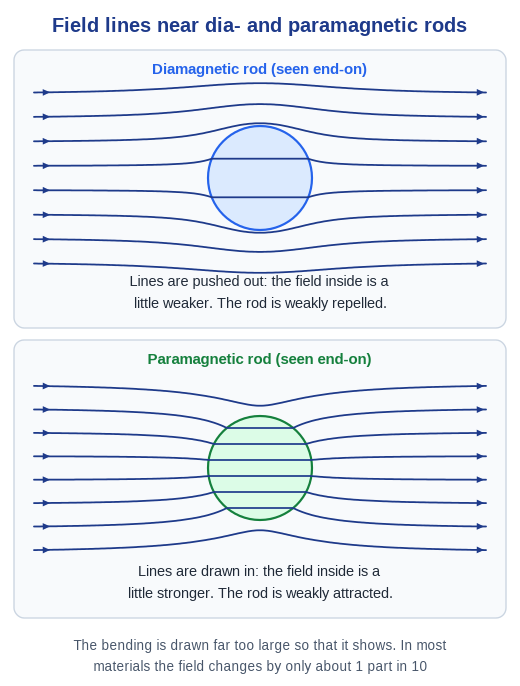
A diamagnetic bar in a field pushes the field lines out slightly, so the field inside is a little weaker (usually by about 1 part in 10⁵). In a non-uniform field the bar moves towards the weaker region: a magnet repels it.
The atoms of these substances have no net moment, because the orbital moments of their electrons cancel. Switching on a field changes the speeds of the orbiting electrons (an induced effect, by Lenz’s law), and this leaves a small net moment opposite to the field. Examples: copper, lead, bismuth, silicon, water, sodium chloride, nitrogen at STP. All substances have this response; it shows only when nothing stronger hides it.
A superconductor (a metal at very low temperature) expels the field completely: χ = −1, µr = 0. This perfect diamagnetism is the Meissner effect.
What is paramagnetism?
In a paramagnetic substance each atom, ion or molecule has a permanent moment. Thermal motion keeps the moments disordered, so there is no magnetisation without a field. A field partly lines them up along itself. The field lines crowd in slightly, the field inside is a little stronger (again about 1 part in 10⁵), and the sample moves towards the stronger field: a magnet attracts it weakly. Examples: aluminium, sodium, calcium, oxygen at STP, copper chloride.
The alignment improves in a stronger field or at a lower temperature, until at saturation all moments point along the field.
What is ferromagnetism?
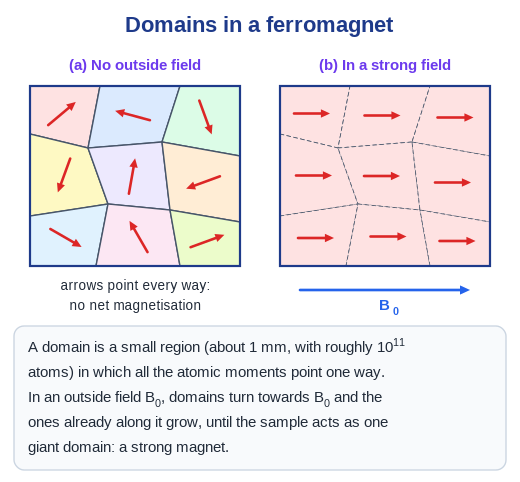
In iron, cobalt, nickel and gadolinium, neighbouring atomic moments line each other up over whole regions called domains, each about 1 mm in size with about 10¹¹ atoms. With no field the domains point in different directions and cancel. An outside field B₀ turns them and lets the well-aligned ones grow, until the piece acts as a single giant domain. The magnetisation is then huge: µr is above 1000 and the sample is pulled strongly into the field.
Hard ferromagnets (alnico, lodestone) keep this magnetisation and serve as permanent magnets. Soft ones (soft iron) lose it when the field goes. On strong heating the domain structure breaks down and a ferromagnet becomes paramagnetic.
Extra (not in this book): the temperature at which a ferromagnet turns paramagnetic is called the Curie temperature. Hysteresis loops are not part of the 2026-27 chapter.
Previous topic: the bar magnet as a magnetic dipole. See also the chapter notes and the NCERT solutions.
Practice
-
A material has relative permeability 0.99998. It is:
Show answer
Answer: (b) diamagnetic
-
Which set contains only ferromagnetic substances?
Show answer
Answer: (a) iron, cobalt, nickel
-
Placed in a non-uniform magnetic field, a paramagnetic rod tends to move:
Show answer
Answer: (b) towards the stronger field
-
A bar of volume 5.0 cm³ has a magnetic moment of 4.0 A m². Find its magnetisation.
Show answer
Answer: M = m/V = 4.0/(5.0 × 10⁻⁶ m³) = 8.0 × 10⁵ A m⁻¹.
-
A core has susceptibility 499. Find its relative permeability and its permeability.
Show answer
Answer: µ_r = 1 + χ = 500, and µ = µ₀µ_r = 4π × 10⁻⁷ × 500 = 6.28 × 10⁻⁴ T m A⁻¹.
Questions students ask
What is the difference between diamagnetic and paramagnetic materials?
The atoms of a diamagnetic material have no net magnetic moment; a field induces a weak moment opposite to itself, so χ is negative and the material is repelled. The atoms of a paramagnetic material have permanent moments that a field partly lines up along itself, so χ is positive and the material is attracted.
What is a magnetic domain?
It is a region of a ferromagnetic material, typically about 1 mm in size and holding about 10¹¹ atoms, inside which the atomic magnetic moments all point the same way. Different domains point in different directions until an outside field lines them up.
What is the Meissner effect?
It is the complete expulsion of magnetic field from a superconductor. The superconductor behaves as a perfect diamagnet, with χ = −1 and µ_r = 0.
Is diamagnetism present in all materials?
Yes. Every substance shows the diamagnetic response, but it is so weak that in paramagnetic and ferromagnetic substances the stronger effect hides it.
What are hard and soft magnetic materials?
Hard ferromagnets, such as alnico and lodestone, stay magnetised after the outside field is removed and are used for permanent magnets. Soft ferromagnets, such as soft iron, lose their magnetisation when the field is removed.
Stuck on a question?
Take a photo and Lagnever AI explains it step by step. Try it for 7 days for ₹2.
Get it on Google Play Open in browser
For parents: after the trial, the plan renews monthly by UPI or card autopay. You can cancel anytime in the app.