
Why is a bar magnet a magnetic dipole?
Answer in short
A bar magnet has two inseparable poles, and its field lines are closed loops like a solenoid’s, so it is a magnetic dipole with moment m. In a uniform field B it feels no net force but a torque m × B, with energy −m·B. Far away, its axial field is twice its equatorial field.
Stuck on a question? Take a photo and Lagnever AI explains it step by step. Try it for 7 days for ₹2. Get it on Google Play
What do the field lines of a bar magnet look like?
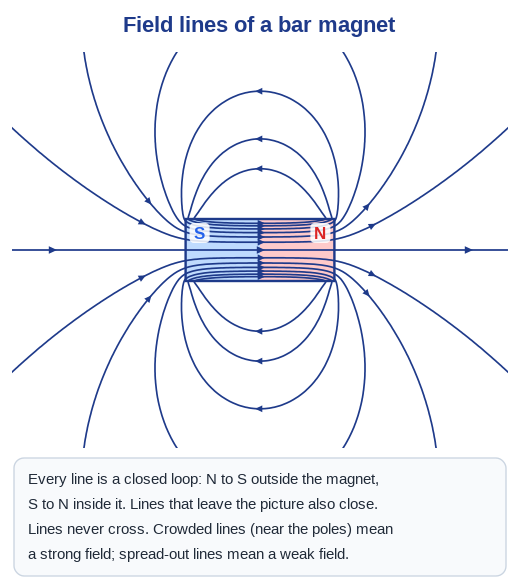
Iron filings sprinkled round a short bar magnet settle into curves that join its two ends. The pattern tells us that the magnet has two poles, as an electric dipole has two charges. From it we draw magnetic field lines, which obey four rules:
- Each line is a closed loop. Outside the magnet it runs from N to S; inside, it continues from S to N.
- The tangent to a line gives the direction of B at that point.
- Lines are closer together where B is larger, as near the poles.
- Lines never cross, because B cannot point two ways at one place.
A compass needle placed at different points shows the same directions. Remember that the lines show how a small needle would settle. They are not paths along which a moving charge is pushed.
Why is a bar magnet like a solenoid?
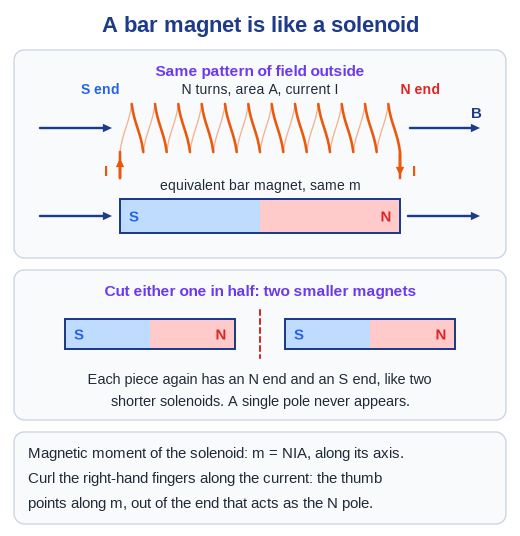
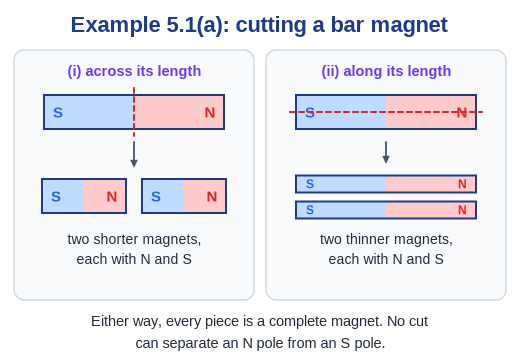
The field lines of a current-carrying solenoid of finite length look just like those of a bar magnet. This fits Ampere’s idea that magnetism is due to circulating currents: a magnet acts as a stack of tiny current loops. Cut the magnet across and you get two shorter magnets, just as a solenoid cut across gives two shorter solenoids. Poles never come out singly.
The book works out the field of a solenoid (length 2l, radius a, n turns per unit length, current I) at a far point on its axis and finds
B = µ₀2m/(4πr³), with m = n(2l) × I × πa²
That is, m = NIA: number of turns × current × area of cross-section. A bar magnet’s far axial field has the same form, so we give the magnet the magnetic moment of its equivalent solenoid. A solenoid of 500 turns and area 2.0 × 10⁻⁴ m² carrying 2.0 A has m = 500 × 2.0 × 2.0 × 10⁻⁴ = 0.20 A m².
What does a uniform field do to the magnet?
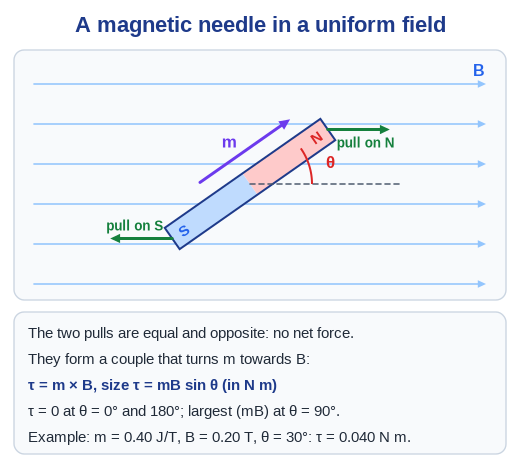
Let the moment m make an angle θ with a uniform field B. The net force is zero, but there is a torque
τ = m × B, τ = mB sin θ
which turns m towards B. The potential energy, with its zero at θ = 90°, is
U = −m·B = −mB cos θ
For m = 0.40 J T⁻¹ and B = 0.20 T, mB = 0.080 J. At θ = 30° the torque is 0.040 N m and U = −0.080 × cos 30° = −0.069 J. The magnet is in stable equilibrium at θ = 0° (U = −0.080 J) and in unstable equilibrium at θ = 180° (U = +0.080 J). Turning it from 0° to 180° needs 2mB = 0.16 J of work.
A magnet near another magnet is in a non-uniform field. That is why an iron nail near a bar magnet is not only turned but also pulled in: the field magnetises the nail, and the nearer induced pole is attracted more strongly than the farther one is repelled.
What is the field of a short bar magnet?
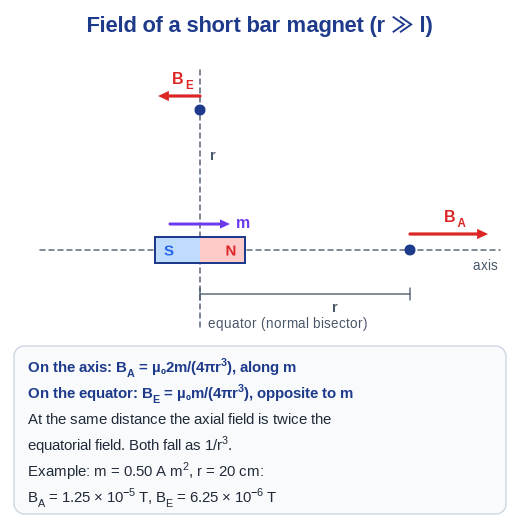
Use the electric dipole results with E → B, p → m and 1/(4πε₀) → µ₀/4π. At a distance r much greater than the magnet’s length:
- Axis: BA = µ₀2m/(4πr³), pointing along m.
- Equator: BE = −µ₀m/(4πr³), pointing opposite to m.
So BA = 2BE at the same distance. Doubling r cuts either field to one eighth. For m = 0.50 A m² and r = 20 cm: BA = 10⁻⁷ × 2 × 0.50/(0.20)³ = 1.25 × 10⁻⁵ T and BE = 6.25 × 10⁻⁶ T.
What does Gauss’s law say for a magnet?
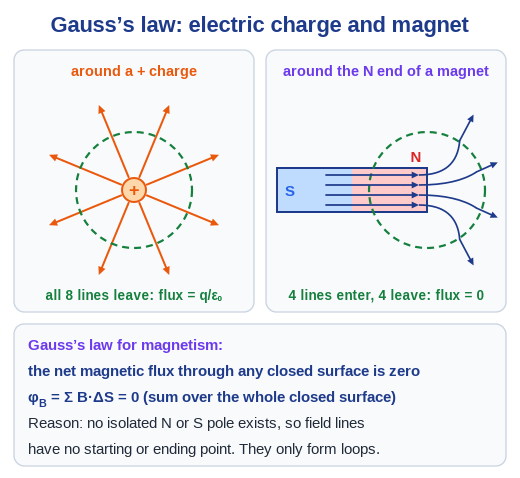
Since every field line is a closed loop, any line that goes into a closed surface comes out again. So
φB = Σ B·ΔS = 0 for any closed surface
For electric fields the same sum equals q/ε₀. The zero on the magnetic side says that there is no magnetic charge: no isolated N or S pole. Even a surface drawn tightly round the N end of a magnet has zero net flux, because the lines leaving the end face are the same lines that entered through the body of the magnet.
Not every source of magnetic field has poles. A toroid and a long straight wire have field lines that circle the current and never pass through anything like an N or S face; their net magnetic moment is zero.
Next topic: diamagnetic, paramagnetic and ferromagnetic materials. See also the chapter notes and the NCERT solutions.
Practice
-
Inside a bar magnet, the magnetic field lines run:
Show answer
Answer: (b) from S to N
-
A bar magnet is held at 90° to a uniform field. Compared with its value at 30°, the torque is:
Show answer
Answer: (c) twice
-
The distance from a short magnet is doubled along its axis. The field becomes:
Show answer
Answer: (c) one eighth
-
A magnet of moment 2.0 J T⁻¹ is held at 60° to a uniform field of 0.10 T. Find the torque on it.
Show answer
Answer: τ = mB sin θ = 2.0 × 0.10 × sin 60° = 0.17 N m, turning m towards B.
-
A short magnet has m = 0.60 A m². Find the field 10 cm from its centre on the axis.
Show answer
Answer: B = (µ₀/4π) × 2m/r³ = 10⁻⁷ × 2 × 0.60/(0.10)³ = 1.2 × 10⁻⁴ T, along m (from S to N).
Questions students ask
Why is a bar magnet called a magnetic dipole?
Because it always has two poles, N and S, which cannot be separated, and its field at large distances has exactly the form of an electric dipole’s field with p replaced by m and 1/(4πε₀) by µ₀/4π.
Why does a bar magnet behave like a solenoid?
Both give the same pattern of field lines and the same far axial field, µ₀2m/(4πr³). A magnet can be pictured as many tiny circulating currents, which is what a solenoid is. Cutting either in half gives two shorter pieces, each with an N and an S end.
Why is there no net force on a magnet in a uniform field?
The pulls on the N and S poles are equal in size and opposite in direction, so they cancel. They act along different lines, so they still produce a torque. In a non-uniform field the pulls are unequal and a net force appears.
In which direction is the magnetic moment of a bar magnet?
From its S pole to its N pole, along the axis. For a solenoid, curl the fingers of the right hand along the current; the thumb gives the direction of m.
Stuck on a question?
Take a photo and Lagnever AI explains it step by step. Try it for 7 days for ₹2.
Get it on Google Play Open in browser
For parents: after the trial, the plan renews monthly by UPI or card autopay. You can cancel anytime in the app.