
What do Faraday’s law and Lenz’s law say?
Answer in short
Faraday’s law says the emf induced in a circuit equals the rate of change of magnetic flux through it: ε = −N dΦ/dt, with Φ = BA cos θ. Lenz’s law gives the direction: the induced current opposes the change in flux. A rod moving across a field has emf Blv.
Stuck on a question? Take a photo and Lagnever AI explains it step by step. Try it for 7 days for ₹2. Get it on Google Play
What did the experiments show?
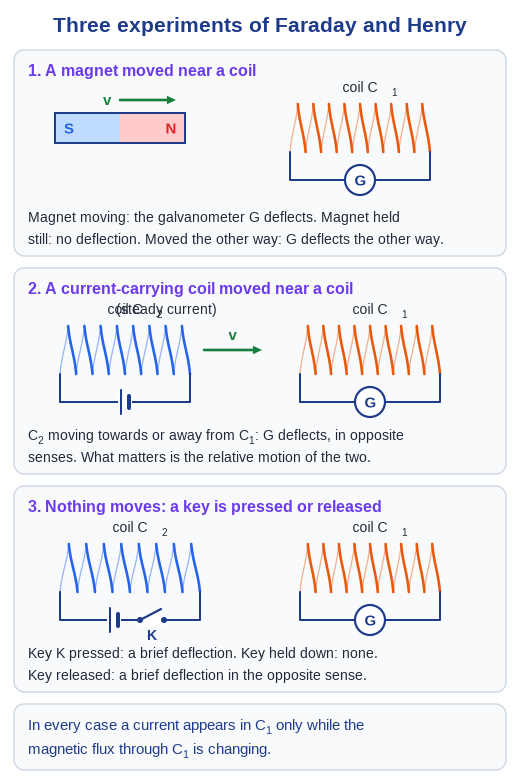
Faraday and Henry joined a coil to a galvanometer, with no battery in that circuit, and found three ways to make a current flow in it: move a magnet near the coil, move a second current-carrying coil near it, or keep both coils still and switch the current in the second coil on or off. In every case the galvanometer moved only while the change was going on. Reversing the change reversed the current, and a faster change gave a bigger current.
What is magnetic flux?
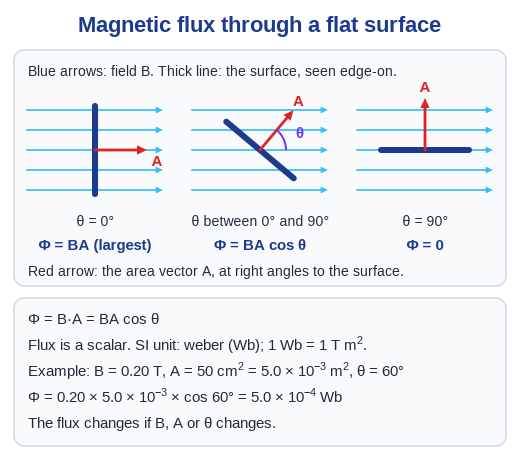
What changes in all three experiments is the magnetic flux through the coil. For a flat surface of area A in a uniform field B,
ΦB = B·A = BA cos θ
The area vector A is at right angles to the surface, and θ is the angle between B and A. The flux is BA when the field goes straight through the surface (θ = 0°) and zero when the field runs along it (θ = 90°). For a field that is not uniform, add up B·dA over small pieces of the surface. Flux is a scalar, measured in weber (1 Wb = 1 T m²).
What does Faraday’s law say?
The emf induced in a circuit is equal in size to the rate at which the magnetic flux through the circuit changes.
ε = −dΦB/dt, and for a tightly wound coil with N turns, ε = −N dΦB/dt
Each turn has the same changing flux and the turns are in series, so more turns give a larger emf. In a closed circuit of resistance R the current is I = ε/R. The flux can be changed through B, through the area A, or through the angle θ.
When the flux changes at a steady rate, use |ε| = N ΔΦ/Δt. Suppose a coil of 50 turns and area 0.02 m² faces a field of 0.3 T, and the field is brought to zero steadily in 0.1 s. The flux per turn falls by 0.3 × 0.02 = 6 × 10⁻³ Wb, so |ε| = 50 × 6 × 10⁻³/0.1 = 3.0 V. If the circuit has a resistance of 15 Ω, the current is 0.2 A while the field is changing. When the rate is not steady, ΔΦ/Δt gives only the average emf.
How does Lenz’s law give the direction?
The induced current flows in the direction that opposes the change in flux. A four-step routine works for every problem:
- Find the direction of the field B through the loop.
- Decide whether the flux is increasing or decreasing.
- The induced current’s own field must point opposite to B if the flux is increasing, and along B if it is decreasing.
- Use the right-hand rule to get the current that gives this field: curl the fingers along the current, and the thumb shows the field inside the loop.
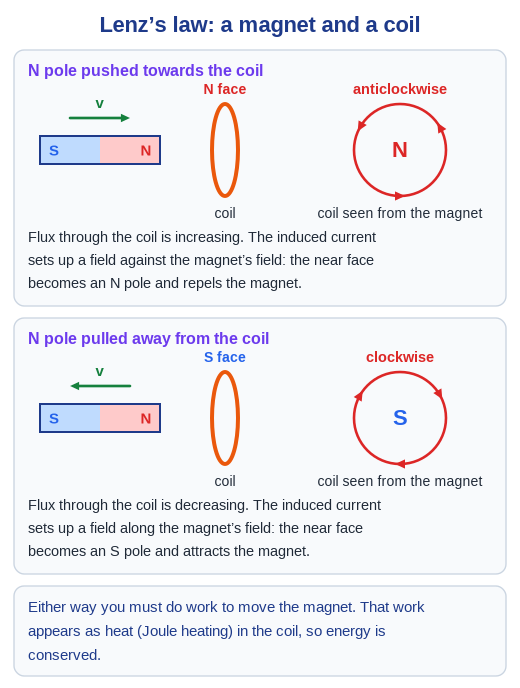
For a magnet and a coil there is a shortcut. An approaching pole is repelled, so the near face of the coil becomes the same pole. A pole moving away is attracted, so the near face becomes the opposite pole. A face is an N pole when its current looks anticlockwise, and an S pole when it looks clockwise.
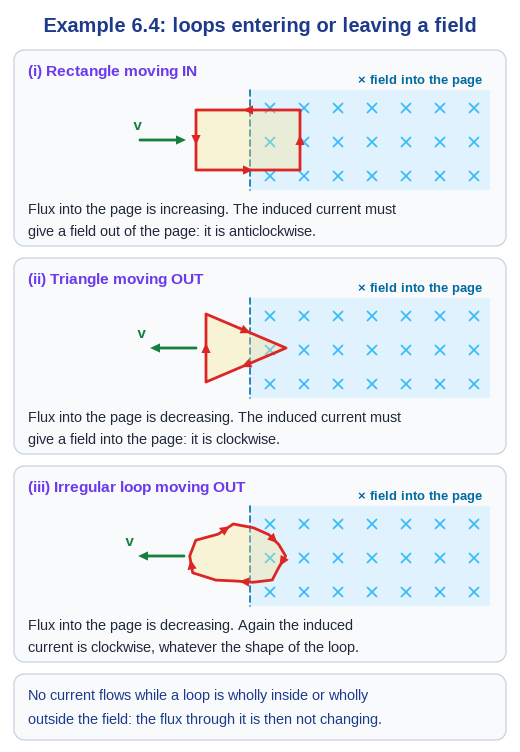
Try the routine on a loop being pulled out of a region where the field points into the page. B is into the page. Less and less of the loop is in the field, so the flux is decreasing. The induced field must therefore be into the page as well, and that needs a clockwise current. A loop being pushed into the region has an anticlockwise current.
Why does Lenz’s law follow from conservation of energy?
Push the N pole of a magnet towards a coil. The coil’s near face becomes an N pole and pushes back, so you must do work, and that work ends up as heat in the coil. If the near face became an S pole instead, it would pull the magnet in. The magnet would speed up, the current would grow and the pull would grow with it. Kinetic energy and heat would both appear with nothing paying for them. So the direction given by Lenz’s law is the only one that conserves energy.
How does a moving rod get an emf?
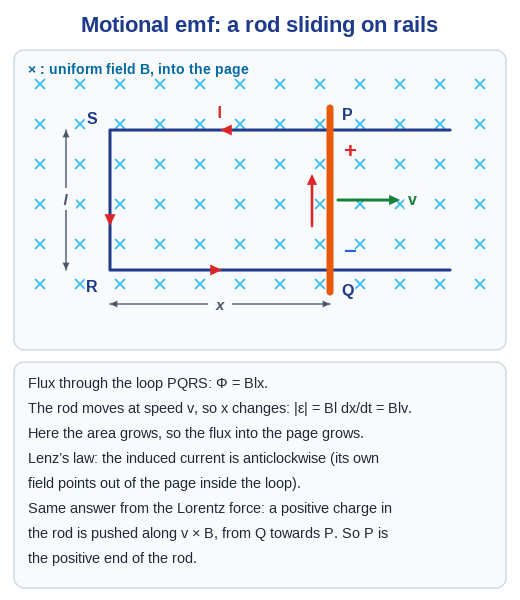
Slide a rod PQ of length l along two rails joined at one end, in a field B at right angles to the plane of the rails. If the rod is at distance x from the joined end, the flux through the loop is Blx, and as the rod moves with speed v the emf is
|ε| = Bl dx/dt = Blv
This motional emf is Faraday’s law with the area changing. It can also be seen directly: each charge q in the rod moves with velocity v in the field, so it feels a Lorentz force qv × B along the rod, and the work done per unit charge over the length l is vBl. The end towards which v × B points is the positive end of the rod.
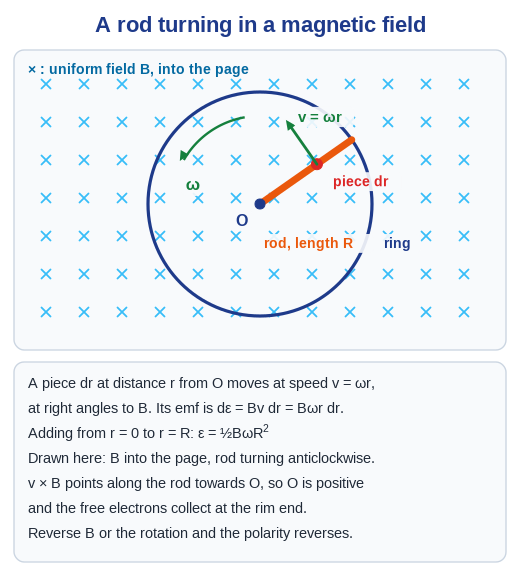
If the rod turns about one end, its points move at different speeds, v = ωr. Adding up the emfs of the small pieces from the pivot to the tip gives
ε = ½BωR²
for a rod of length R turning with angular speed ω in a field parallel to the axis of rotation.
The Lorentz force cannot explain the experiment in which nothing moves, because a charge at rest feels no magnetic force. The push must come from an electric field: a magnetic field that changes with time creates an electric field.
Next topic: self and mutual inductance. See also the chapter notes and the NCERT solutions.
Practice
-
A coil is held still in a strong, steady magnetic field. The induced emf in it is:
Show answer
Answer: (c) zero
-
The flux through a loop that lies in the plane of the page is into the page and decreasing. Seen from the front, the induced current is:
Show answer
Answer: (a) clockwise
-
The speed of a rod sliding on rails in a uniform field is doubled. The motional emf becomes:
Show answer
Answer: (c) double
-
A coil of 50 turns and area 0.02 m² lies with its plane at right angles to a field of 0.3 T. The field is reduced to zero at a steady rate in 0.1 s. Find the induced emf.
Show answer
Answer: The flux per turn falls from BA = 0.3 × 0.02 = 6 × 10⁻³ Wb to zero. |ε| = N ΔΦ/Δt = 50 × 6 × 10⁻³/0.1 = 3.0 V.
-
A straight wire 2 m long moves at 10 m s⁻¹ at right angles to its length and to a field of 0.4 × 10⁻⁴ T. Find the emf across its ends.
Show answer
Answer: ε = Blv = 0.4 × 10⁻⁴ × 2 × 10 = 8 × 10⁻⁴ V.
Questions students ask
What is Faraday’s law of electromagnetic induction?
The magnitude of the emf induced in a circuit is equal to how fast the magnetic flux through that circuit is changing. With the sign, ε = −dΦ/dt, and for a tightly wound coil with N turns ε = −N dΦ/dt.
What is Lenz’s law in simple words?
The induced current always acts against the change that causes it. If the flux through a loop is increasing, the induced current produces a field in the opposite direction; if the flux is decreasing, it produces a field in the same direction, trying to keep the flux as it was.
How is Lenz’s law related to conservation of energy?
Because the induced current opposes the motion of the magnet, work has to be done to keep the magnet moving, and that work becomes heat in the coil. If the current helped the motion instead, the magnet would speed up by itself and energy would appear from nowhere.
Is an emf induced in an open circuit?
Yes. A changing flux induces an emf across the open ends, with the polarity given by Lenz’s law. No current flows because the circuit is not complete.
What is the SI unit of magnetic flux?
The weber (Wb). One weber is one tesla metre squared (T m²). A flux changing at one weber per second through a single turn induces an emf of one volt.
Stuck on a question?
Take a photo and Lagnever AI explains it step by step. Try it for 7 days for ₹2.
Get it on Google Play Open in browser
For parents: after the trial, the plan renews monthly by UPI or card autopay. You can cancel anytime in the app.