
What are self-inductance and mutual inductance?
Answer in short
Inductance is the flux linkage of a coil per unit current, measured in henry. Mutual inductance links a coil to another coil’s current: ε₁ = −M dI₂/dt. Self-inductance links a coil to its own current: ε = −L dI/dt, the back emf. A long solenoid has L = µ₀n²Al, and a coil carrying current I stores energy ½LI².
Stuck on a question? Take a photo and Lagnever AI explains it step by step. Try it for 7 days for ₹2. Get it on Google Play
What is inductance?
A current in a coil sets up a magnetic field, which gives a flux through that coil and through any coil near it. As long as the coils keep their shape and position, the flux is proportional to the current that causes it. For a tightly wound coil with N turns what matters is the flux linkage NΦ, so
NΦ ∝ I
The constant of proportionality is an inductance. It depends only on the geometry of the coils and on the material inside them, as capacitance does for a capacitor. Inductance is a scalar with dimensions [M L² T⁻² A⁻²]. Its SI unit is the henry (H), named after Joseph Henry: 1 H = 1 Wb A⁻¹ = 1 V s A⁻¹.
What is mutual inductance?
Take two long coaxial solenoids of the same length l. The inner one, S₁, has radius r₁ and n₁ turns per unit length. The outer one, S₂, has radius r₂ and n₂ turns per unit length. A current I₂ in S₂ gives a flux through S₁, and the mutual inductance of S₁ with respect to S₂ is defined by
N₁Φ₁ = M₁₂I₂
The field inside S₂ is B₂ = µ₀n₂I₂ (edge effects neglected). Each turn of S₁ has area πr₁², and S₁ has n₁l turns:
N₁Φ₁ = (n₁l)(πr₁²)(µ₀n₂I₂), so M₁₂ = µ₀n₁n₂πr₁²l
Now reverse the roles. A current I₁ in S₁ gives a field µ₀n₁I₁ inside S₁ and practically none outside it. The flux through each turn of S₂ is therefore µ₀n₁I₁ × πr₁² (the area of the inner coil, not πr₂²), and S₂ has n₂l turns. This gives M₂₁ = µ₀n₁n₂πr₁²l. So
M₁₂ = M₂₁ = M
and the book states that this equality is far more general.
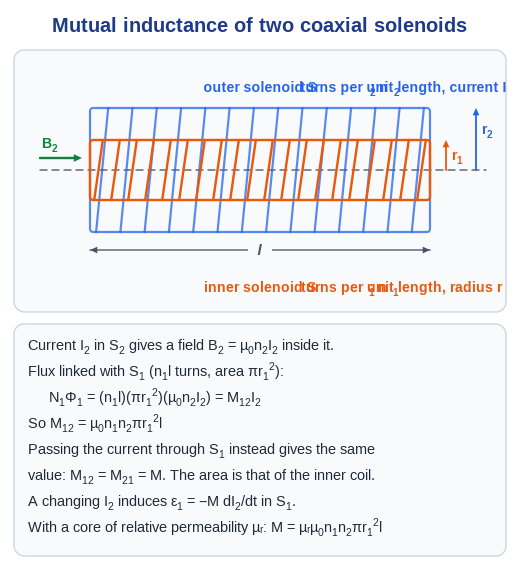
- With a medium of relative permeability µr inside, M = µrµ₀n₁n₂πr₁²l.
- M depends on the separation of the coils and on their relative orientation.
- The equality saves work. For a small coil of radius r₁ at the centre of a large coaxial coil of radius r₂, the field µ₀I₂/2r₂ of the large coil is nearly uniform over the small one, so Φ₁ = πr₁² × µ₀I₂/2r₂ and M = µ₀πr₁²/2r₂. Working from the small coil’s field would be much harder.
If I₂ changes with time, the flux linkage N₁Φ₁ = MI₂ changes too, and
ε₁ = −M dI₂/dt
This is what happened when the key was pressed in Faraday’s third experiment. For example, with n₁ = 2000 m⁻¹, n₂ = 1000 m⁻¹, r₁ = 2.0 cm and l = 0.50 m, M = 4π × 10⁻⁷ × 2000 × 1000 × π × (0.020)² × 0.50 = 1.6 × 10⁻³ H. A current changing at 50 A s⁻¹ in one solenoid induces 0.079 V in the other.
What is self-inductance?
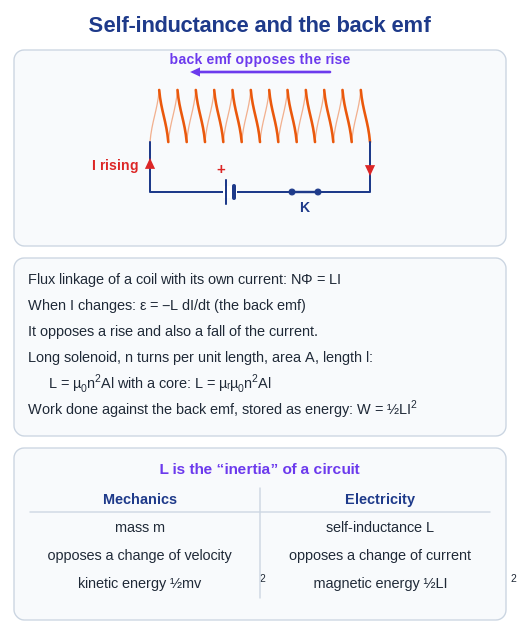
A single coil is linked with its own flux. When its current changes, that flux changes and an emf appears in the coil itself. This is self-induction:
NΦB = LI and ε = −L dI/dt
The constant L is called the coil’s self-inductance. By Lenz’s law the emf opposes a rising current and tries to keep a falling one going, so it is called the back emf.
For a long solenoid of length l, cross-sectional area A and n turns per unit length, B = µ₀nI and the number of turns is nl, so
NΦB = (nl)(µ₀nI)(A), which gives L = µ₀n²Al
With a core of relative permeability µr, such as soft iron, L = µrµ₀n²Al. For n = 1000 m⁻¹, A = 4.0 × 10⁻⁴ m² and l = 0.50 m, L = 4π × 10⁻⁷ × (1000)² × 4.0 × 10⁻⁴ × 0.50 = 2.5 × 10⁻⁴ H, and a core with µr = 500 raises this to 0.13 H. If the current in a 0.50 H coil rises at 4.0 A s⁻¹, the back emf is 0.50 × 4.0 = 2.0 V.
How much energy does an inductor store?
Self-inductance is the electrical counterpart of mass: a coil with a large L is hard to start a current in and hard to stop one in. To set up a current the source must work against the back emf. Leaving out resistance, the rate of doing this work is
dW/dt = |ε|I = LI dI/dt
Adding up from I = 0 to the final current:
W = ∫₀ᴵ LI dI = ½LI²
This is stored as magnetic potential energy, and has the form of ½mv². A 2.0 H coil carrying 3.0 A stores ½ × 2.0 × (3.0)² = 9.0 J.
The energy sits in the magnetic field. For the long solenoid, L = µ₀n²Al and I = B/(µ₀n), so
UB = ½(µ₀n²Al)(B/µ₀n)² = B²Al/2µ₀
Al is the volume that holds the field, so the energy per unit volume of the magnetic field is
uB = B²/2µ₀
It matches the electric energy density uE = ½ε₀E² (Chapter 2), and both hold wherever there is a field. Where B = 1.0 T, uB = (1.0)²/(2 × 4π × 10⁻⁷) = 4.0 × 10⁵ J m⁻³. Here µ₀ is the permeability of free space.
What if two coils both carry changing currents?
Then the flux linkage of coil 1 has two parts, N₁Φ₁ = M₁₁I₁ + M₁₂I₂, where M₁₁ is the self-inductance L₁. Faraday’s law gives
ε₁ = −L₁ dI₁/dt − M₁₂ dI₂/dt
The first term is the back emf and the second is the mutually induced emf.
Previous topic: Faraday’s law and Lenz’s law. See also the chapter notes and the NCERT solutions.
Practice
-
The current in a coil of self-inductance 0.2 H rises at 3 A s⁻¹. The back emf has magnitude:
Show answer
Answer: (b) 0.6 V
-
The current in an inductor is doubled. The energy stored becomes:
Show answer
Answer: (d) four times
-
The number of turns per unit length of a long solenoid is doubled, keeping its length and area the same. Its self-inductance becomes:
Show answer
Answer: (c) four times
-
Two coils have a mutual inductance of 0.5 H. The current in one changes by 4 A in 0.1 s at a steady rate. Find the emf induced in the other.
Show answer
Answer: |ε| = M ΔI/Δt = 0.5 × 4/0.1 = 20 V, for as long as the current is changing.
-
An emf of 6 V is induced in a coil when its current changes at 30 A s⁻¹. Find its self-inductance and the energy stored when the current is 5 A.
Show answer
Answer: L = |ε|/(dI/dt) = 6/30 = 0.2 H. W = ½LI² = ½ × 0.2 × 5² = 2.5 J.
Questions students ask
What is the difference between self-inductance and mutual inductance?
Self-inductance describes the emf induced in a coil by a change of its own current, ε = −L dI/dt. Mutual inductance describes the emf induced in one coil by a change of current in a different coil nearby, ε₁ = −M dI₂/dt. Both are measured in henry.
On what does the self-inductance of a solenoid depend?
On its geometry and its core: L = µ_rµ₀n²Al. It rises with the square of the number of turns per unit length, with the area of cross-section, with the length, and with the relative permeability of the core. It does not depend on the current.
Why is self-inductance called electrical inertia?
A mass resists a change in its velocity, and a coil resists a change in its current through the back emf. Work must be done to set up the current, and the energy stored, ½LI², has the same form as the kinetic energy ½mv².
What is one henry?
A coil has an inductance of one henry if a current changing at one ampere per second induces an emf of one volt in it. Equivalently, 1 H = 1 Wb A⁻¹.
Is M₁₂ always equal to M₂₁?
Yes. The book proves it for two long coaxial solenoids and states that the equality is far more general. It lets you calculate whichever of the two is easier.
Stuck on a question?
Take a photo and Lagnever AI explains it step by step. Try it for 7 days for ₹2.
Get it on Google Play Open in browser
For parents: after the trial, the plan renews monthly by UPI or card autopay. You can cancel anytime in the app.